
What actually makes something an AI agent
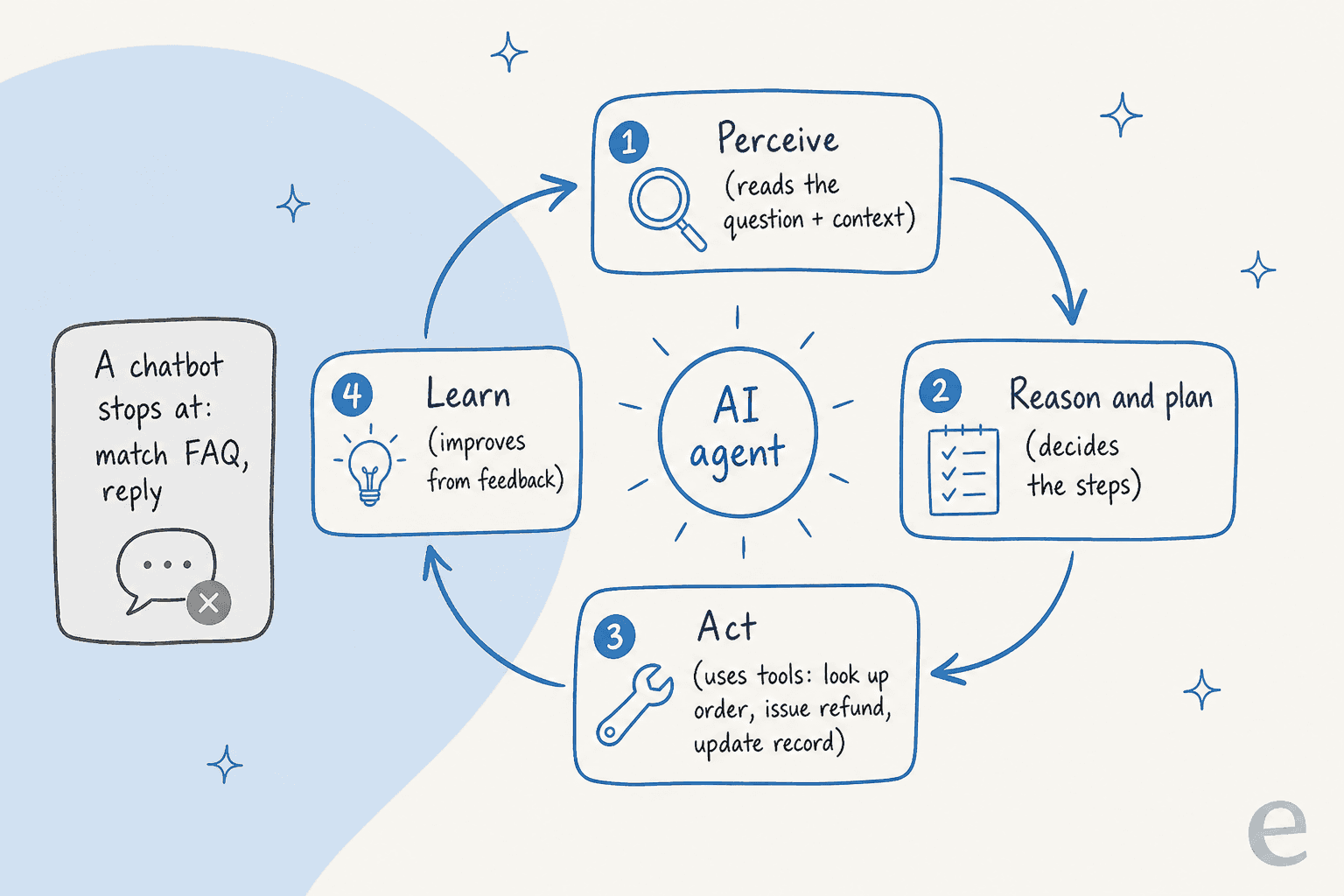
I build AI agents for a living, so let me draw the line clearly, because the marketing has blurred it. A rule-based chatbot follows a decision tree: it matches your message to a pre-written intent and replies with a canned answer. Useful, but it can't do anything it wasn't scripted to do, and it dead-ends to "let me connect you to an agent" the moment you go off-path.
An AI agent runs a loop instead of a script. It perceives the request and its context, reasons about a plan, acts by calling tools (look up an order, process a refund, update a CRM record), and uses the results to decide the next step. That agent loop is the whole difference. It's why an agent can resolve a multi-step request end to end while a chatbot can only answer the one question it recognised.
That definition matters because it sets the bar for the examples below. The useful test is whether the agent can use the relevant context and tools, then hand off when it cannot complete the work. Here’s the shortlist before the detail. The broader vendor examples were researched in June 2026; the eesel CLI walkthrough and pricing were checked on September 8, 2026. Reconfirm current vendor terms before buying.
| AI agent example | The job it does | Real proof point | Pricing model |
|---|---|---|---|
| eesel AI | Resolves helpdesk tickets and chats | 73% of tier-1 resolved in month one (Gridwise) | From $299/mo for 500 credits (1 credit per ticket or chat), regardless of outcome |
| Ada | Omnichannel CX across voice + digital | 34%+ higher resolution at Cebu Pacific | Quote only |
| PolyAI | Answers customer phone calls | $7M+ incremental revenue at Fogo de Chão | Per minute, quote only |
| Moveworks | Internal IT and HR self-service | 50% fewer live chats at CVS Health | Per employee, quote only |
| Siena | E-commerce support and post-purchase | Up to 80% of interactions automated | $750/mo + $0.90/ticket |
| Decagon | High-volume customer deflection | 80% deflection at Duolingo | Quote only |
| Sierra | Enterprise outcomes-based CX | Used by SiriusXM, Sonos, SoFi | Outcomes-based |
1. The helpdesk ticket agent: eesel AI, operated through the CLI
eesel AI connects a support teammate to your helpdesk and knowledge. Depending on the integration and permitted actions, it can draft replies, answer customers, triage tickets, and use connected systems for account-specific work.
The eesel CLI is another way to operate that teammate. It uses the same agent and workspace as the dashboard. People can run it in a terminal, scripts can query it, and coding agents such as Claude Code, Cursor, and Codex can read its JSON results.
A concrete example: answering a return-policy question
Imagine a customer asks whether an opened item can be returned. The teammate needs the approved policy, any relevant order details, and a rule for exceptions. A plausible answer alone is not enough: you need to know what evidence it used and whether it took an action.
With Node.js 18.17 or newer, identify the intended workspace and teammate:
npx @eesel/cli login
npx @eesel/cli whoami
npx @eesel/cli agents
Replace AGENT_ID with the teammate’s ID:
npx @eesel/cli integrations --agent AGENT_ID
npx @eesel/cli instructions --agent AGENT_ID
npx @eesel/cli automations --agent AGENT_ID
Check the connected sources and standing rules. Review existing enabled automations and permitted actions before adding access; the teammate may already be doing customer-facing work.
Add the evidence, then test with restricted actions
If the policy is an approved local document:
npx @eesel/cli files upload ./return-policy.pdf --agent AGENT_ID
npx @eesel/cli status --agent AGENT_ID
Replace the path with your file. Uploading adds knowledge, not standing instructions or permission to refund orders. Status reports operational readiness, such as downloaded content; it does not score the answer.
CLI chat can invoke actions. Before testing, review the connected integration’s action settings in the eesel dashboard. Set consequential actions to off or approval-required; the Shopify guide illustrates these per-action controls. Then use a fictional case:
npx @eesel/cli new --name "return-policy-example" --agent AGENT_ID
npx @eesel/cli chat "Using our approved return policy, draft an answer for a fictional shopper asking whether an opened item is eligible. Identify missing details and exceptions. Do not send messages or change orders." --agent AGENT_ID
The wording communicates intent, not an enforced permission boundary. Check whether the answer follows the policy, identifies what is missing, and avoids promising a refund it cannot authorize. Test a case where the policy requires a human decision too.
Inspect what the teammate actually did
npx @eesel/cli activity --agent AGENT_ID
npx @eesel/cli approvals --agent AGENT_ID
Compare the response with the policy and actual activity. A held approval is not a completed refund; a statement that a lookup happened is not proof without the corresponding work.
This is what makes the example useful for evaluating an agent: inputs, rules, actions, and outcomes can be checked separately. The support lead can review the same teammate in the dashboard.
A coding agent can help with a bounded request such as: “Inspect this eesel teammate’s return-policy sources and instructions. Report conflicts and permitted order-changing actions. Ask before editing.” That instruction to ask first is separate from eesel’s action approvals.
For scripts, select the agent explicitly, keep EESEL_API_TOKEN secret, and verify the intended EESEL_API_URL. For write commands, --dry-run prints the server request without sending it; it does not simulate the customer conversation.
Cost: eesel’s current pricing lists the Teammate plan from $299/month for 500 credits, with 1 credit per ticket or chat regardless of outcome. There is no platform fee or per-seat fee. Check the actual workload rather than treating this as a per-successful-resolution rate.
2. The omnichannel CX agent: Ada
Ada is the example of an AI agent built as a standalone layer spanning every channel at once. It runs voice, chat, email, WhatsApp, SMS, and Instagram from one multi-LLM Reasoning Engine, and brands its category "Agentic Customer Experience." It's a good illustration of what an agent looks like at the top of the market: airline Cebu Pacific reports a 34%+ higher automated resolution rate versus their old chatbot.
The catch is the gate: Ada's pricing states it's a fit for companies with at least 300,000 annual conversations, with no public price. Where you'd see it: large consumer brands with serious omnichannel volume. For everyone else, our Ada breakdown covers the more accessible alternatives.
3. The voice agent: PolyAI
If the agent examples above handle text, PolyAI is the one that picks up the phone. It builds enterprise voice agents that hold natural, human-sounding calls on its proprietary Raven model, trained on 1B+ conversations. It's the clearest example of an agent operating in a channel that used to be human-only, and it's proven on hard calls: fraud, outages, multilingual disputes.
Restaurant brand Fogo de Chão says PolyAI is on track to add $7M+ in incremental revenue, and it's billed per minute of call. Where you'd see it: contact centers drowning in inbound calls. It's worth browsing the wider AI voice companies field if voice is your priority.
4. The internal support agent: Moveworks
Not every AI agent faces customers. Moveworks is the example pointed inward: an agent that answers employees' IT, HR, and finance questions and automates the tasks behind them (resetting access, filing requests) across 100+ internal systems. ServiceNow acquired it for ~$2.85B, which tells you how seriously the enterprise takes internal-support agents.
The proof is real: CVS Health saw a 50% reduction in live agent chats within 30 days, and Amadeus gave back 16,000+ hours a month. Pricing is per-employee headcount, quote-only, and firmly enterprise. Where you'd see it: large orgs with thousands of staff and a heavy internal-ticket load. (eesel does this job too, as an internal helpdesk for IT teams, without the enterprise floor.)
5. The e-commerce agent: Siena
Siena is the example tuned to one vertical: DTC and e-commerce. It runs support, shopping recommendations, and post-purchase flows (order tracking, returns, refunds, subscription pauses) on top of helpdesks like Gorgias and Zendesk, with brand-voice "AI Personas." It shows what an agent looks like when it's deeply wired into commerce tools (Shopify, Recharge, Loop Returns) rather than being a general assistant.
Siena says brands automate up to 80% of interactions, and its pricing is unusually transparent for this category: a $750/month platform fee plus $0.90 per automated ticket. The recurring G2 gripe is escalation, where it can keep responding after it should have handed off. Where you'd see it: Shopify and DTC brands handling WISMO and returns at volume.
6. The high-volume deflection agent: Decagon
Decagon is the example built for sheer scale. Its wedge is "Agent Operating Procedures," natural-language instructions that compile into executable code, so CX teams can author agent logic without living in a flow builder. It runs one agent across chat, voice, email, and SMS, aimed at high-volume consumer brands, and grounds answers in an AI knowledge base rather than a static script.
The numbers are the story: Duolingo reports 80% deflection, ClassPass a 95% cost reduction, and Chime 70% chat-plus-voice resolution. Pricing is sales-led and bracketed by monthly ticket volume. Where you'd see it: enterprises replacing a brittle incumbent bot. A Duolingo operator's line sums up the appeal of a real agent over a flow tool:
"With the previous vendor, at least half my week was dedicated to maintaining their system. With Decagon, it's been a night-and-day difference."
Duolingo, via Decagon case study
7. The enterprise outcomes-based agent: Sierra
Sierra is the example that rethinks the commercial model as much as the tech. Co-founded by former Salesforce co-CEO Bret Taylor, it's an AI-first CX agent for big consumer brands, and it charges outcomes-based pricing, so you pay when the agent resolves the job, not per seat or per message. Its "Ghostwriter" feature is an agent that builds agents from your SOPs and transcripts.
Its logo wall (SiriusXM, Sonos, SoFi, Rocket Mortgage, Vanguard) shows the kind of regulated, brand-sensitive buyer an outcomes model appeals to, and it leads with rare compliance like ISO 42001 for AI management. Where you'd see it: enterprises that want vendor risk tied to results.
How these examples actually differ
Lay the seven side by side and a map appears. Some agents face customers, one faces employees. Some specialize in a channel (PolyAI on voice), some in a vertical (Siena in commerce), some span everything (Ada, Decagon). And the pricing models are genuinely different animals.
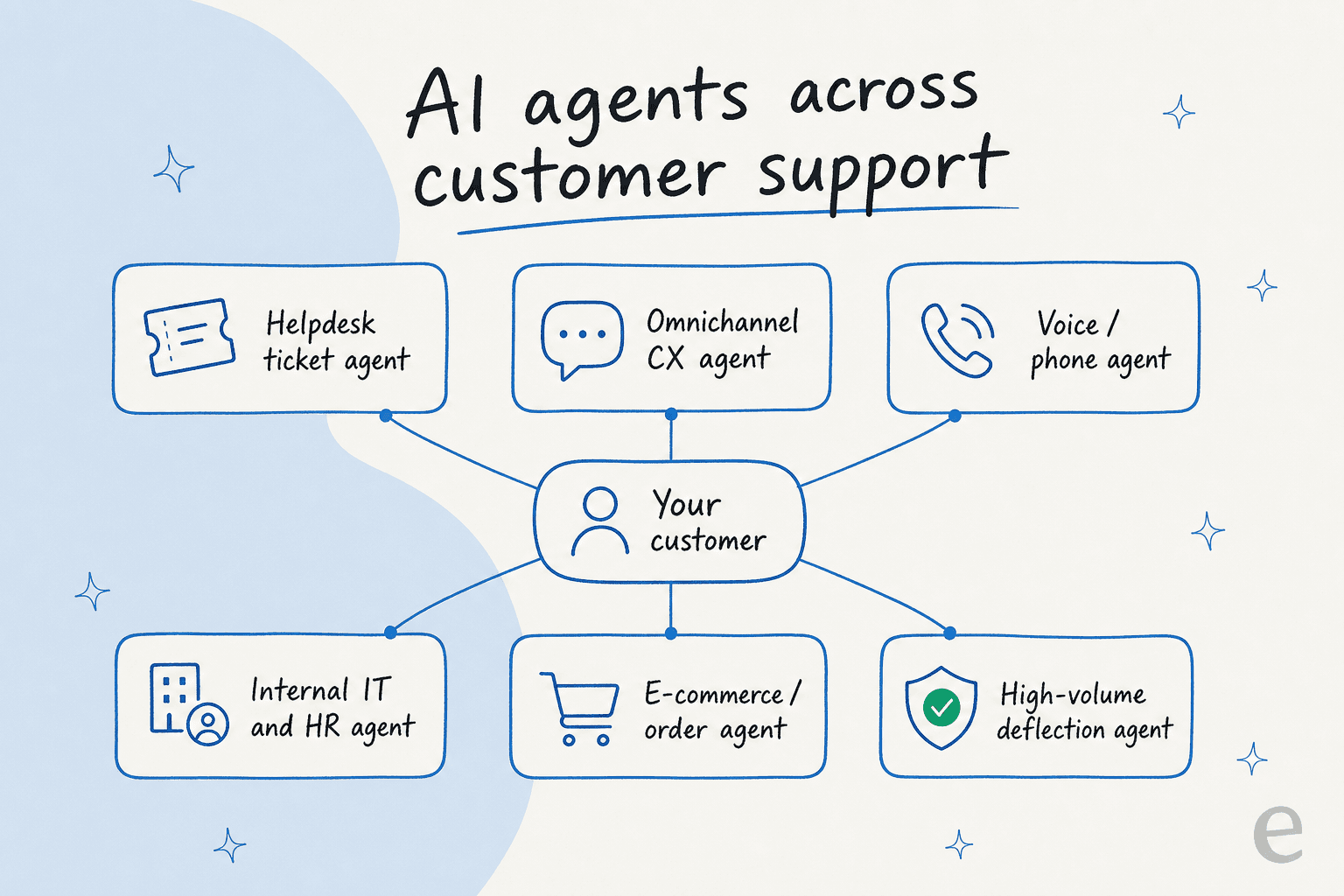
The deeper split is the one I flagged at the top, and it's worth seeing drawn out, because it's the question a buyer should ask of any "AI agent" pitch: does it just talk, or does it act?
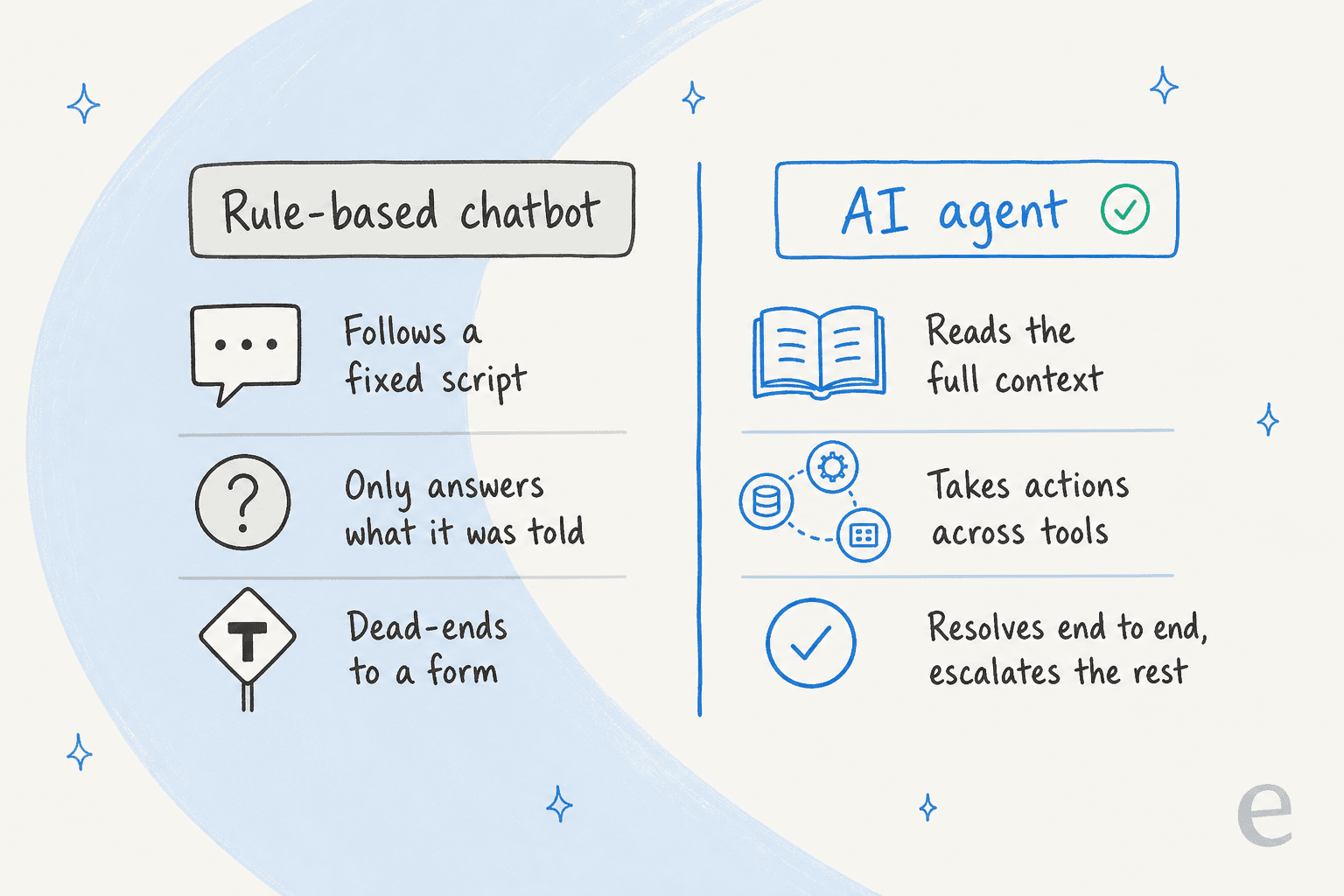
The tools that genuinely clear the agent bar do the second thing. They take actions across your systems, finish the request, and hand off cleanly when they can't, which is exactly the behaviour you want to test for before you buy.
Start with one support task
Choose the job first: phone support, an internal request, a commerce workflow, or a helpdesk ticket. Then test the required knowledge, permitted actions, failure handling, and human handoff. A vendor example is evidence of a use case, not a guarantee of the same result on your queue.
Try eesel and use eesel CLI to inspect the helpdesk-ticket example in your workspace. Start with a policy question and restricted actions, review its response and activity, and expand only when the results support it. The dashboard and CLI remain two ways to operate the same support teammate.
Frequently Asked Questions
What is an example of an AI agent?
What's the difference between an AI agent and a chatbot?
What are the best AI agent examples for customer service?
How much does an AI agent cost?
How do I stop an AI agent from giving customers wrong answers?
How can I try an AI agent example through eesel CLI?


Article by
Kira
Kira is a writer at eesel AI with a Computer Science background and over a year of hands-on experience evaluating AI-powered customer service tools. She focuses on breaking down how helpdesk platforms and AI agents actually work so that support teams can make better buying decisions.