

What "bulk AI content generation" actually means in 2026
The category has fragmented. Three years ago, bulk content generation mostly meant "feed Jasper a list of titles and click Run." Today, depending on the vendor, it can mean any of four things:
- Article-level bulk. Generate 10, 50, or 500 long-form articles from a keyword list. The KoalaWriter / Frase / Writesonic part of the market.
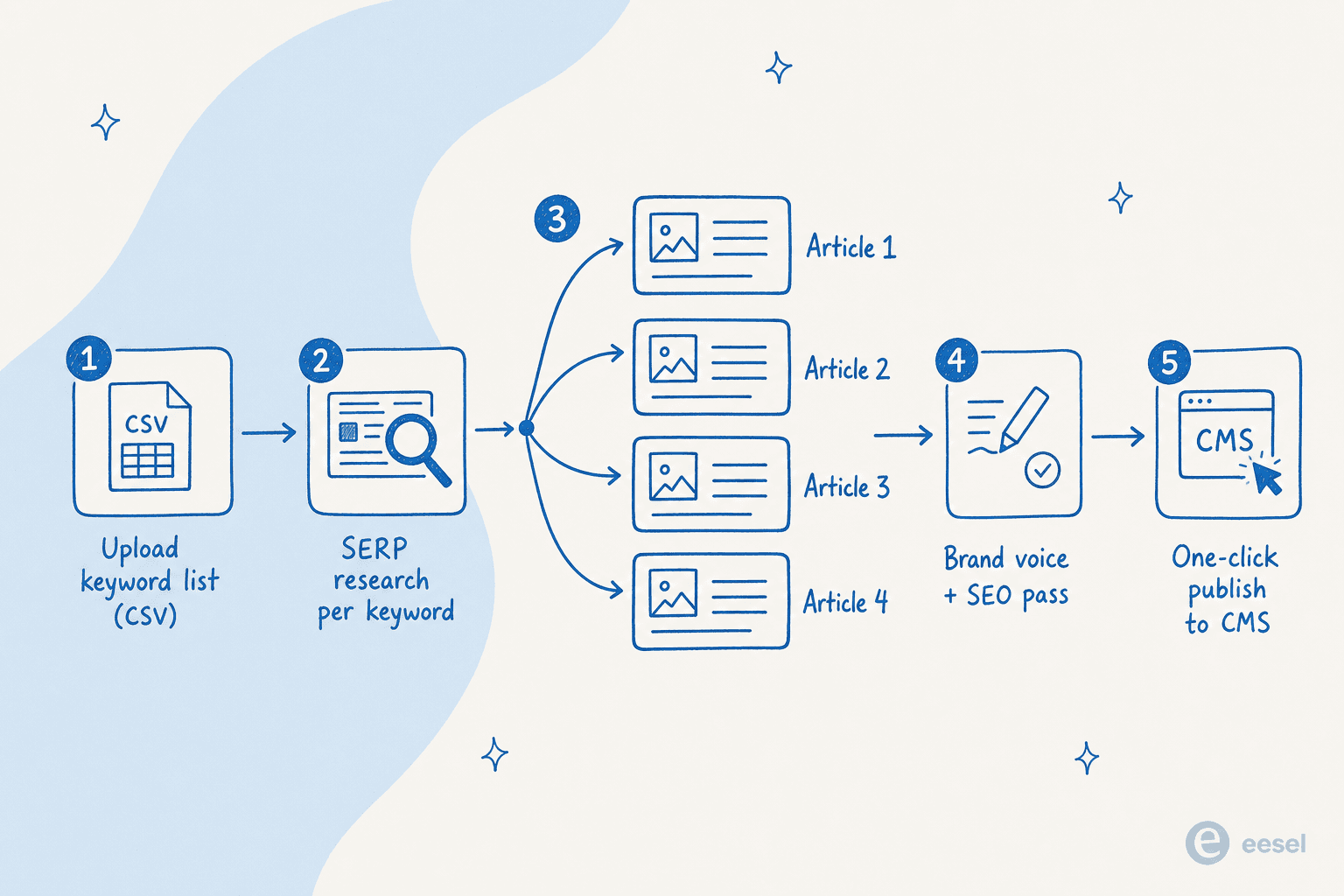
- Workflow-level bulk. Codify a content process (research → outline → draft → optimize → publish) and run it on a queue. Copy.ai Workflows, Writer Playbooks, the eesel Blog Writer agent.
- Variation-level bulk. Generate dozens of variants of the same piece for A/B testing. Anyword's Predictive Performance Scoring.
- Product-catalog bulk. Generate descriptions for thousands of SKUs. Jasper's Adidas pitch.
You'll notice the same tools show up in more than one bucket, but no single tool is best at all four. The point of the comparison below is to figure out which kind of "bulk" you actually have.
How we picked these tools
A few constraints we used to filter the long list:
- It has to actually do bulk. A general-purpose LLM chat (ChatGPT, Claude) doesn't qualify, even though it can technically write 10 articles in a row. There's no queue, no parallel jobs, no publishing pipeline, no brand voice that persists. We wanted tools that treat "many at once" as a first-class workflow.
- It has to be a real product, not a wrapper. A surprising number of "AI bulk writers" on YouTube are GPT wrappers with a CSV uploader. We kept tools with a proper editor, brand voice or knowledge layer, and visible adoption.
- It has to publish. Drafting 50 articles into a workspace that doesn't talk to your CMS isn't bulk; it's homework. Each tool here either pushes directly to WordPress / Shopify / Webflow / Ghost, has a working API, or is itself an autonomous agent.
That cut us to eight. Below is the comparison at a glance, then the per-tool deep dives.
The comparison at a glance
| Tool | Best for | Entry price | Bulk mechanism | Brand voice | Direct publish | SOC 2 | API | Free trial |
|---|---|---|---|---|---|---|---|---|
| eesel Blog Writer | Briefing an autonomous agent | $4 per blog post | Agent runs the queue | Trained from existing content | WordPress, webhooks | Yes | Yes | 100 free credits |
| KoalaWriter | One-click SEO articles | $9/mo Essentials | Native "Bulk content creation" feature | Brand DNA (Pro+) | WordPress, Shopify, Webflow, Ghost | No | Yes | 5K words, no card |
| Jasper | Enterprise marketing at scale | $59/seat/mo | Content Pipelines + Grid (Business) | Brand Voice + Style Guide | Browser extension + API | Yes | Business-only | 7 days |
| Frase | Programmatic SEO (10K+ pages) | $49/mo Starter | Programmatic SEO + Atomization | Brand voice profiles | API, MCP, content calendar | Type II (Enterprise) | All plans | Yes |
| Copy.ai | GTM workflows, not just content | $24/mo Chat | Workflows + Tables | Brand Voice + Infobase | API, 2,000+ integrations | Yes | Yes | 2,000 free words (legacy) |
| Writesonic | Content that ranks in AI search | $79/mo Starter | Article quota + Agentic Workflows | Yes | API | Type II | Yes | 7 days, no card |
| Writer | Regulated enterprise (HIPAA, BAA) | Contact sales | Playbooks + Knowledge Graph | Voice profiles (Enterprise) | Connectors (Snowflake, SharePoint, HubSpot, Gmail, Slack) | Yes (Type II, HIPAA, GDPR, PCI) | Enterprise-only | 14 days |
| Anyword | A/B variants with predicted lift | $49/mo Starter | Bulk generation + Performance API | Brand Voice hub | API (Enterprise) | Yes (Type 2, ISO 27001, GDPR, HIPAA) | Enterprise-only | 7 days |
A few patterns are worth pulling out before we go tool by tool.
The entry price isn't the real price. Jasper's $59/seat looks cheap until you realise Pro is single-seat only; any team usage forces a custom Business contract. Frase is the opposite: every plan includes the full feature set, and you upgrade for volume rather than capability (per Frase's own positioning). Writer is fully sales-gated; expect five- to six-figure ACV territory based on its enterprise customer logos (Vodafone, Vanguard, KPMG, Salesforce, Uber).
"Bulk" means something different on each tool. KoalaWriter has a literal "Bulk content creation" feature. Frase claims teams have built 10,000+ pages in a single workflow. Copy.ai approaches bulk by chaining Actions inside a Workflow. eesel doesn't pitch "bulk" at all; it pitches an autonomous agent that you brief once and let run. They're the same outcome through very different doors.
The real cost per article
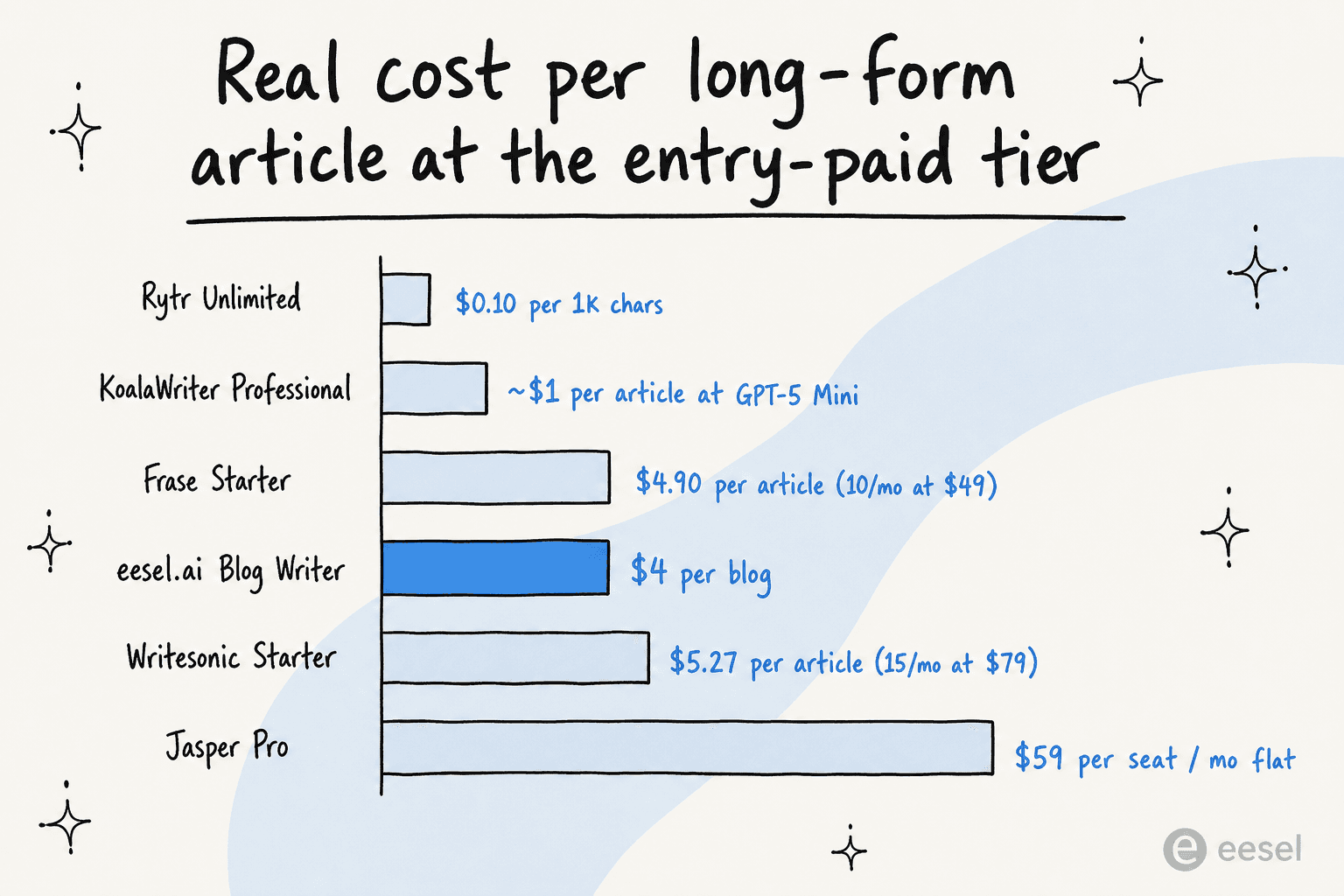
Cost is where most teams stall, and it's not as simple as "compare the monthly subscription." A $79/month plan with 15 included articles costs ~$5.27 per article before edits; a $49/month plan with 10 included articles costs $4.90. Sticker price isn't the whole story.
We charted the real per-article cost at the entry paid tier for the tools that publish a per-article number. Per-seat pricing (Jasper, Writer) is shown as monthly flat for reference.
"You can turn 'full time blog writer' into 'owner spending 3 hours a week … and yes, you're always gonna be heavily editing.'"

That quote shows up almost verbatim across every tool we tested. Bulk AI generation doesn't eliminate editing; it changes where the editing time goes (from drafting to reviewing). Worth budgeting for.
Now the picks.
1. eesel.ai Blog Writer - our pick for autonomous bulk blog production
Best for: Teams that want to brief an agent once and have it ship publish-ready drafts on a schedule, without sitting in front of a prompt window.
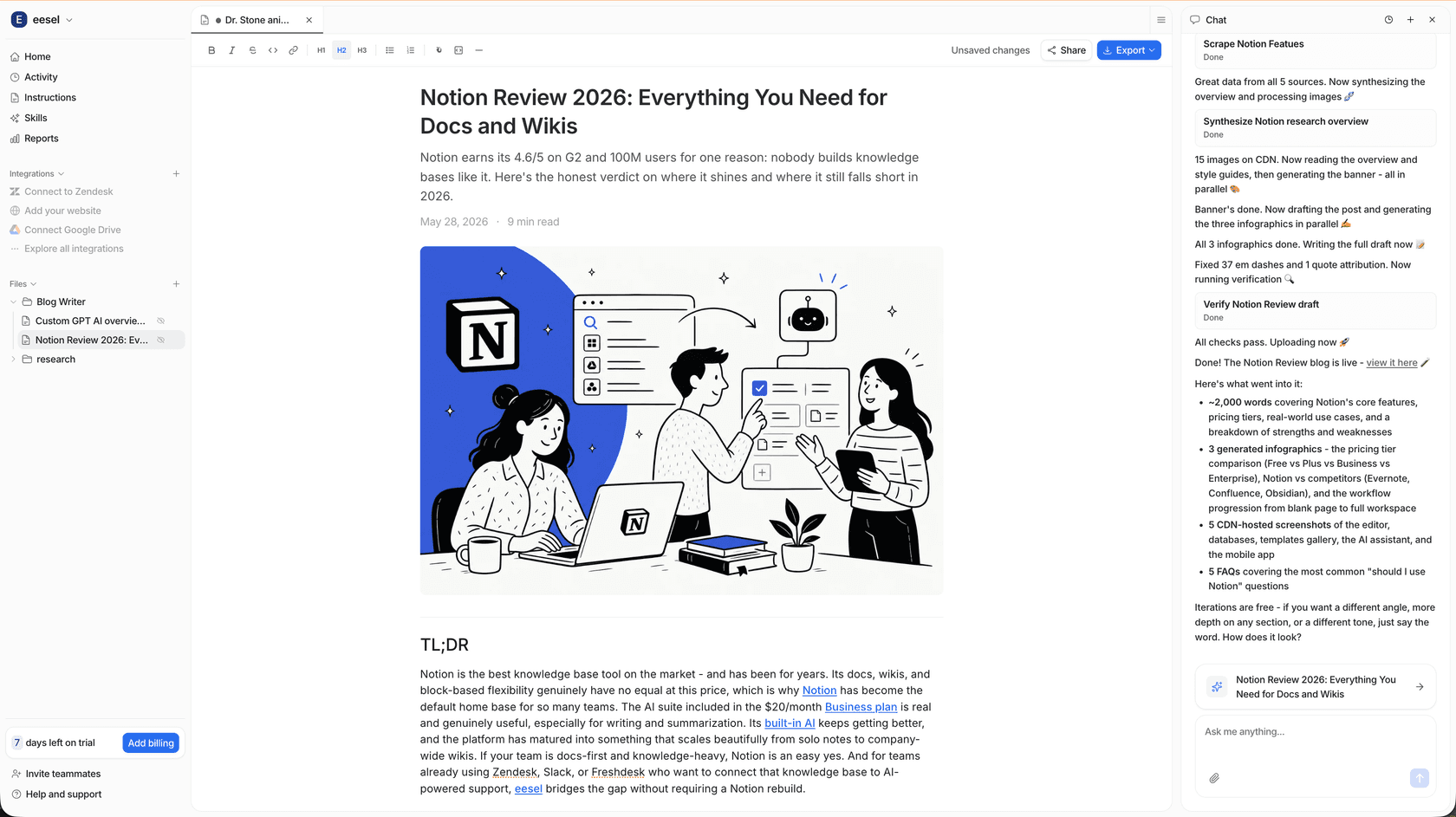
The eesel approach is structurally different from the rest of this list. Instead of giving you a generator UI to click "create article" inside, eesel gives you an autonomous Blog Writer agent that lives alongside its Helpdesk and E-commerce agents. You brief it the same way you'd brief a freelancer (topic, audience, brand voice, what not to say, the assets it can pull from) and it runs the research → outline → draft → publish loop on its own. You see the output in your queue when it's done.
That's the bulk model: the agent is always available, so "produce 30 articles this month" looks like 30 separate brief-and-go cycles rather than 30 prompts you have to babysit.
Features
- Autonomous Blog Writer agent. Briefed in plain language ("write a 2,000-word post on X for [audience], in our voice, citing the case studies we have on Y"). No prompt engineering.
- Living inside your stack. The same eesel platform also runs your Helpdesk Agent and E-commerce Agent - one billing surface, one set of brand-voice settings.
- Knowledge from existing content. The agent reads your existing site, docs, and brand assets to stay on-voice. Onboarding takes minutes rather than weeks.
- Pay only for what it produces. No seats, no platform fee on self-serve, no monthly minimum.
Pros
- Genuinely autonomous: you write a brief, the agent ships the draft. Closest thing on this list to delegating to a human.
- Pricing scales with output, not headcount. A team of 1 and a team of 10 pay the same for the same number of blogs.
- The free plan gives you 100 free credits without a card on the pricing page.
Cons
- Newer than Jasper / Copy.ai. The brand-voice tuning rewards a real first brief rather than expecting magic from one line.
- Best fit for long-form blog work; less suited for high-frequency micro-copy (ad headlines, push notifications). Those are better served by Anyword or Copy.ai.
Pricing
Simple pricing: $4 per blog post generated. The support agent is a separate fixed monthly plan, from $299/month for 500 credits (1 credit per ticket or chat), and dashboard Q&A is mostly free. Pay a year upfront and get two months free. The free plan includes 100 free credits, no credit card required.
Our take
If "bulk" for you means briefing once and getting drafts on your schedule, eesel is the most direct fit on this list. Pick it if you want an autonomous agent rather than a generator UI; skip it if you only need short-form copy and don't care about long-form blog or knowledge-grounded output.
2. KoalaWriter - best one-click SEO article engine
Best for: SEO operators and affiliate-content publishers who want one-click SERP-aware articles pushed straight to WordPress.
KoalaWriter is the most direct bulk play in the list. Its literal "Bulk content creation" feature page does what it says: feed in many target keywords, generate many articles in parallel, push them all to WordPress / Shopify / Webflow / Ghost. The April 2026 Brand DNA + KoalaWriter v2 launch was the biggest update in Koala's history, and the brand voice now persists across the queue instead of having to be re-prompted per article.
"Koala AI writer reviews and comparisons. When it comes to totally hands off one click blog writing, Koala is the best imo."
Features
- Bulk content creation. Generate many articles simultaneously, faster on the higher tiers (2x on Boost, 3x on Scale I+).
- Real-time SERP analysis. Analyses top-ranking content for the keyword in real time, pulls in entities and semantic keywords (per the feature page).
- Automatic internal linking. Indexes your whole site and adds contextual links automatically. Koala claims 10+ million internal links created to date.
- Deep Research mode. Uses 100x more context to research the topic (feature page), available on Professional and up.
- Article types beyond standard blog: Listicle, Local Places, Amazon Roundup, Amazon Single Product, YouTube-to-Blog, Rewrite.
- One-click publishing. WordPress (official plugin), Shopify, Webflow, Ghost, plus Zapier/Make webhooks.
Pros
- The cleanest "keyword in, article out" UX in this list. Setup is genuinely a single screen of options.
- Direct WordPress publish is repeatedly the single most-loved feature in community reviews.
- 3,500+ word articles are typical; community reviewers cite this as the wedge over raw ChatGPT.
Cons
- The on-site testimonial wall is uniformly 5★, but the public Trustpilot aggregate sits at 3.5/5 across 21 reviews. Worth knowing before you commit to an annual plan.
- The word-count footnote: word counts are billed at the GPT-5 Mini rate. Using the recommended Claude 4.5 Sonnet doubles the word cost, so a $49 Professional plan is effectively 50,000 high-quality words per month, not 100,000.
- Brand voice was a weak point before April 2026's Brand DNA update; if you're testing the older version, you'll notice.
Pricing
From Koala's pricing page, annual:
| Plan | Monthly | KoalaWriter words | KoalaChat msgs |
|---|---|---|---|
| Essentials | $9 | 15,000 | 250 |
| Professional | $49 | 100,000 | 1,000 |
| Boost | $99 | 250,000 | 2,500 |
| Growth | $179 | 500,000 | 5,000 |
| Elite | $350 | 1,000,000 | 10,000 |
| Scale I / II / III | $750 / $1,250 / $2,000 | 2.5M / 5M / 10M | 15k / 20k / 25k |
The free trial gives 5,000 words and 25 chat messages with no credit card. Refunds within 15 days if you've used <15,000 words and <100 messages.
Our take
If you're an SEO publisher running affiliate or content-site portfolios, KoalaWriter is the most direct fit: generate, publish, repeat. If your content needs to live inside a brand-voice ecosystem (Slack, helpdesk, sales decks), pair it with a brand-aware agent like the eesel Blog Writer, or use a platform tool instead.
3. Jasper - best for enterprise marketing teams
Best for: Enterprise marketing teams with named brand voices, multiple campaign owners, and a need for governance.
Jasper is the original enterprise pick for content at scale, and it's still the proof point most often cited in the category. Adidas wrote 7,500 product descriptions in 24 hours using it, Anthropologie "automated 60% of its SEO", and customer logos include Wayfair, Boeing, L'Oréal, Mars, Accenture, HarperCollins, Prudential.
The 2026 product is a layered stack: purpose-built marketing agents, Content Pipelines for repeatable scaled execution, Canvas for long-form, and Jasper IQ - a context layer that holds brand voice, style guide, audience profiles, and multi-modal knowledge across every output.
"Quick drafts are okay, but structure and tone for blogs often felt off. I switched to manually editing..."
Features
- Brand Voice. Store and apply brand tone, style, vocabulary across every output. 2 voices on Pro, unlimited on Business.
- Style Guide. Granular formatting and usage rules with an x-ray view inside the editor. Business-only.
- Knowledge Base. Multi-modal (text, image, audio, video) institutional knowledge ingestion.
- Image Pipelines. On-brand product imagery generation at scale.
- AI Studio. No-code AI agent builder for custom marketing agents without developers (Business-only).
- Jasper MCP. MCP server so brand context travels into Claude, ChatGPT, Cursor.
- SOC 2 certified, 99% uptime, 30+ language support (per Jasper Security).
Pros
- The most mature brand-voice + style-guide enforcement in the list. If you have a 50-page brand bible, this is the one tool built to encode it.
- 4.7/5 on G2 across 1,270 reviews with 84% 5-star. Adoption-tested.
- Image Pipelines + Image APIs handle the visual side, claimed up to 10x faster and up to 50% lower cost than traditional production for product imagery.
Cons
- Pro is a single seat only. Any team usage forces an upsell to Business with a 12-month commitment (per the pricing FAQ).
- Style Guide, Visual Guidelines, API access, SSO, and Jasper Studio are all Business-only. Pro buyers get the Brand Voice slice of IQ, not the full surface.
- Pricing complaints are concentrated at the SMB end. G2's reviewer mix is 93% small business, and "Cost" + "Expensive" appear seven times combined in the top cons.
Pricing
From Jasper's pricing page:
| Plan | Monthly | Yearly (saves ~20%) | Seats |
|---|---|---|---|
| Pro | $69 / seat / mo | $59 / seat / mo | 1 seat |
| Business | Custom | Custom | Multiple, 12-mo commit |
7-day free trial on Pro, no sales call required.
Our take
If you're an enterprise marketing team - multiple voices, multiple campaign owners, formal brand governance, and visual production - Jasper is the safe pick. If you're a 1-3-person team writing for a single brand, the Pro plan's single-seat ceiling and missing API will frustrate you fast. SMB teams generally do better on KoalaWriter, Frase, or an autonomous setup like eesel.
4. Frase - best for programmatic SEO at real scale
Best for: Programmatic SEO teams building 1,000-10,000+ pages from structured data.
Frase sits at the SERP-aware end of the spectrum. The pitch is that one agentic platform replaces a stack of single-purpose tools (research, outline, AI writer, optimization scorer, rank tracker, AI visibility monitor). What makes it the bulk pick is Programmatic SEO: Frase explicitly says teams have built 10,000+ pages in a single workflow, with templates that ingest structured data and generate the pages from there.
Features
- AI Agent. Does the research, write, optimize, monitor, fix loop (feature page).
- SEO Research. Scrapes the top 10 SERP results for a target keyword in ~30 seconds and surfaces topic gaps (feature page).
- GEO Content Optimization. Every brief is structured for AI citation readiness (ChatGPT, Perplexity, Claude, Gemini) (feature page).
- Programmatic SEO. 10,000+ pages from structured data templates.
- Content Atomization. Turn one blog into LinkedIn carousels, Twitter threads, newsletters, Instagram posts.
- Content Opportunities. Surfaces declining pages and prioritizes fix/boost/fill actions with estimated traffic impact (feature page).
- 37+ AI writing tools in one platform across 6 categories (hub page).
Pros
- Plans differ in volume, not capabilities. Explicit positioning from the Frase pricing FAQ. You get the full feature set at $49/mo Starter.
- 4.8★ on G2 across 500+ reviews with 98% Would Recommend.
- Kevin Indig (Director of SEO at Shopify) is quoted on the pricing page: "Our organic traffic is up 3x since we started."
Cons
- The "cheaper Surfer SEO" framing is the most common positioning in head-to-head Reddit threads. Surfer still wins on optimization depth, Frase wins on price + breadth.
- A pricing discrepancy worth knowing: the AI Writing Tools page advertises $38/month, but the pricing page starts at $49/mo Starter monthly. The annual-billing math gets close ($49 × 0.8 ≈ $39.20) but doesn't fully reconcile.
- 93.2% of G2 reviews are small business. Frase is built around solo operators and small agencies, not enterprise teams.
Pricing
From Frase pricing (monthly billing; annual = -20%):
| Plan | Price | Seats | Articles/mo | Audits/mo | AI platforms tracked |
|---|---|---|---|---|---|
| Starter | $49 | 1 | 10 | 50 | 2 |
| Professional | $129 | 3 (+$29/seat) | 40 | 250 | 3 |
| Scale | $299 | 5 (+$29/seat) | 100 | 1,000 | 5 |
| Enterprise | Custom | Custom | Custom | Custom | 8 |
Our take
If you're running programmatic SEO - a directory site, a local-pages template, an Amazon catalog, anything with thousands of templated pages - Frase is the cleanest pick. For one-off long-form articles, KoalaWriter is faster; for brand-voice depth, Jasper or eesel is better.
5. Copy.ai - best for codified GTM workflows
Best for: Marketing and sales operations teams codifying multi-step GTM processes, not just writing.
Copy.ai is mid-rebrand from "AI writing assistant" to "The First AI-Native GTM Platform". The bulk angle is no longer "write 10 articles in a row"; it's Workflows - chain Actions together (research, scrape, write, score, send), embed AI Agents inside steps that need decision-making, sit it all on top of Tables as a unified data layer.
The company claims 17 million users on its homepage, up from a "10M users" milestone Reddit was discussing roughly a year ago.
Features
- Workflows. Codified multi-step GTM processes that chain modular Actions.
- Brand Voice. Trained or manually-defined brand personalities that persist across the workflow.
- Actions. Modular building-block tasks (scrape, summarize, classify, draft, send).
- Tables. Unified data layer that consolidates website, CRM, docs, and call transcripts as an embedding-searchable foundation.
- Copy Agents. Constrained AI decision-making units embedded inside Workflows.
- Infobase. Proprietary information store for content generation.
- SOC 2, GDPR, SSO - enterprise security baseline.
- 2,000+ integrations including Salesforce, HubSpot, Gong, Zapier, Outreach, Salesloft.
Pros
- Genuinely good fit if your "bulk" is a recurring multi-step process rather than many isolated articles.
- LLM-agnostic: OpenAI, Anthropic, Gemini, Perplexity all live behind the same platform.
- The Brand Voice + Infobase combination handles brand-voice consistency across long-running workflows better than most.
Cons
- The Chat → Growth jump ($29/mo → $1,000/mo) is the steepest gap in the lineup. There's no middle "scale up" tier; you go straight from self-serve to a $12K annual contract.
- Live URL structure is mid-migration:
/products/workflowsand/products/brand-voicereturn 404 as of June 2026; canonical pages now live under/platform/*. - Skeptic backlash from r/copywriting on AI copywriting as a category. Not specific to Copy.ai but worth knowing for any agency pitch.
Pricing
From Copy.ai pricing (annual):
| Tier | Seats | Workflow Credits/mo | Price |
|---|---|---|---|
| Chat | 5 | none - Chat only | $24/mo ($288/yr) |
| Growth | 75 | 20K | $1,000/mo ($12K/yr) |
| Expansion | 150 | 45K | $2,000/mo ($24K/yr) |
| Scale | 200 | 75K | $3,000/mo ($36K/yr) |
| Enterprise | Custom | Custom | Custom |
Our take
If your bulk problem is multi-step GTM (inbound lead processing, ABM, deal coaching, customer voice summarization), Copy.ai is the cleanest pick, and the Workflow framing genuinely is different from anyone else here. If you mostly want long-form content, the entry price is high for what you get; Frase and KoalaWriter cost less for the same article output.
6. Writesonic - best for content that doubles as AI search optimization
Best for: Teams that care about ranking in ChatGPT, Perplexity, Claude, and Google AI Overviews as much as Google search.
Writesonic is no longer pitched as an AI writer. It's now an "AI Search Growth Engine", tracking brand visibility across 10 AI search surfaces (ChatGPT, Perplexity, Claude, Gemini, Grok, DeepSeek, Microsoft Copilot, Meta AI, Google AI Mode, Google AI Overviews) and traditional Google. The AI Article Writer still lives inside the platform as a metered monthly quota, but the front-door product is GEO + SEO action.
The dataset behind it: 2 billion+ real AI conversations across 10 platforms and 50+ markets, updated weekly. That's the wedge - Writesonic sees what AI engines are citing in close to real time.
Features
- AI Search Visibility Tracker. Monitor brand mentions, citations, and sentiment across up to 10 AI platforms (feature page).
- Action Center. Prioritised list of 5-10 weekly visibility-fixing actions, split into off-page (citations), on-page (content), and technical (schema/crawl).
- AI Article Writer. Bundled monthly article quota (15/25/50/Custom depending on plan).
- AI bot analytics. Track GPTBot, ClaudeBot, PerplexityBot, GoogleOther visits and auto-fix robots.txt/schema/indexing.
- Agentic Workflows. Limited trial runs on paid plans (10/50/100), full access only on Enterprise.
- SOC 2 Type II, GDPR, HIPAA, SSO/SAML, Microsoft Azure hosted.
Pros
- 4.8/2,031 reviews on G2, 4.8/2,102 on Capterra, 10,000+ marketing teams - broad adoption.
- The AI visibility tracker is genuinely novel; nothing else here covers GEO this deeply.
- NP Digital (Neil Patel's agency) switched from "a $1B-valued competitor" - the kind of named switch that's hard to fake.
Cons
- Heavy gating on the higher AI platforms: Perplexity, Claude, Grok, DeepSeek, MS Copilot, Meta AI, Google AI Mode are all Enterprise-only. So is full Action Center, SSO, and Looker Studio integration.
- Article quota is tight: 15 articles on Starter, 25 on Basic. Heavy publishers will outgrow it fast.
- A long-running r/SEO thread phrases the editing reality bluntly: drafts always need heavy human editing.
Pricing
From Writesonic's pricing page (annual; annual saves ~20%):
| Plan | Price | AI platforms | Articles/mo | Site audits/mo | Users |
|---|---|---|---|---|---|
| Starter | $79/mo | ChatGPT only | 15 | 10 (100 pages) | 1 |
| Basic | $199/mo | + Gemini + Google AIO | 25 | 20 (1,200 pages) | 2 |
| Growth | $399/mo | + Gemini + Google AIO | 50 (+20 add-on $100) | 50 (2,500 pages) | 3 |
| Enterprise | Custom | All 10 platforms | Custom | Custom | Custom |
7-day free trial, no credit card.
Our take
If you've started seeing your brand cited in ChatGPT or Perplexity and want to track and act on that, Writesonic is the most specialised pick here. For pure article generation at the same price, Jasper or Frase get you more depth.
7. Writer - best for regulated enterprise deployments
Best for: Enterprises in healthcare, financial services, or any regulated vertical that needs HIPAA, a BAA, or a model trained on their own data.
Writer is the enterprise pick. Every primary CTA on every product page is "Request a demo"; there's no self-serve credit-card path past the 14-day Starter trial. The pitch: "WRITER is where the world's leading enterprises orchestrate AI-powered work." The marquee customer list includes Vodafone (VOIS), Vanguard, Salesforce, KPMG, Qualcomm, American Eagle, Uber, Dropbox, e.l.f. Cosmetics, SCAN Health Plan, Accenture, HubSpot, Hilton, Ally, and exactly zero SMB names.
Features
- WRITER Agent. "Not a tool you prompt. An agent you delegate to." Autonomous multi-step execution across data and tools.
- Palmyra LLMs. Writer's own in-house model family, marketed as "frontier AI, purpose-built for regulated enterprises."
- Playbooks. Repeatable multi-step workflows (e.g. churned-customer win-back: Snowflake query → segment → personalize → Gmail send → Slack notification).
- Knowledge Graph. Proprietary RAG layer; 1 GB on Starter, 50 GB single graph on Enterprise (unlimited graphs).
- Connectors. Microsoft SharePoint, Snowflake, Semrush, HubSpot, Microsoft Teams, Slack, Gmail, PitchBook.
- Trust posture. SOC 2 Type II, GDPR, HIPAA, PCI, plus BAA on Enterprise.
- WRITER Academy. Certifications and self-paced courses for enterprise-wide rollout.
Pros
- Brand-voice enforcement is the most-praised feature across G2, Gartner, and TrustRadius reviewers.
- Departmental voice profiles (Enterprise) genuinely solve the "marketing team and legal team need different voices in the same tool" problem.
- The full compliance stack - HIPAA, BAA, PCI, SOC 2 Type II - opens regulated verticals that nobody else here can serve.
Cons
- No published pricing. Expect five- to six-figure ACV territory based on its competitive set (Glean, Cohere for Business, Microsoft 365 Copilot Enterprise tiers).
- Performance on large documents is the most-repeated complaint: multi-minute query times against the Knowledge Graph come up across multiple Gartner and TrustRadius reviews.
- Enterprise-only feature gating frustrates SMB / solopreneur users who can't access departmental voices, Agent Builder, or BAA without a Sales contract.
Pricing
From Writer plans:
- Starter. Self-serve free trial (14 days, no credit card), then a per-seat plan with fixed credit limits. Up to 5 users, 5 playbooks, 1 voice profile, 1 GB Knowledge Graph, basic connectors.
- Enterprise. Contact sales. Unlimited users, unlimited playbooks, full Knowledge Graph (50 GB single graph), unrestricted connectors, departmental brand/voice profiles, Agent Builder, SAML SSO, SCIM, BAA for HIPAA, audit logs, full RBAC.
Our take
If you're a regulated enterprise - health, finance, government - Writer is the safest pick. For anyone else, the contact-sales price floor is the wrong shape of friction; Jasper covers most of the same enterprise marketing surface with self-serve pricing, and eesel's pay-per-output model is more honest about cost.
8. Anyword - best for performance prediction on bulk variants
Best for: Performance marketers running A/B tests on bulk-generated variants and wanting a predicted lift score before they ship.
Anyword leads with one specific differentiator: Predictive Performance Scoring. The AI doesn't just generate copy; it scores and ranks variations against a target audience, business goal, and channel using a proprietary A/B-tested dataset built from real campaigns. The headline accuracy claim, verbatim from the homepage:
"Anyword's AI delivers industry-leading performance prediction-accurately determining which of two content variations will perform better based on audience, business goal, and channel-with 82% accuracy. In comparison, generic AI models like GPT-4o achieve only 52%."
Features
- Predictive Performance Scoring (82% accuracy vs 52% for GPT-4o). The flagship.
- Data-Driven Editor. Short-form with inline scoring.
- Content Intelligence. Benchmark live content against the A/B-test corpus (Business+).
- Brand Voice Hub. Tone, audience profiles, messaging bank, formulas, brand rules.
- Blog Wizard. Long-form AI blog writer with SEO score, plagiarism check, and brand voice alignment.
- Custom-Built AI Models trained on the customer's own performance data (Business+).
- Performance API + Performance-RAG. Bolt predictions onto ChatGPT, Notion, Gemini, custom agents (Enterprise).
- Bulk generation + 30+ languages.
- SOC 2, ISO 27001, GDPR, HIPAA, 99.9-99.99% uptime, private LLM option on Enterprise.
Pros
- 4.8★ on G2 across 1,226+ verified reviews - the strongest review base in this list outside Jasper.
- Predictive Performance Scoring is genuinely novel: no other tool here predicts CTR/conversion at draft time.
- One verified reviewer: "Yesterday, I executed an entire landing page strategy in 1 day. It would have taken several weeks… before Anyword."
Cons
- Cost is the dominant pushback for solo / freelance users; Starter at $49/mo monthly feels high vs Copy.ai / Writesonic for general-purpose writing.
- Niche / sensitive-topic handling is a stated weakness for content outside mainstream marketing.
- API access and SSO are Enterprise-only: a common mid-market friction point.
Pricing
From Anyword's pricing page:
| Plan | Monthly | Yearly (per mo) | Seats | Predictions/mo |
|---|---|---|---|---|
| Starter | $49 | $39 | 1 | 50 (or 100 yearly) |
| Data-Driven | $99 | $79 | 3 | 100 (or 175 yearly) |
| Business | Custom | Custom | 3+ | 250 |
| Enterprise | Custom | Custom | Custom | 500+ |
7-day free trial on Starter and Data-Driven.
Our take
If your bulk problem is many short-form variants for A/B testing (ad copy, landing pages, email subject lines), Anyword is the most specialised pick. For long-form blog or product-catalog work, the others on this list go deeper, but only Anyword closes the loop with a predicted performance score.
How to pick the right bulk content tool for your team
Eight tools, eight different shapes of "bulk." This is roughly how we'd map your situation to a pick:
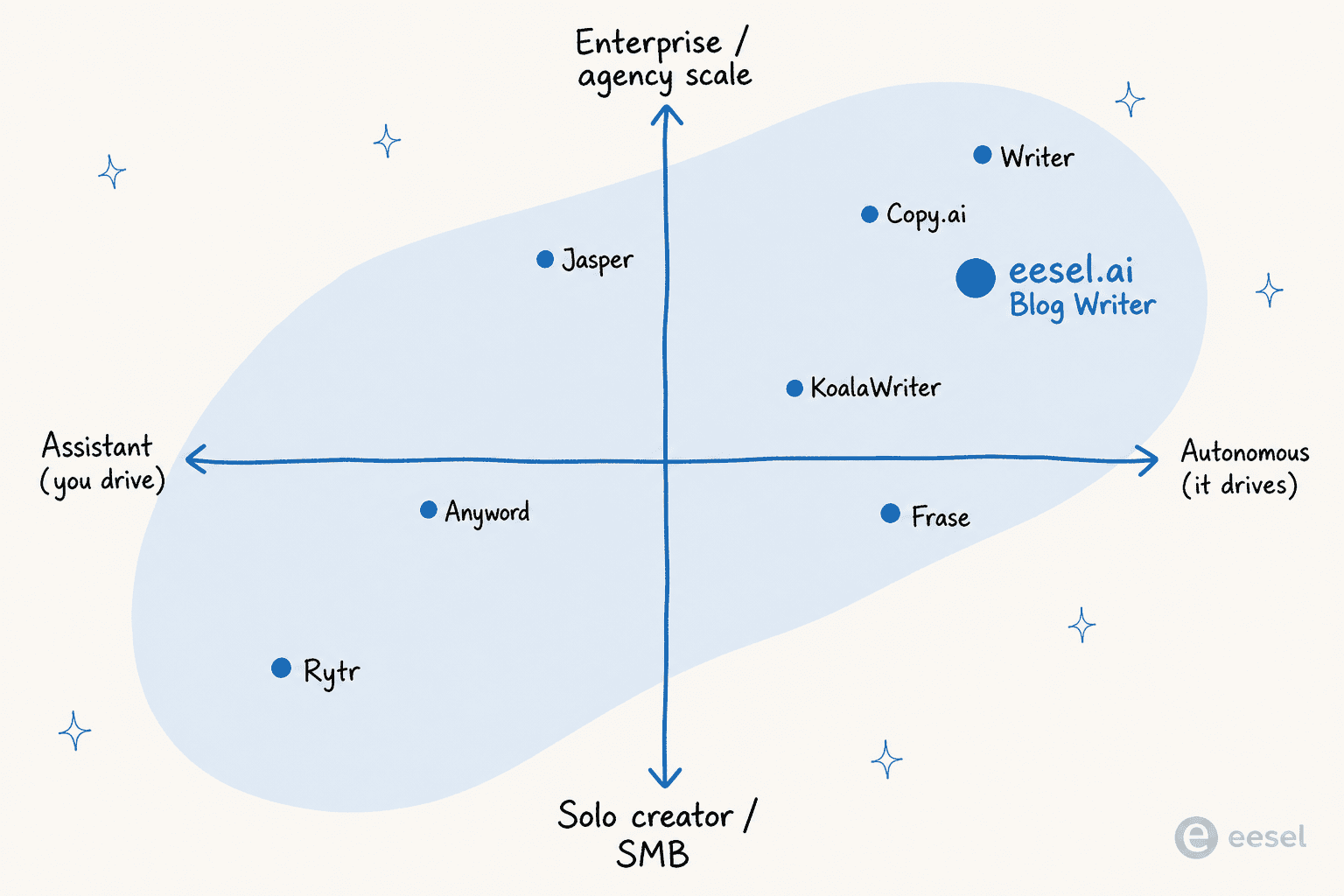
The decision flow:
- You want an autonomous agent rather than a generator UI. → eesel Blog Writer. Brief once, drafts ship without you.
- You're an SEO publisher running portfolios of content sites. → KoalaWriter. One-click WordPress publishing is the unmatched feature.
- You're an enterprise marketing team with formal brand governance. → Jasper. Brand Voice + Style Guide + Visual Guidelines are deepest here.
- You're running programmatic SEO at 1,000+ pages. → Frase. Built for it explicitly.
- Your "bulk" is multi-step GTM, not articles. → Copy.ai. Workflows + Tables is the real wedge.
- You need to rank in ChatGPT and Perplexity, not just Google. → Writesonic. Only one tracking 10 AI surfaces.
- You're in a regulated vertical (healthcare, finance) and need a BAA. → Writer. Only enterprise pick with HIPAA + BAA out of the box.
- You're A/B-testing ad copy at scale. → Anyword. Predicted performance score is the unique angle.
The pattern across all eight is the same: bulk doesn't mean "more output." It means more leverage per brief. The tool you pick should match the way you brief, not just the volume you want.
Try eesel
If you want to brief once and let an agent ship drafts - instead of clicking "create article" forty times - that's what the eesel Blog Writer was built for. It's part of the same eesel platform that runs the Helpdesk Agent and E-commerce Agent, so the brand voice and knowledge you brief once travels across every output the agents produce.
Pricing is $4 per blog post generated. The free plan gets you 100 free credits, no credit card required.
Frequently Asked Questions
What is bulk AI content generation?
What is the best AI tool for bulk content generation?
How much does bulk AI content generation cost?
Can AI really write SEO-ranking content at scale?
What is the cheapest bulk AI content generator?


Article by
Rama Adi
Rama is a software engineer at eesel AI with two years of experience writing about B2B SaaS, AI tools, and customer support technology. Based in Bali, Indonesia, he brings a developer's perspective to product comparisons — cutting through marketing copy to what the integrations and APIs actually do.