


We tested 8 AI tools for content marketing in 2026 - the ones that actually earn a seat in a working marketer's stack, not the ones with the loudest landing pages. If you're publishing SEO blogs at any scale, eesel AI and Koala AI are the two that go from a keyword to a publish-ready 2,000-word post in under 20 minutes. For marketing teams writing on-brand long-form, Jasper is still the safest pick despite the price tag. For SEO-driven briefs, Frase is the cheaper-Surfer alternative most of Reddit has settled on.
The rest of the lineup splits by job: Copy.ai for GTM workflows that mix sales and marketing copy, Writer for enterprise content with strict brand governance, Anyword for ad copy with conversion prediction, and Grammarly for the editing layer that quietly sits across all of them. We've got a comparison table, a worked cost example, and an honest verdict on each below.
| Tool | Best for | Entry price | Free trial | SOC 2 | API |
|---|---|---|---|---|---|
| eesel AI | Keyword-to-publish SEO blogs at scale | $0 + $4/blog post | 100 free credits, no card | Yes | Yes |
| Jasper | Marketing teams on long-form | $59/seat/mo (annual) | 7 days | Yes | Business only |
| Copy.ai | GTM workflows (marketing + sales) | $24/mo (Chat) | Self-serve | Yes | Growth+ |
| Writer | Enterprise content with brand governance | Contact sales | 14 days | SOC 2 Type II | Yes |
| Frase | SEO content briefs + AI visibility | $49/mo | 5 days | SOC 2 Type II | All plans |
| Anyword | Conversion-predicted marketing copy | $49/mo | 7 days | SOC 2 + ISO 27001 | Enterprise |
| Grammarly | Editing + brand voice consistency | $12/mo (annual) | Free plan | Yes | Limited |
| Koala AI | One-click bulk SEO blog posts | $9/mo | 5,000 free words | Not published | Yes |
How I picked these
A "best content marketing tools" list with 30 entries is somebody hedging. The real question a marketer is asking is which one earns its seat? So we cut the long tail and kept the 8 that show up in actual workflows - the G2 cross-recommendations, the Reddit threads on r/SEO and r/marketing, and the ones we've watched real customers wire into their stack.
For each, we looked at: who it's actually for, what it does that competitors don't, the real price (not the "starts at" sticker), what frustrates users in G2 reviews and Reddit threads, and where the tool isn't the right fit. The goal isn't to crown a single winner - it's to tell you fast which one matches the job you're trying to do.
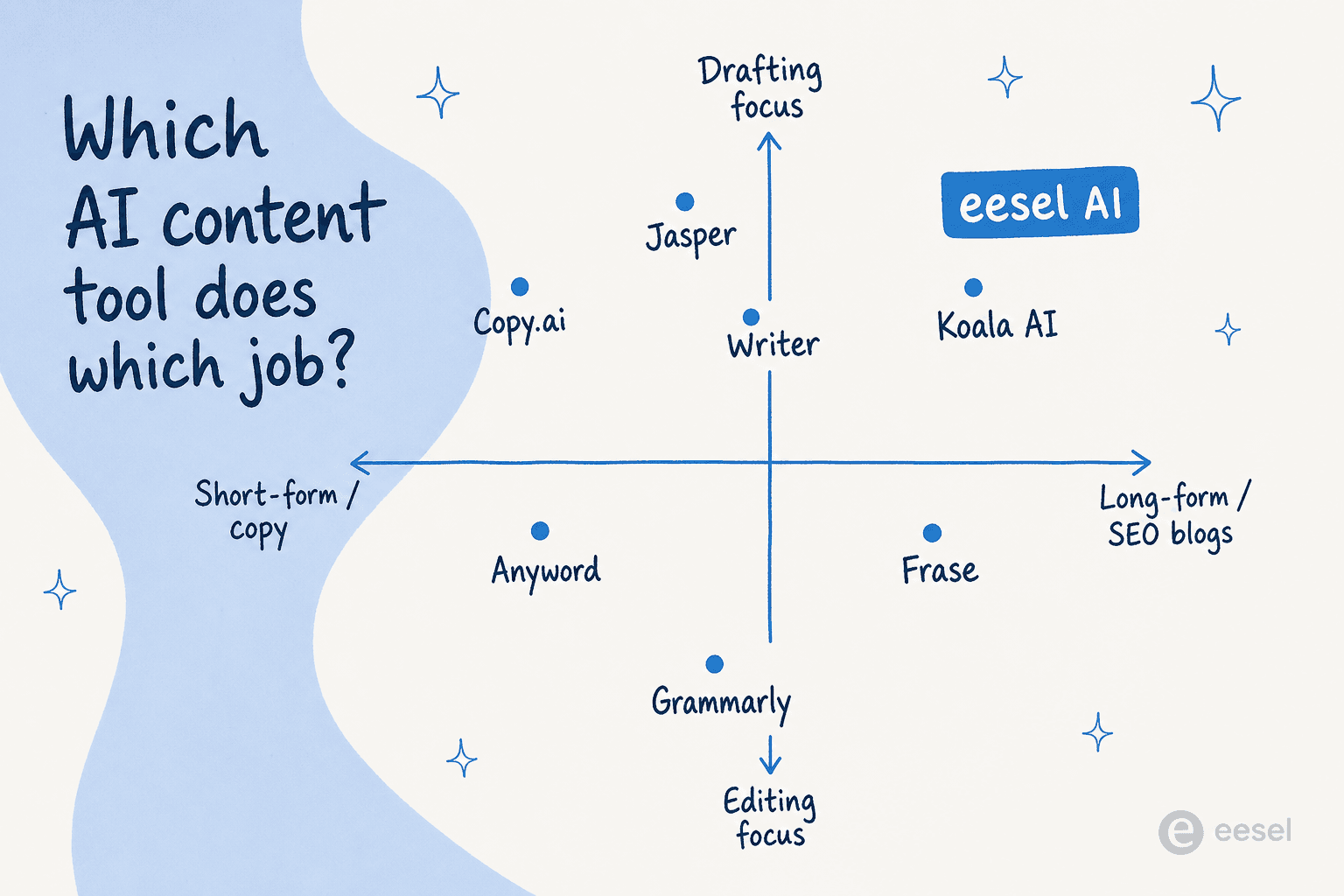
A useful frame before we go tool-by-tool: most of these tools cluster around two axes. Are you using AI to draft new content or edit what's already there? And are you working in long-form SEO blogs or short-form copy and variations? The right answer to those two questions narrows your shortlist from 8 to 2 or 3, fast.
AI detection is also worth considering when deciding which AI tools best belong in a content workflow, especially when a team uses several platforms to produce first drafts. Instead of tying that check to the same tool used for writing, marketers can use Getsolved.ai as a separate AI detection step to assess whether a finished draft shows patterns associated with AI-generated text. This gives editors an additional signal to review alongside originality, brand voice, factual accuracy, and the usual human edit before publication.
1. eesel AI - best for keyword-to-publish SEO blogs at scale
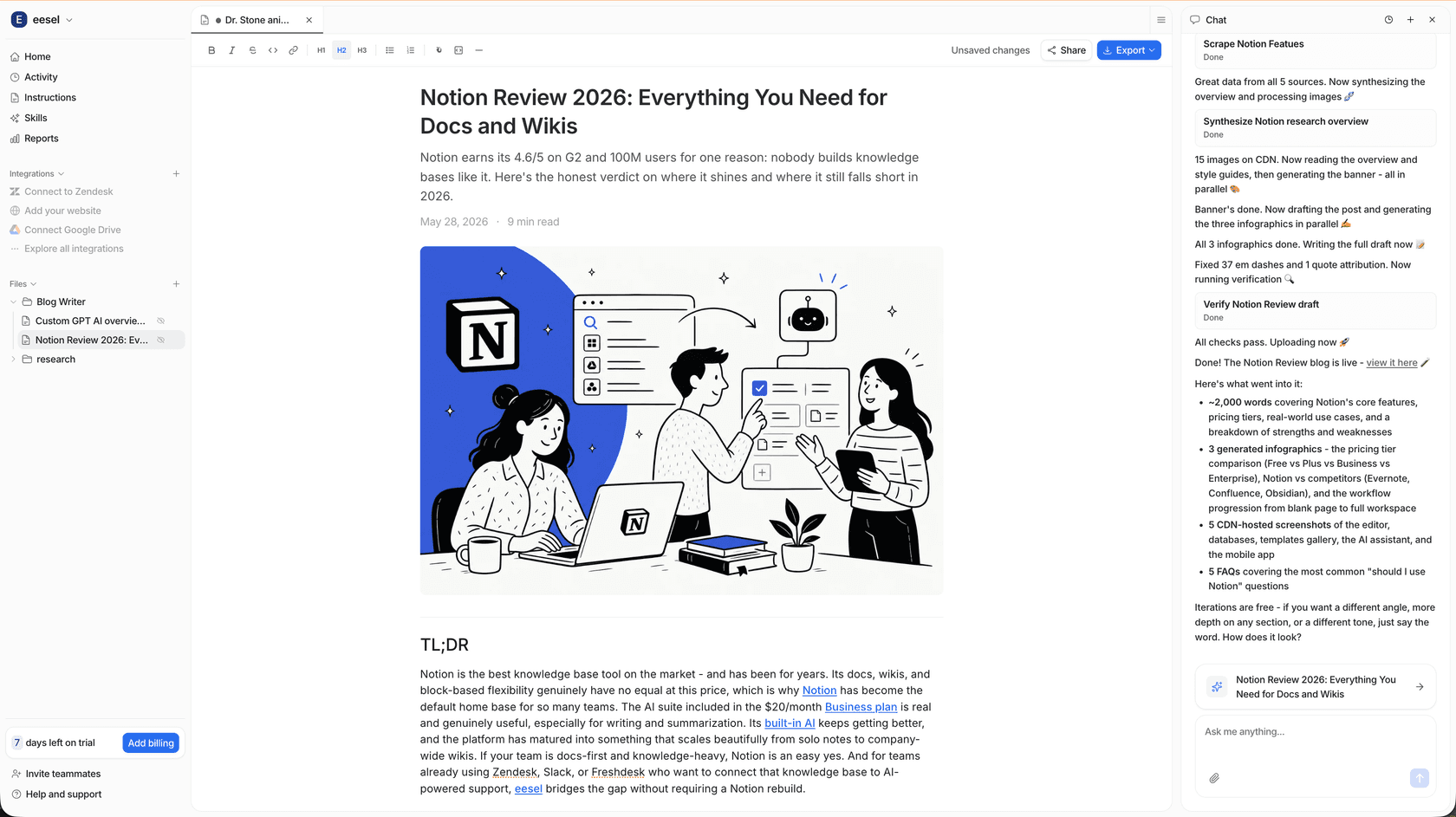
eesel AI is built on the premise that briefing an AI should feel like onboarding a new employee, not learning a prompt language. You point it at a keyword, give it a few plain-English instructions about your audience and brand, and the Blog Writer agent handles the research, drafting, hero banner, infographics, FAQs, internal linking, and CMS publish. Most posts land at 2,000–2,900 words in 12–20 minutes.
The differentiator isn't the model - eesel routes across frontier LLMs - it's that the agent operates autonomously against your own context. Brand voice, banned phrases, competitor exclusion rules, internal-link wiki, image registry, prior posts - all live alongside the agent and travel into every generation. That's why one customer we anonymized as a marketer at a tour-operator booking-software company can ask, in chat, "this article has too much phrasing identical to that one - adjust any longer phrases that match" and the agent acts on it without re-prompting from scratch.
For volume, the numbers are real. We've watched an AI phone-support startup ship 360 Blog Writer SEO posts per month - 12 a day - using a keyword-to-publish pipeline on Webflow CMS. The same fleet quietly handles a 5,000-word French scientific article with 25 references in a single chat, and German baby-textile eCommerce posts at 2,000–2,900 words with hero banner, 3–5 brand-colored infographics, and FAQs in 12–20 minutes - all anonymized examples from real eesel customers.
Pros:
- Keyword-to-published-post pipeline that genuinely works at 12+ posts/day per author.
- Brand context (voice, banned terms, competitor exclusions, internal link wiki) stays sticky across every generation.
- Hero banner + in-body infographics generated in the post's brand palette, not stock visuals.
- Plug-in CMS publish for WordPress, Webflow, Ghost, and Shopify.
- $4 per finished blog post, no seat fees, no platform fee on self-serve.
- The dashboard chat doubles as a configuration surface - you onboard the agent conversationally.
Cons:
- It's a content operating system, not a "give me a sentence" toy - there's more setup than a chat box.
- The autonomous agent style means you trust it to act; teams that want every output gated for human approval will need to wire the review step manually.
- Brand-new to teams who think of eesel as a helpdesk AI - the Blog Writer agent is one of three agent roles, not the headline product.
Pricing: No platform fee on self-serve. Blog generation runs at $4 per finished post. Support tickets and chats run on a separate Teammate plan, from $299/month for 500 credits (1 credit per ticket or chat). The free plan includes 100 credits, no card required. See the full breakdown on eesel's pricing page.
"In a business where transactions need to be processed as quickly as possible, every second counts. With eesel, we can find specific answers to questions extremely fast. We can onboard new employees very quickly and have seen up to 80% time savings."
Alex Capurro, Chief Innovation Officer, Global Pay (Global Payments), customer story
Our take: Pick eesel if you're trying to publish 5+ SEO posts a week and your team is sick of orchestrating a brief → draft → edit → upload pipeline by hand. Skip it if your content is one or two artisanal long-reads a month - the per-post pricing makes sense at volume, not at one-offs. For a deeper test see our AI blog writer for marketing breakdown.
2. Jasper - best for marketing teams writing on-brand long-form
Jasper is the AI platform that planted its flag in marketing - not general writing, not SEO specifically, not customer support. The current product surface is built around three layers: purpose-built marketing agents (SEO, campaigns, research, optimization), content pipelines for scaled execution (Canvas for long-form, Grid for systematic production), and Jasper IQ - a context layer storing brand voice, style guides, audience profiles, and multi-modal knowledge so every output across the team stays on-brand automatically.
Jasper's social proof is stacked: 4.7/5 across 1,270 G2 reviews, named customers including Wayfair, Boeing, L'Oréal, Mars, Anthropologie, and HarperCollins, and a much-quoted Adidas case where Jasper wrote 7,500 product descriptions in 24 hours. Anthropologie reports 60% of SEO now automated with Jasper. It's also multimodal: Image Pipelines generate on-brand product imagery at enterprise scale.
The complaints are consistent too. Across G2 and Reddit, the dominant negative is "generic / repetitive / surface-level output" - "quick drafts are okay, but structure and tone for blogs often felt off" is the r/SaaS thread verdict that lines up with what mid-market reviewers say. And the SMB end of G2 (which is 93% of Jasper's review base) flags pricing as steep - "Cost" and "Expensive" show up 7 times combined in top cons.
Pros:
- The marketing-team product. Workflows like Optimization and Research agents are purpose-built, not generic chat with a marketing skin.
- Jasper IQ keeps brand voice, style guide, and audience profiles sticky across every output and every seat.
- Enterprise trust signals: SOC 2 certified, 99% uptime, 30+ language support, marquee logos.
- Multimodal - text plus on-brand image generation through Image Pipelines.
- Browser extensions so Jasper sits inside Gmail, Docs, HubSpot, LinkedIn, and WordPress.
Cons:
- The flagship complaint across G2 and Reddit: output reads as generic without heavy brand-voice training.
- $59/seat/month (annual) is the steepest entry-tier price on this list, and Pro is single-seat.
- Brand IQ + Style Guide + Visual Guidelines are Business-only - meaningful brand governance lives behind a sales call.
- The Pause Plan billing model has a specific 1.5/5 G2 complaint: pausing cuts off remaining prepaid access immediately.
Pricing: Two tiers only - Pro at $69/seat/month (monthly) or $59/seat/month (annual), single seat. Business is custom pricing with a 12-month commitment, and it's where unlimited Brand Voices, the Style Guide, API, SSO, and Jasper Studio live. See the full breakdown for what each tier actually unlocks.
"Jasper saves me hours on first-draft work and template-based campaigns. The bigger issue is the output reads generic until you spend real time training Brand Voice - which is Pro-tier locked unless you go Business."
synthesized from recurring G2 themes, G2 Jasper reviews.

Our take: Pick Jasper if you're a marketing team of 5–50 with a real brand voice to enforce and a budget to match - the Brand IQ stack is the real moat. Skip it if you're a solo creator (the per-seat math is brutal) or if your job is SEO blog volume specifically - Jasper isn't faster than Koala or eesel at that, and it's much pricier. See Jasper alternatives for the cheaper sidegrades.
3. Copy.ai - best for GTM workflows that mix marketing and sales copy
Copy.ai is the most repositioned tool on this list. It started as the "AI writing assistant that beats the blank page" and is mid-pivot to "The First AI-Native GTM Platform" - a single platform that codifies sales, marketing, and operations workflows. The 2026 product is built around Workflows, Tables, Agents, Actions, Brand Voice, and Infobase - building blocks for a GTM operating layer, not just a copywriting box.
The pivot leaves Copy.ai in an interesting spot. The homepage claims 17 million users - up from the 10M figure Reddit was discussing a year ago - and there's no doubt the original Wizard-and-templates product still works ("beats the blank page" is the most-repeated G2 phrase). But the new GTM framing pushes hard up-market: the public price gap between the Chat plan at $24/month and the Growth plan at $1,000/month is the steepest jump in this entire list, and the place buyers most often stall.
The Reddit signal on Copy.ai is mixed. The most recent r/AskMarketing thread calls out "they seem to remember brand voice and tone" as the differentiator. The r/copywriting crowd is more skeptical - "value is created by putting time and effort into copy, not by prompting away on a hunch" - which isn't specific to Copy.ai but applies to the category. Third-party reviewers also flag reliability and SMB-perceived expense.
Pros:
- Real workflows: Tables and Workflows compose into multi-step processes (e.g. inbound lead → enrich → personalize → send) rather than one-shot prompts.
- Brand Voice at the platform level - train once, applied across every workflow.
- LLM-agnostic: routes across OpenAI, Anthropic, Gemini, and Perplexity.
- Strong integration story: 2,000+ integrations claimed, with Salesforce, HubSpot, Gong, Zapier, Outreach, and Salesloft surfaced as anchors.
- SOC 2, GDPR, SSO on enterprise plans.
Cons:
- The pricing gap from Chat ($24/mo) to Growth ($1,000/mo) is brutal - there's no middle for a small team.
- The /products/* URL space (workflows, brand voice) returns 404 as of mid-2026 - canonical pages moved to /platform/* but legacy links rot.
- Reliability complaints recurring in third-party reviews.
- The "AI-Native GTM Platform" framing is genuinely useful but means content marketers now share the product roadmap with revops.
Pricing: Chat at $24/mo (annual, $29/mo monthly) - 5 seats, Chat-only, no Workflow credits. Then Growth at $1,000/mo, Expansion at $2,000/mo, Scale at $3,000/mo, and Enterprise (custom). The meter is Workflow credits, not words. See Copy.ai pricing.
"They seem to remember brand voice and tone - that's the thing that flipped me from generic ChatGPT prompts to Copy.ai for our actual ad variants."
recent r/AskMarketing thread, synthesized from SERP snippets.

Our take: Pick Copy.ai if your content team is already wired into GTM ops and you want one tool for marketing copy and sales-cadence automation. Skip it if you're a content-only team - the GTM features are wasted and the Growth-tier jump kills the math. For pure writing, see our Jasper vs Copy.ai comparison.
4. Writer - best for enterprise content with strict brand governance
Writer (writer.com) is the only tool on this list where every primary CTA on every product page is "Request a demo." That tells you the audience instantly: this is enterprise content infrastructure, not a marketer's freelance side-tool. Founded in 2020, 201–500 employees, headquartered in San Francisco, and built around three pillars - WRITER Agent for autonomous multi-step execution, AI Studio for IT-grade agent building, and Palmyra, Writer's own in-house model family marketed as "frontier AI, purpose-built for regulated enterprises."
The customer logo wall is what most large enterprises buy on: Vodafone, Vanguard, Salesforce, KPMG, Qualcomm, American Eagle, Uber, Dropbox, e.l.f. Cosmetics, Accenture, HubSpot, Hilton, Ally. No SMB logos surfaced - Writer is unapologetically up-market. Compliance certifications are stacked: SOC 2 Type II, GDPR, HIPAA, PCI.
The "what it actually does" lives in Playbooks - repeatable multi-step workflows (the canonical example is a churned-customer win-back: Snowflake query → segment → personalize → Gmail send → Slack notification). Connectors cover Microsoft SharePoint, Snowflake, Semrush, HubSpot, Microsoft Teams, Slack, Gmail, and PitchBook, with industry-specific connectors gated to Enterprise.
The honest verdict from reviewers is polarized. Brand-voice enforcement gets the most praise across G2, Gartner, and TrustRadius - it's the wedge against ChatGPT and Grammarly in reviewer language. The most-repeated complaint is performance on large documents: multi-minute query times against the Knowledge Graph come up across multiple reviews. And one 1-star Gartner review pushes back hard: "Cannot be trained like it says it can be."
Pros:
- The most rigorous brand-voice enforcement on the list - departmental voice profiles, terminology, style guide enforcement at scale.
- Palmyra LLMs keep the model layer in-house - important for regulated verticals (healthcare, finance) that can't ship to a third-party API.
- Compliance is genuinely enterprise-grade: SOC 2 Type II, GDPR, HIPAA, PCI, BAA available, SAML SSO, SCIM, audit logs.
- Knowledge Graph (RAG over customer data) up to 50 GB per graph on Enterprise.
- WRITER Agent is "not a tool you prompt - an agent you delegate to."
Cons:
- No published dollar pricing. "Contact sales" everywhere. Expect five- to six-figure ACV.
- Multi-minute latency on Knowledge Graph queries is a real complaint.
- Phased rollouts: Gartner reviewers note an "agents must be approved" workflow that limits experimentation.
- Starter trial caps at 5 users and 1 GB Knowledge Graph - usable as proof of concept, not as a deployment.
- Two product URLs (
/product/agent-builder/,/product/ai-models/) currently 404, consolidated under WRITER Agent and AI Studio.
Pricing: Two-tier model with no public dollar amounts. Starter is a self-serve trial then per-seat (sales-touch likely required to upgrade), capped at 5 users, 5 playbooks, 1 voice profile, 1 GB Knowledge Graph. Enterprise is contact-sales only. See Writer's plans page and our breakdown of Writer AI pricing.
"The brand-voice enforcement is the single feature that justifies Writer's price tag for us - once it's set up, every team's output reads like one company."
synthesized from recurring G2 + Gartner reviewer themes.
Our take: Pick Writer if you're a Fortune 500 with a compliance team that owns model selection and a content org that spans dozens of brands. Skip it if you're a 5-person marketing team - the price tag, sales motion, and enterprise gating will frustrate you faster than the AI helps. For lighter-weight alternatives see Writer AI alternatives.
5. Frase - best for SEO content briefs and AI-visibility tracking
Frase is the agentic SEO + GEO platform that replaced a stack of single-purpose tools for a lot of small SEO teams. The product pitch: one AI Agent that does SEO research (scrapes the top 10 SERP results for a keyword in 30 seconds), brief generation, AI writing, SEO optimization scoring, and now GEO content optimization + AI visibility tracking across ChatGPT, Perplexity, Claude, and Gemini.
The community positioning is unambiguous. Across r/SEO threads, Frase is "the cheaper Surfer SEO" - wins on price and content creation, loses to Surfer on detailed optimization depth. The numbers back it: 4.8★ on G2 across 301 reviews on the Frase.io product page, 98% Would Recommend, and named third-party endorsements like Kevin Indig (Director of SEO, Shopify) saying "Our organic traffic is up 3x since we started" on the Frase pricing page.
The "every plan includes everything" angle is one of the cleaner pricing models we tested - plans differ in volume, not capabilities, and that's stated explicitly in the pricing FAQ.
Pros:
- 30-second SERP analysis turns into a working brief faster than any other tool we tested.
- GEO + AI visibility tracking on every plan - most competitors gate this behind Enterprise.
- 37+ AI writing tools in one platform across 6 categories.
- Programmatic SEO at scale (10,000+ pages from structured data).
- SOC 2 Type II + GDPR available on Enterprise.
- Plans differ in volume, not capabilities - no feature gating across tiers.
Cons:
- SERP-mirroring optimization tools are in an active identity debate - r/seogrowth threads actively question whether they still earn their keep in the LLM era. Frase's GEO pivot is a direct answer, but the skepticism lingers.
- Some marketing pages cite "$38/month" while the actual pricing page starts at $49/mo monthly ($39/mo annual) - minor confusion worth flagging.
- 93.2% small-business reviewer base - enterprise depth is shallower than Writer or Jasper.
- Brand-voice enforcement is per-plan-capped (1 voice on Starter, more on higher tiers).
Pricing: Monthly billing (annual saves 20%). Starter $49/mo (1 seat, 10 articles, 50 audits, 1 domain, 2 AI platforms tracked). Professional $129/mo (3 seats +$29/seat, 40 articles, 250 audits, 5 domains, 3 platforms). Scale $299/mo (5 seats +$29/seat, 100 articles, 1,000 audits, 10 domains, 5 platforms). Enterprise - custom. Full breakdown in our Frase AI pricing guide.
"Cheaper Surfer SEO, basically. Wins on price and content creation, Surfer wins on detailed optimization depth. For a small content team that's not the trade-off you think - Frase's brief generation is fast enough that the optimization gap stops mattering."
synthesized from recurring r/SEO comparison threads.
Our take: Pick Frase if SEO is the primary job and you want briefs + writing + AI visibility tracking in one tool without going up-market to Surfer or MarketMuse. Skip it if your content is brand storytelling, not SERP-mirroring - Frase's whole architecture optimizes for ranking, and that's a hammer that doesn't fit every nail. See Frase AI alternatives if you want to compare adjacent tools.
6. Anyword - best for performance-predicted marketing copy
Anyword is the marketing copy tool that doesn't just generate - it predicts. The flagship feature is Predictive Performance Scoring: a numeric prediction of how a piece of copy will perform against a target audience, business goal, and channel, before it's published. The headline accuracy claim, verbatim from the Anyword homepage:
"Anyword's AI delivers industry-leading performance prediction - accurately determining which of two content variations will perform better based on audience, business goal, and channel - with 82% accuracy. In comparison, generic AI models like GPT-4o achieve only 52%."
That's the buy: 82% accuracy on which-variation-wins versus 52% for raw GPT-4o. And the company claims the customer base sees roughly 30% lift in conversion rates on the same homepage. The flagship is bundled with a Blog Wizard (long-form AI blog writer with SEO score, plagiarism checker, brand voice alignment, research panel), a Brand Voice hub, a Performance API for embedding predictions into ChatGPT, Notion, Gemini or custom agents, and Custom-Built AI Models trained on your own performance data (Business+ plans).
Trust posture is also stacked: SOC 2, ISO 27001, GDPR, HIPAA, 99.9–99.99% uptime, private LLM option on Enterprise.
Where it gets harder: G2's 4.8★ across 1,226+ verified reviews skews praise toward ease of use and speed-to-output, but cost is the dominant pushback for solo and freelance users - Starter at $49/mo (monthly) feels high versus Copy.ai or Writesonic for general writing. One verified Software Advice reviewer captured the upside best:
"Yesterday, I executed an entire landing page strategy in 1 day. It would have taken several weeks… before Anyword."
verified Software Advice review, Anyword profile.
Pros:
- 82% predictive accuracy beats every other tool's "trust me" copy claim.
- Custom-built AI models on Business+ - the AI literally learns your historical campaign data.
- Performance API is unusual: lets developers bolt conversion prediction onto ChatGPT, Notion, Gemini, custom agents.
- Compliance: SOC 2 + ISO 27001 + GDPR + HIPAA, private LLM option.
- Chrome extension overlays predictions on ChatGPT, Notion, and Gemini.
Cons:
- No
/featuresindex - the page 404s. You have to walk the use-case pages. - API access and SSO are Enterprise-only - a friction point for mid-market.
- The 30+ supported languages aren't enumerated publicly.
- Niche or sensitive-topic handling is a stated weakness for content outside mainstream marketing.
- Starter's 50 predictions/month is light for an active marketing team.
Pricing: Four tiers. Starter $49/mo ($39/mo annual) - 1 seat, 50 predictions (100 yearly), 50 data rows. Data-Driven $99/mo ($79/mo annual) - 3 seats, 100 predictions (175 yearly), 50 data rows. Business - custom. Enterprise - custom. Extra Data-Driven seats run $59/mo ($49/mo annual), capped at 10. See Anyword pricing.
Our take: Pick Anyword if your content marketing is measurably tied to conversion - paid ads, landing pages, sales emails, CTA copy. The 82% prediction accuracy is the only feature on this list that meaningfully derisks copy decisions. Skip it for pure SEO blogs (Frase or Koala) or brand long-form (Jasper or Writer) - the predictive layer is wasted there. For deeper testing see our Anyword review and Anyword alternatives.
7. Grammarly - best for editing and brand-voice consistency
Grammarly is the tool every content team already has - or thinks they don't need. 40 million users, 50,000+ organizations, and a G2 score of 4.7/5 across 12,969 reviews, where it's ranked #1 AI Writing Assistant in the G2 Winter 2026 Grid. The product works as a browser extension, desktop app, and mobile app across more than a million apps and websites.
As of October 2025, Grammarly is part of the Superhuman suite - a merged productivity platform combining Grammarly, Superhuman Mail, Coda docs, and the Superhuman Go cross-tab AI assistant. The repositioning means Grammarly Business is now bundled with Superhuman Mail at $33/member/month annual.
For content teams the real value is upstream of writing: Style Guide, Brand Tones, Knowledge Share, and Snippets turn Grammarly into the editing layer that sits on top of every other tool on this list. Drafts come out of Jasper, Copy.ai, eesel, or Koala - and Grammarly polishes them to brand-compliant English before they ship.
The reputation has two cracks worth naming. First, billing - Grammarly's BBB score is 1.04/5 from 49 reviews, almost entirely auto-renewal complaints (the gap between $30/month monthly and $12/month annual catches users by surprise). Second, the Expert Review scandal in March 2026, where Grammarly attached real writers' names (including Stephen King's) to AI-generated feedback without consent - TechCrunch's headline was "Grammarly's 'expert review' is just missing the actual experts." Class action followed; Grammarly killed the feature.
There's also a sharp anti-recommendation from creative writers. A post from @deimosatellite on X - "do not use grammarly please... it's just ass and ai and will hurt your writing AND your ability to write" - reached 73,412 views and 4,459 likes. r/writing echoes it: Grammarly "strips your voice" by flagging intentional stylistic choices as errors. For marketers writing personality-led content, that's worth knowing.
Pros:
- The inline editing layer is unmatched - works inside Gmail, Docs, Notion, Slack, LinkedIn, Salesforce, every CMS.
- Style Guide + Brand Tones keep team output on-brand without retraining a separate model.
- 40M users / 50K organizations is the largest reviewer base on this list - the social proof signal is real.
- Plagiarism check + AI-generated text detection bundled on Pro.
- SAML SSO, SCIM, BAA for HIPAA, DLP, BYOK encryption - full enterprise stack on Enterprise tier.
Cons:
- The $30/month monthly vs $12/month annual gap drives the bulk of BBB billing complaints.
- Creative writers actively dislike it - flags intentional stylistic choices as errors.
- The Expert Review scandal hit trust hard in early 2026.
- "Why pay for Grammarly when ChatGPT is free?" is a recurring Reddit and LinkedIn argument - value migration is real.
- Expert Review feature was killed; some paid value-add gone.
Pricing: Free at $0/month (grammar/spell in 6 languages, 100 AI prompts/mo, collaborative docs). Pro at $12/member/month (annual) or $30/member/month (monthly) - 2,000 AI prompts, translations in 19 languages, plagiarism check, 1 style guide, 1 brand tone. Business (Superhuman Suite) at $33/member/month annual or $40/member/month monthly - adds Superhuman Mail and AI inbox organization. Enterprise is contact sales for SAML SSO, SCIM, DLP, BYOK, unlimited style guides. See Grammarly plans and our Grammarly pricing breakdown.
"We distinctly remember canceling Grammarly last year after we were charged $144 for an account that our son was no longer going to use."
Kara I., BBB review, Feb 2026.
Our take: Pick Grammarly Business for the editing layer if your content team is generating drafts from one of the other 7 tools and needs a single style-guide enforcement surface. Skip the monthly plan - it's a billing trap. Skip Pro entirely if your team writes personality-led brand content where "voice strip" is a feature loss. For sidegrades see our Grammarly alternatives roundup.
8. Koala AI - best for one-click SEO blog generation
Koala AI (koala.sh) is the most aggressively SEO-focused tool on this list. The homepage pitch is literal: "AI Articles That Actually Rank." The whole architecture optimizes for winning SERPs, not reading well - and the bundle is five products under one subscription: KoalaWriter (the flagship one-click SEO blog generator), KoalaChat (chat with real-time data and SEO commands), KoalaImages, KoalaLinks (automated internal linking + entity schema; Koala claims 10+ million internal links created to date), and KoalaMagnets (custom GPTs embedded on a customer's site).
The current product generation is Brand DNA + KoalaWriter v2, announced April 8, 2026 and described by Koala itself as "the biggest update in Koala AI's history." Brand DNA captures business context that feeds every generation - the missing piece in the previous version's complaint sheet.
The killer feature, per community: one-click publishing to WordPress, Shopify, Webflow, and Ghost. Multiple Reddit users in 2025 and 2026 call this out as the time-saver that flipped them off plain ChatGPT. Output is also long - 3,500+ words per article is the figure community reviewers cite, and the canonical model recommendation is Claude 4.5 Sonnet.
The reality check on Trustpilot is more honest than Koala's on-site testimonials. The public Trustpilot aggregate sits at 3.5/5 across 21 reviews, versus a 5-star wall on koala.sh. That's the gap worth quoting - the on-site testimonials cherry-pick the wins.
There's also a footnote that catches new buyers off-guard: word counts on every plan are billed at the GPT-5 Mini rate. "If you choose to use GPT-5.2 or Claude 4.5 Sonnet, the word count for that specific article will be counted as 2 times higher" - meaning a $49/mo Professional plan is effectively 50,000 high-quality words, not 100,000. See the Koala pricing footnote for the exact language.
Pros:
- The cheapest entry-tier on this list - $9/month for KoalaWriter, KoalaChat, KoalaImages.
- One-click publishing to WordPress, Shopify, Webflow, Ghost - the named killer feature.
- 7 article types (Blog Post, Listicle, Local Places, Amazon Roundup, Amazon Single Product, YouTube-to-Blog, Rewrite).
- Real-time data sources: web, Google Scholar, Google News, custom search.
- Deep Research mode - "uses 100x more context" - locks in factual citations.
- Brand DNA (April 2026) finally addresses the brand voice gap.
Cons:
- Trustpilot 3.5★ aggregate vs cherry-picked 5★ on-site testimonials.
- Word-count double-count on premium models (Claude 4.5 Sonnet, GPT-5.2) cuts effective output in half.
- Common stack adds NeuronWriter for optimization - Koala doesn't fully replace dedicated optimization tools.
- SOC 2 / compliance posture not publicly published.
- The on-site testimonial wall is misleadingly positive.
Pricing: Tagline is "Simple pricing starting at $9 per month." Monthly + annual (annual saves 20%, credits up front, year-long expiry). Essentials $9 (15,000 words, 250 chat msgs). Professional $49 (100,000 words, 1,000 msgs - the most-recommended tier). Boost $99 through Scale III $2,000. See the full Koala pricing and our Koala AI pricing breakdown.
"Koala AI is the first platform that produced full blog posts good enough to publish on my niche sites. Ridiculously in-depth and structured."
Our take: Pick Koala if you're a niche site operator, affiliate marketer, or one-person agency shipping volume to WordPress and the killer feature is publishing speed. Skip it if your content needs serious brand-voice consistency across a team - Brand DNA helps but isn't yet at Jasper's or Writer's level. See our full Koala AI review and Koala Writer review.
A worked cost example: what a small content team actually pays
Most "best content marketing tools" lists stop at the sticker price. What buyers actually want to know is: what does this cost in production? So here's a worked example for a team publishing 4 SEO blog posts a week (16/month), using 2 seats.
| Tool | 2 seats, 16 posts/mo | Monthly cost |
|---|---|---|
| eesel AI | $0 platform + $4 × 16 posts | $64/mo |
| Koala AI Professional | $49 (100k words / month, ~25 posts) | $49/mo |
| Frase Professional | $129 (40 articles, 3 seats) | $129/mo |
| Jasper Pro (annual, ×2) | $59 × 2 seats | $118/mo |
| Copy.ai Chat ($24) → Growth ($1,000) | Chat caps at 5 seats Chat-only | $1,000/mo (Growth needed for workflows) |
| Anyword Data-Driven (annual) | $79 (3 seats, 100 predictions) | $79/mo |
| Grammarly Business | $33 × 2 seats (annual) | $66/mo |
| Writer Enterprise | Contact sales - typical mid-five figures ACV | ~$3-5k/mo estimated |
Notes worth flagging:
- eesel and Koala have the cleanest math at this volume - both come in under $70/month and both handle the keyword-to-publish workflow end-to-end.
- Copy.ai is misleading at sticker price: Chat at $24/mo doesn't include Workflows, and the next real tier is $1,000/mo. There's no $100 middle.
- Jasper Pro is single-seat - two seats means two subscriptions, not one shared plan.
- Writer's Enterprise pricing isn't published; the LinkedIn/Vendr data on Grammarly Enterprise (which is more transparent) suggests $10-13/seat at 50-200 seats - Writer is meaningfully higher than that based on its competitive set.
Most teams end up running two tools: one for drafting (eesel, Koala, Jasper, or Copy.ai) and one for editing (Grammarly). The combined cost still lands well under what a single freelance content writer charges per post - which is the math that makes the category work in the first place.
So which AI content marketing tool should you pick?
The honest summary: there's no single winner, because content marketing isn't one job. Here's the verdict by what you're actually trying to do.
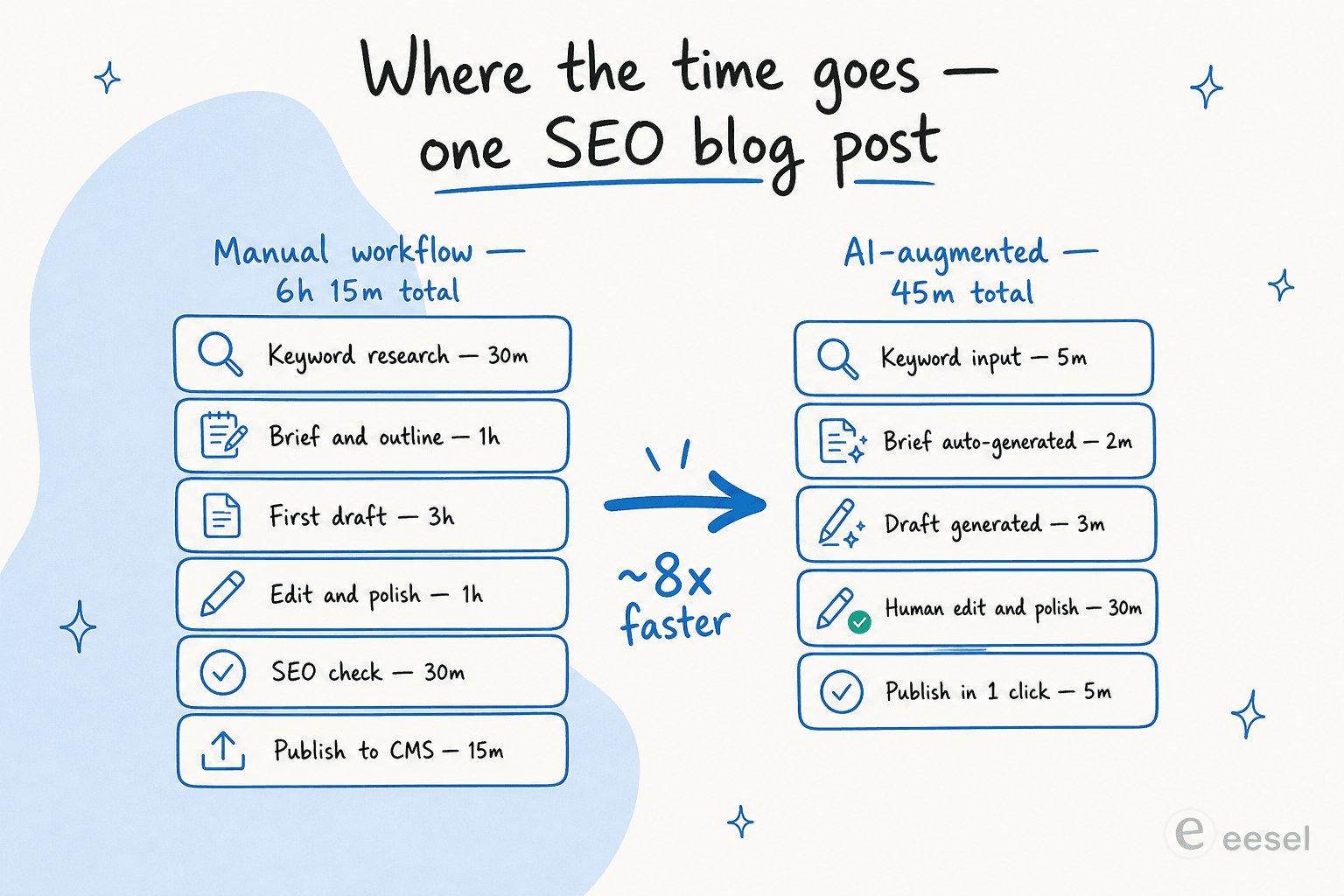
- You publish 5+ SEO blogs a week and want one tool that owns keyword → published post: eesel AI ($4 per post, brand context sticks) or Koala AI (cheapest at $9/mo, killer one-click publishing).
- You're a marketing team of 5–50 with a real brand voice and a budget: Jasper for the Brand IQ stack and marketing-team workflows.
- You're a content team that also owns sales workflows: Copy.ai - its Workflows earn the platform cost only when GTM is a real use case.
- You're a Fortune 500 with compliance + dozens of brands: Writer - Palmyra LLMs in-house, SOC 2 Type II, HIPAA BAA, departmental voice profiles.
- SEO is the primary job, briefs are the bottleneck: Frase - 30-second SERP analysis, GEO tracking, plans differ by volume not features.
- Conversion-rate-tied copy (ads, landing pages, CTAs): Anyword - 82% predictive accuracy beats every other "trust me" claim.
- Editing + brand-voice consistency across whatever you draft: Grammarly Business for the team layer - but always annual, never monthly, to avoid the billing trap.
For a deeper compare across categories see our content marketing tools roundup, AI content generation tool tests, and the AI SEO tools comparison.
Try eesel
If your content marketing problem is volume - you need to ship more SEO blog posts every week than your team can write - eesel AI's Blog Writer agent is the tool we'd hand you first. Keyword in, publish-ready 2,000–2,900-word post out, with hero banner, in-body infographics, FAQs, internal linking, and one-click CMS publish across WordPress, Webflow, Ghost, and Shopify. Real teams are running 12 posts a day on it; the simple price ($4 per finished blog post, no platform fee) keeps the math honest at any volume.
The 100 free credits start without a card - point it at a keyword and see what comes back in 15 minutes.
Frequently asked questions
What are the best AI tools for content marketing in 2026?
The 8 we'd actually put in a content stack today are eesel AI for keyword-to-publish SEO blogs, Jasper for marketing teams, Copy.ai for GTM workflows, Writer for enterprise governance, Frase for SEO briefs, Anyword for performance-predicted copy, Grammarly for editing, and Koala AI for one-click bulk SEO articles. See our full AI blog writing tools review for deeper testing notes.
Which AI tool is best for SEO blog content marketing?
For pure SEO blog volume, eesel AI and Koala AI are the two we'd reach for first - both go from keyword to publish-ready draft in minutes. Frase is the choice if you want SERP-driven briefs and AI-visibility tracking layered on top. See our deeper AI SEO tools comparison for benchmarks.
Are there free AI tools for content marketing worth using?
The free tiers from Copy.ai (Chat) and Grammarly (Free) cover real ground, and ChatGPT's free model handles a surprising amount of light copywriting. Most of the SEO-heavy tools (Frase, Koala, Jasper) only offer short trials. Our roundup of free AI marketing tools goes through what each free plan actually unlocks.
How much do AI content marketing tools cost?
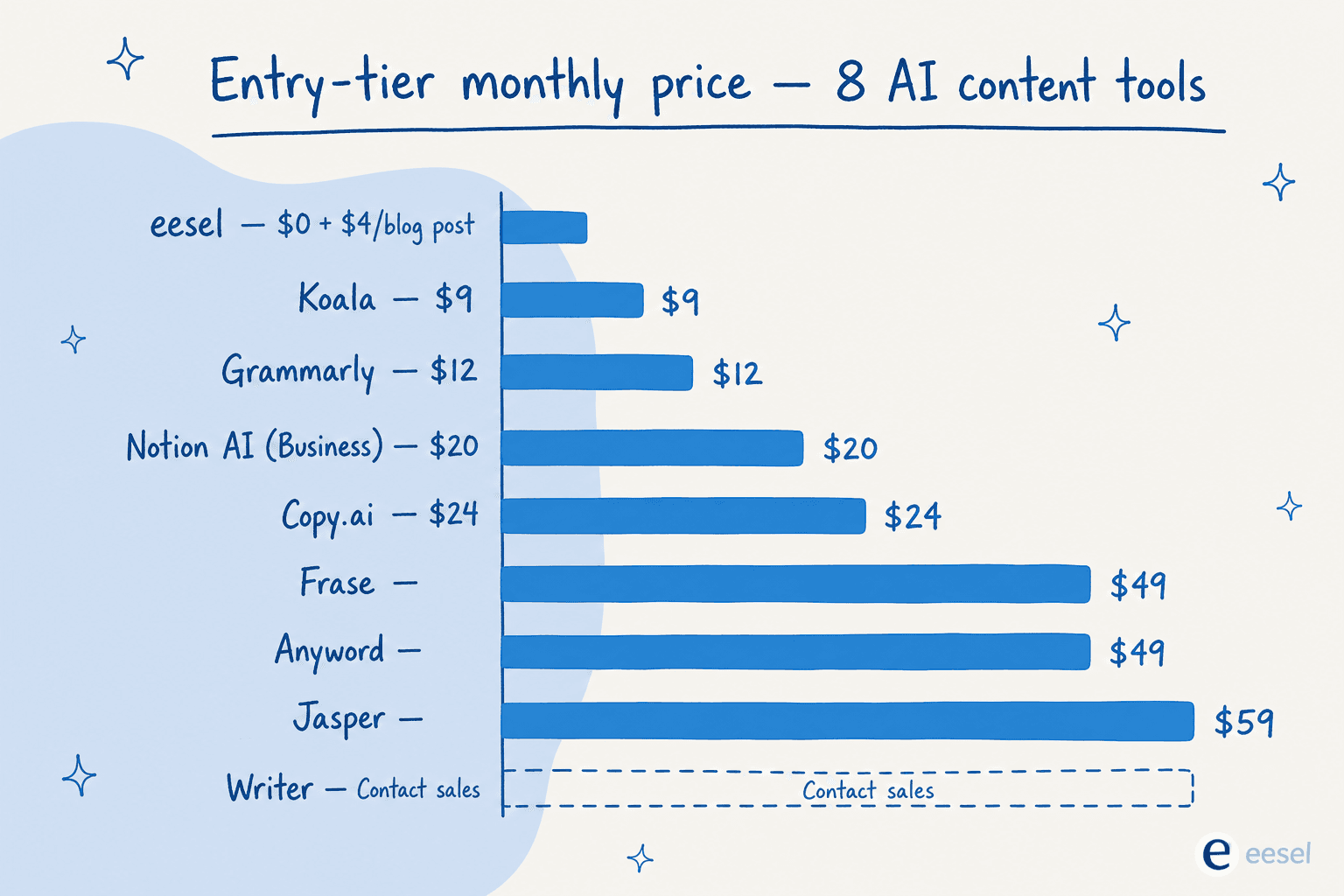
Entry-tier pricing in 2026 ranges from about $9/month for Koala to $59/seat for Jasper (annual), with Grammarly Pro at $12/month annual, Frase at $49, and Anyword at $49 all sitting in between. eesel charges $4 per finished blog post with no platform fee. See our AI blog writer pricing guide for the full math.
Can AI content tools really write a publish-ready blog post?
The honest answer: yes, but only with the right setup. eesel AI and KoalaWriter produce 2,000–5,000-word SEO posts in 12–20 minutes; Jasper and Copy.ai handle long-form too. The catch is brand voice - without an uploaded style guide, the output reads as generic. Our brand-voice training guide covers the setup.
What's the difference between an AI writing tool and an AI content marketing platform?
An AI writing tool produces a draft (think Grammarly or a raw ChatGPT blog writer). An AI content marketing platform handles the whole workflow - keyword research, brief, draft, brand voice, SEO scoring, internal linking, CMS publish - like eesel AI, Jasper, or Frase. The platform wins on volume; the writing tool wins on a single great draft.
Will AI content marketing tools hurt my SEO?
Not if you treat them as a first draft, not the final draft. Google has said it ranks content by quality, not origin, but raw AI output usually fails on originality and depth. The fix is to lean on tools with SERP grounding (Frase) or real-time research (Koala's Deep Research, eesel's Blog Writer) and add genuine human editing. Our E-E-A-T compliance guide goes into the editorial workflow.