
The state of play in 2026
For the first time, "AI customer support" stops being a 2018-style scripted chatbot and starts being something that actually closes tickets. The technical jump is real: large language models replace keyword matching, retrieval-augmented generation grounds answers in your actual knowledge base, and the agentic layer means the system can take an action - issue the refund, reset the password, change the plan - instead of just describing what the customer should do.
The numbers track that jump. G2's 2026 AI in customer service data shows 95% of decision-makers using AI report reduced support costs, 92% say it improves service quality, and AI-augmented agents handle 13.8% more inquiries per hour. 43% of contact centers have already adopted AI in some form, up from 28% in 2023.
But here's the part most coverage glosses past: Gartner's 2026 research found that 64% of enterprise CX teams ran an agentic AI pilot, and only 27% had at least one channel in full production. The gap between "we tried this" and "this is live" is enormous, and it's almost entirely about whether the team figured out the human side of the equation - escalation, sentiment, edge cases - not whether the model was good enough.
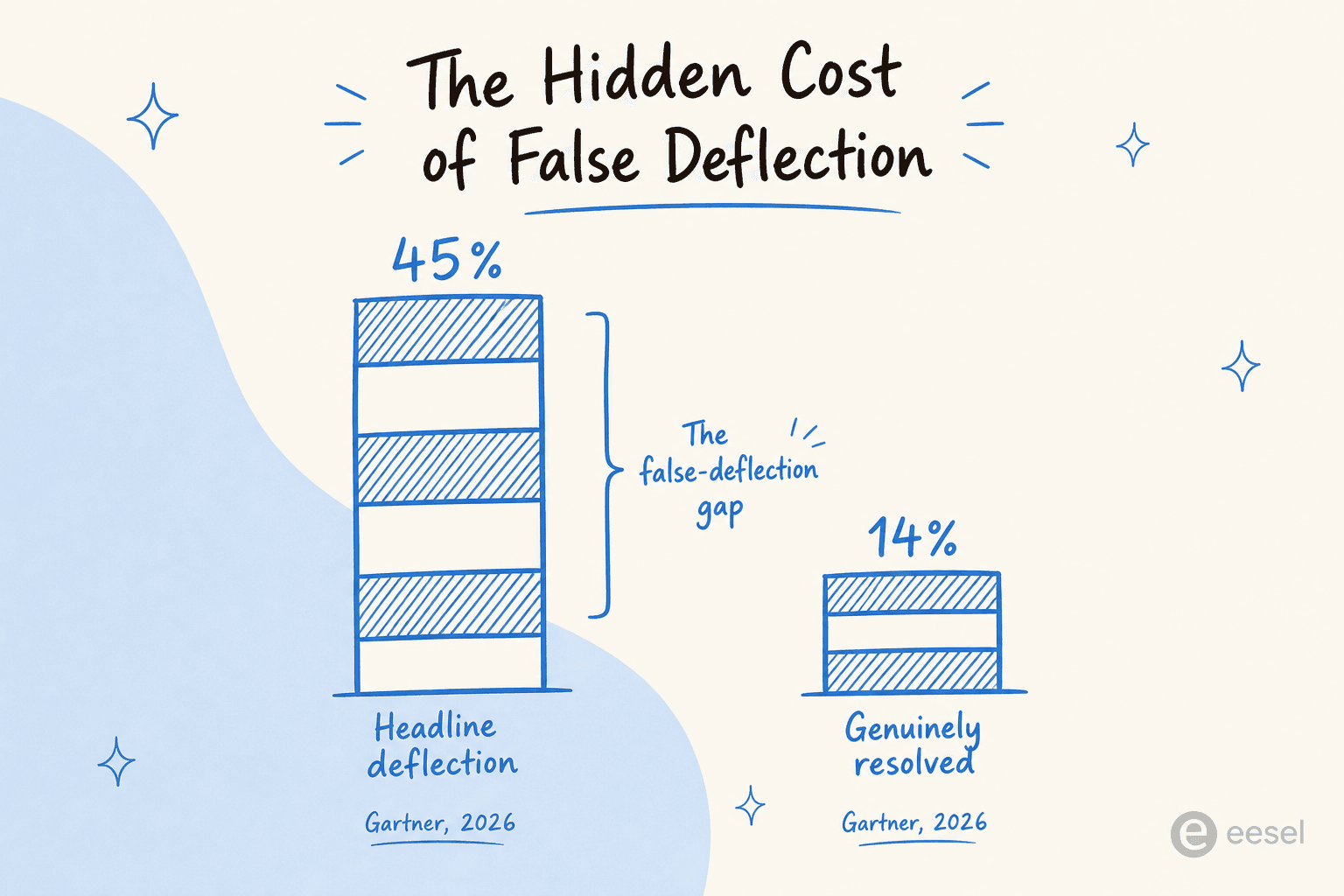
That 31-point gap is the single most important number in this whole conversation. It's the difference between AI that resolves and AI that just stops the ticket from reaching a human. Most of the rest of this post is about how to land on the 14% side, not the inflated-headline side.
Where AI actually beats humans
We'll write this section the way we'd talk about it on a sales call: with the wins, not the marketing.
Cost. This is the one that drives every other decision. Gartner's 2025 benchmarks, as compiled by theStacc, put AI-handled tickets at $0.20-$0.40 for basic FAQ deflection and $0.80-$1.50 for account-aware agents - call it ~$0.50-$1.05 blended. Forrester's human-handled benchmark for the same year sits at $8-$12 per ticket. McKinsey's sample puts the human ticket at $7.40 and the AI ticket at $0.62 - different numbers, same shape. The ratio is roughly 12× to 24× per interaction. For a team doing 10,000 tickets a month, that's the difference between a $5,000 AI bill and a $100,000 human payroll line for the same volume.
Speed. G2's industry data shows AI cuts first response times by 37% and resolves tickets 52% faster on average. The "first response" half is mostly because AI doesn't queue - a customer who'd wait 12 minutes for a human gets an answer in 12 seconds. That alone moves CSAT, because the bulk of CSAT damage in long-tail queues happens in the waiting, not in the answer.
Coverage. 24/7 with no shift premium, no holiday pay, no graveyard-shift attrition. The graveyard-shift problem is real - most ticket queues bulge between 9pm and 6am customer local time, exactly the hours where staffing is hardest. AI absorbs that bulge cleanly.
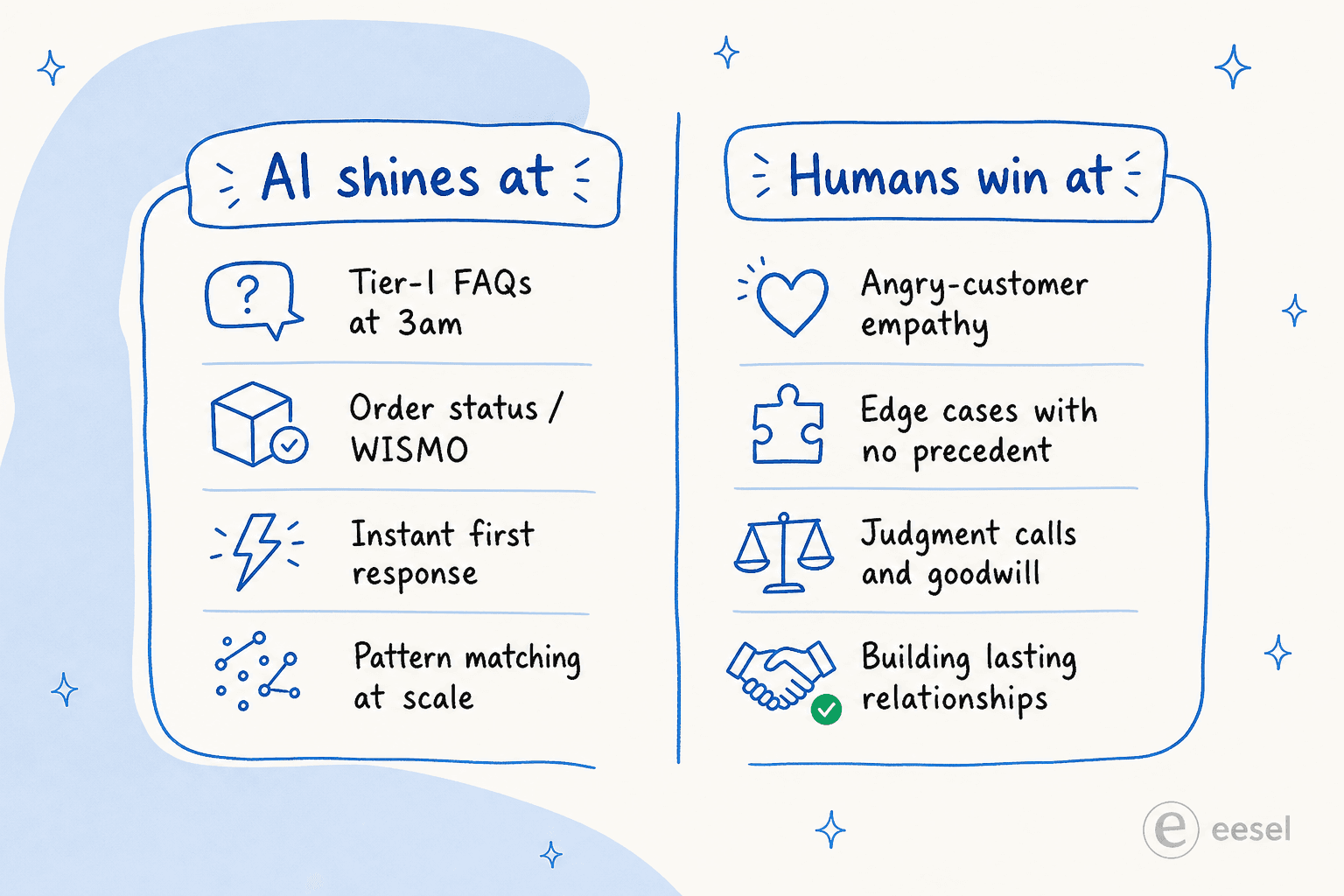
Pattern matching at scale. A human agent learns the playbook on maybe a few hundred tickets a year. An AI agent has read every ticket your team has closed since you turned the helpdesk on. That asymmetry is invisible until you watch an AI find the obscure macro from 18 months ago that solves a ticket nobody on the current team remembers writing.
The proof points are public. Grammarly went from 60% deflection to 87% in 10 days with Forethought and held CSAT at 4.2/5. Klarna's AI handles ~two-thirds of all customer service, equivalent to 700 full-time human agents. Bilt Rewards handles 70% of 60,000 monthly tickets with AI agents. Duolingo runs above 80%.
Where humans still win
If you only read the above, you'd think the verdict was over. It isn't. The deflection rate by query type, from ClarityArc's 2026 production benchmarks:
| Query type | AI deflection rate |
|---|---|
| Password resets, account access | 70%+ |
| Billing, order status, standard product questions | 50-70% |
| High-structure intents with backend systems | 65-80% |
| Sentiment-heavy / dispute-style intents | 19-34% |
| Nuanced complaints, complex technical issues | rarely above 25% |
That bottom band - sentiment-heavy disputes and nuanced complaints - barely moves even with the best models on the best knowledge bases. That's not a model problem. That's the work humans do.
The clearest framing we've seen comes from Ojas Patil, recounting a delayed-order experience with Zomato's AI chatbot in a LinkedIn post that picked up ~160 reactions in February 2026:
"AI in customer support is one area where the rush to automate is breaking the very thing it was built to fix. In theory, that should make support faster. In practice, customers spend more time trying to convince a bot to let them talk to a human... when a customer is hungry and irritated, the first thing they need is empathy. For frustrated customers, empathy still matters, and right now humans are far better at it."
Ojas Patil, LinkedIn, February 2026

The other place humans win quietly is anywhere precedent matters. When a high-LTV customer is asking for an exception that isn't in the playbook, a human can decide to make goodwill happen. An AI agent set up to follow the knowledge base will follow the knowledge base - confidently, every time, and exactly wrong for the moment.
The false-deflection trap
This is the part most "AI vs human" articles skip, and it's the part that gets teams fired. Optimising for deflection rate as a KPI looks great on the dashboard and quietly destroys the business underneath.
The most-cited failure quote, from Corebee's analysis of 50+ support team discussions:
"Optimizing for ticket deflection with AI almost ruined our churn rate. Stop using bots as bouncers."
SaaS founder, quoted in Corebee.ai's discussion synthesis
The mechanism is grim and well-documented. The bot loops. The contact button gets buried. The AI answers out-of-scope questions with confident-wrong answers (a 100,050-interaction study cited by Corebee found AI bots are 37% more likely to move issues away from resolution than humans when configured for deflection-first). Customers who can't reach a human give up - and "gave up" gets counted in the deflection bucket. The metric improves. The high-LTV customers churn. Six months later the support lead is gone.
There's a public Reddit version of this same mechanism, from the customer side, that shows up in escalation-design discussions repeatedly:
"Talked to the bot, it got escalated to a human and then it said humans are overwhelmed with requests and will get back to me soon over email."
Original poster, r/Anthropic, "Anthropic Support team broken??"

The handoff technically happened. The customer didn't get help. CSAT counts that as a fail every time.
The fix isn't to slow down AI deployment. It's to measure the right thing. Track 48-hour re-contact rate, not raw deflection. A "deflected" ticket that comes back through email two days later isn't deflection - it's debt. Teams that get this right usually find their real deflection rate is 15-25 points lower than their dashboard number, per ClarityArc's production observations.
The hybrid model is the answer
Here's what actually ships in 2026: AI takes the first pass on every ticket, scores its confidence, and either resolves or hands off - with the full conversation, sentiment flag, and reason-for-handoff attached.
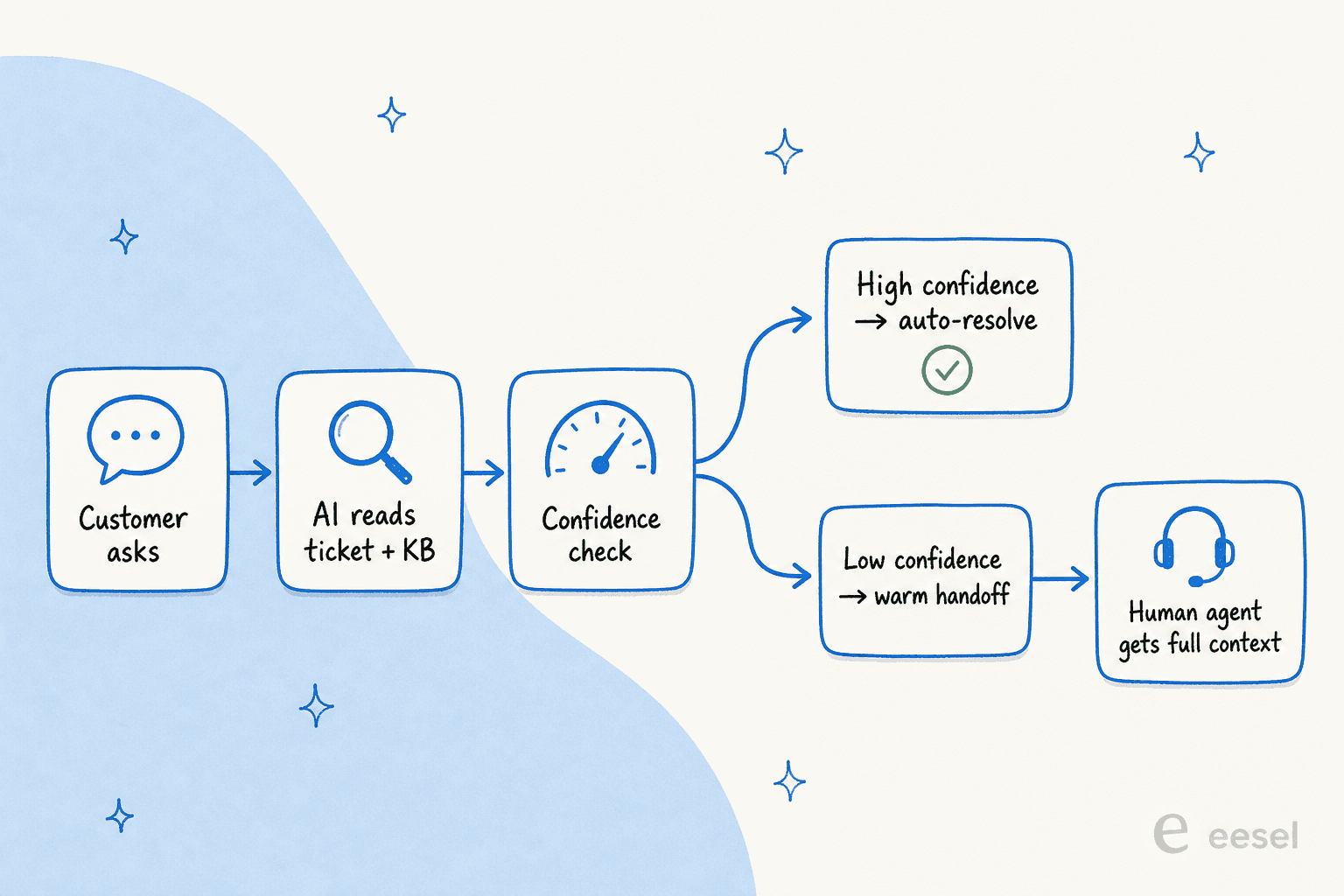
The two things that separate a good hybrid setup from a bad one are both on the handoff. Navdeep Singh Gill, in a LinkedIn Pulse piece on AI-human handoff design, put it sharper than we could:
"Handoffs are where trust is built or broken... A handoff that loses context doesn't transfer work. It destroys work... Before deploying any agent, ask: 'When this agent hands off, will the customer have to repeat themselves?' If yes, you haven't built a handoff. You've built an abandonment with extra steps."
Navdeep Singh Gill, LinkedIn Pulse, February 2026
The four artefacts a warm handoff has to carry, from a practitioner checklist on r/AI_Customer_Support:
- AI-generated summary of the conversation, attached to the ticket.
- Full chat history transferred, not just the last message.
- Sentiment flag if the customer is frustrated.
- Clear reason-for-escalation tag - so the human knows whether they're solving the problem or resetting expectations.
If the handoff drops any of those, you're back in the "convince a bot to let me talk to a human" failure mode and you've spent money to make CSAT worse.
The other half is configuring when to hand off in the first place. The bar set by builders in r/EcommerceWebsite after testing 10+ chatbots:
"We set up escalation rules. Basically when the bot should hand off to a human. Clear triggers are key here... Started with simple rules: explicit human request, low confidence on the answer, three failed clarifications in a row. Then layered sentiment on top."
Original poster, r/EcommerceWebsite
Those four triggers - explicit ask, low confidence, three failed clarifications, negative sentiment - are the floor. Don't ship without them.
The cost math, in real numbers
Here's the spreadsheet most teams want and most articles skip. Same volume, same blend, AI-first vs human-first:
| Monthly tickets | Human-only cost (avg $10/ticket) | AI-first @ 60% deflection (AI $0.50, human $10) | Net monthly saving |
|---|---|---|---|
| 1,000 | $10,000 | $4,300 | $5,700 |
| 5,000 | $50,000 | $21,500 | $28,500 |
| 10,000 | $100,000 | $43,000 | $57,000 |
| 50,000 | $500,000 | $215,000 | $285,000 |
At 60% deflection - well below Klarna or Duolingo but in line with the SaaStr 60%+ benchmark for AI customer support vendors in 2025 - the savings are real and obvious. Lorikeet CX's three-year ROI tracking backs the same shape: 41% ROI in year one, 87% in year two, 124%+ in year three.
The caveat from the same theStacc roundup is worth keeping in your back pocket: companies that did NOT redesign workflows around AI saw 47% report flat or rising costs. Adding AI on top of a broken process doesn't fix the process. It usually just adds a line item.
How to decide what to automate (and what to leave to humans)
The question to ask, for each query type, isn't "can AI do this?" It's "can AI do this and will the customer feel taken care of?"
A simple rubric we'd hand a support lead today:
- Default to AI for high-confidence, high-structure, high-volume intents: password resets, order status, plan changes, shipping questions, basic product docs. These deflect at 70%+ with a decent knowledge base, and a human's time is wasted answering the 500th "where is my package" of the week.
- Default to AI with low-confidence handoff for everything in the middle: account-aware billing questions, integration troubleshooting, returns and refunds inside policy. AI tries, hands off when it isn't sure, and the rule of thumb on confidence threshold is to start strict and loosen over time as you watch the audit data.
- Default to human for sentiment-heavy disputes, churn-risk conversations, anything involving a goodwill exception, and any ticket from a customer above your high-LTV threshold. Let AI draft a starter reply for the human if you want, but the human owns the call.
- Never trust AI to make the goodwill call. A bot deciding when to issue an extra month free is a bot that will either issue too many or too few. Either way you'll regret it.
The Decagon, Sierra, and Forethought style "best-in-class" deployments - the ones with 80%+ public deflection numbers - are running this rubric, just with very rigorous escalation triggers and very deep CRM integrations underneath. The integration depth matters more than the model: ClarityArc's analysis shows deep CRM, billing, and order integrations add 20-30% to real deflection quality because most queries need account-specific context, not just generic knowledge base articles.
What this looks like in your existing helpdesk
The wrong move is to rip out your helpdesk for an AI chatbot vendor. The right move is to layer an AI teammate on top of the helpdesk you already use - Zendesk, Freshdesk, Gorgias - so your humans don't change workflows and your customers don't notice the seam.
That's the bet eesel makes: instead of a new chat widget, an AI agent that lives inside your existing helpdesk, reads tickets, drafts replies, and escalates the ones it isn't sure about - to the same humans who'd see those tickets today. Customers like Smava (fully automated Zendesk agent, 100,000+ tickets/month in German), Design.com (50,000+ tickets/month across Freshdesk with 1,000+ help articles), and Ecosa (10,000+ tickets/month across Zendesk, Slack and the website) are running it at scale today.
The reason this matters for the AI-vs-human question: when the AI lives in the same ticket queue as the human, the handoff isn't a handoff - it's a single ticket that started with the AI and ended with a human, in the same UI, with the full history visible. No context drop. No "I already explained this" rage-tweet. That's what good hybrid looks like.
Try eesel
If you're sold on the hybrid model and want to skip a six-month vendor RFP, eesel is the cleanest path: an AI teammate that plugs into your existing Zendesk, Freshdesk, Gorgias, Slack, or email and starts drafting and resolving tickets in minutes - not weeks. You brief it in plain language ("handle the support queue this afternoon, anything over $500 in refunds loop me in first"), it learns from years of past tickets and your help center on day one, and it pauses when credits run out, or keeps going on optional overage with a cap you set.
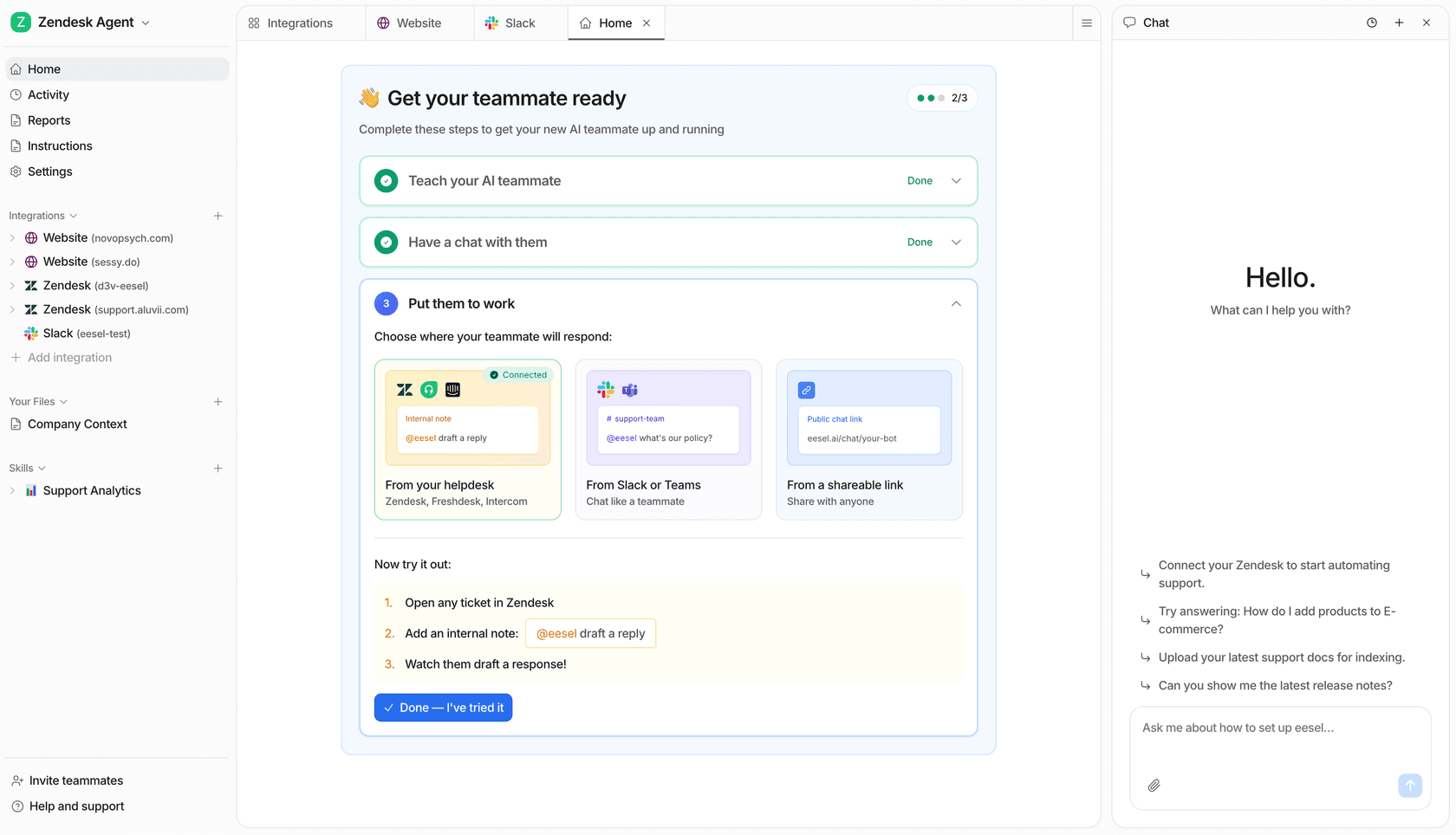
Pricing is one fixed monthly price, not per-seat: from $299/month for 500 credits (1 credit per ticket or chat), with a free plan of 100 credits and no card required to start. At 60% deflection on 5,000 monthly tickets that's 3,000 AI-handled tickets, or $1,349/mo on the 3,500-credit plan, against $50,000/mo in human-only baseline - the kind of ROI math that doesn't need to be massaged. Try eesel or book a 30-minute demo if you'd rather walk through your specific volume first.
Frequently Asked Questions
Can AI fully replace human customer support agents?
How much cheaper is AI customer support than human support?
What does AI customer service do better than humans?
Where do human support agents still beat AI?
What is a hybrid AI and human support model?
What's the biggest risk of replacing human customer support with AI?
How do I decide which tickets to send to AI vs a human?


Article by
Kira
Kira is a writer at eesel AI with a Computer Science background and over a year of hands-on experience evaluating AI-powered customer service tools. She focuses on breaking down how helpdesk platforms and AI agents actually work so that support teams can make better buying decisions.