

How we picked
A "best of" list is only useful if the picks were chosen against the same bar. Here's ours:
- Real Freshdesk integration, not a "Zapier-only" connection. Each app either has a direct Freshdesk app, an official API integration documented on the vendor's site, or sits inside Freshdesk natively. We're not interested in tools that need a developer to babysit the wiring.
- Autonomous ticket handling, not just suggested replies. The bar is deflection - the app needs to be able to resolve a ticket end-to-end on at least one channel (chat, email, or in-app). Agent-assist copilots on their own didn't make the cut.
- Public sourcing on pricing or a real reference number. If we couldn't find a number to anchor what a team would actually pay, we say so. No "starts at" hand-waving without a real ticket-volume scenario behind it.
- Coverage across team sizes. The list has to be useful to a 5-agent ecommerce shop running Freshdesk Pro and to a 500-agent CX team running Freshdesk Omni Enterprise. We deliberately picked across that span.
- No vendor double-counting. Tools that have effectively been folded into another product on the list (e.g. Ultimate.ai, which Zendesk acquired in January 2024 and merged into Zendesk AI Agents) don't get a separate slot.
The 8 best AI automation apps for Freshdesk in 2026 at a glance
A quick scan before we get into the details.
| # | App | Best for | Starting price | Setup time | Self-serve trial | Security |
|---|---|---|---|---|---|---|
| 1 | eesel AI | Freshdesk teams that want real autonomy without switching | From $299/mo (500 credits), no seat fee | Minutes | Yes (100 free credits) | SOC 2, GDPR, HIPAA (talk to us) |
| 2 | Freddy AI | Already paying for Freshdesk Pro / Enterprise | $0.49 per session after 500 free | Hours to weeks | Yes (500 free) | SOC 2, ISO 27001, GDPR |
| 3 | Forethought | Mid-market and enterprise wanting agentic actions | Quote only (~$30k–$150k+ ACV) | Weeks (POV) | No (POV instead) | SOC 2, GDPR, HIPAA |
| 4 | Ada | Enterprise CX teams with large conversation volumes | Quote only (demo-led) | Sales-led (vendor says days) | No | SOC 2, GDPR, HIPAA, AIUC-1 |
| 5 | Aisera | Cross-functional IT + HR + customer service | Quote only | Multi-week | No | SOC 2, ISO 27001, HIPAA, CSA STAR |
| 6 | Kore.ai | Fortune 500 regulated industries | Quote only | Multi-week | No | SOC 2, HIPAA, GDPR, PCI DSS |
| 7 | Tidio | SMB ecommerce on Freshdesk + chat | $24.17/mo + Lyro from $32.50/mo | Hours | Yes (7 days) | SOC 2 Type II, GDPR |
| 8 | Zapier | DIY no-code AI workflows | $19.99/mo (Professional) | Hours | Yes (14 days) | SOC 2 Type II, SOC 3, GDPR |
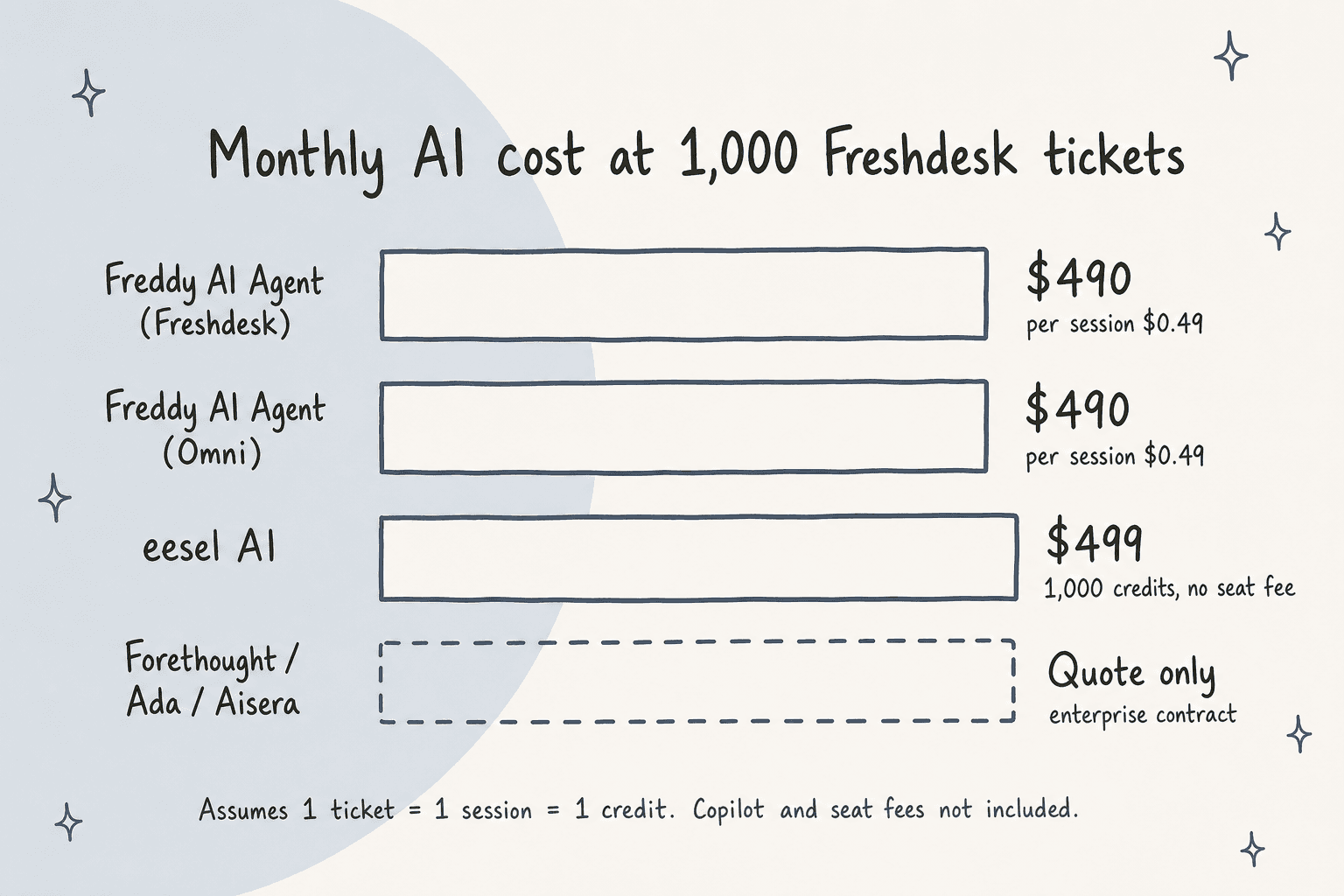
A worked example at 1,000 tickets/month tells you where the pricing actually lands:
| App | Monthly cost at 1,000 tickets |
|---|---|
| eesel AI | $499 (1,000 credits, 1 per ticket, no seat fee) |
| Freddy AI Agent (Freshdesk) | $490 (1,000 × $0.49) |
| Freddy AI Agent (Freshdesk Omni) | $490 (1,000 × $0.49) |
| Tidio Growth + Lyro | ~$200 (≈ $0.50/Lyro convo on 1,000 chats) |
| Zapier Professional 2,000 tasks | ~$49 (1 ticket ≠ 1 task; usually 3-5 tasks each → $129+) |
| Forethought / Ada / Aisera / Kore.ai | Quote only (typically $30k+ annual) |
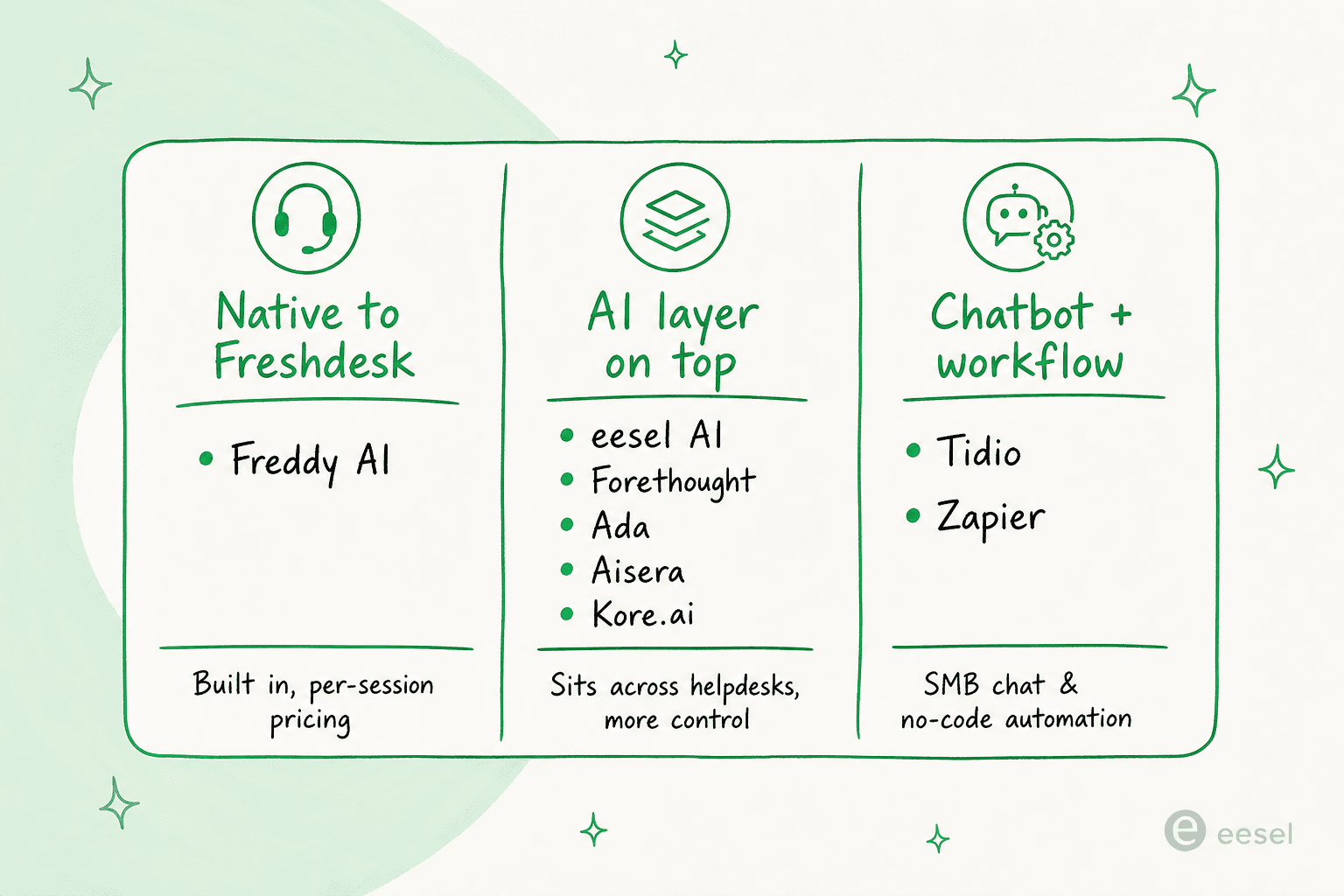
The infographic below makes the same point if you'd rather skim:
What "AI automation" actually means for Freshdesk in 2026
Before the picks, a quick framing: when a Freshdesk admin says "AI automation," they usually mean one of three different things, and the tool you want depends on which one. The category is broader than it looks.
- Autonomous AI agents - software that reads a customer's question, decides what to do, takes action (refund, account update, KB lookup), and replies. Examples in this post: eesel AI, Freddy AI Agent, Forethought, Ada, Aisera, Kore.ai, Tidio's Lyro.
- Agent-assist copilots - AI that drafts replies, summarises threads, and translates inside the inbox while a human stays in the loop. Freddy AI Copilot and Forethought Assist both fit here; we cover Freshdesk Copilot separately.
- Workflow automation with AI inside - a Zapier or webhook-based pipeline that uses an LLM step somewhere in the chain to tag, classify, or summarise. Zapier is the canonical example.
Most of the apps below do at least two of those three, and the strongest do all three. Where a tool is mostly one thing, we flag it.
1. eesel AI - best for Freshdesk teams that want real autonomy without switching helpdesks
eesel AI is an AI teammate platform that connects to Freshdesk (and 100+ other tools) and resolves tickets autonomously inside your existing inbox. The pitch we hear most often: "briefing eesel is like onboarding a new support hire." You point it at your Freshdesk past tickets and your knowledge base, write a short policy in plain English, and the agent starts drafting and sending replies on the ticket types you've allowed.
The reason eesel keeps landing on Freshdesk shortlists in 2026 isn't the AI itself - every serious vendor on this list has a capable LLM behind it. It's the pricing model and the speed to first value. There are no per-agent fees, no per-conversation surprise charges, and the agent connects in minutes through the Freshdesk integration.
Features that matter for Freshdesk admins:
- Native Freshdesk integration - installs into your ticket workflow without an engineer.
- Learns from existing Freshdesk tickets and your knowledge base on connect - no rules to write, no flows to build before it works.
- Confidence-based routing - the agent only answers tickets it's sure about and hands off the rest, addressing the single biggest objection support leads have to AI replies.
- Works across Slack, email, Shopify, and your knowledge base - not just Freshdesk - so a single brain handles internal Q&A and customer tickets.
- Plain-language skill definitions you can update via chat ("don't promise delivery dates we can't guarantee", "always escalate refund requests over $200" - those become rules the agent obeys).
Pros:
- Free plan with 100 credits, no credit card required - you can validate ROI before signing anything.
- No per-seat pricing means adding agents to your support team doesn't increase your AI bill.
- Setup is genuinely minutes, not weeks - most teams go live the same day.
- Honest about limits: if a ticket type isn't safe for AI, eesel will refuse to answer rather than guess.
Cons:
- Newer brand than the legacy enterprise vendors on this list - if your procurement requires a Gartner Magic Quadrant placement, you'll need to push that internally.
- The platform is opinionated: it doesn't want to be a chatbot builder, and it won't replace Freshchat for marketing widgets.
- Heavy task pricing for content generation ($4 per blog post) is a separate budget line, useful but distinct from support automation.
Pricing: One fixed monthly price from $299/month for 500 credits, no per-seat fees, no platform fee. 1 credit covers one ticket or chat, however long. Larger batches run $499/month (1,000 credits), $999/month (2,500) and $1,899/month (5,000). A blog post is $4. Pay a year upfront and get two months free. SSO is an add-on, and HIPAA is available on request. Full pricing here.
Our take: This is the pick for Freshdesk teams in the 5–200 agent range who want autonomous AI without renegotiating their helpdesk contract or sitting through a six-week Forethought POV. The combination of helpdesk-agnostic architecture, public fixed monthly pricing, and a free plan with 100 credits is genuinely rare in this category - most of the other apps on this list will quote you somewhere between "expensive" and "wildly expensive" before you've even seen them work. We're the company writing this post, so consider us biased - but we'd reach for eesel here even if we weren't.
2. Freddy AI - best if you're already paying for Freshdesk Pro or Enterprise
Freddy AI is Freshworks' native AI suite - three products under one brand: Freddy AI Agent (the autonomous bot), Freddy AI Copilot (the agent-assist sidecar), and Freddy AI Insights (the analytics layer). It's the default starting point for Freshdesk customers, and for most teams, the "do we add a third party or not?" question goes through Freddy first.
The advantage of going native is real: zero integration work, the AI lives in the same workspace your agents already use, and Freshworks bundles 500 free sessions on Growth, Pro and Enterprise to get you started. The disadvantage is that you're now committed to Freshdesk's AI roadmap - and the per-session billing on standalone Freshdesk gets expensive fast.
Features:
- Freddy AI Agent - autonomous chat and email bot with 50+ prebuilt agentic workflows, no-code AI Agent Studio, and prebuilt integrations with Shopify, Stripe, and PayPal.
- Freddy AI Copilot - reply suggestions, conversation summaries, real-time translation, draft generation inside the Freshdesk inbox.
- Freddy AI Insights - proactive alerts, root cause analysis, CSAT trend tracking, SLA breach detection (currently in Beta).
- Freddy AI Trust - PII masking, risky content detection, audit trails, access controls.
- Freshworks claims up to 80% of queries resolved autonomously, <2 minutes average resolution time, and 60% productivity improvement with Copilot.
Pros:
- Zero integration work - toggle it on inside Freshdesk and it works.
- 500 free Freddy AI Agent sessions included on Growth, Pro and Enterprise to validate before you start paying.
- Native Freshdesk Omni coverage - chat, email, voice, messaging all share one AI brain.
- Strong security baseline - SOC 2, ISO 27001, GDPR.
Cons:
- Per-session pricing scales unpredictably - a viral incident or product launch will spike your AI bill with no cap. At $0.49 per session on standalone Freshdesk, 5,000 tickets/month is $2,450 in AI charges before you've added Copilot or Insights.
- Session packs expire with your billing cycle. Buy 10,000 sessions quarterly, use 6,000 → 4,000 vanish at renewal.
- Copilot is locked to Pro/Enterprise plans and adds $29/agent/month on top of base seat fees.
- The Shopify Freshworks app has a 3.0/5 marketplace rating (61 reviews) - the integration exists but isn't the bright spot you'd want it to be.
Pricing: Growth, Pro and Enterprise plans include 500 free Freddy AI Agent sessions (one-time). After that, it's $49 per 100 sessions ($0.49/session) on both standalone Freshdesk and Freshdesk Omni. Freddy AI Copilot is $29/agent/month on Pro/Enterprise. Freddy AI Insights is included on Enterprise plans. Full breakdown in our Freddy AI pricing guide.
Real Freshdesk admins do flag the gaps. One Freshdesk customer told us:
"Edited drafts send as the original unedited version when approved, making the workflow unusable."
A heavily-invested Freshdesk customer on a Freddy AI workflow issue, shared via eesel team support
It's a niche bug but the kind of thing that doesn't surface on the marketing page.
Our take: Freddy is the right starting point if you're already paying for Pro or Enterprise and want to test AI without a vendor evaluation. Check Freshdesk Omni if you want one AI brain across chat, email, voice and messaging - the per-session rate is the same $49 per 100 sessions, so Omni's higher seat prices ($29/$79/$119 versus $19/$55/$89) won't pay back through cheaper sessions. But if you're scaling past 5,000 AI sessions a month and Copilot fees on top, do the math against a credit-based tool like eesel before renewing - the bill compounds quickly. For more depth, our Freshdesk AI review goes deeper on what Freddy actually does well and where it falls short.
3. Forethought - best for mid-market and enterprise wanting agentic actions
Forethought is an enterprise AI platform that sits on top of any helpdesk - Freshdesk, Zendesk, Salesforce Service Cloud, or older deployments - and brands itself as a "multi-agent system." The product line is five named agents: Discover (knowledge gaps), Solve (the customer-facing AI), Triage (classification), Assist (agent copilot), and Agent QA (automated scoring on 100% of tickets vs. the typical <5% sampling). Backed by ~$92M in funding from NEA, Steadfast, Sound Ventures (Ashton Kutcher) and others - Forethought has been in this space since 2018. Forethought now describes itself as part of Zendesk, and Zendesk's pricing page lists "Zendesk + Forethought" as AI for any stack, with no migration required.
For Freshdesk teams, Forethought's pitch is "you can keep Freshdesk and add agentic AI on top." That's the main reason it lands on this list - it doesn't try to replace your helpdesk, it adds a smarter brain to it.
Features:
- Solve - omnichannel AI agent across chat, email, voice, SMS, Slack, mobile, API. Uses Autoflows (multi-step workflows) and Custom Actions to call Freshdesk and third-party APIs.
- Browser Agent - operates legacy systems that don't have APIs (rare in the category and very useful if your org has a homegrown CRM behind a web UI).
- Discover - analyses historical Freshdesk tickets and KB to surface knowledge gaps and auto-generate Autoflows and articles.
- Forethought Voice - the newer voice-channel agentic add-on, launched 2025.
- Headline claims (from their 2025 AI in CX Benchmark): 15× ROI, 55% reduction in first response time, up to 98% resolution rate.
Pros:
- Helpdesk-agnostic - strongest pitch is "plug into your existing CX stack." Works on Freshdesk without forcing a migration.
- Strong agentic action story - the Browser Agent is genuinely differentiated.
- Mature customer list - Upwork (50% reduction in time to resolution), Carta, Grammarly, UPS, Lattice, Justworks.
- Multi-LLM architecture - not locked to one model.
Cons:
- Quote-only pricing, no self-serve trial. Forethought runs a Proof-of-Value engagement instead - useful for enterprise, painful for mid-market teams that want to test in a sprint.
- ACV is mid-five-to-low-six figures (industry estimates put Forethought at $30k–$150k+ annually). Out of reach for SMB.
- Setup is multi-week - Autoflows, Custom Actions, and Browser Agent all need configuration.
Pricing: Three tiers - Team, Professional, Enterprise - plus add-ons for Multibrand, Analytics API, and Discover. Every tier is "Get a Quote." From Forethought's pricing FAQ: "Our pricing model is a blend of platform access fees and an outcome-based pricing cost. Optional add-ons can be added to customize the platform."
Our take: Forethought is what you reach for when you've outgrown Freddy but you're not yet at Ada's enterprise scale. The Browser Agent is the most unusual capability on this list - if your support team has to operate a legacy tool that doesn't have an API, Forethought is genuinely the right pick. For pure ticket deflection on Freshdesk, you can get to the same outcome faster and cheaper with eesel AI. The deciding question is whether you need the agentic-action depth Forethought built around Custom Actions.
4. Ada - best for enterprise CX teams with large conversation volumes
Ada is a Toronto-headquartered enterprise AI customer service platform that calls its category "Agentic Customer Experience (ACX)." Ada raised a $130M Series C in 2021 at a $1.2B valuation (Spark Capital led), bringing total funding to ~$190M, and has been one of the most-funded standalone AI customer service companies since.
For Freshdesk, Ada is the furthest enterprise pick on this list. Its own pricing page is now a demo request form that asks for your expected annual contact volume, with bands from under 100,000 up to more than 100 million. The 300,000-conversation minimum Ada used to state is gone, but the sales-led, enterprise-focused motion remains.
Features:
- Reasoning Engine - multi-LLM orchestration brain. Ada explicitly doesn't bet on one model.
- Conversation Hub - omnichannel: voice, email, chat, Messenger, WhatsApp, SMS, Instagram, in-app, custom channels.
- Playbooks - multi-step SOPs the AI agent reasons through.
- Coaching - review past conversations, leave notes, the agent applies them to future interactions automatically.
- MCP-native developer toolkit - Ada is positioning early for the Model Context Protocol ecosystem.
- Headline outcomes: Monday.com 42% AHT reduction; IPSY $2.7M annual savings, 943% ROI in 4 months; Cebu Pacific 34% higher resolution vs declarative chatbot.
Pros:
- Strongest claim to AI-specific compliance - AIUC-1, zero data retention with LLM providers. A real moat for regulated industries.
- Voice agents as a frontline product, not an afterthought - dedicated voice page.
- Enterprise customer roster: Monday.com, Pinterest, Sky, Grab, Cebu Pacific, Malaysia Airlines, Barnes & Noble, Life360, IPSY.
- Coaching as a first-class workflow - the AI learns from human review, not from rule-writing.
Cons:
- Sales-led, enterprise-focused purchase. If you process 50 tickets a day on Freshdesk, expect the demo-and-business-case process to be more than you need.
- No public pricing whatsoever. The pricing page is a sales-qualification form.
- Sold as a service-led bundle (ACX Platform + Practice + Experts), not a SaaS subscription. Annual contracts only.
- No free trial, no freemium, no self-serve signup.
Pricing: Quote only. Volume-based contracts inferred from the qualification form, which asks for annual contact volume with bands up to "more than 100 million."
Our take: Ada is the right pick if you have enterprise-scale conversation volume on Freshdesk and want one of the most-funded, enterprise-mature standalone AI agents in the market. For smaller teams, most other AIs on this list are a better fit. For mid-market teams that want Ada-like architecture (multi-LLM, helpdesk-agnostic) with public pricing, eesel AI is the closest analogue at a fraction of the entry point.
5. Aisera - best for cross-functional IT + HR + customer service
Aisera is an enterprise AI Service Experience platform that delivers autonomous AI agents across IT, HR, customer service, finance, procurement, and ops. Unlike CX-only AI products, Aisera is positioned as cross-functional from day one - a single platform whose Universal Agent orchestrates Domain Agents (IT, HR, Finance, Customer Service) and Task Agents across the enterprise.
In November 2025, Automation Anywhere announced the acquisition of Aisera, bundling Aisera into its Agentic Automation platform. For Freshdesk teams already on Freshworks for both customer service and internal IT/HR (Freshservice), Aisera is the natural cross-domain layer.
Features:
- Universal Agent + Domain Agents + Task Agents - three-tier orchestration model for multi-domain support.
- Agent Composer - no-code/low-code/pro-code custom agent builder.
- Aisera Unify - open-standards orchestration on A2A, MCP, and AGNTCY for third-party agent integration.
- AiseraLLM + LLM Gateway - supports proprietary AiseraLLM plus OpenAI, Claude, Google models with OpenTelemetry observability.
- TRAPS framework - Trusted, Responsible, Auditable, Private, Secure for governance.
- Customer outcomes: NJ Transit 60% agent productivity lift; OmniTRAX 70% ticket auto-resolution; LifeScan 65% auto-resolution and $2.2M savings; BDO Canada $1.9M cost savings.
Pros:
- Genuine cross-functional coverage - useful if your IT team runs Freshservice and your CX team runs Freshdesk and you want one AI layer over both.
- Strong compliance posture: SOC 2, GDPR, ISO 27001, CSA STAR Level 1, CCPA, HIPAA.
- Multi-LLM gateway means you're not locked to one foundation model as the market evolves.
- Heavily funded - $171M total raised across Series A-E.
Cons:
- Cross-functional scope is a strength and a downside - if you only need customer service AI on Freshdesk, you're paying for breadth you won't use.
- Quote-only pricing, no self-serve.
- Automation Anywhere acquisition (Nov 2025) introduces roadmap uncertainty as the products bundle.
- Enterprise-only - not a fit for SMB or small mid-market.
Pricing: Quote only. No public per-seat or per-conversation rates.
Our take: Aisera is the pick when your company runs Freshdesk + Freshservice (or any IT/HR helpdesk alongside customer service) and you want one AI agent platform across both. For pure customer service on Freshdesk, the breadth becomes overhead - you'd be better served by Forethought, Ada, or eesel depending on volume.
6. Kore.ai - best for Fortune 500 regulated industries
Kore.ai is an enterprise AI agent platform (internal codename Artemis) that brands itself as "the AI-programmable platform for the agentic enterprise." Kore.ai has been positioned as a Leader in the Gartner Magic Quadrant for Conversational AI 2025 and the Forrester Wave: Cognitive Search Q4 2025.
The customer roster makes the positioning clear: AAA, Aegon, Assurant, Morgan Stanley, Deutsche Bank, Mashreq, MetLife, Huntington, Johnson & Johnson, Florida Blue, Roche, Pfizer, PNC Bank, AT&T, Cigna, Coca-Cola, Airbus. Banking, healthcare, telecom, large enterprise - the regulated end of the market.
Features:
- Pre-built Applications for Banking, Healthcare, Retail, HR, IT, Recruiting.
- Application Accelerators - marketplace of pre-built AI agents, templates, integrations.
- Tailored Applications - custom agent design on the Agent Platform.
- AI for Service - the customer-facing suite that integrates with Freshdesk and other helpdesks.
- AI for Work - internal/employee agents (IT, HR, recruiting) that pair with Freshservice.
- Stated reach: "Trusted by over 200 partners and 400 Fortune 2000 companies."
Pros:
- Strongest analyst recognition on this list - Leader in two 2025 Forrester/Gartner reports.
- Industry-specific pre-built applications mean less time tuning a generic agent for a regulated vertical.
- Strong governance and compliance - SOC 2, HIPAA, GDPR, PCI DSS, with attention to financial-services and healthcare requirements.
Cons:
- No public pricing. No self-serve trial. Enterprise sales cycle.
- The full Kore.ai platform is a deep, configurable system - implementation timelines are measured in months for the regulated verticals where it's strongest.
- For Freshdesk SMB customers, the platform is dramatically over-spec'd.
Pricing: Quote only. No self-serve signup. Demo via request-a-demo.
Our take: Kore.ai earns its slot when you're a Fortune 2000 in banking, insurance, healthcare, or telecom that already runs Freshdesk for customer support and needs an AI agent that compliance, legal, and IT will sign off on. For SMB and mid-market Freshdesk teams, eesel AI gives you 80% of the capability at <5% of the cost and you can be live this afternoon.
7. Tidio - best for SMB ecommerce on Freshdesk plus chat
Tidio is a customer service platform built for SMB and mid-market ecommerce brands. It combines an AI agent (Lyro), live chat, helpdesk/ticketing, and proactive automation (Flows) into one product. Lyro is powered by Anthropic's Claude - not the OpenAI stack that most competitors use - and Tidio claims up to 67% of customer problems solved as the market-highest. The platform reports 300,000+ business customers including Under Armour, The Body Shop, Dermalogica, Stanley, and ADT.
For Freshdesk teams, Tidio is most often used in two modes: as a standalone Lyro AI plugged into an existing Freshdesk via API, or as a proactive chat layer on top of Freshdesk's ticketing.
Features:
- Lyro AI (Claude-powered) - answers customer questions across chat, with a $0.50/conversation rate on paid plans.
- Live chat + helpdesk + Flows - full chat-and-ticketing suite, or pick standalone modules.
- Shopify-native actions - Lyro can look up orders, process returns, and trigger refunds inside the chat.
- Money-back guarantee if Lyro resolves <50% of conversations - rare in the category.
- 4.8/5 on the Shopify App Store (1,300+ reviews), 4.8/5 on Capterra (200+).
Pros:
- Self-serve, with a 7-day free trial on all paid plans, no credit card required.
- Strongest SMB ecommerce ergonomics on this list - built for Shopify-shaped teams.
- Lyro is on Claude, which lands more naturally on tone for consumer brands than the OpenAI default.
- Standalone Lyro AI plan works alongside any existing helpdesk including Freshdesk.
Cons:
- Tidio's helpdesk module is built for SMB - Freshdesk teams handling complex enterprise tickets will outgrow Tidio's ticketing fast (and you can't really "demote" Freshdesk to a Tidio backend).
- Lyro's $0.50/conversation rate is the highest per-conversation number on this list, though it's predictable.
- Plus plan starts at $300/month plus usage - the jump from Growth to Plus is steep.
- Limited reach outside chat/email - voice and SMS are weaker than Ada or Forethought.
Pricing: Free plan up to 50 conversations. Starter $24.17/month (100 convos). Growth from $49.17/month (250–2,000). Plus from $300/month plus usage. Lyro AI standalone from $32.50/month (works with existing helpdesks). Full pricing.
Our take: Tidio is the right pick if you're an SMB ecommerce brand running Freshdesk for tickets and you want an AI agent specifically for the chat widget on your store. The standalone Lyro plan is the cleanest way to layer Tidio's AI onto a Freshdesk-anchored stack. For broader ticket automation (not just chat), eesel AI handles both the chat-widget use case and the Freshdesk ticket inbox in one tool.
8. Zapier - best for DIY no-code AI workflows on Freshdesk
Zapier isn't a customer service AI in the way Ada or Forethought are - it's the no-code automation backbone that connects 9,000+ apps (Freshdesk among them) and, since 2024, includes its own AI orchestration layer with Zaps, Agents, Chatbots, and a Copilot. For Freshdesk admins, it's the tool you reach for when you'd rather wire an LLM step into a workflow yourself rather than buy a packaged agent.
Real Zapier-on-Freshdesk patterns: auto-tag incoming tickets via an OpenAI step, summarise threads into Slack, escalate VIP customers via GPT-judged sentiment, sync ticket data to a Google Sheet for reporting. The recurring trade-off is task economics - Zapier bills per task (one successful action step), and a single Freshdesk ticket usually generates 3–5 tasks once you've added an AI classification step, a tag write, a Slack notification, and a logging step.
Features:
- Zaps - visual no-code workflows across 9,000+ apps including Freshdesk.
- Agents - Zapier's autonomous AI agent product, 450K+ built on the platform.
- Chatbots - embedded chat widgets that run Zap-style logic.
- Copilot - natural-language Zap builder.
- MCP support - 66,000+ triggers and actions exposed via Model Context Protocol.
- Tables + Forms - lightweight data layer and form builder for AI inputs.
Pros:
- Extraordinary breadth - anything you want to connect to Freshdesk probably already has a Zapier integration.
- Cheap starting point - Professional from $19.99/month (annual billing).
- Trusted infrastructure: Nvidia, Airbnb, Meta, Lowe's, Cursor, Samsung run on it. SOC 2 Type II, SOC 3, GDPR, 99.9% uptime SLA.
- 4.5/5 on G2 (1,830+ reviews), 4.7/5 on Capterra (3,051 reviews).
Cons:
- Task economics surprise teams that scale fast. Overage is billed at 1.25× the base per-task rate, max 3× the plan task limit before Zaps pause.
- It's a workflow layer, not a packaged AI agent - you are the one writing prompts, picking models, and tuning behaviour. No "set it and forget it."
- Reliability concerns: Trustpilot rating is 1.4/5, heavily skewed by billing disputes. The G2/Capterra side reads much better.
- Doesn't replace an AI customer service agent. If you want autonomous ticket resolution, Zapier is the glue, not the brain.
Pricing: Free plan (100 tasks/month). Professional from $19.99/month (750 tasks base, slider up to 2M). Team from $69/month (25 users). Enterprise custom. Annual billing saves 33%. Full pricing.
Our take: Zapier is the right call when you have a specific, weird Freshdesk automation that no packaged agent will cover - a custom data flow, a one-off LLM classification, a sync to an obscure tool. For routine ticket deflection and agent-replies, you'll spend more time tuning Zaps than you would just running eesel or Freddy. The honest framing: Zapier complements every other tool on this list rather than competing with them - most mature Freshdesk stacks use Zapier plus a packaged AI agent, not Zapier instead of one.
How session, task, and seat pricing actually compare
Pricing-model differences are the single biggest reason teams pick the wrong AI tool for Freshdesk. A $0.49/session price on Freshdesk or Freshdesk Omni sounds cheap - until you realise one ticket can generate three sessions, or that the "$29/agent/month" copilot fee compounds with seat counts you'll grow into. Here's the picture at scale:
A few things to internalise from that:
- Per-session pricing on Freshdesk and Freshdesk Omni is the most expensive per-unit option at high volume. $0.49/session × 5,000 tickets = $2,450/month before Copilot fees.
- Omni uses the same per-session rate. Its AI Agent sessions are also $49 per 100 ($0.49 each); only the seat price differs.
- Credit plans are predictable. eesel AI's monthly price is fixed regardless of how many agents you employ, which matters because adding human agents shouldn't increase your AI bill.
- Quote-only platforms (Forethought, Ada, Aisera, Kore.ai) typically start at $30k+ ACV with multi-week implementation. Right for large enterprise teams; wrong for 5,000-ticket-a-month shops.
The other piece most pricing comparisons miss: what counts as a "session" or a "task". Freddy AI defines a chat session as a 24-hour window from session start; an email session is 72 hours from first email. If a customer opens a ticket, gets one reply, comes back the next day, that's two sessions if the timing crosses the window. eesel's "credit" is per ticket or chat regardless of how many replies cross the conversation. Zapier's "task" is per successful action step inside a Zap - usually 3–5 per Freshdesk ticket once you've added tags, notifications, and logging.
Read the unit definition before you anchor to a per-unit price. The numbers don't compare apples to apples until you do.
Picking the right Freshdesk AI app for your team
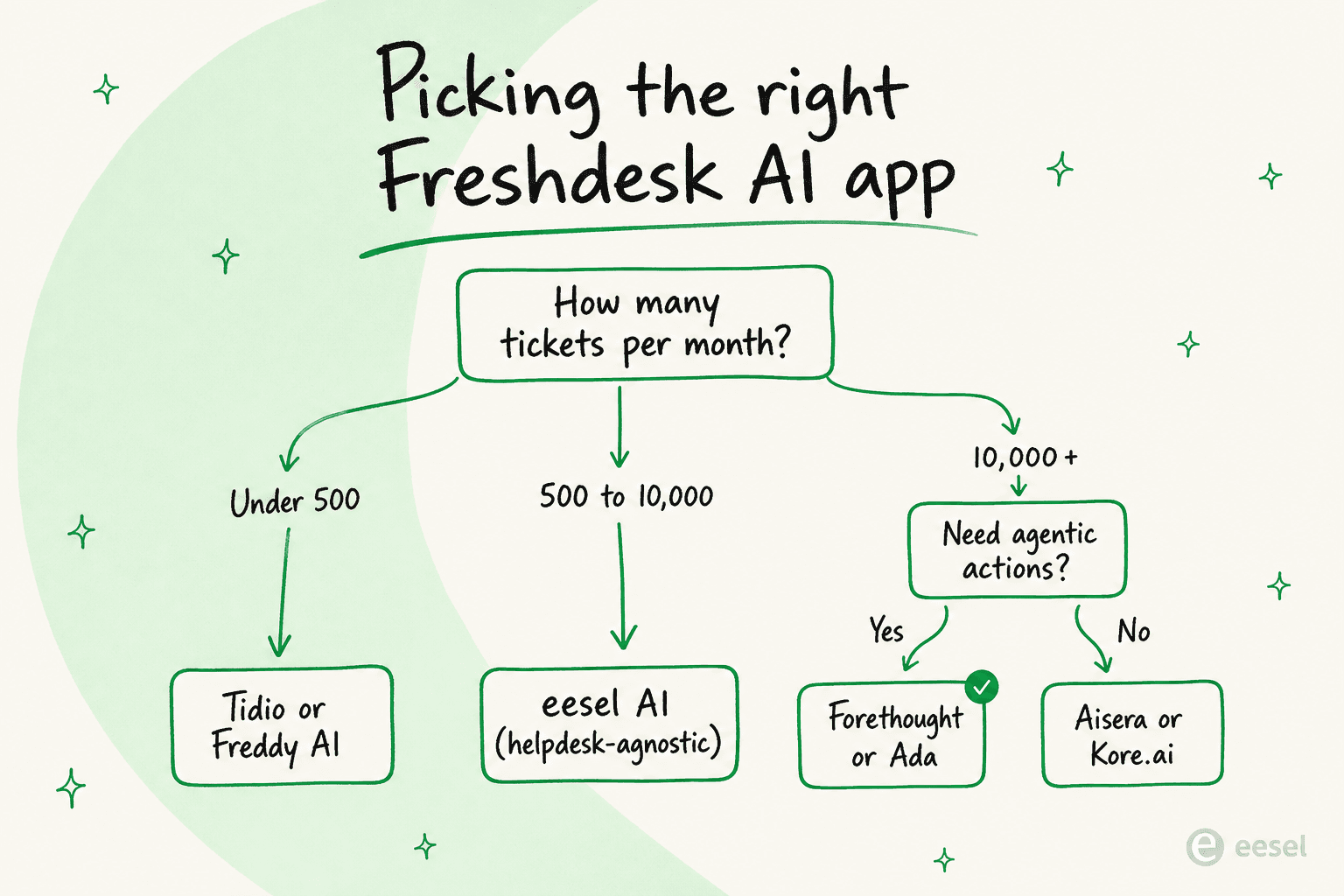
If you've gotten this far and you're still not sure, the decision usually comes down to three questions, in this order:
-
How many tickets does Freshdesk process per month?
- Under 500 → Freddy AI's free 500-session bundle or Tidio's free plan will cover you. Pick whichever matches your channel mix (chat vs ticket).
- 500–10,000 → eesel AI is the sweet spot. Per-task pricing scales predictably, setup is minutes, no enterprise contract required.
- 10,000+ → Forethought or Ada become economically reasonable. The POV/qualification cycle is worth the investment at that volume.
-
Do you need agentic actions outside Freshdesk?
- Yes (refunds, account updates, legacy-system operations) → Forethought (Browser Agent), Ada (Reasoning Engine), or eesel AI (100+ integrations).
- No (just ticket replies and triage) → Freddy AI or Tidio standalone Lyro.
-
Is your AI use case cross-functional (IT + HR + CS) or pure customer service?
- Cross-functional → Aisera or Kore.ai.
- Customer service only → any of the others.
The honest answer most Freshdesk teams arrive at: start with Freddy's free 500 sessions to validate the use case, then move to eesel AI for production once you've decided AI is worth budget. The native option is the cheapest way to learn what your team actually wants; the agnostic option is the predictable way to run it at scale once you know.
What we left off the list and why
A few tools you might expect to see and don't:
- Intercom Fin - we don't cover Intercom or Fin in our roundups.
- Ultimate.ai - acquired by Zendesk in January 2024 and fully merged into Zendesk AI Agents. The standalone brand is retired; the Freshdesk integration is gone with it.
- Salesforce Service Cloud Einstein - Einstein is Salesforce-anchored; it doesn't really sit on top of Freshdesk in a clean way. If you're considering it, you're probably evaluating a full helpdesk swap, which is a different post.
- Generic chatbot builders (ManyChat, Drift, etc.) - they connect to Freshdesk via Zapier or API, but they're not autonomous AI agents in the 2026 sense. We held the bar at "can resolve a ticket end-to-end."
- HappyFox AI, Helpshift, Kustomer IQ - capable products but their helpdesk lock-in means you're picking a new helpdesk, not adding AI to Freshdesk. We covered some of these in our best Freshdesk alternatives roundup.
Try eesel for Freshdesk
eesel AI is the AI teammate platform built to sit on top of Freshdesk and resolve tickets autonomously inside the inbox your team already uses. It learns from your past Freshdesk tickets and knowledge base on connect, holds a clear point of view on confidence-based routing (it only answers tickets it's sure about), and prices at a fixed monthly price from $299/month with no per-seat fees.
The free plan includes 100 credits (100 tickets or chats) with no card required, so you can validate the ROI on your real Freshdesk volume before signing anything. Try eesel or book a 30-minute demo if you'd rather walk through it with a solutions engineer.
Frequently asked questions
What are the best AI automation apps for Freshdesk in 2026?
How much do Freshdesk AI automation apps cost in 2026?
Can I add AI to Freshdesk without paying for Freddy AI?
What's the difference between Freddy AI Agent and Freddy AI Copilot?
Will an AI automation app work on the Freshdesk Free or Growth plan?
Does Freshdesk's API throttling break third-party AI apps?
What's the best AI automation app for Freshdesk-based ecommerce teams?
How long does it take to set up AI automation on Freshdesk?



Article by
Riellvriany Indriawan
Riell is a designer and writer at eesel AI with about two years of experience researching CX platforms, AI chatbots, and helpdesk software. She combines her design background with a sharp eye for how these tools actually look and feel in practice — making her comparisons unusually visual and user-focused.