

What separates a good AI live chat app for Shopify from a chat bubble
Three things actually matter once AI enters the picture, and most "best live chat" roundups skip past them:
- Does it read live Shopify data? A chat widget that can't see the customer's order is just email with a faster font. The tools worth paying for surface order history, tracking, and product data inside the conversation, so the AI can answer "where's my order" and process returns instead of escalating everything.
- Does the AI know when to shut up? This is the one buyers underrate. The fastest way to lose trust is an AI that confidently answers a question it should have escalated. The best tools let you scope what the AI handles and hand cleanly to a human for everything else.
- How does it bill? Per resolution, per conversation, per seat, or flat? The unit decides whether a Black Friday traffic spike is a non-event or a surprise invoice.
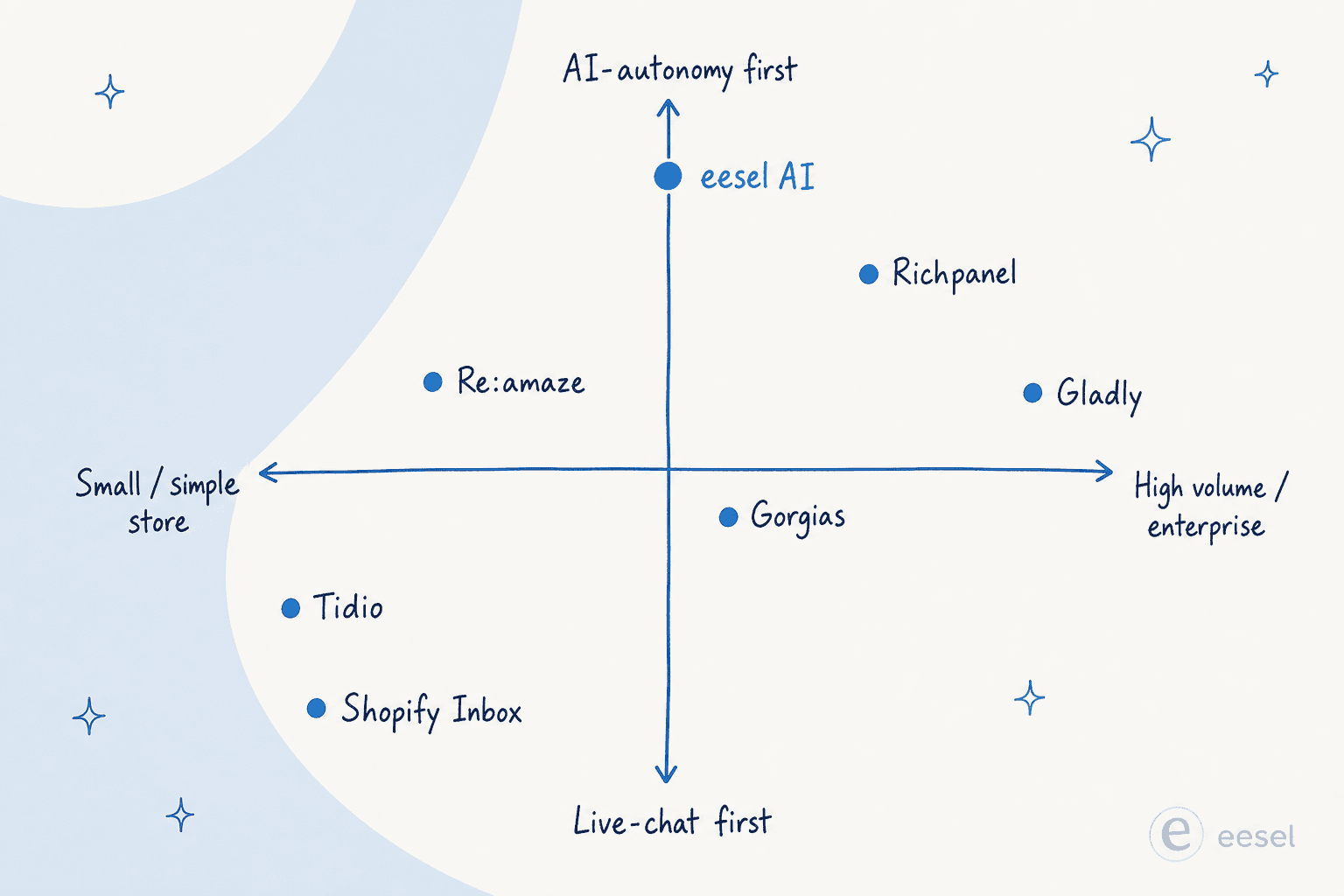
Here's roughly how the eight tools land when you plot them by store size and how AI-forward they are:
The 8 best AI live chat apps for Shopify at a glance
| Tool | Best for | AI billing unit | Starting price | Native Shopify order actions | Free tier | AI resolution claim | Security |
|---|---|---|---|---|---|---|---|
| eesel AI | Adding AI to your existing helpdesk | Credits (1 per chat) | From $299/mo (500 credits) | Yes (via integrations) | Free plan (100 credits) | Confidence-scoped | SOC 2, GDPR |
| Gorgias | All-in-one Shopify helpdesk | Per resolved conversation | $10/mo + $0.90 | Yes (deepest) | 7-day trial | ~60% automated | GDPR, CCPA |
| Tidio | Small teams, easy setup | Per Lyro conversation | $0 (Lyro from $32.50/mo) | Yes (Growth+) | 67% (claimed) | SSO on Premium | |
| Re:amaze | Multi-channel SMB support | Per resolution | $29/seat + $0.85 | Order data in-chat | 14-day trial | Beta AI agent | Standard |
| Zoho SalesIQ | Stores already in Zoho | Per operator | $7/operator/mo | Via integration | Yes (3 ops) | Answer Bot (Enterprise) | ISO 27001, SOC 2, HIPAA |
| Richpanel | AI-first ecommerce support | Per conversation | $500/mo + $0.25 | Yes (deterministic) | 30-day guarantee | 50% guaranteed in 30 days | SOC 2 Type II, HIPAA |
| Shopify Inbox | Free, native, getting started | Free | $0 | Native | Free forever | Shopify Magic | Shopify-native |
| Gladly | Enterprise DTC / retail | Per AI resolution | $1.50 / resolution | Yes (real actions) | 30-day trial (Shopify) | 76% (claimed) | Enterprise-grade |
A quick word on methodology: we pulled each tool's live pricing and AI behaviour from its own pricing pages and docs, cross-checked the user sentiment against review sites, and judged each one on the three criteria above rather than feature-count. Now to the picks.
1. eesel AI: best for adding AI live chat without ripping out your stack
Most tools on this list ask you to move your support onto their platform. eesel AI takes the opposite bet: keep the helpdesk and live chat widget you already run, and add an AI layer on top of it. For a Shopify store that already uses Gorgias, Zendesk, Freshdesk, or even a plain chat bubble, that means you get AI resolution without a migration project.
The reason we lead with it is the second criterion above. eesel agents are scoped by confidence: you decide which questions the AI handles autonomously and which ones it leaves for a human, so it doesn't confidently improvise a refund policy. It onboards from your existing tickets and help docs, drafts or sends replies, and can take actions like order lookups through your connected tools. There's a real Shopify integration behind it, plus a dashboard chat you configure in plain language instead of building decision trees.
This is the exact problem a lot of stores are trying to solve. One CX lead at a DTC supplements brand we interviewed put the whole tension in a sentence: the AI will never answer 100% of questions, so what they actually wanted was "an AI who is only handling the tickets that it's confident to handle, and all the other ones, leave them alone." That confidence-scoped behaviour is the design eesel is built around.
Pros
- Layers onto your existing helpdesk and chat widget, so no migration.
- Confidence-based scoping means the AI escalates instead of guessing.
- Onboards from past tickets and docs; pricing scales with usage, not seats.
- Simulation mode lets you test on historical tickets before going live.
Cons
- It's an AI layer, not a full helpdesk, so you still need a chat tool underneath it.
- If you want one vendor for everything, an all-in-one like Gorgias may feel tidier.
Pricing: One fixed monthly price from $299/month for 500 credits (1 credit per chat or ticket, however long), with no per-seat fees. There's a free plan with 100 credits, and if a sale-day spike uses up your credits, agents pause or you can turn on overage with a monthly cap you set, so it can't surprise you. Full detail on the pricing page.
Our take: Best for the majority of Shopify stores that already have a support stack and want AI resolution without the risk of a platform switch. If you're starting from absolute zero with no helpdesk at all, you'll want to pair it with one of the chat tools below.
2. Gorgias: best all-in-one helpdesk built for Shopify
If there's a default answer for Shopify support, it's Gorgias. It's Shopify's only Premier Partner for CX, powers around 40% of the top Shopify brands, and its Shopify integration is genuinely the deepest in this list, order history, product catalog, and customer context all appear inside every chat and ticket without tab-switching.
The live chat widget feeds a unified inbox, and the AI Agent runs two modes: a shopping assistant for pre-purchase questions and a support agent for post-purchase work like returns, refunds, order edits, and discount codes. Gorgias claims it can automate up to 60% of support, and the community broadly agrees the AI is the real efficiency unlock, not just the inbox.
Pros
- Deepest native Shopify data integration of any tool here.
- AI Agent takes real post-purchase actions (refunds, order edits, subscriptions).
- Unlimited users on every plan; 4.6/5 on G2 from 560+ reviews.
Cons
- Pricing is the number-one objection: roughly 3x Zendesk for similar volumes.
- Ticket-based plans plus a separate AI fee make total cost hard to predict.
- Overkill if fewer than ~40% of your tickets need direct Shopify actions.
Pricing: Five plans by ticket volume, from Starter at $10/mo (50 tickets) to Advanced at $900/mo (5,000 tickets), with Enterprise above that. The AI Agent is a separate $0.90 to $1.00 per resolved conversation. Annual billing saves up to 16%.
Our take: The strongest choice if you want one Shopify-native platform and your support volume justifies it. If the price makes you wince, the community rule of thumb is real, and our Gorgias alternatives guide (or layering eesel on a cheaper helpdesk) is worth a look.
3. Tidio: best for small Shopify teams that want easy setup
Tidio is the one we'd point a small, non-technical team toward first. It bundles live chat, ticketing, and an AI agent called Lyro into one tidy product, and it's installable in minutes without engineering help. It rates 4.8/5 on the Shopify App Store across 1,300+ reviews, so the ecommerce fit is well proven.
Lyro is, notably, powered by Anthropic's Claude rather than ChatGPT, and Tidio claims a 67% average resolution rate. Reviewers specifically praise Lyro for staying grounded in your provided content rather than hallucinating, exactly the behaviour you want. Native Shopify actions (order tracking, cart recovery) unlock on the Growth plan and up.
Pros
- Genuinely easy to set up; strong Shopify App Store track record.
- Lyro runs on Claude and is praised for not hallucinating.
- A real free tier to start, plus visual Flows for proactive automation.
Cons
- Three separate billing axes (conversations, Lyro chats, Flows visitors) get complex to predict.
- The jump from Growth to Plus ($749/mo) is a steep step up.
- Native Shopify actions are gated behind Growth and above.
Pricing: Free plan (50 conversations, 50 lifetime Lyro chats). Paid plans start at $24.17/mo (Starter) and $49.17/mo (Growth) annually. Standalone Lyro AI starts at $32.50/mo and can sit on top of other helpdesks like Zendesk or Salesforce.
Our take: Best for small stores that want one simple tool and value setup speed over deep customization. Larger teams should sanity-check the per-conversation math, or browse Tidio alternatives before committing.
4. Re:amaze: best for multi-channel SMB support
Re:amaze (owned by GoDaddy since 2021) unifies email, live chat, social, SMS, and even VoIP into one shared inbox, with live chat, chatbots, proactive Cues, and a real-time visitor dashboard all shipping as first-party features rather than paid add-ons. For a small ecommerce team juggling channels, that consolidation is the pitch, and customer order context surfaces inside conversations.
The AI agent is still in beta, which is the honest caveat here: Re:amaze is a strong multi-channel helpdesk first and an AI tool second. There's AI reply drafting, conversation summaries, sentiment analysis, and an FAQ-trained agent, but it's less mature than the AI-first tools further down this list.
Pros
- True multi-channel inbox with live chat, chatbots, and co-browsing built in.
- Flat-rate Starter plan ($59/mo) is great for low-volume teams of any size.
- Strong customer testimonials on support speed (one cited a 5-6x jump).
Cons
- AI agent is still beta and trails dedicated AI tools.
- Per-seat pricing on the main plans adds up as the team grows.
- Limited public review data to verify AI quality at scale.
Pricing: Basic $29/seat/mo, Pro $49, Plus $69, plus a flat Starter at $59/mo (unlimited members, capped at 500 conversations). The AI agent includes a handful of resolutions per user, then $0.85 per resolution. 14-day trial, no card required.
Our take: Best for SMB stores whose pain is channel sprawl, not AI sophistication. If AI resolution is your priority, look at Re:amaze automation options or pair a more capable AI layer on top.
5. Zoho SalesIQ: best if you already live in Zoho
Zoho SalesIQ is a live chat, analytics, and chatbot platform with a real free tier and aggressive per-operator pricing. Its trump card is the Zoho ecosystem: if your store already runs Zoho One or Zoho CRM Plus, SalesIQ is bundled in, which makes it the path of least resistance regardless of whether the AI is best-in-class.
Here's the catch worth flagging loudly, though: the AI features (Answer Bot, smart suggestions, the writing assistant) are gated to the Enterprise plan at $20 per operator. You cannot get the genuinely AI-powered version at the $7 or $12.75 tier. So the "cheap live chat" framing is true, but "cheap AI live chat" is not.
Pros
- Real free plan (3 operators) and very low per-operator entry price.
- Bundled free inside Zoho One / CRM Plus subscriptions.
- Strong compliance posture: ISO 27001, SOC 2 Type II, HIPAA, GDPR.
Cons
- All meaningful AI is locked to the $20/operator Enterprise tier.
- Bot-chat-session caps (200K/mo on Enterprise) become a real ceiling at scale.
- Shopify integration is via connector, not the deep native data of Gorgias.
Pricing: Free ($0, 3 operators), Basic $7/operator/mo, Professional $12.75, Enterprise $20 (all annual). A 5-agent Enterprise team lands around $100/mo before the visitor-tracking and bot-session add-ons.
Our take: Best for stores already invested in Zoho, where SalesIQ is effectively free. If you're outside that ecosystem and buying for the AI, the Enterprise-only gating makes other tools better value.
6. Richpanel: best for AI-first ecommerce support
Richpanel leans hardest into the "hire an AI team" framing of anyone here. It's an AI-native helpdesk for ecommerce with a stack of AI roles, a Frontline agent that resolves tickets, a Copilot for humans, and a QA AI that reviews every reply before it sends. That QA layer is its answer to the hallucination worry, and it's a genuinely smart bit of design.
The commercial hook is bold: Richpanel guarantees 50% autonomous resolution within 30 days or your money back, claims 70 to 80% at maturity, and prices AI conversations at roughly $0.30, the cheapest per-conversation rate on this list. It backs the pitch with named brands like The Ridge (reporting a 70% drop in cost per ticket) and Jones Road Beauty (18 to 10 agents while revenue grew).
Pros
- Genuinely AI-first, with a QA layer that grades every reply.
- Cheapest per-conversation AI rate here (~$0.25 to $0.30).
- 30-day money-back resolution guarantee; SOC 2 Type II and HIPAA.
Cons
- $500/mo base plan is a high floor for very small stores.
- ROI only really lands above ~3 agents or ~2,000 conversations/month.
- Less public review data than the older incumbents.
Pricing: AI Agent plan at $500/mo base, $0.25 per conversation, plus $100 per human seat. A sample bill of 2 AI agents and 3 seats lands at $800/mo. Enterprise is custom.
Our take: Best for established stores with real volume that want to go AI-first and have the ticket count to justify the floor. Smaller stores will get better economics from a usage-priced layer like eesel on their existing helpdesk.
7. Shopify Inbox: best free starting point
Shopify Inbox is the obvious place to start because it's free, native, and already one click away in your admin. It rates 4.7/5 across 5,386 Shopify App Store reviews, and Shopify says 70% of Inbox conversations involve a shopper actively making a purchasing decision, so it's as much a conversion tool as a support one.
On the AI side, Shopify Magic powers AI-generated instant answers and suggested replies, and automated order-status updates take some WISMO load off. It's solid for getting started. But merchants are candid about the ceiling: instant answers pull from website text rather than real conversation history, there's no chat export, and power users describe it as "very basic, not built out" with no advanced routing or external channels.
Pros
- Completely free, native, and live in minutes from the admin.
- Cart visibility and product/discount sharing make it a real sales tool.
- Shopify Magic suggested replies help during busy queues.
Cons
- AI is shallow; instant answers feel generic and there's no chat export.
- No advanced routing, ticketing, or non-Shopify channels.
- Most growing stores outgrow it within a year.
Pricing: Free. A Shopify subscription is required, but Inbox itself costs nothing extra. You can customize the chat appearance from the admin.
Our take: Best for new or small stores that want a zero-cost start. When you hit its limits, the natural move is to add an AI layer like eesel rather than jump straight to a heavyweight platform.
8. Gladly: best for enterprise DTC and retail brands
Gladly plays a different game from everyone else here. Its whole model is "people, not tickets", one lifelong conversation per customer instead of discrete threads, and it explicitly positions against "deflection bots" with the tagline "the only AI built for LTV." Its customer roster (TUMI, Ulta, UGG, Nordstrom, Bombas) tells you who it's for: established DTC and retail brands.
Its Sidekick AI resolves end to end and takes real actions (cancel order, return/exchange, price adjustment) across chat, voice, email, SMS, and social, with a claimed 76% full AI resolution. It rates 4.7/5 from 1,112 reviews on G2. The unified customer profile is the consistently praised strength.
Pros
- Unified lifelong customer profile across every channel; strong personalization.
- Sidekick takes real actions, including on voice, not just chat answers.
- 4.7/5 on G2; built for high-touch consumer brands.
Cons
- Consistently flagged as expensive and "less flexible for small businesses."
- Reporting is fragmented (the #1 user complaint) and the UI has a learning curve.
- Core platform pricing is contact-sales only; no transparent self-serve tier.
Pricing: Mostly demo-gated. The only public self-serve rates come from its Shopify App Store listing: a free 30-day trial, then pay-as-you-go at $1.50 per AI resolution, $0.25 per AI assist, and $120/mo per seat, the priciest per-resolution rate in this roundup.
Our take: Best for enterprise consumer brands that prize customer lifetime value and can absorb the cost and complexity. Smaller teams will find it heavy; our Gladly alternatives guide covers leaner options.
How AI live chat actually works on a Shopify store
Strip away the marketing and every "AI live chat" tool on this list runs roughly the same loop. Understanding it makes the differences between tools much easier to judge:
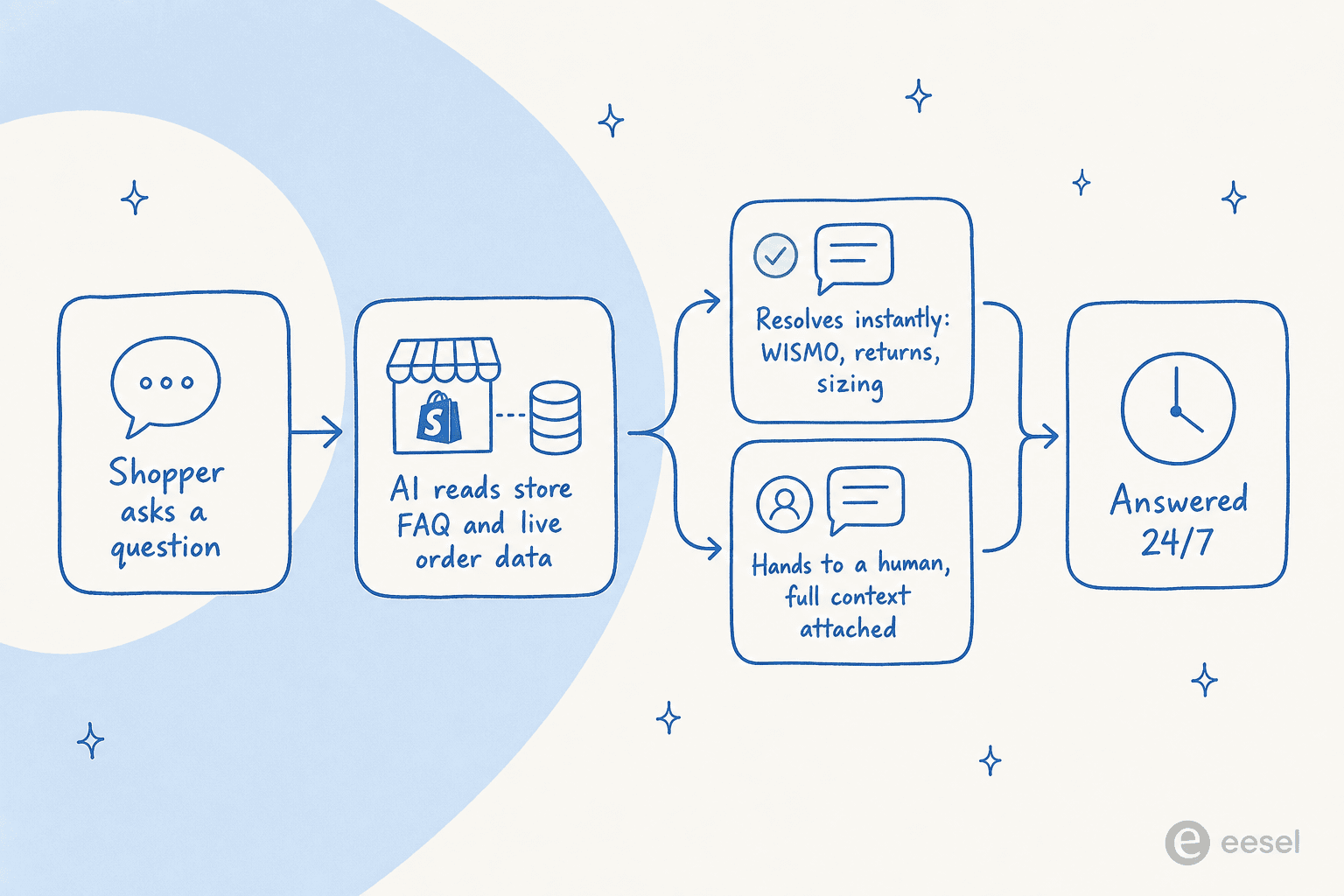
A shopper asks a question. The AI reads your store's knowledge (FAQs, help docs, policies) plus live Shopify order data, then either resolves the common stuff instantly (where's my order, return eligibility, sizing) or hands the conversation to a human with the full context attached. The two places tools differ most are whether step two includes real-time order data, and how cleanly step three's handover works. A proper deflect-then-handover flow is the difference between AI that helps and AI that annoys.
This is also the moment the "scope what the AI handles" point earns its keep. A team running this well doesn't try to automate everything on day one. As one CTO described their setup after consolidating scattered docs into a single AI across a chat bubble:
"We chose eesel AI because it offers multi-channel data input options. By linking our CSVs, Zendesk, and Google Docs as sources, we can make the most of our vast documentation, even if it's scattered."
Wesley Wang, CTO, Ecosa (read the case study)
What you'll actually pay
Sticker prices hide the real story, because these tools don't bill the same way. The cleanest comparison is cost per AI-resolved chat, and even that needs an asterisk for the seat-based and per-conversation tools:
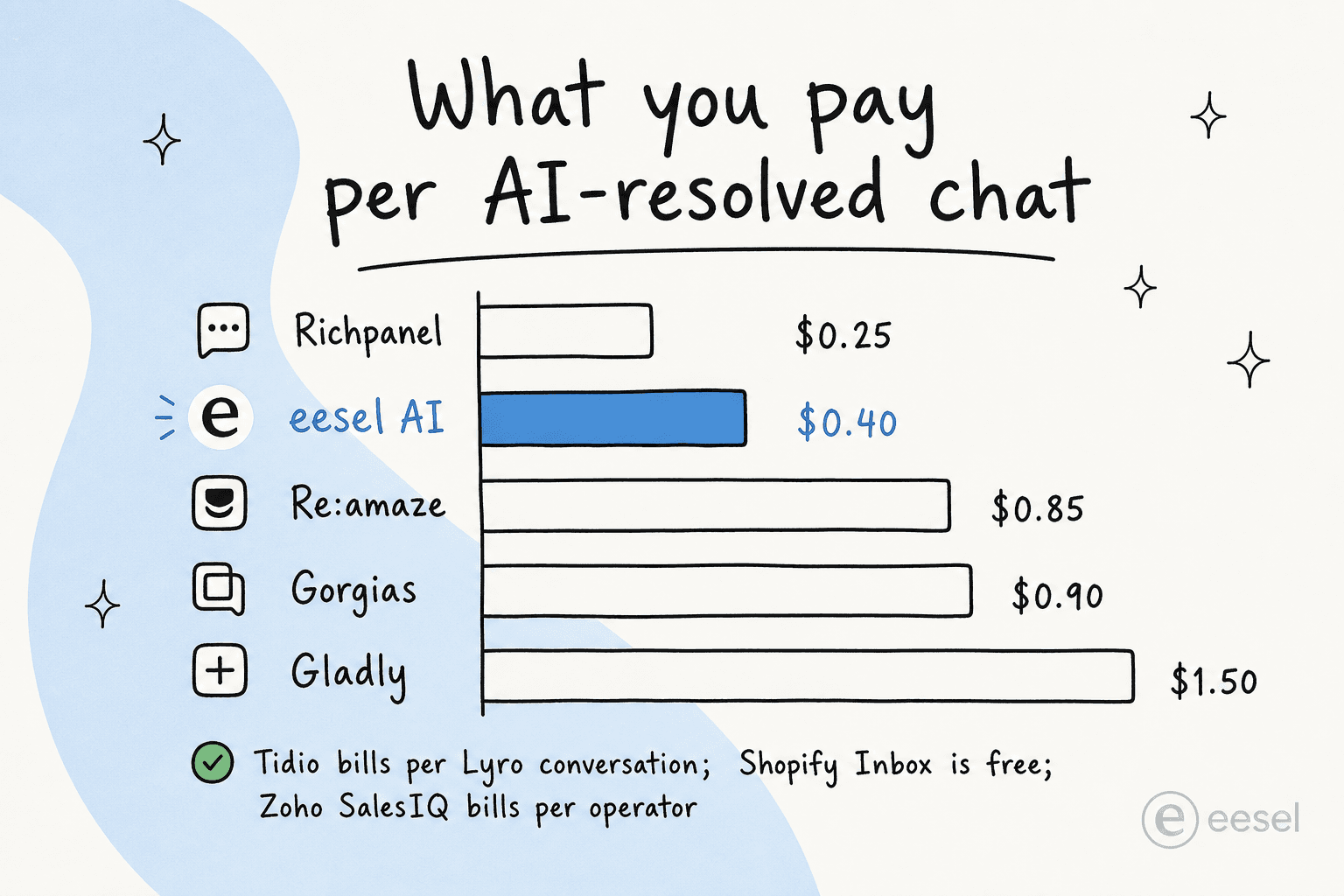
Here's a worked example. Say your store handles 2,000 support chats a month and you want AI to resolve about half of them (1,000 resolutions). On a pure per-resolution basis that's roughly $250 with Richpanel's rate, $900 with Gorgias's AI Agent, and $1,500 with Gladly, before you add the platform fees, seats, or ticket plans most of them also charge. eesel bills differently: credits count the chats the agent works on (1 credit each), so if it handles all 2,000 chats that is the 2,500-credit plan at $999/month, with no per-resolution charge on top. The unit you're billed on matters more than the headline price.
The other half of the math is the spike. Per-conversation and per-resolution models scale with volume, which is great until a flash sale triples your chats overnight. This is why an overage cap you set (eesel) or a flat-rate option (Re:amaze Starter, Shopify Inbox) is worth real money for stores with seasonal peaks.
How to choose in one minute
- You already have a helpdesk and want AI: add a layer like eesel AI instead of migrating.
- You want one Shopify-native platform and have the budget: Gorgias.
- Small team, want it easy: Tidio.
- Channel sprawl is your pain: Re:amaze.
- Already in Zoho: Zoho SalesIQ.
- High volume, going AI-first: Richpanel.
- Just starting, zero budget: Shopify Inbox.
- Enterprise consumer brand: Gladly.
For more options, our roundups of the best Shopify chatbot apps, best live chat software for ecommerce, and AI live chat software go deeper on adjacent picks.
Try eesel for AI live chat on your Shopify store
If the through-line of this list is "don't rip out your stack to get AI," eesel AI is the cleanest way to act on it. It sits on top of the helpdesk and chat widget you already run, learns from your past tickets and help docs, and only auto-resolves the chats it's confident about, handing everything else to your team with full context.
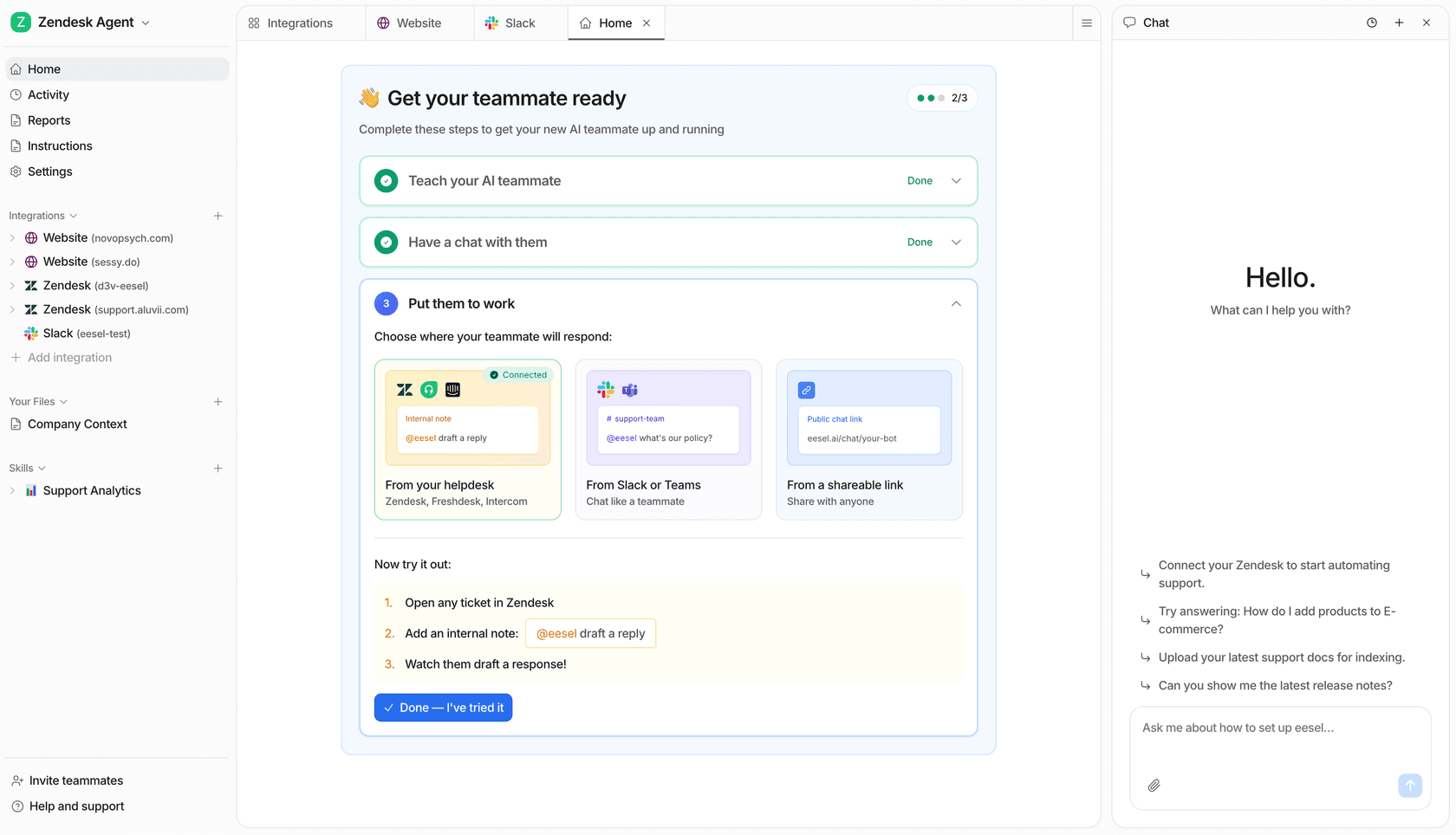
The differentiator is control without a migration: you can simulate the AI on your real historical tickets before it ever talks to a shopper, scope exactly what it handles, and set an optional overage cap so a sale-day rush can't blow the budget. You can start free with 100 credits, no card required, and see how it does on your own Shopify support before committing.
Frequently Asked Questions
What is the best AI live chat app for Shopify stores?
Is there a free AI live chat app for Shopify?
How much do AI live chat apps for Shopify cost?
Can AI live chat handle order tracking and returns on Shopify?
Do I need to replace my helpdesk to add AI live chat to a Shopify store?


Article by
Kira
Kira is a writer at eesel AI with a Computer Science background and over a year of hands-on experience evaluating AI-powered customer service tools. She focuses on breaking down how helpdesk platforms and AI agents actually work so that support teams can make better buying decisions.