
Gladly has a genuine differentiator: it organizes support around people, not tickets. Every conversation a customer has ever had lives in one continuous conversation on a single customer profile, regardless of channel. For luxury retail brands like Nordstrom and TUMI that's a meaningful advantage. Their agents really do stop context-switching, and the data backs it up - 76% of conversations fully resolved by AI, 3x resolution rate improvement in the first 30 days.
But Gladly isn't for everyone, and a lot of teams find that out the hard way. Pricing is enterprise-only with no self-serve trial or public rate card. The product is optimized for B2C and e-commerce; B2B SaaS teams, internal IT desks, and anyone without a large retail-style support operation often don't get the same return. Gladly's primary offering is a full platform replacement, though it does offer a "Gladly for helpdesks" add-on tier that runs alongside existing platforms like Zendesk and Salesforce. Even so, getting full value means leaning into the Gladly model, and switching costs are real for most teams.
So if you're evaluating whether to move off Gladly - or whether it's even worth getting in - this is the list I'd work through. Nine real alternatives, seven of them tested hands-on, with full pricing, honest trade-offs, and a clear answer for who each one actually suits.
What makes a good Gladly alternative
Before jumping to the list, it's worth being specific about what "better than Gladly" actually means, since it depends heavily on your situation.
Transparent pricing. Gladly is sales-only, custom-quoted, with no public rate card. If you want to know what something costs before getting on a call, most of these alternatives are better.
No forced migration. Gladly is primarily a full platform replacement (it does offer a helpdesk add-on tier for Zendesk/Salesforce, but full value requires the full platform). Several alternatives on this list let you add AI and smarter workflows on top of a helpdesk you already use - no data migration, no retraining your agents on a new UI.
AI that resolves, not just assists. "AI-powered" can mean a chatbot that deflects, a copilot that writes draft replies, or a fully autonomous agent that resolves tickets end-to-end. These are very different things and worth checking before you sign anything.
Channel fit. Gladly's strength is omnichannel with voice, SMS, social, and lifelong conversation history. If you only need email and chat, you're paying for features you won't use. Pick something that matches your actual channel mix.
Vertical fit. Gladly was built for consumer-facing brands with high ticket volumes and a focus on customer loyalty (retail, DTC, airlines). B2B SaaS teams, IT help desks, and professional services often need different things.
Quick comparison
| Tool | Pricing model | Starting price | AI resolution | Best for |
|---|---|---|---|---|
| eesel AI | Credits | From $299/mo (500 credits) | Autonomous | Teams keeping their current helpdesk |
| Kustomer | Custom quote | Varies | Autonomous | E-commerce, CRM-first teams |
| Zendesk | Per-agent/mo | $55/agent/mo | Autonomous | Mid-market to enterprise |
| Freshdesk | Per-agent/mo | $19/agent/mo | Autonomous | Budget-conscious teams, SMB |
| Front | Per-seat/mo | $25/seat/mo | Autonomous | Complex ops, logistics, manufacturing |
| Help Scout | Per-user/mo | $25/user/mo | Per-resolution | B2B SaaS, human-first support |
| Zoho Desk | Per-agent/mo | $7/agent/mo | Autonomous (Enterprise) | Budget teams, Zoho ecosystem users |
| Gorgias | Monthly ticket volume | $10/mo (50 tickets) | Autonomous | Shopify and ecommerce brands |
| Salesforce Service Cloud | Per-user/mo | $195/user/mo | Autonomous (Agentforce) | Enterprises on Salesforce CRM |
1. eesel AI - best for teams that want AI without switching helpdesks
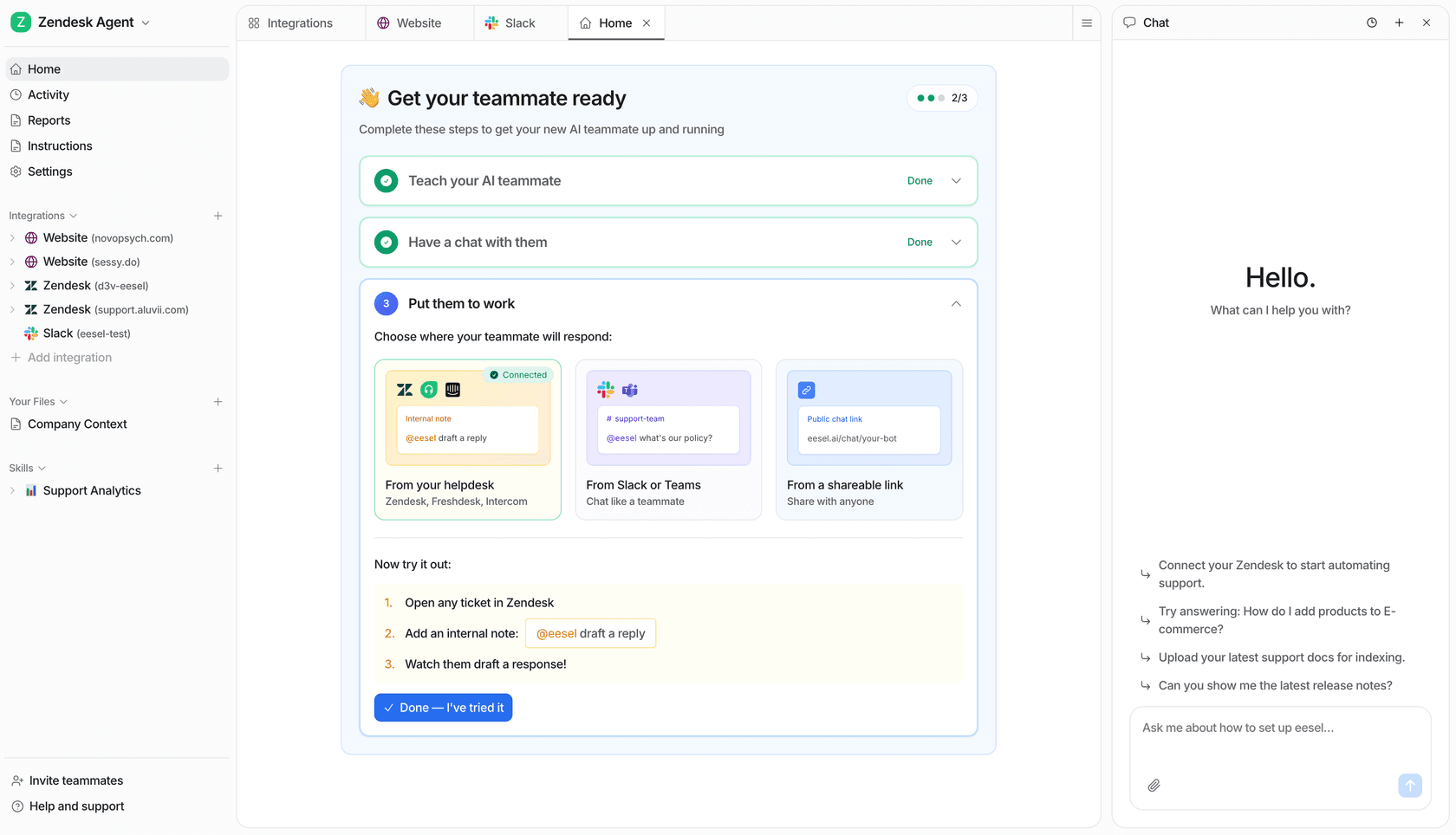
eesel AI takes a different approach from every other tool on this list. Rather than replacing your helpdesk, it sits on top of it as an AI agent layer. You keep Zendesk, Freshdesk, Gorgias, or Help Scout. eesel connects to your knowledge base, learns your past tickets, and starts handling the repetitive ones autonomously.
The reason it belongs at the top of a Gladly alternatives list: Gladly's core model asks you to migrate your entire support operation onto its platform (its helpdesk add-on tier is available, but the full benefit comes from full adoption). eesel doesn't. If you want the AI resolution wins without the switching costs, this is the path.
Setup genuinely takes under 15 minutes for a basic integration. Connect your helpdesk, point it at your knowledge base, run a simulation against your past tickets to see the projected resolution rate, then go live. The confidence-based routing means low-confidence responses queue as drafts for human review rather than going out automatically - you can promote eesel to full autonomy as you build trust in it, or keep it in copilot mode indefinitely.
What's different from the AI already built into Zendesk or Freshdesk: eesel is knowledge-source agnostic. It pulls from Notion, Confluence, Google Drive, SharePoint, past tickets, your website - not just the native knowledge base of whatever helpdesk you're running. And it handles 80+ languages with auto-detection, which matters for international teams.
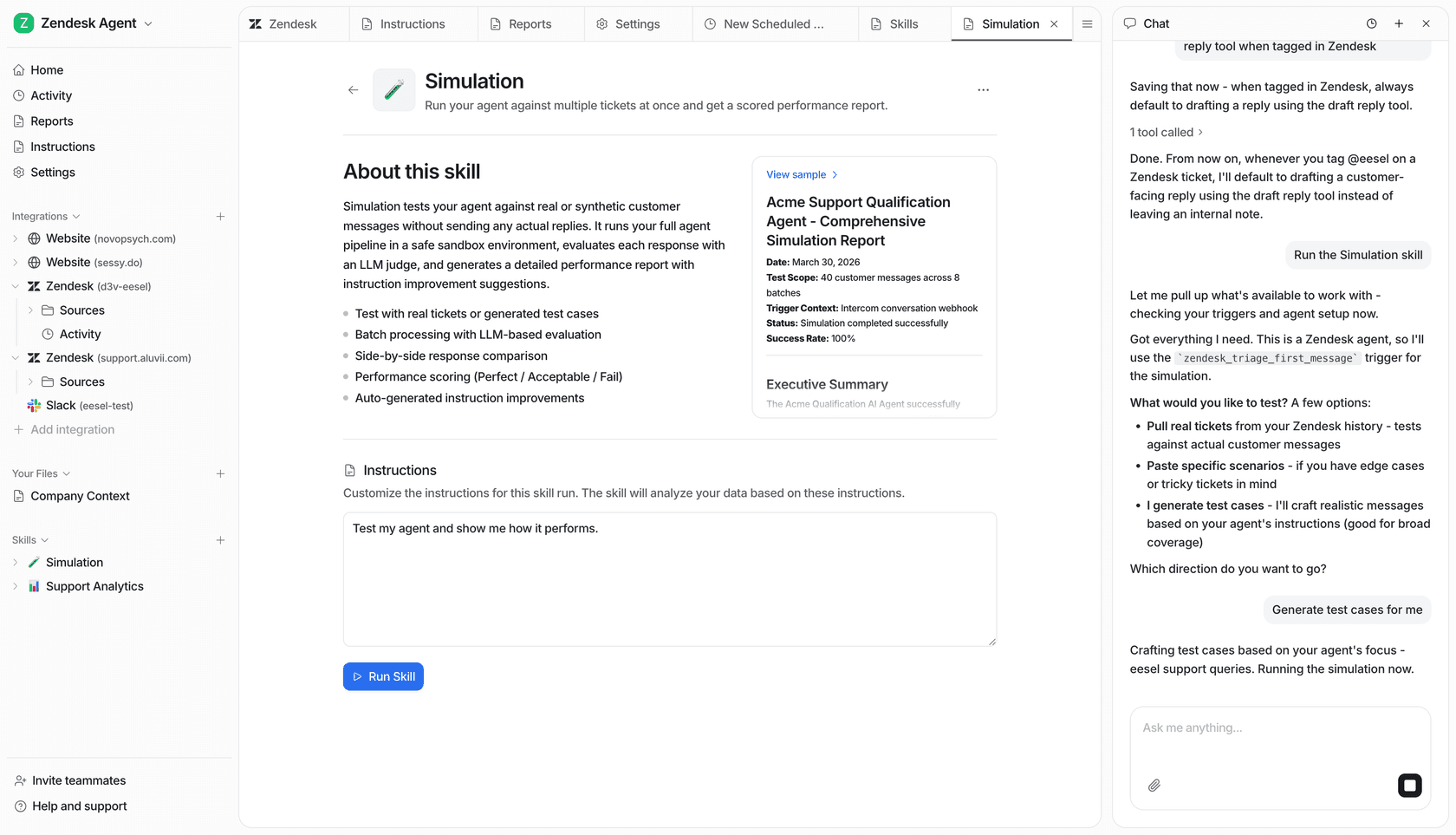
The eesel simulation mode is one of the more honest features in this space. You run it against thousands of historical tickets and get a data-driven forecast of what the resolution rate will actually be before you commit. That's rare - most tools give you a case study with a headline number and ask you to trust it.
Pros
- No helpdesk migration required - works on top of Zendesk, Freshdesk, Gorgias, Help Scout, and others
- One fixed monthly price with no per-seat fees - large teams aren't penalized for headcount
- Connects to Notion, Confluence, Google Drive, SharePoint, not just native KB
- Simulation mode lets you forecast resolution rates before going live
- Free plan with 100 credits, no credit card
Cons
- You're paying for two tools: eesel plus your existing helpdesk
- Plans are sized to monthly volume, so high-traffic teams should model their expected ticket count before picking a batch
- No voice channel support - email, chat, Slack, and helpdesk-ticketing only
- Output quality depends on source document quality; poorly written KB articles produce poor responses
Pricing
eesel uses one fixed monthly price sized to your volume. 1 credit = 1 ticket or chat, however long. Every integration, channel, and seat is included.
| Plan | Price | Notes |
|---|---|---|
| Free | 100 credits | No card required |
| 500 credits | $299/mo | 1 credit per ticket or chat |
| 1,000 credits | $499/mo | Larger batches up to 5,000 credits ($1,899/mo) |
| Add-ons | SSO and MFA from $199/mo | Priority support from $299/mo, data residency $500/mo |
Pay a year upfront and get two months free.
Who it's for: Teams already on a helpdesk who want to add autonomous AI resolution without migrating. Also works well for teams running AI support across multiple channels including Slack and Teams.
2. Kustomer - best for e-commerce teams that want the closest Gladly substitute
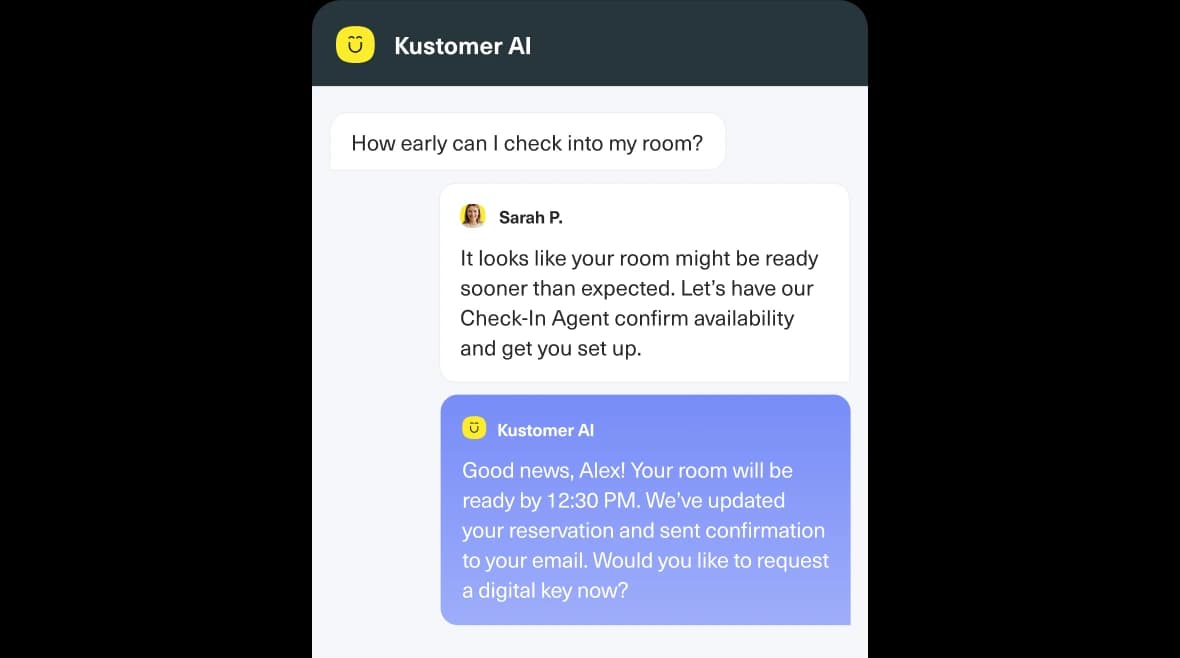
Kustomer is the most direct structural analog to Gladly on this list. Both are CRM-first customer service platforms that organize support around unified customer timelines rather than tickets. Both target e-commerce and retail. Both push toward AI-first autonomous resolution.
The key differences: Kustomer was acquired by Meta in 2022 and spun back out in 2023 - it now operates independently, with 600+ customers and over 551 G2 reviews. The AI layer (Kustomer AI) is built around a multi-agent architecture with a supervisor agent coordinating specialist subagents, real-time observability traces, and MCP server integration as of March 2026.
Kustomer also markets a "Kustomer AI" tier sold as an add-on to your existing helpdesk - so you don't necessarily have to migrate. But the customer case studies (Hopper from Intercom, Bulletproof Coffee from Zendesk) skew heavily toward full platform migrations, and the product's full value comes from owning the CRM layer.
The most consistent user complaint across 551 G2 reviews is knowledge base authoring. Even reviewers giving 5 stars note that the KB feels like an afterthought compared to how strong the customer-facing features are. One reviewer, a Quality Manager named Kari A., put it directly: "The biggest pain point for my specific team by far is the knowledge base. For a platform that does so much so well on the customer-facing side, the knowledge base feels like an afterthought."
The other consistent complaint: performance. 21 reviews tag Slow Performance, 17 tag Slow Loading. That's worth knowing before you sign a long-term contract.
Pros
- Unified customer timeline across email, chat, voice, SMS, social - the closest equivalent to Gladly's core model
- Multi-agent AI architecture (supervisor + specialist agents) with full observability traces
- Strong e-commerce vertical support with TikTok Shop, AfterShip, Narvar, and Attentive integrations
- Bidirectional MCP support as of March 2026
- 80% improvement in first response times reported by customers
Cons
- No public base pricing - annual contract, sales-quoted
- Knowledge base authoring and search consistently flagged as weak by reviewers
- Slow performance / loading reported across 38 G2 reviews
- External knowledge source support is narrower than competitors (no Notion, Confluence, Drive, or SharePoint natively)
Pricing
| Plan | What it includes | Price |
|---|---|---|
| Kustomer AI | AI layer on your existing helpdesk | Custom (annual contract) |
| Kustomer AI + Platform | Full CRM platform replacement | Custom (annual contract) |
| AI Agents for Customers add-on | $0.60/engaged conversation | |
| AI Agents for Reps add-on | $40/user/month | |
| HIPAA Compliance | $25/user/month | |
| Voice | From $0.02/minute |
Who it's for: E-commerce and retail teams that want Gladly's CRM-first philosophy with a more established product. Also strong for teams that need full voice support alongside digital channels.
3. Zendesk - best for teams that want the most complete platform
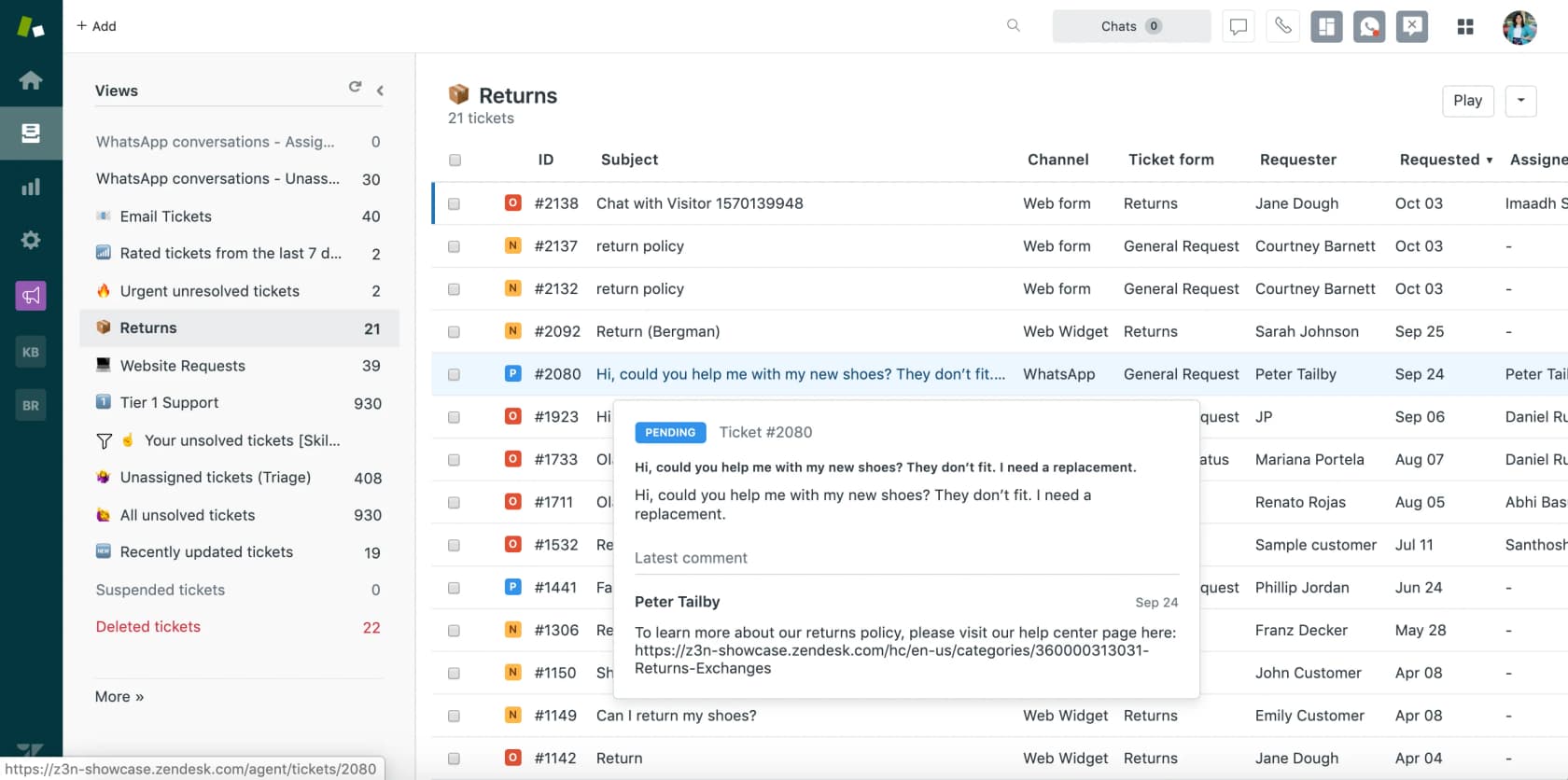
Zendesk is the market leader in customer service software - 100,000+ companies, 20,000+ AI customers, and a product that covers ticketing, omnichannel, knowledge, contact center, and a growing AI layer all under one roof. If Gladly is the relationship-focused boutique, Zendesk is the industrial platform.
The AI story got significantly stronger in March 2026 when Zendesk acquired Forethought, folding Forethought's agentic AI into what it now calls the Resolution Platform. AI Agents (autonomous resolution) are included in all Suite tiers, with a more powerful Advanced AI Agents add-on available. Zendesk Copilot (proactive agent assist) runs at $50/agent/month or bundled in Suite + Copilot plans.
The big trade-off with Zendesk vs. Gladly: Zendesk is ticket-centric. Every interaction creates a ticket with an ID. Gladly's philosophy was to eliminate that - to give agents a lifelong conversation view without the ticket abstraction. If that customer-history continuity is what drew you to Gladly, Zendesk's ticket model will feel like a step backward.
But Zendesk's marketplace (1,800+ apps), API depth, and the sheer maturity of the product make it the safe bet for teams that need reliability, compliance, and a vendor that will be around in five years. The Forethought acquisition in particular means the agentic AI roadmap is now significantly better-resourced.
For teams already on Zendesk who want better AI resolution rates, eesel AI integrates directly with Zendesk and is worth comparing to Zendesk's native AI Agents on your specific ticket mix.
Pros
- 1,800+ app marketplace - the most integration breadth on this list
- AI Agents included in all Suite tiers; Forethought acquisition strengthens the autonomous resolution roadmap
- 100,000+ customer base means the product is battle-tested at every scale
- Strong compliance posture (SOC 2, GDPR, HIPAA on Enterprise)
Cons
- Ticket-centric model - no lifelong conversation timeline equivalent to Gladly
- AI Agents at lower tiers (Suite Team, $55/agent/mo) are limited to 5 included Automated Resolutions per agent/month
- Gets expensive at scale: $155-$209/agent/mo for Suite + Copilot plans
- Smaller teams often find onboarding and configuration complexity overwhelming
Pricing
| Plan | Price (annual) | AI agents | Included ARs/agent/mo |
|---|---|---|---|
| Support Team | $19/agent/mo | Add-on only | 5 |
| Suite Team | $55/agent/mo | Essential | 5 |
| Suite Professional | $115/agent/mo | Essential | 10 |
| Suite Enterprise | $169/agent/mo | Essential | 15 |
| Suite + Copilot Professional | $155/agent/mo | Essential + Copilot | 10 |
| Suite + Copilot Enterprise | $209/agent/mo | Essential + Copilot | 15 |
Additional Automated Resolutions beyond the included allowance: $1.50 (committed usage) or $2.00 (pay-as-you-go) each.
Who it's for: Mid-market to enterprise teams that need a complete, compliance-ready platform with a large app ecosystem. Also teams migrating from Gladly who need to minimize disruption risk by choosing the market-standard tool.
4. Freshdesk - best value for AI-first support on a budget
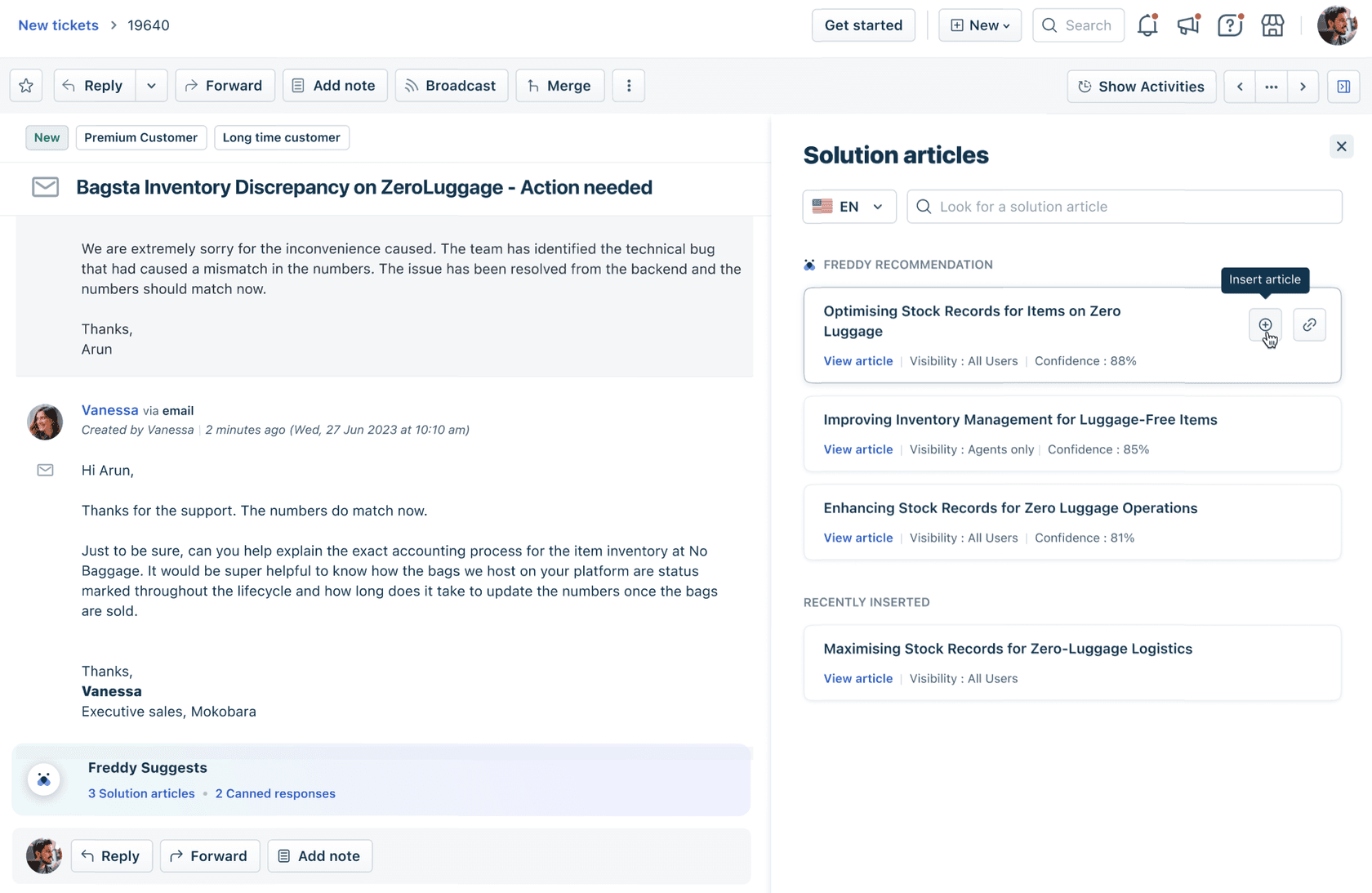
Freshdesk by Freshworks is the value competitor to Zendesk - broadly similar feature coverage at meaningfully lower price points. The AI layer, branded Freddy AI, is now substantial: Freddy AI Agent handles customer-facing autonomous resolution, Freddy Copilot handles agent-assist (writing, translation, summarization, sentiment), and Freddy Insights provides analytics.
The numbers from Freshworks' Q4 2025 earnings give some signal on where the product is heading: 8,000+ customers using Freddy AI, Freddy AI conversations up more than 80% to 3.5 million in Q4, and Freddy AI Agent deflecting more than 50% of tickets for CX and EX customers. The product has clearly moved past "chatbot" stage.
The Freshdesk Omni product bundles Freshdesk (ticketing) with Freshchat (messaging) into a unified omnichannel package - which is where you want to be if you're coming off Gladly's omnichannel setup. On Omni, the AI Agent Studio lets you configure, test, and deploy autonomous bots across chat, email, and social without writing code.
The consistent community complaint - backed by 4.4/5 across 3,728 G2 reviews - is reporting and analytics flexibility. Freshdesk's ticket organization and automation are well-regarded; its reporting tools consistently trail what users expect at the price point.
Pros
- Substantially cheaper than Zendesk at comparable tiers - $19-$89/agent/mo on Freshdesk vs. $55-$169 on Zendesk
- Freddy AI Agent is now production-ready with 50+ pre-built Agentic Workflows
- AI Agent Studio makes configuration accessible to non-technical CX admins
- Free plan for 1-2 agents (6-month limit) lets you test before committing
Cons
- Reporting and analytics consistently flagged as weak across community reviews
- Performance lag reported with many tabs or tickets open
- AI Copilot is a per-seat add-on ($29/agent/mo) not bundled into base plans - the total cost creeps up
- Freddy AI session pricing had a significant list-price increase from $0.10 to $0.50 per interaction in 2025
Pricing
| Product | Plan | Price (annual) |
|---|---|---|
| Freshdesk | Free | $0 (1-2 agents, 6 months) |
| Freshdesk | Growth | $19/agent/mo |
| Freshdesk | Pro | $55/agent/mo |
| Freshdesk | Enterprise | $89/agent/mo |
| Freshdesk Omni | Growth | $29/agent/mo |
| Freshdesk Omni | Pro | $79/agent/mo |
| Freshdesk Omni | Enterprise | $119/agent/mo |
| Freddy AI Copilot | Add-on (Pro/Enterprise Omni only) | $29/agent/mo |
| Freddy AI Agent sessions | 500 included free, then $49/100 sessions ($0.49/session) | Pay-per-use |
Who it's for: Budget-conscious teams migrating from Gladly who need omnichannel coverage and solid AI without paying Zendesk prices. Particularly strong for mid-market teams where per-seat costs matter.
5. Front - best for complex customer operations teams
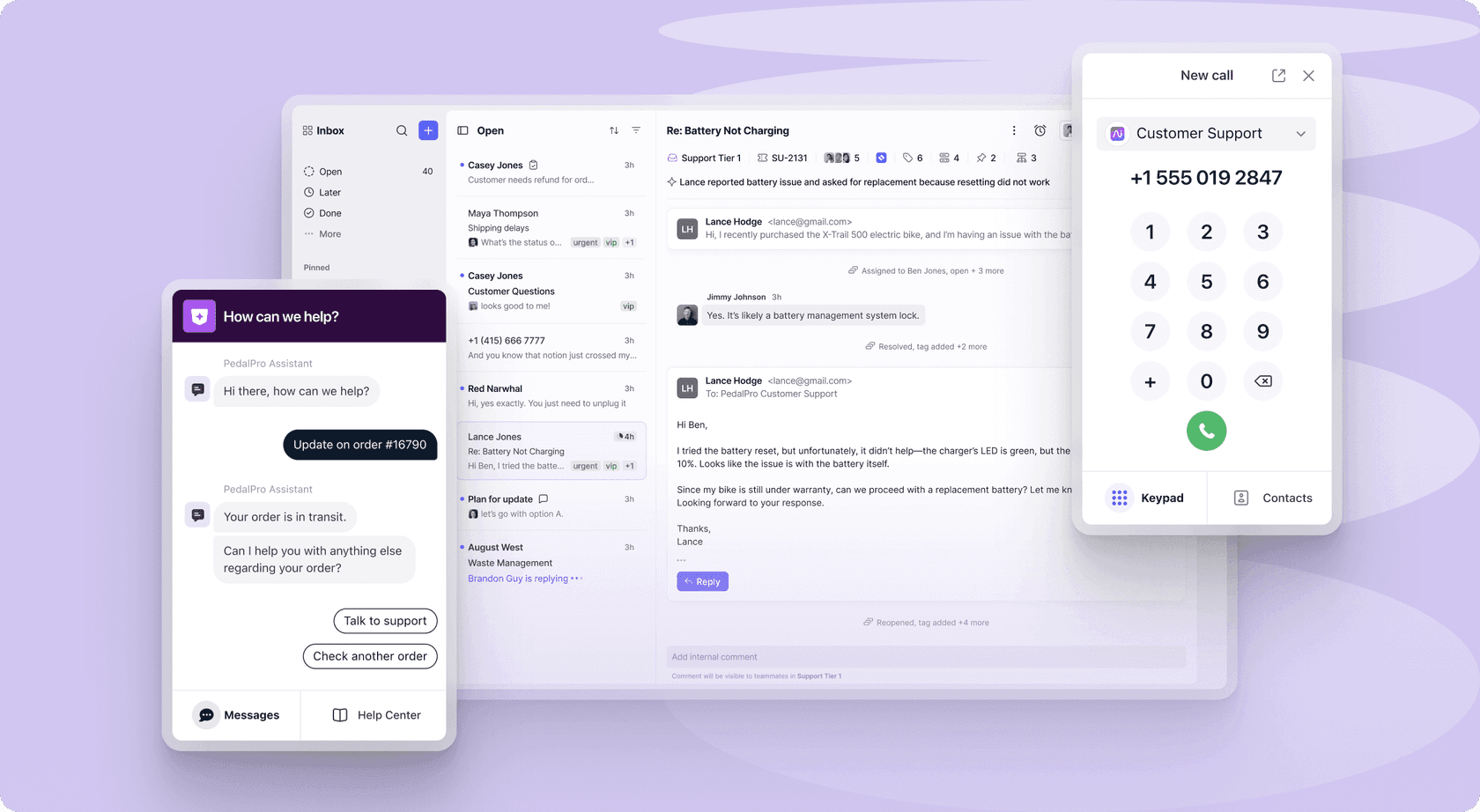
Front occupies a distinct niche: it's a customer operations platform built around a shared inbox model rather than traditional ticketing. Trusted by 9,000+ companies, Front's target customer is teams in logistics, manufacturing, and professional services where support requires deep context from across multiple systems - not just the knowledge base.
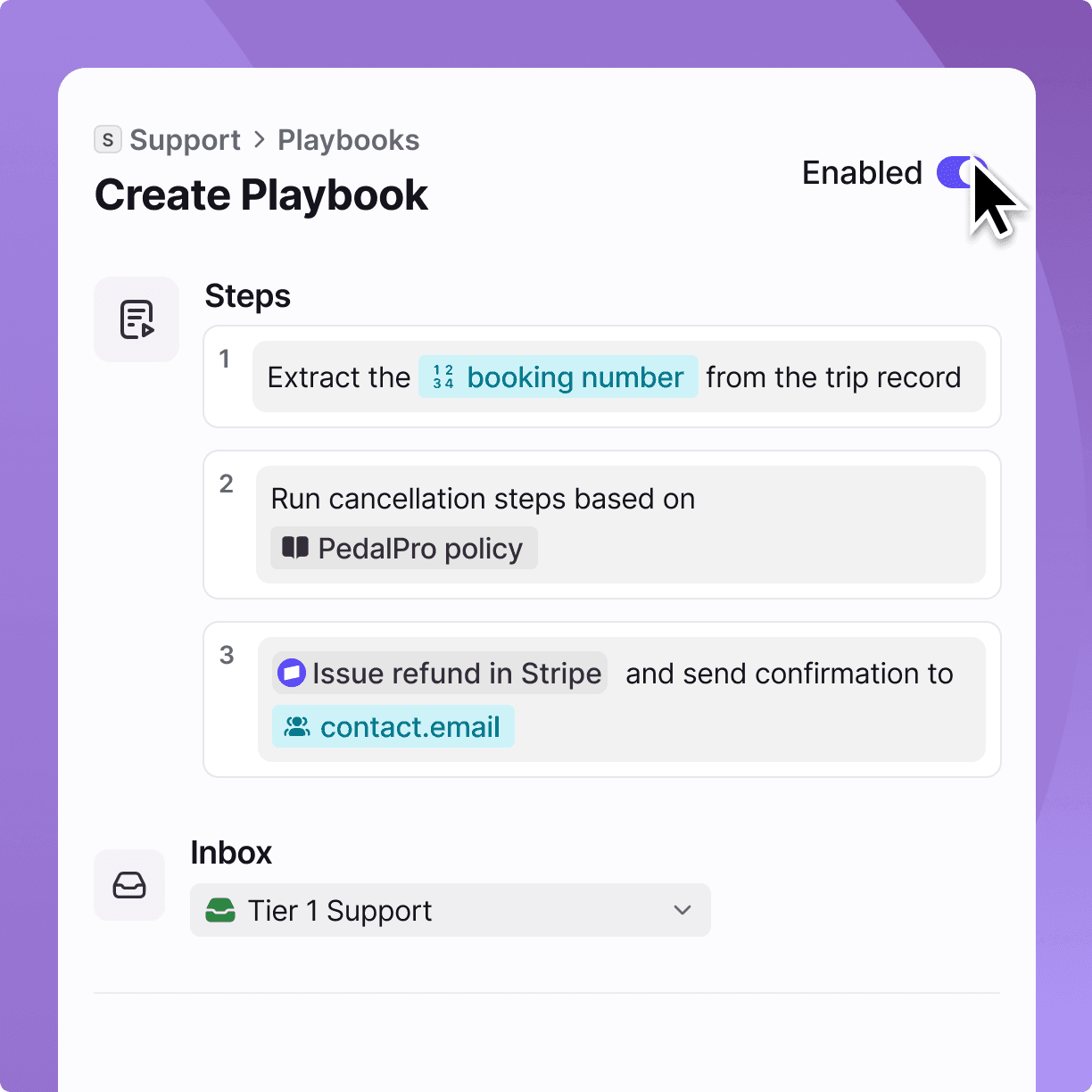
The AI layer, called Autopilot, doesn't just deflect. It executes multi-step "playbooks" across third-party systems - think: look up an order in Shopify, update a record in Salesforce, and send a response, all in sequence without a human in the loop. The claimed resolution rate of 70% of customer requests handled by AI Autopilot is for this kind of end-to-end workflow automation.
What makes Front different from Gladly: where Gladly unifies customer history across channels for agents, Front unifies team communication with customer conversations. Internal comments, @mentions, and collaborative drafting happen on the email thread itself - which is why it's particularly popular in operations teams where multiple people need context on the same conversation.
The AI Copilot feature conducts research across conversation history and connected CRMs to draft contextually aware replies - not just boilerplate from a KB. For complex B2B accounts where the agent needs to know the relationship history before responding, this is genuinely useful.
The community complaints to know about: Capterra reviewers flag steep price increases and seat minimums enforcement as a recent friction point. Some long-term users describe a recent interface redesign as disruptive. And Outlook sync moving to one-way has frustrated teams that relied on the bidirectional behavior.
Pros
- Autopilot executes multi-step cross-system workflows, not just KB lookups
- Internal @mentions and collaborative drafting on email threads - strong for operations teams
- AI Copilot researches across conversation history and CRM before drafting
- 160+ integrations including Salesforce, HubSpot, Jira, and logistics-specific tools
Cons
- AI Copilot and Smart QA are only included free in the Enterprise plan ($105/seat/mo) - on lower tiers they're paid add-ons
- Seat minimums on upper plans and recent price increases have frustrated existing customers
- Not built for high-volume consumer support - better suited to complex B2B operations
- Outlook sync limitations reported by users who relied on bidirectional behavior
Pricing
| Plan | Price (annual) | Seat cap | AI included |
|---|---|---|---|
| Starter | $25/seat/mo | Up to 10 | Basic (AI Topics, Compose, Translate, Summarize) |
| Professional | $65/seat/mo | Up to 50 | Basic + add-ons |
| Enterprise | $105/seat/mo | Unlimited | AI Copilot, Smart QA, Smart CSAT included |
AI Copilot add-on (Starter/Professional): pricing on request. Smart QA and Smart CSAT also add-on on lower tiers.
Who it's for: Operations-heavy teams in logistics, manufacturing, financial services, and professional services where support is relationship-based and requires multi-system context. Not the right fit for high-volume, fast-moving consumer support.
6. Help Scout - best for B2B and SaaS teams that care about the human touch
Help Scout is the anti-Gladly in the best possible sense: it built its product around the idea that support can be both efficient and human. Trusted by 12,000+ companies including Buffer, Vimeo, Gusto, and Mixmax, it's most popular with SaaS and B2B teams where maintaining a personal, thoughtful relationship with customers matters.
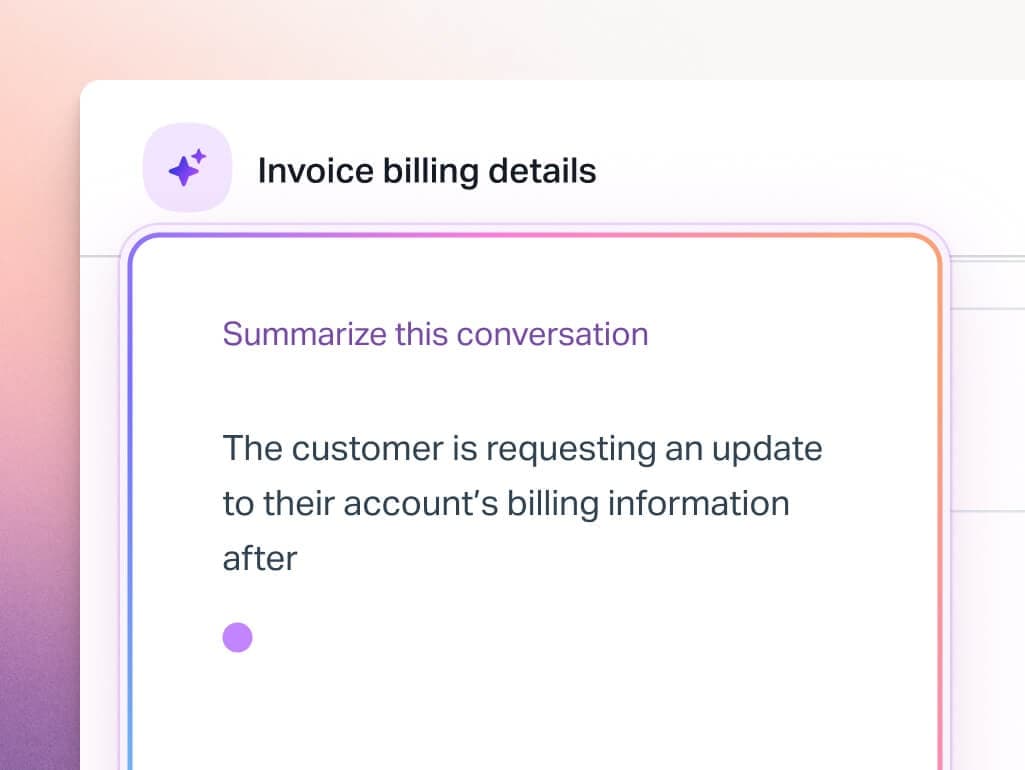
The core product is a shared inbox (email, live chat, Facebook Messenger, Instagram) with a knowledge base (Docs) and an embeddable widget (Beacon) that surfaces relevant KB articles before the customer sends a message. The AI layer - AI Answers for autonomous resolution, AI Drafts for suggested replies, AI Summarize - is optional and priced per successful resolution at $0.75.
That per-resolution pricing model is interesting. It aligns Help Scout's incentives with yours: they only charge when the AI actually resolves the issue, not when it gives a canned response the customer ignores. There's a 3-month free trial of AI Answers on new accounts, and you can set a monthly spending cap so you don't get surprised.
The trade-off is channel depth. Help Scout covers email, chat, social, and WhatsApp (Plus and above). It doesn't cover voice or SMS natively. If Gladly's voice support is something you rely on, Help Scout is not a direct replacement.
Help Scout users on Capterra consistently praise the learning curve - new agents are productive in hours, not days. The most common complaint is a recent UI update that some long-term users found disruptive. It scores 4.8/5 on Capterra with 1,000+ reviews.
Pros
- $0.75/resolution pricing aligns incentives - only pay when AI actually resolves
- 3-month free trial for AI Answers with spending cap protection
- Clean, fast UI that agents adopt quickly - teams report 56% more messages handled in year one
- Strong B2B/SaaS positioning - Docs and Beacon are purpose-built for self-service in that context
Cons
- No voice or SMS support - limited channel coverage compared to Gladly
- 100 contacts/month limit on the free plan makes it impractical for anything but tiny teams testing
- Pro plan requires 10-user minimum, which adds cost for smaller teams wanting enterprise features
- Recent UI changes have frustrated some long-term users
Pricing
| Plan | Price | Users | AI Answers |
|---|---|---|---|
| Free | $0 | Up to 5 | Not included |
| Standard | $25/user/mo | Up to 25 | $0.75/resolution |
| Plus | $45/user/mo | Up to 50 | $0.75/resolution |
| Pro | $75/user/mo | Unlimited (min 10) | $0.75/resolution |
3-month free trial of AI Answers for new accounts. Spending cap on AI Answers is configurable.
Who it's for: B2B SaaS, professional services, and any team where customer relationships are long-term and the agent needs to know the account history. Not for high-volume consumer support or teams that need voice.
7. Zoho Desk - best for budget-constrained teams in the Zoho ecosystem
Zoho Desk is the most affordable option on this list, and it covers more ground than you'd expect for the price. Trusted by 125,000+ businesses and serving 33 million people daily, it's a serious product - not a budget also-ran.
The AI layer is called Zia. At the Enterprise tier ($40/agent/mo), you get the full Zia suite: AI-powered response drafting, ticket summarization, sentiment analysis, the Answer Bot for automated customer resolution, and Guided Conversations for building structured chat flows. The catch: most of Zia's advanced features are Enterprise-only. The lower tiers (Express at $7/agent/mo, Standard at $14/agent/mo) include more limited automation.
For teams already using Zoho CRM, Zoho Books, or other Zoho products, the ecosystem integration is a genuine advantage - data flows between products without middleware, and the single-vendor billing simplifies procurement. For teams outside the Zoho ecosystem, that advantage is neutral, and you're just getting a well-priced helpdesk with decent AI.
Capterra reviewers rate it 4.5/5 and highlight two things consistently: the ability to see full customer history across tickets in one view (the "context" feature), and the depth of the Blueprints automation builder. The complaints are configuration complexity - Blueprints takes time to learn - and occasional performance slowdowns in the mobile app.
One notable stat: NOOA Brasil saved 35% in licensing costs while increasing team productivity by 30% after switching to Zoho Desk. The cost argument is real, particularly for teams coming off Gladly's enterprise pricing.
Pros
- Starting at $7/agent/mo - the most affordable full-featured option on this list
- Free plan for 3 agents with email ticketing, knowledge base, and basic automation
- Full Zoho ecosystem integration (CRM, SalesIQ, Cliq) for teams already on Zoho
- Enterprise tier includes the full Zia AI suite: Answer Bot, sentiment analysis, response suggestions, and Guided Conversations
Cons
- Zia's best AI features (Answer Bot, sentiment analysis) are Enterprise-only at $40/agent/mo
- Blueprints automation is powerful but has a steep learning curve - multiple reviewers note significant trial and error
- Performance issues reported on the mobile app
- Standard plan limits to 5 agents maximum - a gotcha for growing teams
Pricing
| Plan | Price (annual) | Agent limit | AI features |
|---|---|---|---|
| Free | $0 | 3 agents | None |
| Express | $7/agent/mo | Unlimited | Basic AI agents |
| Standard | $14/agent/mo | Max 5 agents | Generative AI (requires OpenAI API key), ASAP widget |
| Professional | $23/agent/mo | Unlimited | Everything in Standard + telephony, Blueprints |
| Enterprise | $40/agent/mo | Unlimited | Full Zia AI: Answer Bot, sentiment, Guided Conversations |
Who it's for: Budget-conscious teams, Zoho ecosystem users, and SMBs that want a full-featured helpdesk without enterprise pricing. Also worth considering if you're coming off Gladly and need to reduce licensing costs significantly.
8. Gorgias - best for Shopify brands that want helpdesk and AI on one bill
Gorgias is a helpdesk and AI agent built for ecommerce. It says it powers customer conversations for 40% of Shopify brands. Like Gladly, it puts customer context in front of the agent: one unified inbox across channels, with live Shopify data inside every conversation.
The pricing model is different from most of this list. Gorgias charges by monthly ticket volume, not by agent. Plans run from 50 to 5,000 tickets a month, and Basic and above include up to 500 user seats. AI Agent is on every plan and is billed per automated interaction, from $0.85 to $1.00 depending on the tier. Voice and SMS are add-ons on Basic and above, priced by call and text volume.
I compared Gorgias from its own pricing and product pages rather than testing it hands-on like the first seven, so read this entry as a spec comparison.
The main trade-off versus Gladly is scope. Gorgias describes its helpdesk as designed specifically for ecommerce and Shopify, so B2B SaaS and internal support teams get less from its order-data features.
Pros
- Priced by ticket volume, not per agent, with up to 500 user seats from Basic up
- AI Agent included on every plan, billed per automated interaction ($0.85-$1.00)
- Shopify, Shopify Plus, and WooCommerce on every plan; BigCommerce from Basic, Magento from Pro
- AI Agent actions like cancellations and discounts on Basic and above
Cons
- Starter is capped at 50 tickets/month and 3 seats, without AI Agent actions or brand voice controls
- Voice and SMS cost extra and are not available on Starter
- Overage applies above the plan allowance ($0.40/ticket on Starter, $36-$40 per 100 tickets on higher plans)
- Built for ecommerce, so less suited to B2B or internal support
Pricing
| Plan | Tickets/mo | Helpdesk (monthly) | Helpdesk (annual) | AI Agent per automated interaction |
|---|---|---|---|---|
| Starter | 50 | $10/mo | Monthly only | $1.00 |
| Basic | 300 | $60/mo | $50/mo | $0.90 |
| Pro | 2,000 | $360/mo | $300/mo | $0.90 |
| Advanced | 5,000 | $900/mo | $750/mo | $0.85 |
| Custom | 5,000+ | Contact sales | Contact sales | Contact sales |
With AI Agent added, Starter is $40/mo for 50 tickets plus 30 automated interactions.
Who it's for: Shopify and DTC brands that want Gladly-style customer context with helpdesk and AI on one bill, without per-seat pricing.
9. Salesforce Service Cloud - best for enterprises already on Salesforce CRM
Salesforce Service Cloud is the service side of the Salesforce CRM, and its AI layer is Agentforce. If your customer data already lives in Salesforce, this is the comparison to run, since Gladly's helpdesk add-on tier also runs alongside Salesforce.
Service Cloud is priced per user. Core is $195/user/month billed annually, with case management, a self-service help center, and omni-channel routing. Agentforce for Service is included in Max and available for purchase on Core and Advanced. Bought separately, Agentforce costs $2 per conversation for customer-facing agents, or $500 per 100,000 Flex Credits. At 10 agents on Core, that's $1,950/month before any Agentforce usage.
As with Gorgias, I compared Service Cloud from Salesforce's own pricing pages rather than testing it hands-on.
The trade-off versus Gladly mirrors Zendesk's: Service Cloud is built around cases, while Gladly is built around one conversation per customer.
Pros
- Full CRM underneath, so service and sales work from the same customer record
- Agentforce for Service included in Max, available on Core and Advanced
- Several ways to buy AI: per conversation, Flex Credits, or a $125/user/month add-on for unmetered employee use
- Max adds contact center features: digital channels, Partner Contact Center, workforce and quality management
Cons
- Highest starting per-user price on this list: $195/user/mo for Core
- Agentforce for Service is a paid extra below Max
- Core, Advanced, and Max are billed annually
- Case-based model rather than one continuous conversation per customer
Pricing
| Plan | Price | Agentforce for Service |
|---|---|---|
| Core | $195/user/mo (annual) | Available for purchase |
| Advanced | $395/user/mo (annual) | Available for purchase |
| Max | $550/user/mo (annual) | Included, plus 2.75M Flex Credits per org per year |
| Agentforce Conversations | $2/conversation | Customer-facing agents |
| Agentforce Flex Credits | $500 per 100,000 credits | Pay per action |
Salesforce also sells a Starter Suite at $25/user/month, a combined sales, service, and marketing CRM for smaller teams.
Who it's for: Enterprises whose customer data already lives in Salesforce and who want service, sales, and AI agents on one platform.
How to choose
The right pick depends on what actually bothered you about Gladly - or what you want that it doesn't offer.
If pricing was the issue: Zoho Desk starts at $7/agent/mo and has a free plan. Freshdesk's entry tier is $19/agent/mo with a free plan for small teams. Neither has Gladly's demo-only model.
If you didn't want to migrate your support operation: eesel AI is built specifically for this situation. It layers on top of whatever helpdesk you're already running. You get AI resolution gains without a platform migration, new agent training, or data transfer. The 100 free credits let you run it against real tickets before committing.
If you're coming from Gladly specifically because of its CRM-first approach: Kustomer is the closest equivalent. It organizes support around a unified customer timeline with the same e-commerce vertical focus. It's also enterprise pricing and sales-quoted, so the process of getting there is similar.
If voice support is non-negotiable: Kustomer and Zendesk both offer voice. Front has voice integrations. Help Scout and eesel AI do not.
If B2B relationships and thoughtful replies matter more than high-volume deflection: Help Scout is built for exactly this. The per-resolution AI pricing means you're only paying when it actually works, and the product's entire philosophy is about maintaining the human relationship through automated efficiency - not sacrificing one for the other.
If you're already in the Zendesk ecosystem: Before switching platforms entirely, it's worth testing whether eesel AI on Zendesk closes the gap. A lot of teams find that the limitation they're experiencing is their native AI, not their helpdesk.
For teams that want a comprehensive comparison of all the best helpdesk tools before deciding, or specifically need to think through ticket deflection rates before signing a contract, those resources cover the trade-offs in more detail.
What I'd actually do
If I were switching off Gladly today, the first test I'd run is eesel AI - specifically because it doesn't require a commitment to a new platform. Connect it to whatever helpdesk you're already using, run the simulation against your past tickets, see what the projected resolution rate is. If the number is good, you have your answer. If it's not, you've lost an afternoon and $0.
The full platform replacements - Kustomer if you're staying CRM-first, Zendesk if you want the industry standard, Freshdesk if you want to spend less - are meaningful commitments that take weeks to migrate and months to fully settle. Get the data before making that call.
The one platform alternative I'd take most seriously is Front, but only for B2B operations teams. If you're running 50,000 tickets/month from DTC customers, Front is not the right tool. If you're running complex, multi-touch B2B accounts where the agent needs to know three months of email history before responding - that's exactly what Front was built for.
For the best AI customer service tools overall, the landscape is moving fast. Gladly's "devotion not deflection" framing is smart marketing, but the underlying capability - AI that knows the customer's full history and resolves issues with context - is now available across several of these alternatives. The question is just which one fits your team's size, budget, and the channels you actually use.
Frequently Asked Questions
What are the main reasons teams switch away from Gladly?
The two most common reasons are pricing and scope. Gladly's enterprise pricing (custom quote, no self-serve trial) puts it out of reach for smaller teams. The second reason is scope: Gladly is purpose-built for B2C and e-commerce - teams running B2B support, internal IT, or SaaS often find the customer-centric model doesn't quite fit their workflow. eesel AI is worth a look if you want AI on top of a helpdesk you already have.
Is there a free alternative to Gladly?
Yes. Zoho Desk has a free plan for up to 3 agents. Help Scout offers a free plan for up to 5 users (limited to 100 contacts/month). eesel AI has a free plan with 100 credits and no credit card required, so you can test it on real tickets before committing. None of these are feature-for-feature replacements for Gladly, but they're solid starting points for teams evaluating cost.
Which Gladly alternative works best if I want to keep my current helpdesk?
If you want to stay on Zendesk, Freshdesk, Gorgias, or Help Scout and just add smarter AI on top, eesel AI is the cleaner option. It works as an AI agent layer over your existing helpdesk rather than replacing it - so your agents keep using the same tool and you avoid a migration. Setup takes under 15 minutes and it connects to your existing knowledge base. See the best AI helpdesk tools comparison for more context.
How much does a Gladly alternative typically cost?
Costs vary widely. Per-seat helpdesks like Zendesk ($55-$169/agent/mo) and Freshdesk ($19-$89/agent/mo) scale with headcount. Shared-inbox tools like Front start at $25/seat/mo. Credit-based tools like eesel AI charge a fixed monthly price from $299/month for 500 credits (1 credit per ticket or chat), with no per-seat fee, which keeps costs predictable as headcount grows. Gladly itself does not publish pricing - it's custom quote only, with most publicly cited figures starting above $150/agent/mo.
What should I look for when choosing a Gladly alternative?
Start with channel coverage (do you need voice, SMS, social, or just email and chat?), then pricing model (per-seat vs. per-interaction vs. flat-rate), and finally AI depth (copilot vs. fully autonomous resolution). If you're in e-commerce and care about customer lifetime value, Kustomer is the closest equivalent. If you want simpler and cheaper, Help Scout or Zoho Desk work well. If you want AI without migrating your support stack, eesel AI's agent approach is worth testing first.