The 7 best Zendesk AI alternatives in 2026

Stevia Putri

Katelin Teen
Last edited May 13, 2026
Zendesk has done a lot of work to position itself as an AI-first platform. The Resolution Platform pitch, the acquisition of Forethought in March 2026, the bundled AI Agents on every Suite plan - it adds up to a credible AI roadmap.
But credible doesn't mean cheap, fast, or the right fit for every team. The pricing climbs steeply once you cross into Suite Professional or Enterprise, the Advanced AI Agents add-on is sales-gated with no public per-agent price, and a lot of teams already running on Zendesk feel locked into upgrades they didn't budget for. The flip side: teams not on Zendesk often find the migration too heavy to justify just to get its AI, and want something they can layer onto their existing stack.
This guide is for both groups. We've spent the last few weeks digging through pricing pages, help docs, G2 reviews, and Reddit threads to put together a shortlist of Zendesk AI alternatives that actually hold up in 2026. Each one is a real option with public reviews and named customers, not a category placeholder. Here's how they stack up.
What to look for in a Zendesk AI alternative
A handful of features separate the platforms that will save your team time from the ones that will quietly add a line item to your renewal. Before we get to the list, here's what we paid attention to.
- How the AI gets trained. Some platforms train only on formal help docs; others can read your past tickets, internal wikis, macros, and product catalog. The breadth of source material is the single biggest predictor of out-of-the-box resolution rate.
- Whether it replaces or layers on top of your helpdesk. Switching helpdesks is expensive - data migration, agent retraining, integration rewrites. Some AI alternatives, like eesel AI, are designed to plug into Zendesk (or Freshdesk, Gorgias, etc.) so you never touch the underlying system.
- Pricing model. Per-seat, per-resolution, per-conversation, or flat tier. Each one rewards a different shape of team. A 30-seat support team with low ticket volume gets crushed by per-seat pricing; a 5-seat team with 50,000 monthly tickets gets crushed by per-resolution pricing.
- Implementation time. Some tools are live in under an hour. Others, including most of the enterprise platforms, require 8 to 16 weeks with a dedicated implementation engineer before they handle a single ticket.
- How honest the deflection numbers are. Every vendor claims 70-80% automation. Tools that let you simulate against historical tickets before going live give you a real number; the others ask you to trust the marketing page.
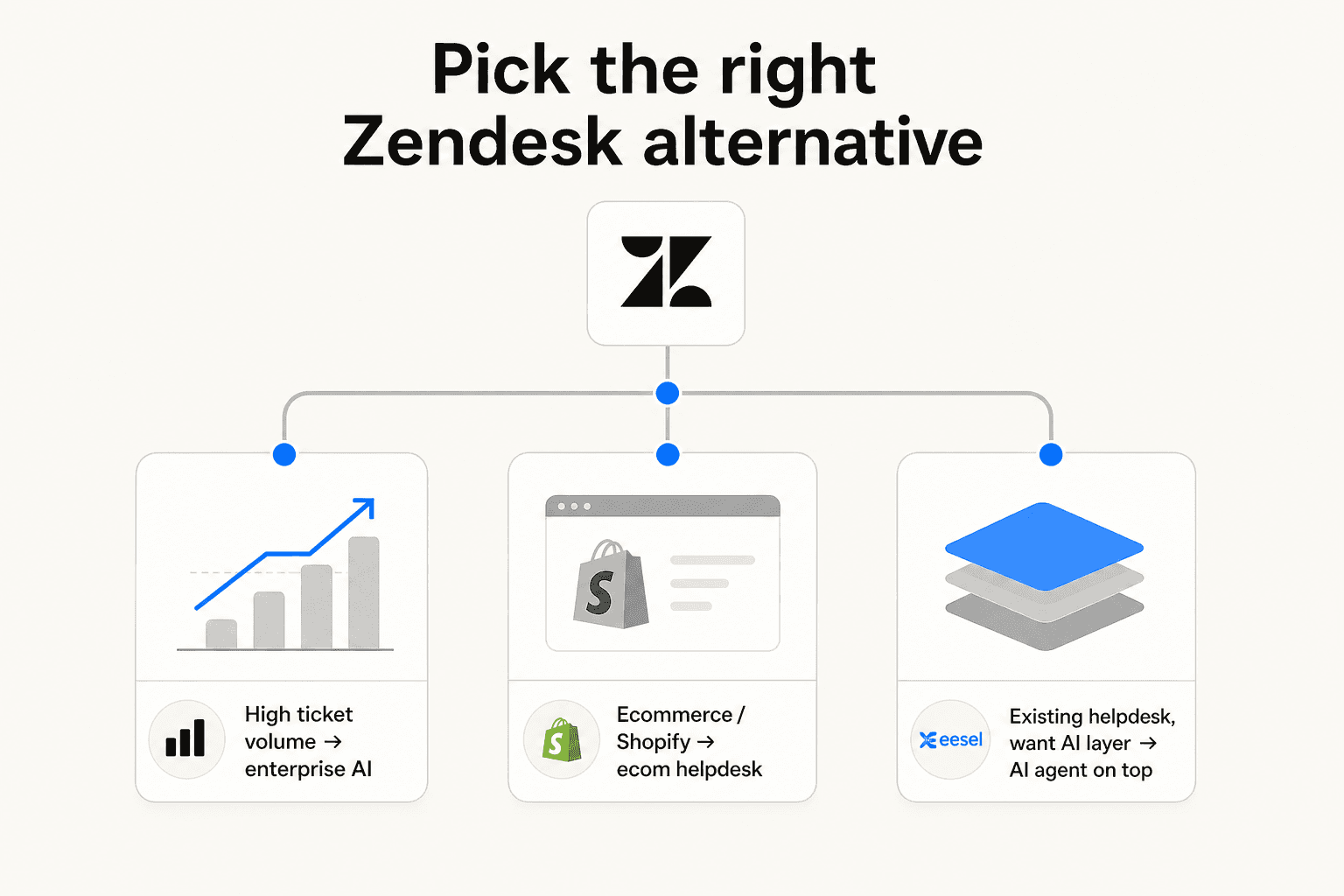
The 7 best Zendesk AI alternatives in 2026 at a glance
| Tool | Best for | Starting price | AI model | G2 score |
|---|---|---|---|---|
| eesel AI | Layering AI onto an existing helpdesk in minutes | $0.40 per task, no per-seat fee | Tickets + docs + macros + connectors | 4.3/5 (Zoftware) |
| Freshdesk + Freddy AI | Teams already in the Freshworks ecosystem | $19/agent + $0.10–$0.50/session | Freddy AI Agent on 4 source types | 4.4/5 |
| Gorgias | Shopify and ecommerce brands | $10/mo + $0.90–$1.00/AI resolution | Shopify-trained AI Agent | 4.6/5 |
| Help Scout | Small B2B/SaaS teams who want a clean shared inbox | $25/user + $0.75/AI resolution | AI Answers, Drafts, Summarize | 4.4/5 (Capterra) |
| Ada | Enterprise omnichannel deployments | Sales-gated ($100K–$300K+) | Unified Reasoning Engine | 4.6/5 (G2) |
| Decagon | High-volume enterprises with eng capacity | Sales-gated ($95K–$590K) | Agent Operating Procedures (AOPs) | Aggregated, no public G2 |
| Aisera | Internal IT/HR service desks at Global 2000 scale | Sales-gated, enterprise only | Aisera Unify + Agent Composer | Gartner MQ leader |
1. eesel AI
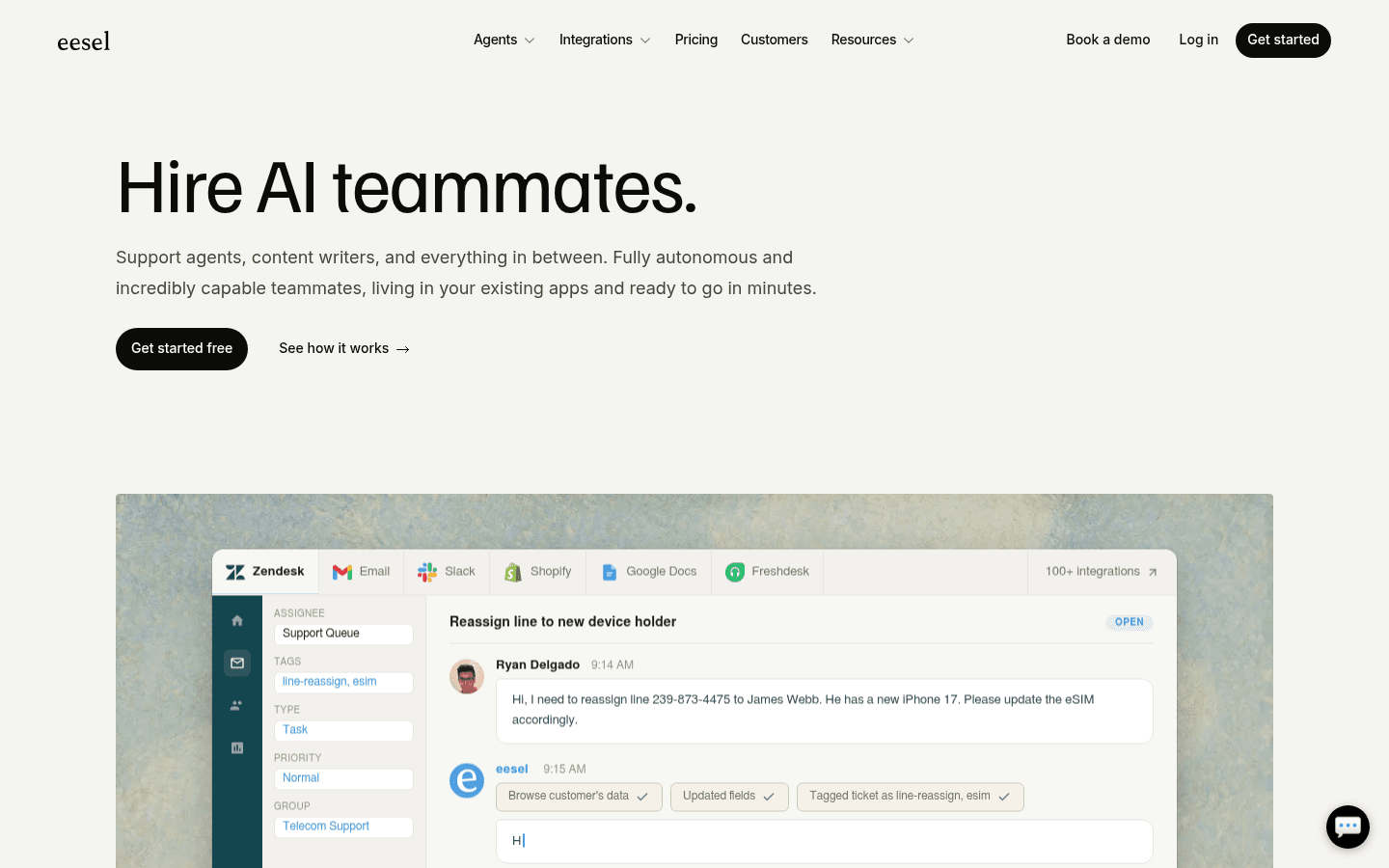
eesel AI is an AI agent layer that sits on top of your existing helpdesk rather than replacing it. The pitch is "AI teammates. Not chatbots. Not copilots." - autonomous agents that read your Zendesk tickets, your help docs, your Notion wiki, your Google Drive, and respond inside the helpdesk your team already uses.
The contrast with Zendesk's native AI is the architecture. Zendesk's Advanced AI Agents are gated to a sales call and tied to the Resolution Platform. eesel works on top of Zendesk, Freshdesk, Intercom, Gorgias, Help Scout, and HubSpot Service Hub - so you don't migrate, you connect. Setup is under 15 minutes, and there are no per-seat fees.
What stands out:
- Simulation before launch. Before flipping a single agent live, eesel runs your AI against thousands of past tickets and gives you a data-driven forecast of resolution rate, escalation rate, and tone fit. Most competitors don't offer this - you find out how well it works once it's already replying to customers.
- 80+ languages, auto-detecting and replying in the customer's language without configuration.
- Knowledge from everywhere. Past tickets, help center, Google Docs, Notion, Confluence, SharePoint, Shopify orders, website crawl. This breadth is what gives the AI useful context out of the box.
- Graduated autonomy. Start in supervised "copilot" mode where the AI drafts replies for human review, then promote to full agent once you trust the behavior.
Pricing: Usage-based. Free for "light tasks" like dashboard questions, $0.40 per regular task (ticket replies, chats), $4.00 for "heavy tasks" like long-form drafts. There's also a flat-rate Team plan at $299/month for 1,000 interactions and a Business plan at $799/month for 3,000. $50 in free credits on signup, no credit card.
Real customer numbers:
"We chose eesel AI for its multi-channel data input. By linking our Zendesk and Google Docs, customers get instant responses and tough questions are automatically triaged." -- Wesley Wang, CTO, Ecosa
- Smava handles 100,000+ tickets/month with full automation in German.
- Gridwise resolved 73% of tier-1 requests in the first month.
- Global Pay reports up to 80% time savings.
Where it's weaker: Output quality depends on the underlying knowledge - one Featurebase analysis notes that "if the document is not well written, eesel struggles." And because it layers on top of a helpdesk, you're paying for two tools, not one. For very small teams that don't already have a helpdesk, that's a real tradeoff.
Best for: Teams already running on Zendesk, Freshdesk, Intercom, or Gorgias who want to add agentic AI fast without switching platforms. If you want to test the "AI layer" approach without a migration, see our Zendesk integration page.
2. Freshdesk + Freddy AI
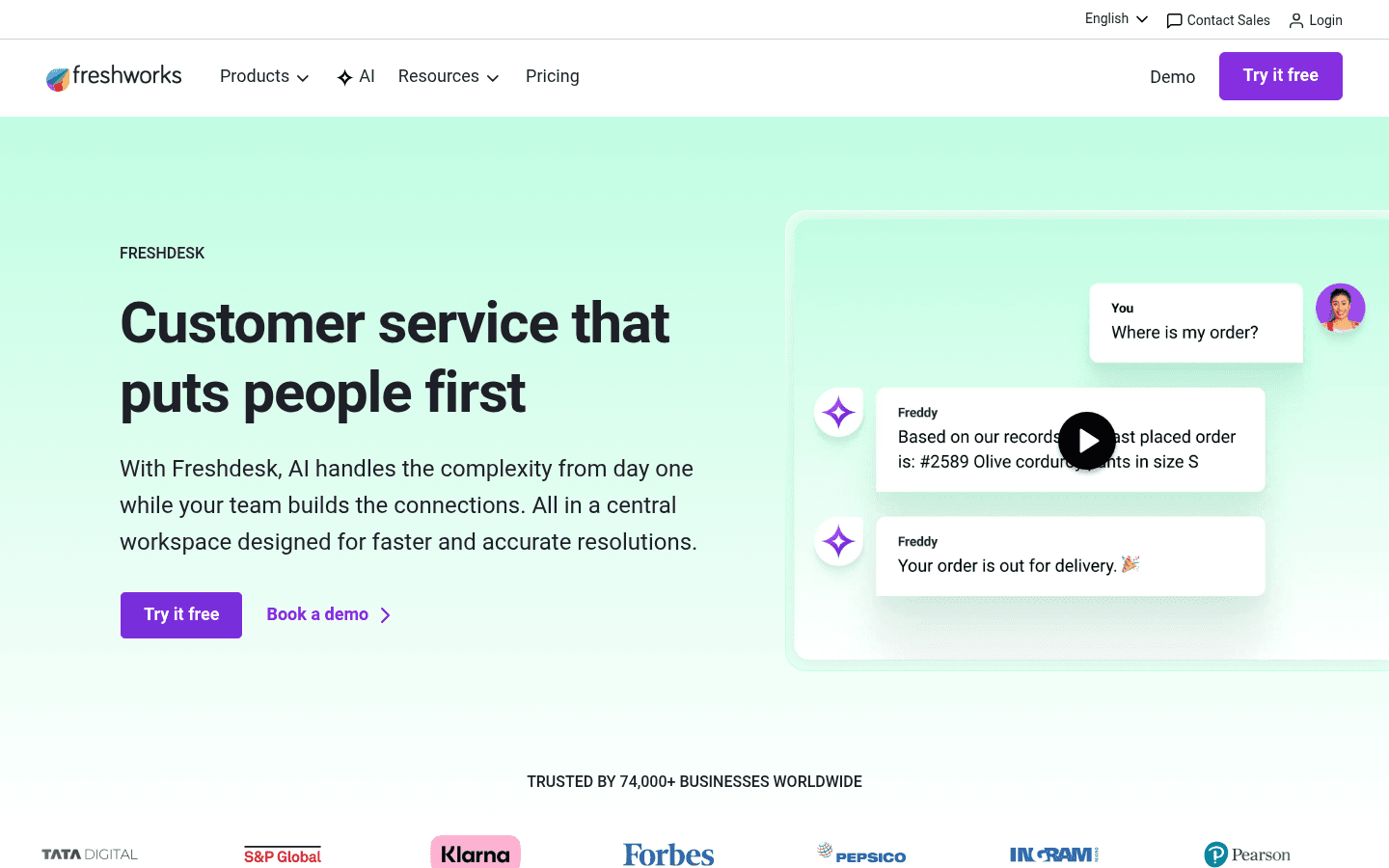
Freshdesk is the obvious head-to-head Zendesk replacement, and Freshworks has been pushing its Freddy AI suite hard. The Q4 2025 earnings call confirmed more than 8,000 customers are now using Freddy AI and Freddy AI Agent conversations were up more than 80% to 3.5 million in Q4.
The product splits into three: Freddy AI Agent (customer-facing bot), Freddy AI Copilot (agent assist), and Freddy AI Insights (beta analytics).
Pricing: Two SKUs. Standalone Freshdesk runs Growth $19, Pro $55, Enterprise $89 per agent per month annually. Freshdesk Omni is Growth $29, Pro $79, Enterprise $119. Freddy Copilot is a $29/agent/month flexi-add-on. Freddy AI Agent gives you 500 free sessions then charges by session pack - and Freshworks disclosed on the earnings call that the list price moved from $0.10 to $0.50 per interaction, so old comparisons understate the cost.
The catch: Freddy AI Agent supports exactly four knowledge sources: files, URLs, solution articles, and Q&As. The hard caps are 200 files per agent, 10 URLs per agent, 35MB per file. There's no native connector for Confluence, Google Docs, Notion, SharePoint, or Slack. If most of your support knowledge lives in those tools, you're going to have a bad time.
"What I like most about Freshdesk is how simple and well-organized it makes managing customer support. The interface is clean and easy to navigate, even for new users."
- verified user, G2 review
The flip side from the same review pool:
"At times, Freshdesk can feel a bit slow or laggy, especially when handling multiple tickets at once. The reporting and analytics tools also aren't as flexible as I'd like."
- verified user, G2 review
Best for: Teams that want a full Zendesk-like helpdesk replacement, especially mid-market support orgs already in the Freshworks ecosystem. For more on Freshworks AI specifically, see the best AI helpdesk tools roundup.
3. Gorgias
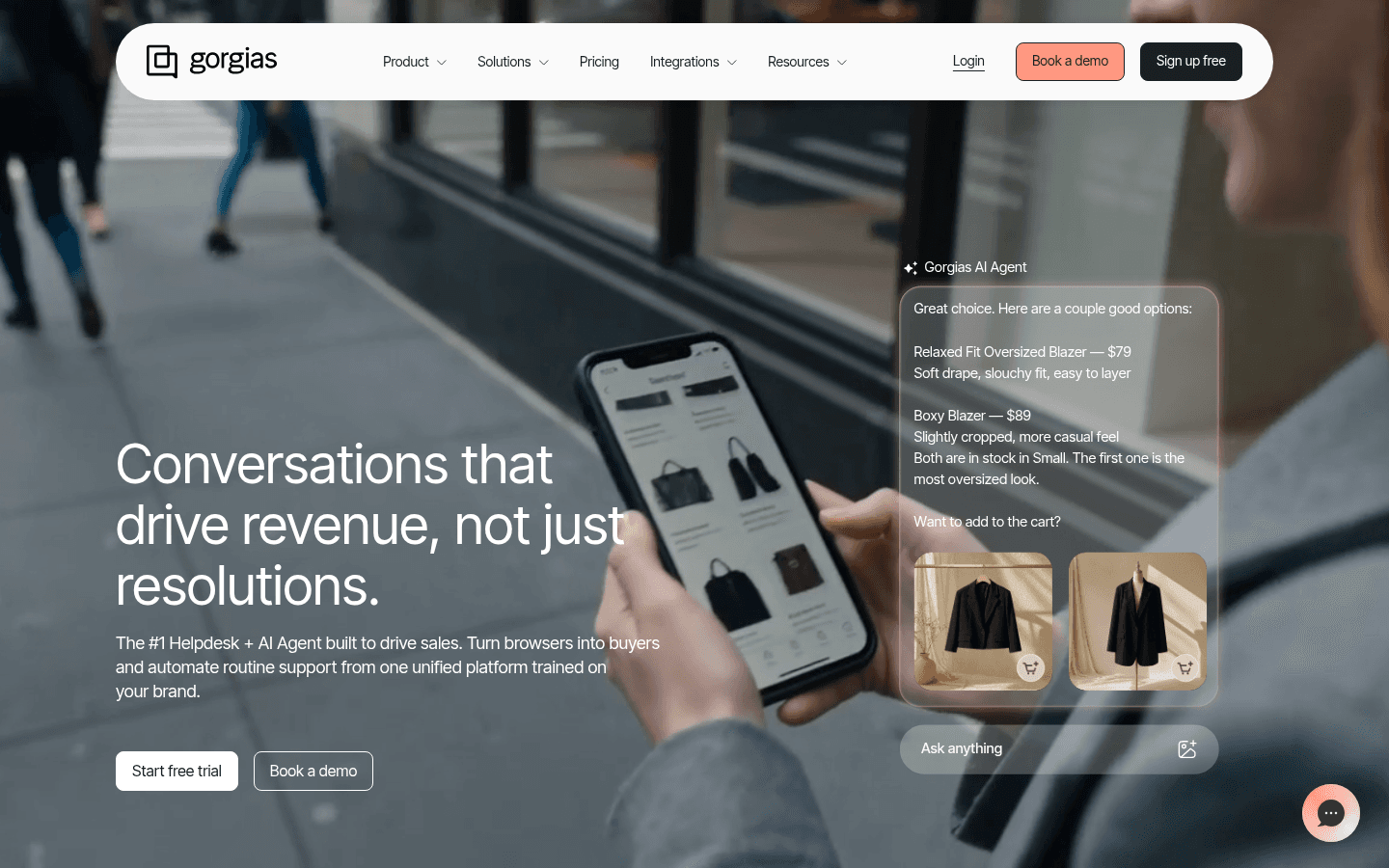
Gorgias is purpose-built for ecommerce. The company powers 40% of Shopify brands and serves 17,000+ ecommerce companies, with named customers like Tommy John, Arc'teryx, Reebok, and Steve Madden. The AI Agent is trained on Shopify data - order history, transaction details, product catalog - which is what makes it qualitatively different from a general helpdesk bot.
Pricing: Starter at $10/month for 50 tickets up to Pro at $300-360/month for 2,000 tickets. All plans include unlimited team seats, which is unusual. AI Agent automation costs $0.90-$1.00 per fully resolved conversation, billed separately. Voice and SMS are add-ons.
The Shopify integration is the killer feature on G2:
"Having order data, customer history, and transaction details pulled directly into the support ticket means our team can resolve issues quickly without toggling between multiple systems."
- verified user, G2 review (4.6/5, 555 reviews)
And the AI Agent:
"Gorgias has enabled our team to automate about 50% of our customer interactions."
- verified user, G2 review
Where it stings: Ticket-based pricing is unpredictable during peak season. The single most common Gorgias complaint on G2 is:
"The main frustration with Gorgias is the pricing model, which is based on ticket volume rather than a flat monthly fee. During peak seasons like the holidays when support volume spikes, the costs can increase significantly in a short period."
- verified user, G2 review
Reporting is also a known weak spot, and one reviewer noted: "While we still have quite a few snags with the AI agent who does give the wrong answers sometimes, it is still faster and more efficient than Zendesk."
Best for: Shopify, BigCommerce, and Magento brands. If you're not in ecommerce, Gorgias isn't the right shape. For ecommerce specifically, our best helpdesk software for ecommerce roundup covers more options.
4. Help Scout
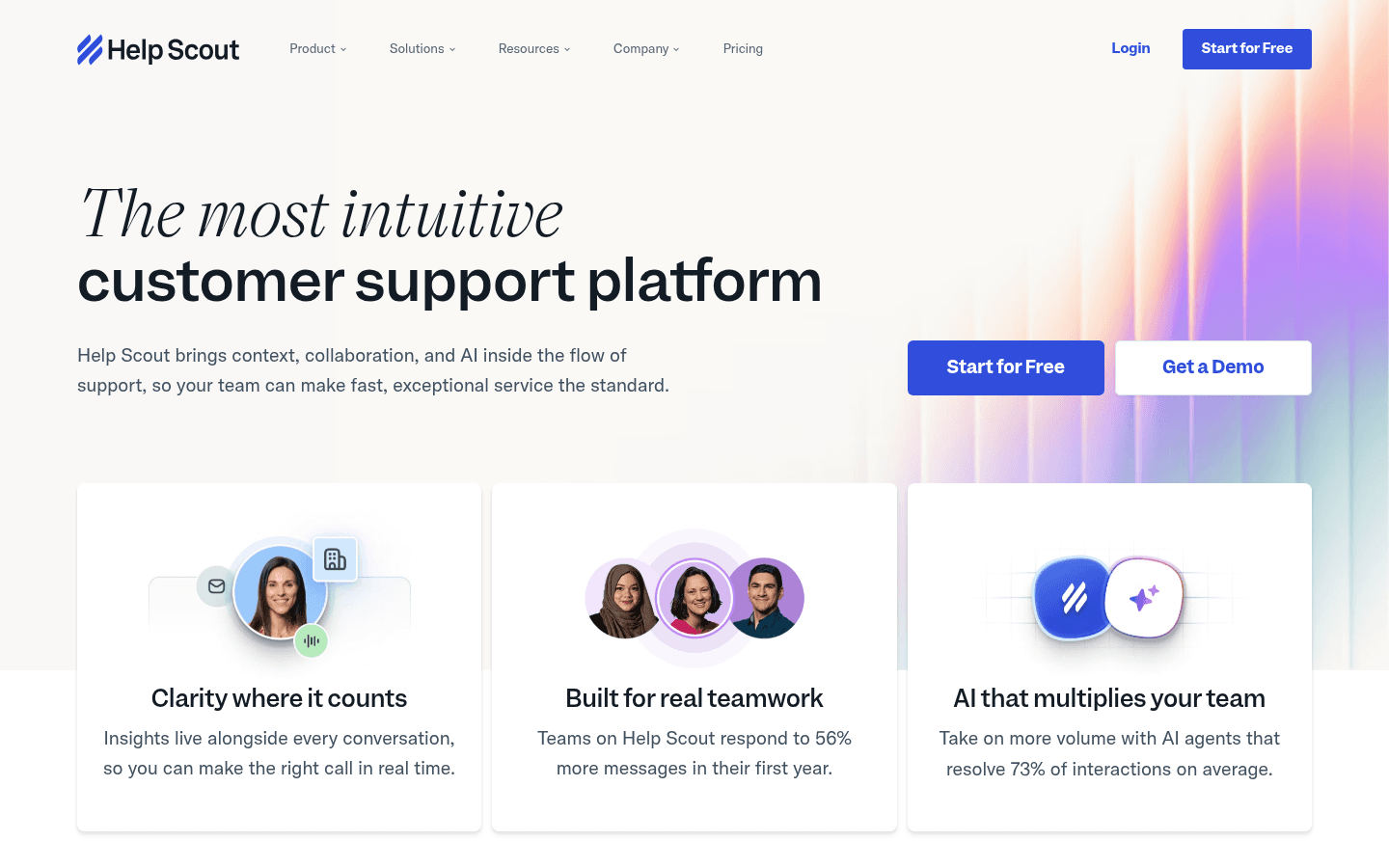
Help Scout is the platform that small B2B and SaaS teams pick when Zendesk feels like too much. The hero copy - "the most intuitive customer support platform" - is also a fair summary of the product. Trusted by 12,000+ companies including Buffer, Vimeo, Gusto, and Litmus.
The AI suite has three pieces: AI Answers (autonomous resolution), AI Drafts (reply generation), and AI Summarize (conversation summaries). The headline number: AI agents resolve an average of 73% of interactions.
Pricing: Free up to 5 users (100 contacts/month), Standard $25/user, Plus $45/user, Pro $75/user (10 user minimum). AI Answers costs $0.75 per successful resolution after a three-month free trial - a generous trial window compared to most competitors.
"Help Scout is a breath of fresh air compared to complex enterprise solutions. It focuses on no-frills support and is just a pleasure to use."
- verified user, Capterra review
Where it's weaker: Recent UI updates have rubbed long-term users the wrong way:
"UX has gotten worse since the last update - agents say things are harder to navigate."
- verified user, Capterra review
And the feature footprint is narrower than Zendesk's - no native voice, lighter omnichannel, less customization on workflow logic. For teams that want a shared inbox plus AI without enterprise sprawl, that's a feature, not a bug.
Best for: Small to mid-sized B2B and SaaS support teams who value a clean, opinionated product over feature breadth. Our I tested the 6 best customer service AI platforms post compares Help Scout's AI against the field.
5. Ada
Ada is the enterprise option. Founded in 2016 and headquartered in Toronto, Ada has deployed 550+ AI agents globally, powered 6.4 billion interactions, and serves 350+ customers including Monday.com, IPSY, Pinterest, Square, and Cebu Pacific.
The technical centerpiece is the Unified Reasoning Engine, a patent-pending AI brain launched in February 2026 that runs identically across 8+ channels (voice, chat, email, WhatsApp, SMS, Instagram, in-app, custom). Named customer outcomes are concrete: Monday.com reports 42% reduction in average handle time, Tilt hit 84% automated resolution on chat, Loop Earplugs cut first response time from 5-6 days to a maximum of 2 hours.
Pricing: Sales-gated, no public pricing. Ada requires a minimum of 300,000 annual customer service conversations to qualify. Third-party estimates put it in the $100,000–$300,000+/year range. From Reddit:
"Used to work for a company paying ~300k+ for Ada, it's expensive. I would stick with Zendesk messaging and answer bot." -- r/CustomerSuccess discussion
The implementation reality: Setup runs 8-16 weeks with Ada's professional services team. Knowledge quality is heavily determinative - Ada's AI learns from formal help documents but, per Reddit feedback, struggles with unstructured sources like past tickets, PDFs, Notion, or Confluence. G2 admin reviews are 4.6/5, but Trustpilot (end-user chatbot experiences) is 2.0/5, which is a telling divergence: builders like the product, end users don't always.
Best for: Enterprises with 300K+ annual conversations, multi-channel deployments, dedicated implementation budget, and patience for an 8-16 week ramp.
6. Decagon
Decagon is the newer enterprise option, founded in 2023 and already serving Hertz, Oura, Duolingo, Chime, Affirm, Notion, and Dropbox. The product is built around Agent Operating Procedures (AOPs) - natural-language instruction sets that CX teams use to design agent logic without code, which compile down to executable workflows.
The case studies are unusually concrete. Chime reports 70% chat and voice resolution, 60% cost reduction, and 1M+ calls/month with zero reliability issues. Duolingo hit 80% chat deflection in one month after a previous vendor failed for a year. Hunter Douglas generated $1M in revenue from fully AI-handled conversations and saw 85% higher average order value from AI-engaged customers.
Pricing: Sales-gated. Industry research suggests a $50,000/year platform fee plus ~$0.99/conversation (most common) or ~$0.50/resolution. Total contract range is $95K-$590K annually, median ~$400K. Implementation requires dedicated engineers and weeks of setup. No trials.
"Limited transparency… you can't always see why it decided something. This is a frequently mentioned complaint, with users noting you can't always see why the AI did what it did, making it tough to review conversations, tweak the agent's behavior, or figure out what went wrong when it makes a mistake." -- r/CustomerSuccess thread on Decagon
Decagon has been investing in transparency tooling (Trace View, Agent Workbench, Watchtower QA) in direct response to this feedback.
Best for: 500+ seat support teams with high ticket volume, existing helpdesk infrastructure, and in-house engineering capacity. Decagon is explicit that it's not for SMBs.
7. Aisera
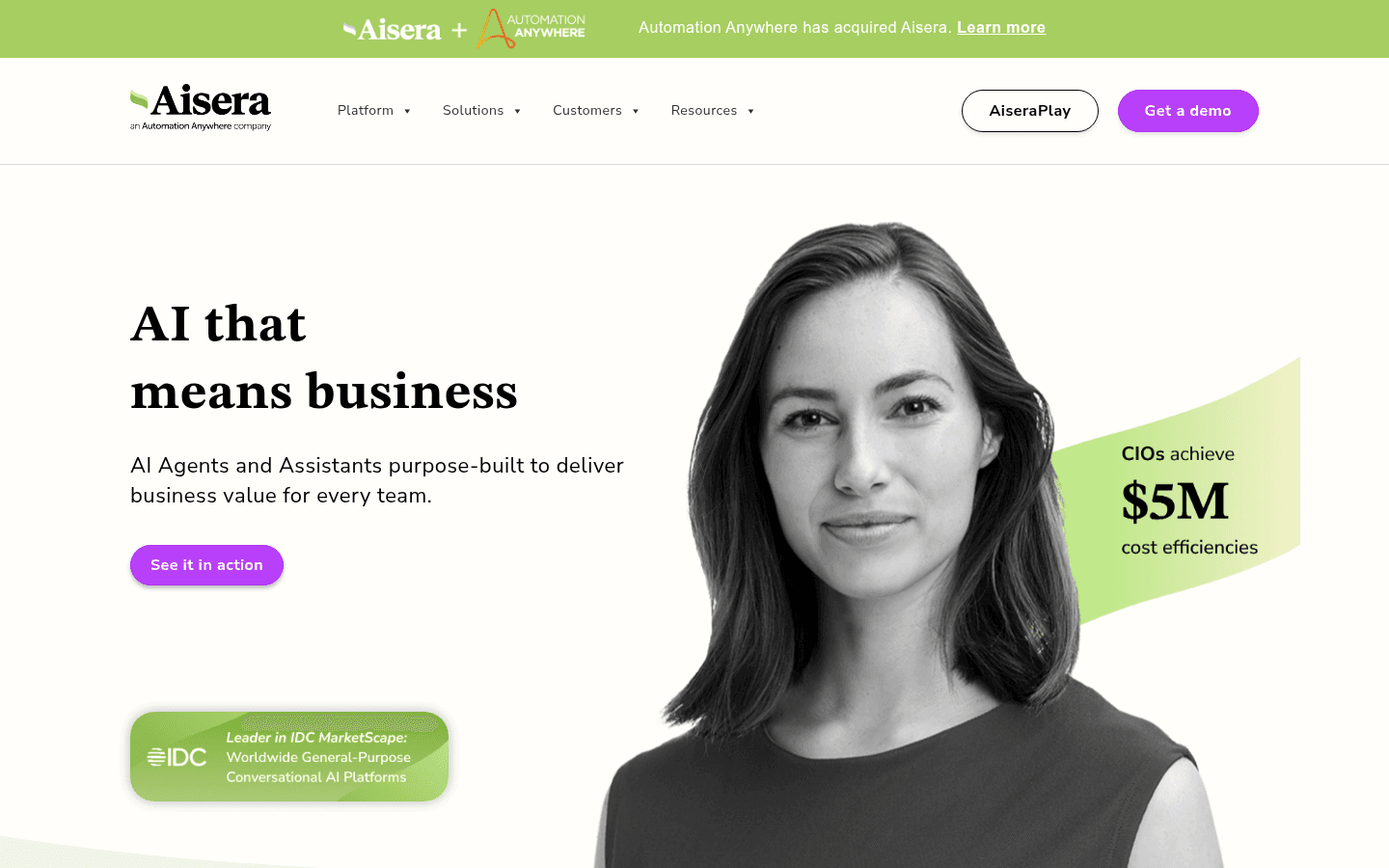
Aisera is the outlier on this list. While most of the alternatives target external customer support, Aisera's center of gravity is internal IT and HR service desks at Global 2000 enterprises. The company was acquired by Automation Anywhere in November 2025 and continues as a product within the Automation Anywhere portfolio.
Aisera is a Gartner Magic Quadrant Leader for AI Applications in ITSM. Named customers include Cisco, Nokia, Workday, Adobe, Gilead Sciences, Instacart, and NJ Transit. The headline metrics are internal-facing: City and County of Denver reports an 81% auto-resolution rate and 79,000 user hours saved; LifeScan reports $2.2M in cost savings and a 65% automatic resolution rate.
Pricing: No public pricing - the pricing page returns 404. Enterprise sales-led model only.
What's in the box: AI Service Desk, Agent Composer (no-code/low-code/pro-code agent creation), Aisera Unify (orchestration across IT, HR, Finance, Procurement, Legal), AIOps, Aisera Assistant, and Agent Assist. Multilingual support across 95+ languages. Compliance covers SOC 2, ISO 27001, GDPR, HIPAA, and CCPA.
Best for: Global 2000 enterprises consolidating internal employee support across IT, HR, and Finance, especially organizations that need ITSM-grade governance.
How pricing models actually break down
The starting-price column in the comparison table is the most misleading part of any Zendesk alternative shortlist. What matters is the model - per-seat scales with headcount, per-resolution scales with success, per-conversation scales with volume.
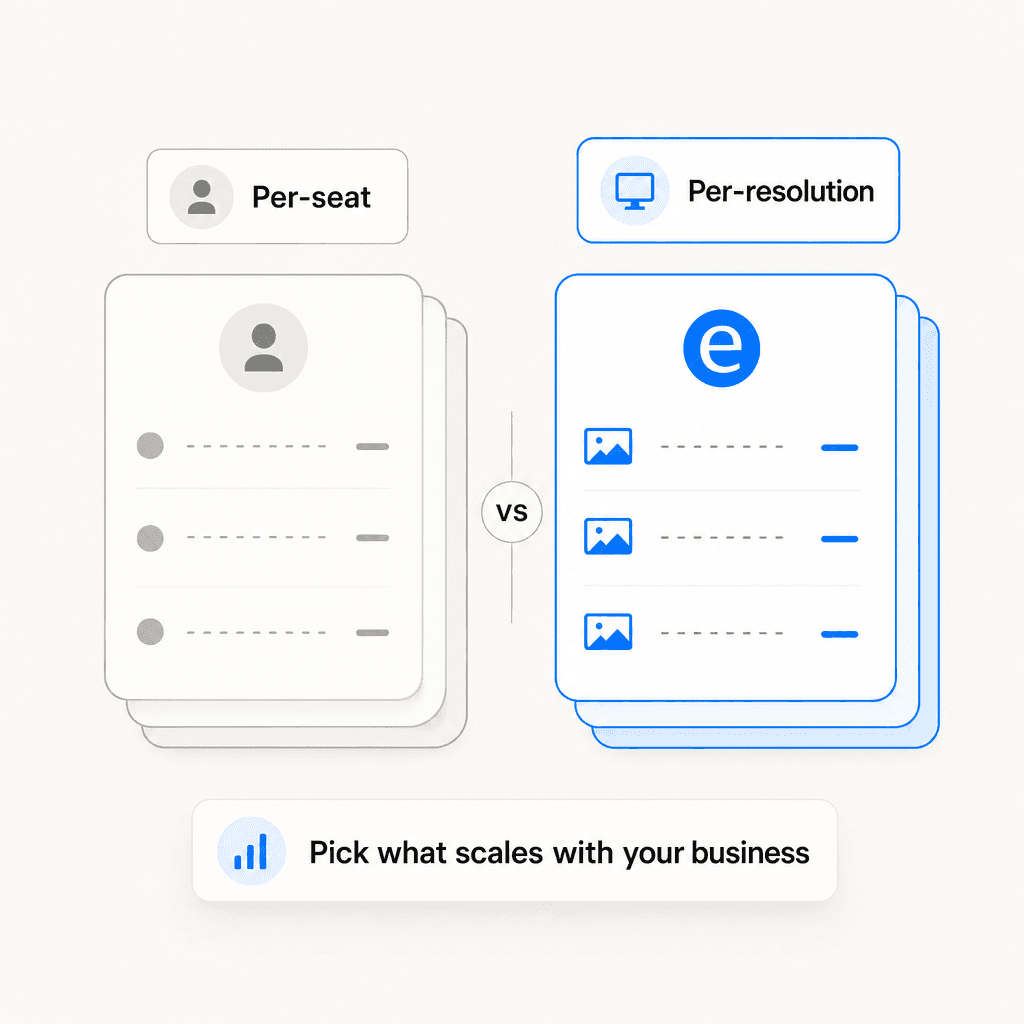
A quick gut check on which model rewards which shape of team:
- Per-seat (Zendesk, Freshdesk, Help Scout) works when your team is small and your volume per agent is high. It punishes growth in headcount even if AI is doing most of the resolving.
- Per-resolution (Help Scout AI Answers, Gorgias AI Agent, eesel AI tasks) works when AI is genuinely deflecting volume. You pay for what the AI actually closes, not for the human seats around it.
- Per-conversation (Decagon, Ada) rewards consistent, high-volume traffic at enterprise scale, but contracts are gated to sales calls and floor pricing means SMBs need not apply.
- Flat tier with usage cap (eesel Team/Business, some Freshworks bundles) gives you a predictable monthly number with a ceiling, which is the easiest to budget against.
If you've already got a helpdesk you're not planning to replace, the cleanest answer is usually to add an AI layer on top rather than re-buy the entire stack.
Why the "AI layer on top" approach is having a moment
Zendesk, Freshdesk, Gorgias, and Help Scout all bundle AI into the platform you're already paying for. That's fine, but it ties you to the AI quality of whichever helpdesk you happened to pick. The alternative pattern - AI as a layer - separates the two decisions.
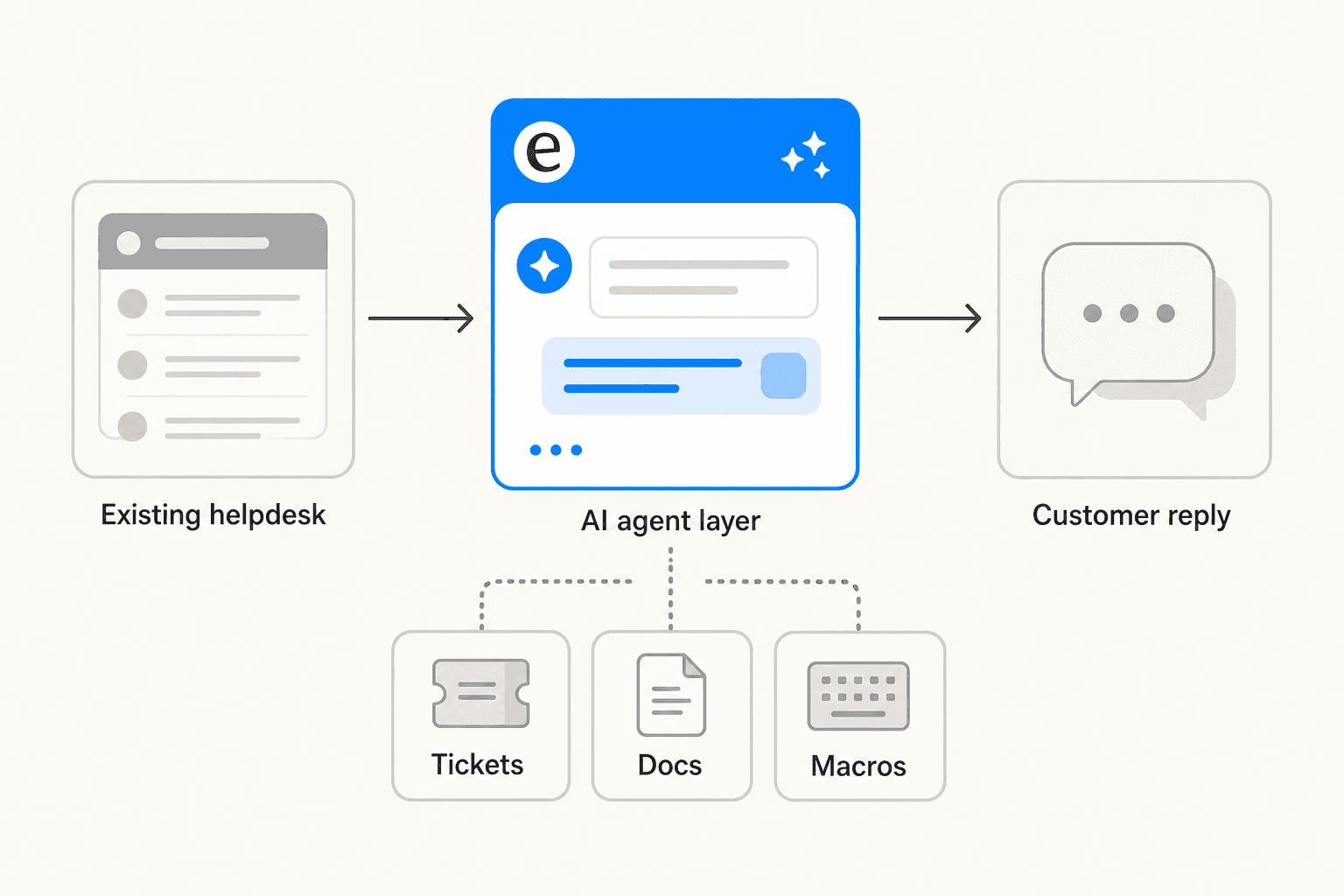
The mechanics: a tool like eesel AI reads your helpdesk's API, ingests your past tickets and knowledge sources, and posts replies through that same API. Your team sees the responses inside Zendesk (or Freshdesk, Gorgias, Help Scout) the way they would any other agent's. The AI doesn't run on the helpdesk vendor's roadmap; it runs on its own.
The reason this is gaining traction: most teams already have a helpdesk they don't want to move off, and the cost of switching outweighs the AI gains from any individual platform's native bot. Adding an AI layer is a $0.40-per-task experiment instead of a six-week migration. If it works, you scale it; if it doesn't, you've changed nothing in your underlying support system.
This is also the only pattern on this list that's compatible with running multiple helpdesks at once - e.g. Zendesk for external customers and Intercom for in-app - without each one having a different AI brain.
Which one is actually right for you
A short summary, in case you skipped to here:
- You're on Zendesk, you don't want to leave, but you want better AI fast. Add eesel AI on top. Live in 15 minutes, no migration, simulate against your past tickets first.
- You want to leave Zendesk for a comparable platform. Freshdesk Omni is the closest like-for-like with bundled Freddy AI, especially if you're mid-market.
- You sell on Shopify. Gorgias, full stop. The ecommerce-specific integrations are not approximated by general helpdesks.
- You're a small B2B/SaaS team. Help Scout. The product is opinionated, the AI is solid, and the pricing scales gently.
- You're enterprise with 300K+ conversations/year and an implementation budget. Ada or Decagon - both will give you the deflection numbers, both will take 8-16 weeks to deploy.
- You're consolidating internal IT/HR service desks at Global 2000 scale. Aisera.
If none of the platforms above feels right, our best AI helpdesk tools and companies using AI for customer service posts cover more options and real-world playbooks.
Try eesel AI on your Zendesk
If you're reading this because Zendesk's bundled AI isn't enough and the Advanced AI Agents add-on is gated behind a sales call, eesel AI is the fastest way to add real agentic AI without changing your helpdesk. It connects to your existing Zendesk in minutes, trains on your past tickets and knowledge sources, and runs a simulation against historical conversations so you see the expected resolution rate before a single live ticket goes through it.
Pricing is usage-based - $0.40 per regular task, no per-seat fee - with $50 in free credits on signup. See the Zendesk integration page for the technical details.

Frequently Asked Questions
For small teams, Help Scout's $25/user Standard plan is one of the cheapest entry points, with autonomous AI Answers billed at $0.75 per successful resolution after a three-month free trial. eesel AI is the cheapest way to add an AI layer without changing your existing helpdesk, since it charges $0.40 per regular task instead of a per-seat fee.
You don't have to switch. Tools like eesel AI sit on top of Zendesk and use your existing ticket history as training data, so the AI inherits your knowledge without a migration. If you do migrate to another helpdesk like Freshdesk or Help Scout, both offer import tools, but the AI training data has to be rebuilt from scratch in most cases.
Zendesk's Essential AI Agents are bundled into every Suite plan and resolve a useful share of tier-1 questions, but the more advanced reasoning, builder, and language features sit behind the sales-gated Advanced AI Agents add-on. If you've outgrown the included tier or want to test agents against your historical tickets before going live, a third-party alternative usually gives you more control.
It ranges from minutes to months. Tools that layer on top of an existing helpdesk, like eesel AI, can be live in under 15 minutes because they reuse your past tickets and docs. Enterprise platforms like Ada and Decagon usually involve 8 to 16 weeks of implementation with dedicated engineers, especially if you're integrating multiple back-end systems.
Nothing changes on the Zendesk side. You keep your existing Suite plan, agent seats, and ticket data, and the AI layer reads from your helpdesk through the official API. The trade-off is you're paying for two tools, so it only makes sense if the AI deflection genuinely offsets the cost. See our guide to AI support ticket deflection for how to model that.
Share this article

Article by
Stevia Putri
Stevia Putri is a marketing generalist at eesel AI, where she helps turn powerful AI tools into stories that resonate. She’s driven by curiosity, clarity, and the human side of technology.