Capacity AI vs. Forethought: Which enterprise AI agent is right for you in 2026?

Stevia Putri
Last edited May 1, 2026
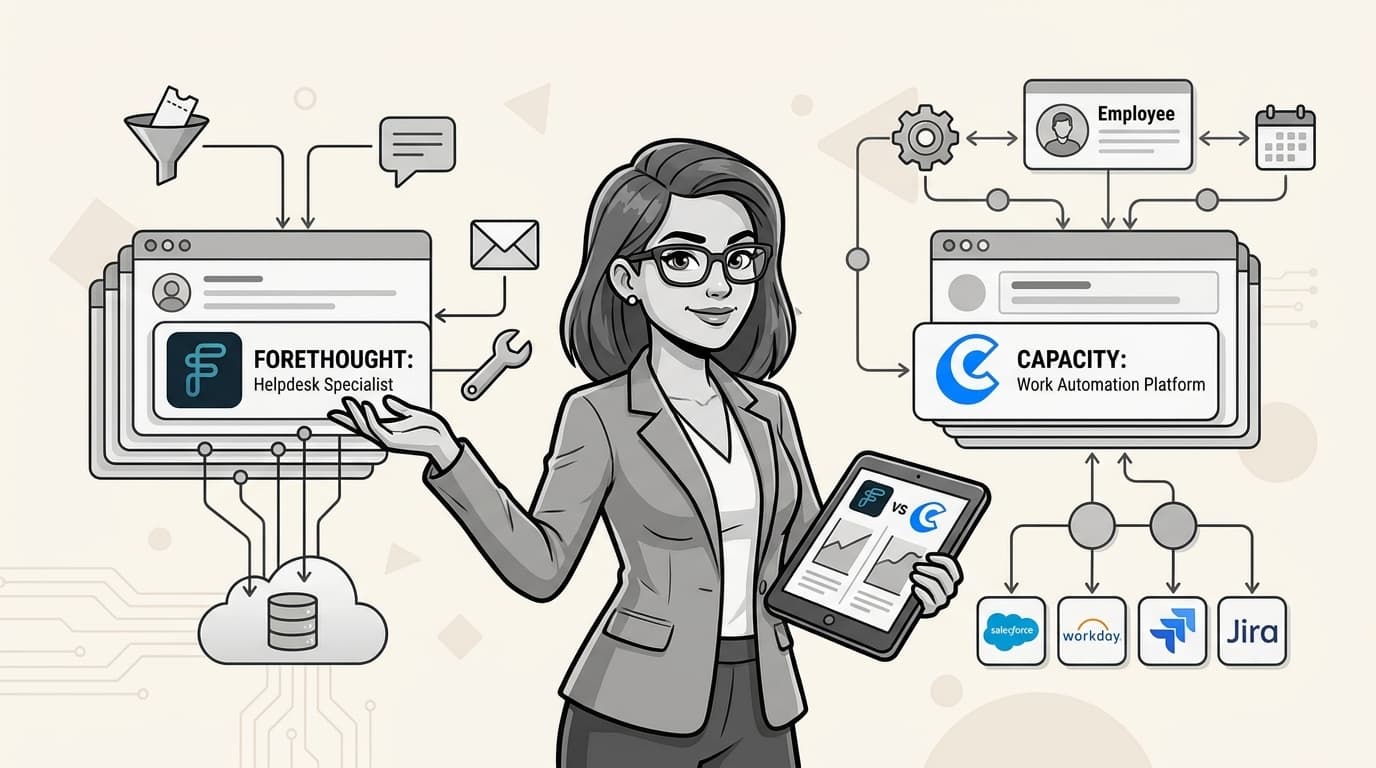
If your team manages 20,000+ monthly tickets, Forethought's enterprise-grade engine wins on raw scale; if you need a broader "Work Automation Platform" across employees and customers, Capacity pulls ahead. The split comes down to one specific requirement: whether you need a deep helpdesk specialist or a cross-functional automation layer. Full comparison below.
The 2026 AI landscape has shifted away from simple chatbots toward fully autonomous agents that can act on your behalf. Choosing between two heavyweights like Capacity AI and Forethought AI is no longer just about who has the better NLP. It is about where you want that intelligence to live: inside your helpdesk, or across your entire business workflow.
What are Capacity AI and Forethought?
Capacity AI positions itself as a "Work Automation Platform." Founded in 2017, it was built to solve a specific problem: the overwhelming volume of repetitive questions hitting both support and HR teams. It functions as an orchestration layer that connects your tech stack to automate support for both customers and employees. Instead of just answering questions, Capacity uses low-code workflows to trigger actions in third-party apps like Salesforce, Workday, and Jira.
Forethought, on the other hand, is a specialized, AI-native customer support platform. It is famous for its 5-agent architecture, which includes Solve, Triage, Assist, Discover, and Agent QA. Each "agent" handles a specific part of the support lifecycle, from autonomous resolution to backend analytics. Forethought focuses exclusively on the customer experience (CX), aiming to be a "24/7 AI team member" that understands the nuance of human conversation.
The context for both tools changed significantly in early 2026. Zendesk's acquisition of Forethought in March 2026 has introduced a new variable for enterprise teams. While Zendesk has committed to maintaining support for other helpdesks like Intercom and Freshdesk, the acquisition signals a deep integration into the Zendesk ecosystem that may leave non-Zendesk users looking for independent alternatives.
Key features comparison: Capacity AI vs. Forethought
When you look under the hood, the philosophies of these two platforms diverge quickly. Forethought's engine, known as SupportGPT, is purpose-built for the complexities of customer service. Its Solve agent handles inquiries across chat, email, and social channels, while Triage automatically routes tickets to the right human agents based on intent.
For agents, Assist serves as a copilot, surfacing relevant knowledge base articles and suggesting complete responses within the helpdesk UI. The 2026 addition of Agent QA is particularly notable, as it automatically audits 100 percent of conversations to ensure brand compliance and quality.
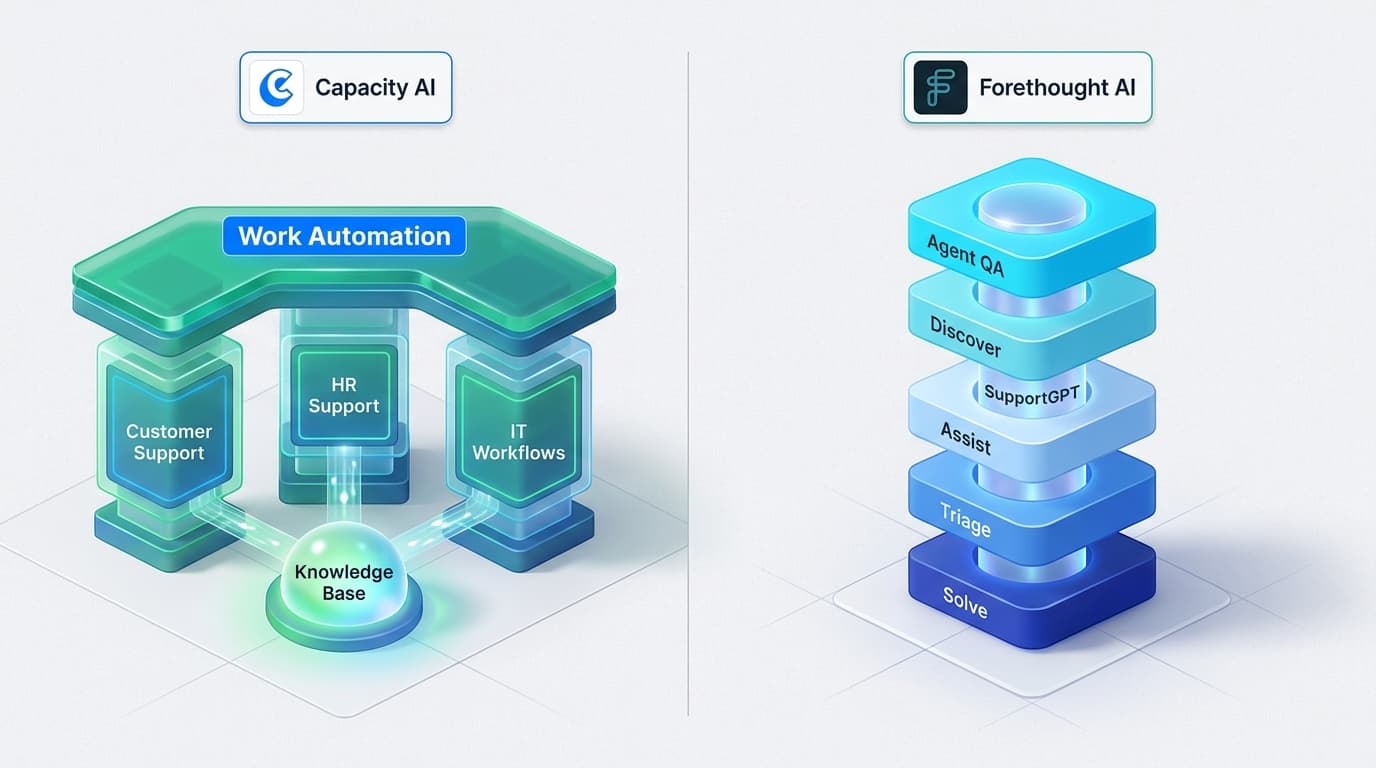
Capacity AI takes a more horizontal approach. While it handles customer support via its Cloud Concierge, its true strength lies in "Work Automation." This includes employee self-service for HR and IT, knowledge management, and task automation. In 2026, Capacity has leaned into "Autonomous Operations," where the platform identifies and resolves systemic IT errors via self-healing workflows before a user even reports them.
Both platforms offer deep integrations with major helpdesks. You can connect Capacity or Forethought to Zendesk, Salesforce, and ServiceNow. However, Capacity's low-code workflow builder makes it a better fit for teams that need to automate complex tasks that span multiple departments, such as employee onboarding or multi-system data synchronization.
Pricing and implementation: The enterprise barrier
Neither tool is a "plug-and-play" solution. Both Capacity and Forethought target mid-to-large enterprises and use sales-led pricing models that often involve high five-figure annual contracts.
Forethought's entry barrier is particularly high. To train its proprietary models effectively, the platform has historically required a significant volume of historical tickets. If you are a smaller team or a startup without that volume of data, Forethought may not be an option. Following Zendesk's acquisition of Forethought in March 2026, pricing is no longer publicly available — contact Zendesk/Forethought directly for a quote.
| Plan | Price | Requirements |
|---|---|---|
| Forethought Enterprise | Pricing not publicly available; contact Zendesk/Forethought for a quote | Significant historical ticket volume required |
Capacity AI uses a sales-led pricing model and does not publish plan prices publicly. To get pricing details, you must request a demo directly with Capacity's sales team.
| Plan | Price | Key Features |
|---|---|---|
| Growth | Pricing available on request | Basic support automation, 1 AI bot |
| Professional | Pricing available on request | Advanced workflow automation, up to 3 bots |
| Enterprise | Custom pricing | Unlimited bots, SSO, 120+ integrations |
Implementation for either platform is an enterprise-scale project. You can expect a timeline of 30 to 90 days to get fully deployed. This includes data ingestion, model training, and workflow configuration. It is a "measure twice, cut once" approach that favors stability over speed.
A more agile alternative for 2026: eesel AI
If the idea of a high five-figure enterprise contract and a three-month setup feels like overkill for your team, you are not alone. In 2026, many teams are moving toward the "Hire your AI team" model pioneered by us at eesel AI.
We believe that you shouldn't have to "configure" an AI platform. You should be able to hire an AI Helpdesk Agent the same way you would hire a human teammate. While enterprise legacy tools take months to ramp up, our AI agents learn your business in minutes. We plug directly into your existing helpdesk (Zendesk, Freshdesk, Intercom, and 100+ other sources) and start learning from your past tickets, help center articles, and internal docs immediately.
One of the biggest frustrations with enterprise AI is the "Black Box" nature of their contracts. We have replaced opaque pricing with a transparent, usage-based model. We charge $0.40 per ticket or chat session, with no platform fees or monthly minimums. This means you only pay for what our AI actually does. We even offer a $50 free trial so you can see the value before committing a single dollar.
| Task Type | Price | Key Features |
|---|---|---|
| Support ticket / chat session | $0.40 each | Autonomous resolution, no platform fee |
| Blog post draft | $4.00 each | SEO-aware, brand voice matching |
| Enterprise | $1,000/month platform fee + usage | SSO, HIPAA, dedicated solutions engineer |
Our performance isn't just for show. Mature eesel AI deployments achieve up to 81% autonomous resolution out of the box. You can even run simulations on your past tickets to see exactly how our AI would have responded, giving you total confidence in the quality of the output before you ever go live.
Choosing the right AI agent for your business
The choice between Capacity AI and Forethought ultimately depends on where your biggest bottlenecks live.
Pick Forethought if you are a large enterprise team (primarily on Zendesk) that manages massive ticket volumes and needs specialized agents for every stage of the customer journey. It is a powerful, deep-vertical tool for support leaders who have the budget and the data to feed its engine.
Pick Capacity if you need a horizontal automation layer that can handle both employee and customer support. If your goal is to automate repetitive tasks across HR, IT, and customer service using a single platform, Capacity's workflow orchestration is the better fit.
However, if you want the same high-tier performance without the enterprise baggage, we recommend trying an agile approach. Our AI Helpdesk Agent gives you the speed, transparency, and 81% autonomous resolution you need to scale your support without the months of implementation or the high five-figure barrier to entry.

Frequently Asked Questions
Share this article

Article by
Stevia Putri
Stevia Putri is a marketing generalist at eesel AI, where she helps turn powerful AI tools into stories that resonate. She’s driven by curiosity, clarity, and the human side of technology.