Ticket deflection has become a top priority for support teams looking to scale without proportionally increasing headcount. When customers can resolve issues on their own, everyone wins: they get faster answers, and your team focuses on complex problems that actually need human expertise.
Decagon has emerged as one of the most visible players in this space, with reported deflection rates nearing 70% and high-profile customers like Duolingo and Bilt. But how does their approach actually work? And what alternatives should you consider before making a decision?
Let's break it down.
What is ticket deflection?
Ticket deflection is the practice of resolving customer issues through self-service or automation before they become formal support tickets requiring human agent time. Think of it as giving customers the tools to solve their own problems, whether that's through a knowledge base article, an AI chatbot, or an automated workflow.
Here's the key distinction: deflection is not about avoiding customers or making support harder to reach. That's ticket avoidance, and it backfires. Good deflection makes help easier to access and faster to consume. A customer who finds an accurate answer in two minutes through self-service has a better experience than one who waits 20 minutes for an agent to provide the same information.
How to calculate your deflection rate
The basic formula is straightforward:
Deflection Rate (%) = (Total Issues Resolved via Self-Service / Total Issues Submitted) × 100
Some teams also track it as a ratio: if 800 people use your self-service options and 200 still open tickets, your deflection ratio is 4:1.
Industry benchmarks
Context matters when evaluating your numbers:
| Performance Level | Deflection Rate | Source |
|---|---|---|
| Average (tech industry) | 23% | Pylon research |
| Good performance | 40-50% | Industry standards |
| Best-in-class | 60-85% | Leading AI implementations |
How Decagon approaches ticket deflection
Decagon positions itself as a conversational AI platform for enterprise customer experiences. The company has raised significant funding ($131M at a $1.5B valuation according to industry reports) and counts notable brands like Notion, Duolingo, Rippling, and ClassPass among its customers.
Core technology: Agent Operating Procedures
Decagon's platform is built around something they call Agent Operating Procedures (AOPs). This is a hybrid system that lets support teams define how the AI behaves using plain English instructions, while engineers maintain code-level control over technical boundaries.
The idea is that support managers who understand customer problems can directly teach the AI how to handle situations, without waiting for engineering resources to code every change. When policies change, customer service managers can adjust the AI's responses the same day.
Action-oriented AI
Where some AI tools stop at conversational responses, Decagon emphasizes action. Their agents can execute multi-step tasks like:
- Processing refunds and returns
- Updating subscriptions
- Verifying user identity
- Looking up order status
- Creating tickets in other systems
This requires API integrations with your existing tools, which Decagon handles through their platform.
Quality assurance layers
Decagon includes systems called Watchtower and Guardrails that monitor every AI interaction in real-time. These check responses against company policies, flag potential hallucinations before they reach customers, and alert human supervisors when the AI encounters situations outside its training.
The platform also uses intelligent segmentation to route different types of issues differently. Simple password resets get fully automated handling. Complex billing disputes route to specialists. Emotional situations involving frustrated customers trigger immediate human intervention.
Decagon ticket deflection results and case studies
Decagon publishes several customer success metrics:
| Customer | Metric | Result |
|---|---|---|
| Duolingo | Chat deflection | 80% (up from 30% with previous vendor) |
| Bilt | Ticket handling | 70% of 60,000 monthly tickets with AI |
| Rippling | Chat deflection | Increased from 38% to 50%+ |
| NG.CASH | Autonomous resolution | From 13% to 70% |
| ClassPass | Cost reduction | 95% reduction in support conversations |
The Duolingo case study is particularly detailed. Decagon claims they went live in one month with immediate results: 80% of chat inquiries fully resolved from day one, automated hourly FAQ updates that eliminated manual work, and minimal ongoing management effort. The Senior Operations Manager called it "a night-and-day difference" and "a game changer for our team."
Implementation timeline
Decagon emphasizes speed to value. The Duolingo implementation reportedly took one month from start to full deployment, which is faster than many enterprise AI rollouts that can take 3-6 months.
Key features of Decagon's deflection system
Based on their documentation and case studies, here are the core capabilities:
- Natural language understanding for intent detection and contextual responses
- Multi-step workflow automation for complex processes like refunds and account updates
- Ground truth enforcement that prevents the AI from extrapolating or creating its own policies
- Multi-model architecture using different AI models for different tasks rather than a single LLM
- Seamless escalation with full conversation preservation when human help is needed
- Real-time analytics monitoring performance and flagging issues
- Continuous learning from agent corrections and feedback
Notable customer list
Decagon's website displays logos from: Notion, Eventbrite, Oura, Bilt, ClassPass, Rippling, Curology, Noom, Samsara, Duolingo, Gopuff, Chime, Affirm, Hertz, Mercado Libre, Hunter Douglas, and Wonder.
Decagon alternatives for ticket deflection
Decagon isn't the only option for teams looking to implement AI ticket deflection. Here's how some alternatives compare.
eesel AI
We approach ticket deflection differently at eesel AI. Instead of positioning our product as a tool you configure, we frame it as an AI teammate you hire and level up.
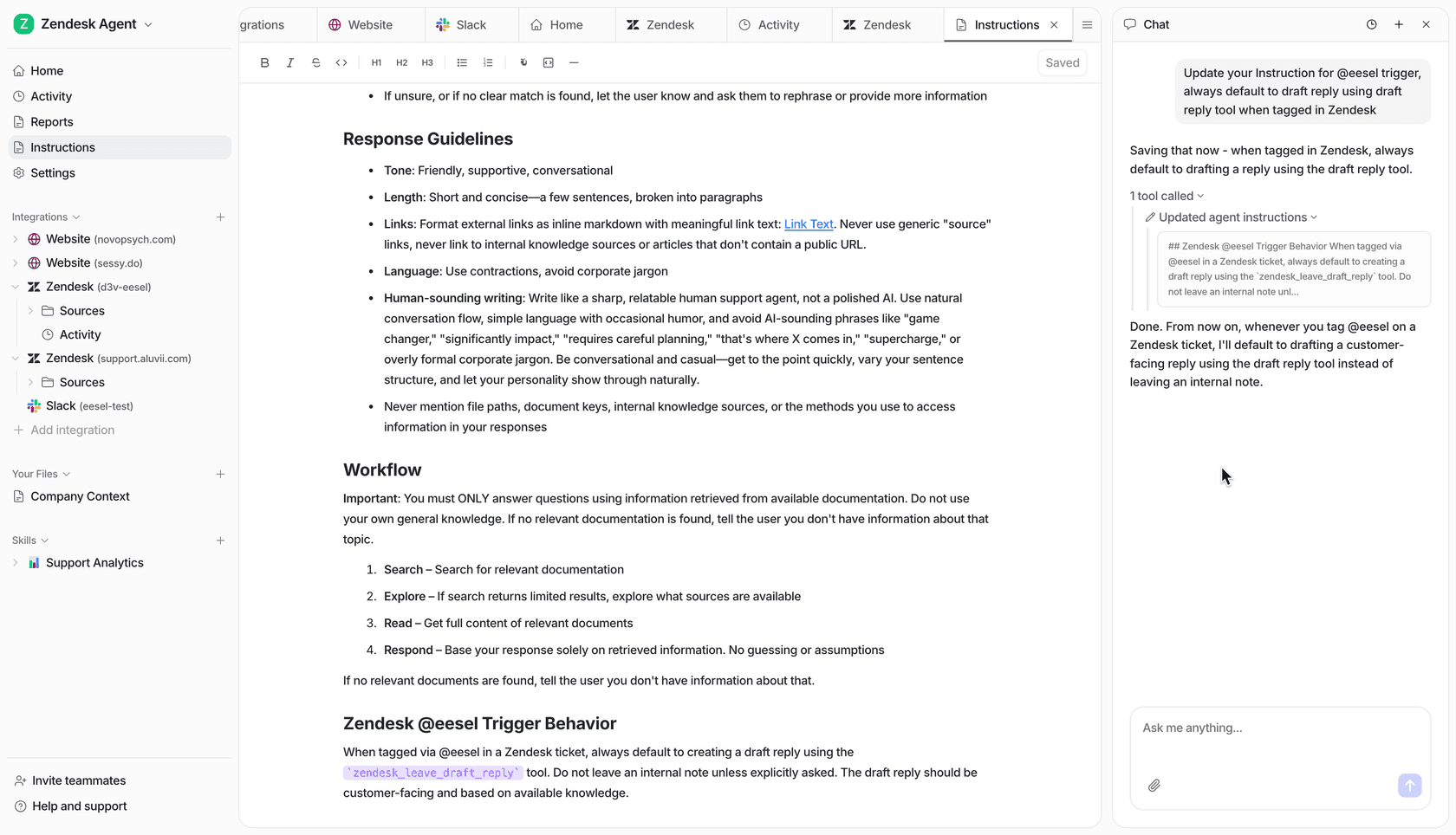
The core difference is in the mental model. Traditional AI tools require extensive setup, training, and configuration. Our AI Agent connects to your help desk and learns your business in minutes from existing data: past tickets, macros, help center articles, and connected docs like Confluence or Notion. What takes a human weeks to learn, we absorb instantly.
Progressive rollout
One of our key differentiators is how teams deploy the AI. Rather than flipping a switch and hoping for the best, you start with guidance:
- Have the AI draft replies that agents review before sending
- Limit it to specific ticket types or queues
- Set business hours when the AI can respond
As the AI proves itself, you expand its scope based on actual performance. Mature deployments achieve up to 81% autonomous resolution, with a typical payback period under 2 months.
Pre-go-live testing
Before the AI ever touches a real customer, you can run simulations on thousands of past tickets. See exactly how it would have responded. Measure resolution rates. Identify gaps. Tune prompts. This lets you verify quality and gain confidence before going live.
Plain-English control
You define what the AI handles and when it escalates using natural language: "If the refund request is over 30 days, politely decline and offer store credit." "Always escalate billing disputes to a human." No code required.
Pricing
Our pricing is transparent and based on interactions, not seats:
| Plan | Monthly | Annual | Bots | Interactions/mo |
|---|---|---|---|---|
| Team | $299 | $239/mo | Up to 3 | 1,000 |
| Business | $799 | $639/mo | Unlimited | 3,000 |
| Custom | Contact us | Custom | Unlimited | Unlimited |
We also offer a 20% discount on annual plans, month-to-month options, and no per-agent fees.
Integration ecosystem
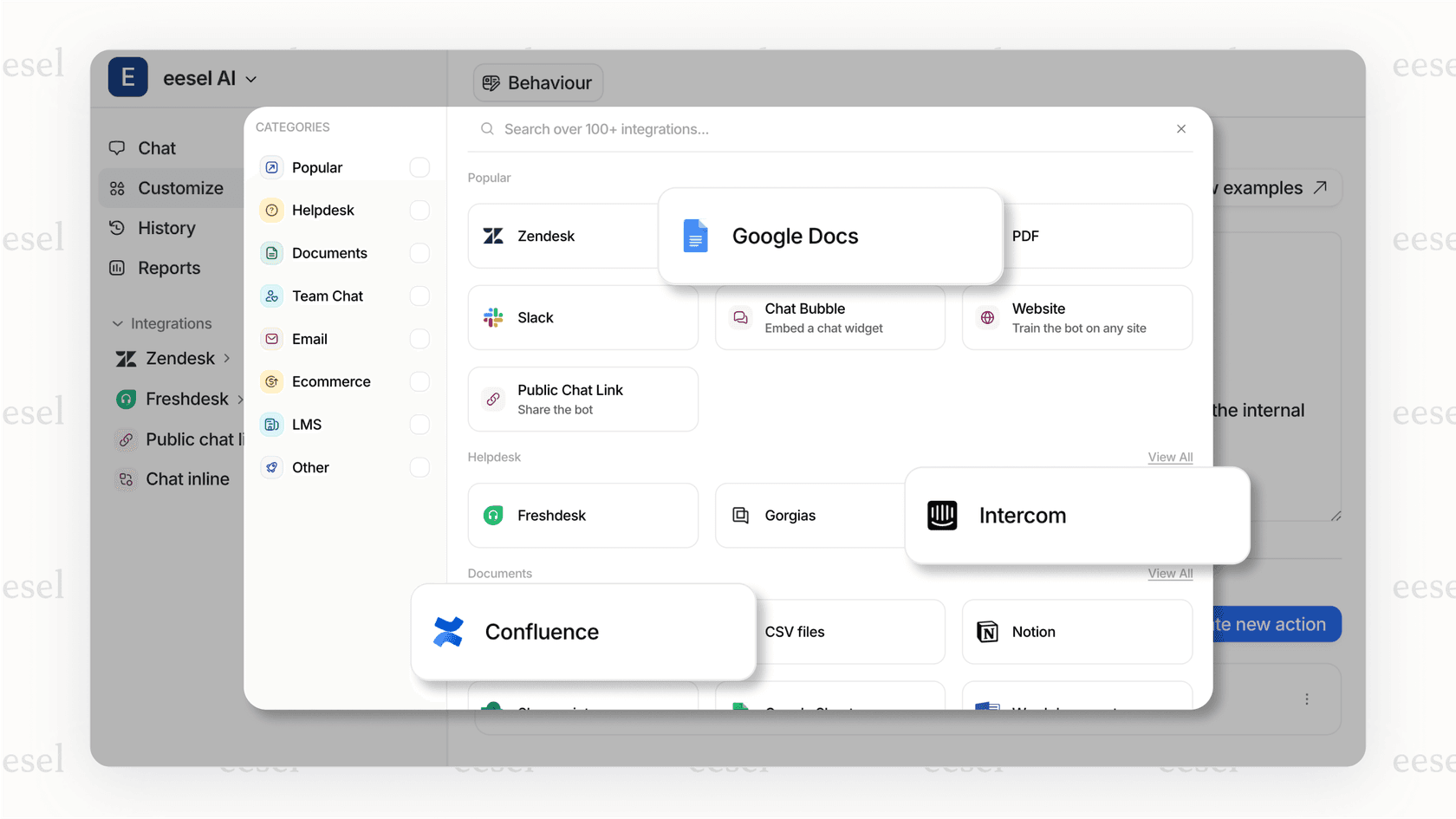
We connect with 100+ tools including Zendesk, Freshdesk, Intercom, Gorgias, Slack, Shopify, and many more. You can see the full list on our integrations page.
Other platforms to consider
Gorgias focuses on eCommerce support with strong Shopify integration, reporting 60% deflection rates for smaller SMBs.
Forethought emphasizes conversational AI with a workflow builder for creating automated processes.
Pylon targets B2B support with omnichannel capabilities across Slack, Teams, email, and chat.
Capacity claims up to 90% automation for SaaS and tech-forward teams.
Choosing the right ticket deflection solution
The best choice depends on your specific situation. Here are factors to consider:
Integration requirements: What help desk and tools do you already use? The AI needs to connect to your existing stack.
Team size and ticket volume: Some platforms target enterprise teams with 10,000+ monthly tickets. Others work well for smaller operations.
Implementation complexity: How quickly do you need to see results? Some platforms promise deployment in weeks, others take months.
Pricing model: Per-interaction, per-seat, or custom enterprise pricing? Make sure you understand total cost of ownership.
Testing capabilities: Can you verify quality before going live? Pre-deployment testing reduces risk significantly.
Transparency: Is pricing public or contact-sales? Are case studies detailed or vague? Transparency often correlates with confidence in the product.
Getting started with AI ticket deflection
If you're considering AI ticket deflection, here's a practical path forward:
-
Audit your current support operations. Identify high-volume, low-complexity issues that follow predictable patterns. These are your best deflection candidates.
-
Start with a limited pilot. Pick one channel (email or chat) and a subset of ticket types. Get the system working well before expanding.
-
Build quality knowledge base content. AI is only as good as the information it can reference. Invest in clear, accurate documentation.
-
Monitor deflection rate alongside CSAT. High deflection with low satisfaction means you're avoiding tickets, not resolving issues.
-
Plan for continuous improvement. The best implementations get better over time through feedback and iteration.
If you want to see how an AI teammate approach might work for your team, you can try eesel AI free or book a demo to discuss your specific needs.