


New AI models are released frequently, and one that is gaining significant attention is DeepSeek V3.2. This new open-weight model from DeepSeek AI is notable for its performance, which is being compared to models like GPT-5.
While this represents a significant step for developers and researchers, the technical details can be complex. For businesses, the primary question is about its practical applications. Understanding its uses, limitations, and the costs involved is key to leveraging its capabilities.
What is DeepSeek V3.2?
DeepSeek V3.2 is a large language model (LLM) built to be both powerful and computationally efficient. It is the official follow-up to the experimental V3.2-Exp model, and it is designed to handle tough reasoning tasks and act as a capable AI agent without needing a supercomputer for every job.
It comes in a couple of different flavors:3.2 Speciale, though... isn't the 'Speciale' part just making it better at math stuff? Not sure the '3.2 Speciale' improvements over '3.2' will do anything for writing. (NOT talking about '3.2 Exp', the one that has been out for a while. Talking about the two that both came out today: '3.2' vs '3.2 Speciale').

-
DeepSeek V3.2: This is the main version, available through a web interface, app, and API. Think of it as the versatile all-rounder, great for a wide range of tasks and particularly good at using external tools to get things done.
-
DeepSeek V3.2-Speciale: This one is a specialist, available only via API. It was trained exclusively on deep reasoning tasks and excels at competitive programming and advanced math. The trade-off is that it doesn't support tool-calling, so it is less of a generalist. It is also only available for a limited time, through a temporary endpoint until December 15th, 2025.
What makes this a big deal is that it is an "open-weight" model. This means the model's core components (its weights) are publicly available on platforms like Hugging Face for both the standard and Speciale versions. This opens the door for researchers and developers to build on top of it, customize it, and see what's possible.
Key features of DeepSeek V3.2
The model's performance is attributed to several innovations that enhance its speed, intelligence, and capabilities.
Greater efficiency with DeepSeek Sparse Attention (DSA)
One of the biggest bottlenecks for LLMs is "attention," which is how the model looks back at the context of a conversation to generate a relevant response. Normal attention is computationally expensive because the AI has to analyze every single previous word.
DeepSeek V3.2 uses a smarter approach called DeepSeek Sparse Attention (DSA). It has a "lightning indexer" and "token-selector" that quickly find and focus on only the most relevant parts of the text. Instead of analyzing everything, it picks out the key pieces.
This change significantly cuts down the computational load, improving speed and reducing costs, especially for tasks involving long documents or chat histories. It is an innovation that was first tested in the experimental V3.2-Exp model and has now been perfected.
Scalable reinforcement learning for advanced reasoning
To get really good at complex reasoning, DeepSeek V3.2 was trained using a method called Reinforcement Learning with Verifiable Rewards (RLVR). Instead of just getting feedback from humans, the model is rewarded for producing verifiably correct answers in areas like math and coding. This is analogous to rewarding a student for showing their work, not just for getting the right answer.
It also learns to double-check its own work. The model can verify its reasoning steps and refine its answers, which leads to more reliable outputs. As the creators noted, this is important because "correct answers don't guarantee correct reasoning."
The model even has a "Thinking" mode, available in the deepseek-reasoner API model, which lets it plan and reason about a task before generating an answer. This is a big step towards more thoughtful and accurate AI.
Agentic capabilities and tool integration
DeepSeek V3.2 isn't just about generating text; it is designed to be an "agent" that can use external tools to complete tasks. It was trained using a pipeline with over 1,800 environments.
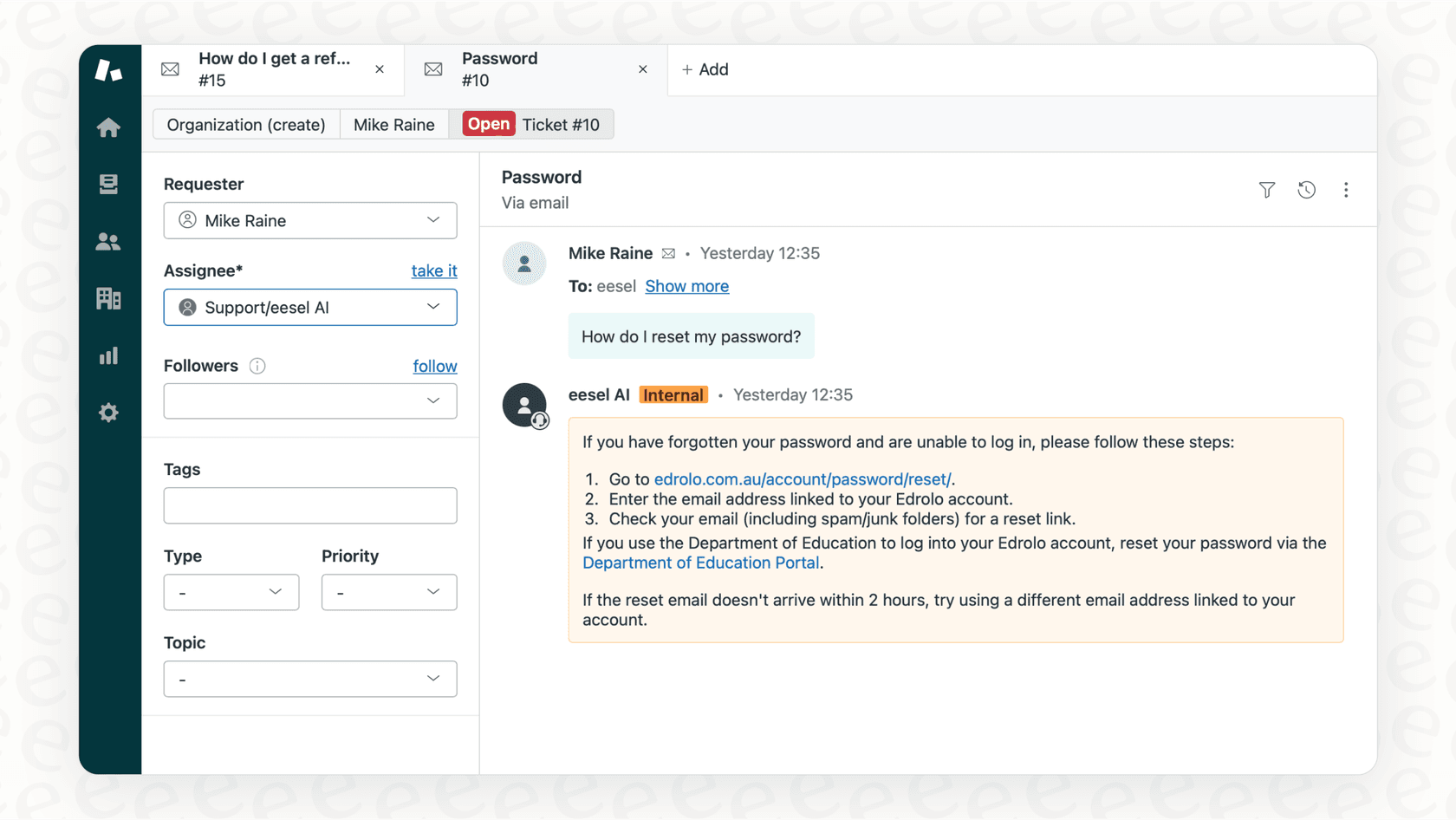
This is what lets the AI move from just talking about something to actually doing it, like looking up an order or processing a refund. For businesses, this is a significant capability. However, building and managing connections to your specific business tools (like Zendesk for support tickets or Shopify for e-commerce) is a significant engineering project if you are just using the raw model. It is a powerful engine, but you still have to build the car around it.
DeepSeek V3.2 performance and benchmarks
The team at DeepSeek AI has been transparent, publishing extensive benchmarks in their technical report. The results show that V3.2 is not just catching up to proprietary models; it's competing head-to-head with the best in the world.
Comparison to leading models
The official technical report shows that the standard DeepSeek V3.2 model performs on par with GPT-5 on key benchmarks. The V3.2-Speciale variant reportedly surpasses GPT-5 in reasoning and has performance comparable to Gemini-3.0-Pro.
Here is a quick look at how the models stack up on some of the toughest evaluation benchmarks:Just tried it in OpenRouter as the deepseek web still has the old version, then gave it my most difficult questions that only Sonnet 4.5, Opus 4.5 and Gemini 3.0 can do. Results: DeepSeek v3.2 Speciale also responds them correctly. First Open Model that does that, not even GLM 4.6 could.
| Model | HLE (Holistic Language Evaluation) | Codeforces (Elo) | MMLU-Pro | GPQA-Diamond |
|---|---|---|---|---|
| DeepSeek V3.2 | 21.7 | 2046 | 85.0 | 80.7 |
| DeepSeek V3.2-Speciale | 25.1 | 2401 | 86.2 | 84.1 |
| GPT-5 | 23.5 | 2355 | 85.8 | 83.0 |
| Gemini-3.0-Pro | 26.3 | 2420 | 86.5 | 84.8 |
Achievements in specialized domains
Beyond benchmark scores, the model has shown notable real-world achievements. The V3.2-Speciale model demonstrated high-level performance in international academic competitions.
It also aced tests in the ICPC World Finals and the Chinese Mathematical Olympiad. This demonstrates its capability to handle complex and specialized problems, extending beyond simple text generation to high-level problem-solving.
Practical considerations for using DeepSeek V3.2
While the model's raw power is undeniable, turning it into a useful tool for your business requires some practical planning. It is not quite plug-and-play.
It is certainly good at writing compelling and creative scenes. However, it looks like it's a model that likes to impersonate and that's a no go. I'll have to see if it can be prompted to avoid that pitfall, because otherwise, I can see it becoming one of my regular rotation.
How to access and run the DeepSeek V3.2 model
The easiest way to get started is by using the DeepSeek Platform API. You can sign up and start making calls right away. Remember that the hyper-specialized Speciale variant is on a temporary endpoint that expires on December 15th, 2025.
Running the model on your own servers is technically possible, but it is a serious undertaking. It requires custom code, specialized tools like vLLM, and a whole lot of expensive GPU hardware. For most businesses, this just is not a practical option.
API pricing and cost for DeepSeek V3.2
DeepSeek V3.2 is priced per million tokens (a token is basically a word or part of a word). The cost is competitive, but it can add up fast if you are using it at scale. The pricing also changes based on whether the model is in "Thinking Mode" and whether your input text has been processed before (a "cache hit").
Here's the breakdown from their official pricing page:
| Model Version | Input Price (1M Tokens) | Output Price (1M Tokens) |
|---|---|---|
| DeepSeek-V3.2 (Non-thinking) | $0.28 (cache miss) / $0.028 (cache hit) | $0.42 |
| DeepSeek-V3.2 (Thinking) | $0.28 (cache miss) / $0.028 (cache hit) | $0.42 |
The V3.2-Speciale model is offered at the same price for as long as it's available, which is a great deal for its specialized power.
The gap between a model and a business solution
A key consideration is that DeepSeek V3.2 is a foundational engine. For a business, a complete solution requires more than the engine alone. A raw LLM is one component of a larger system.
Here's what's missing if you just use the API:
-
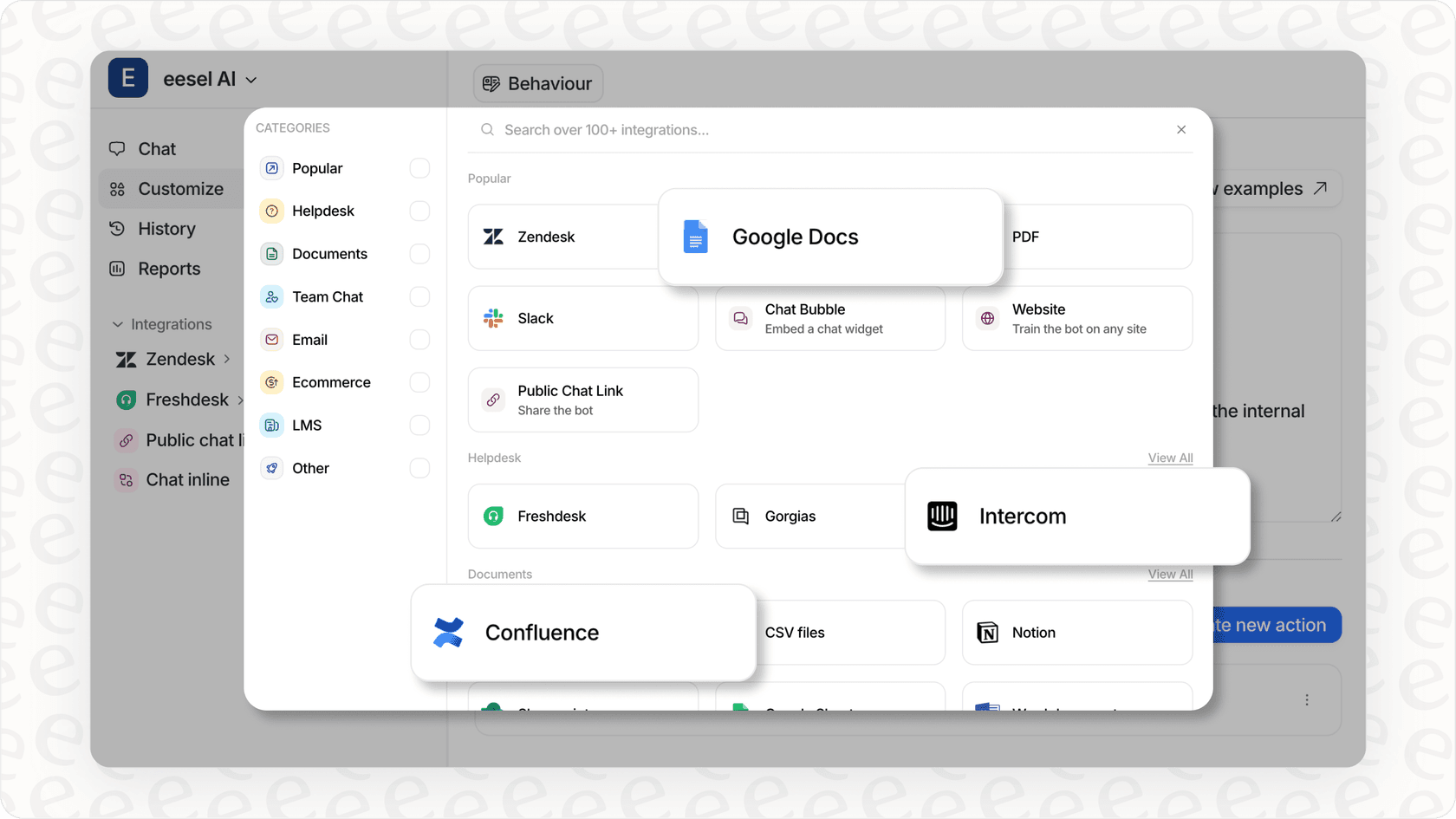
Integrations: The model can't talk to your help desk, e-commerce platform, or internal wiki out of the box. Connecting it to your business systems like Zendesk, Shopify, or Slack takes a ton of custom development work.
-
Application Layer: There's no dashboard for your team to use, no reporting to see how it is performing, and no simple way to set business rules like, "Always escalate billing questions to a human."
-
Continuous Learning Loop: The model won't automatically learn from your latest support tickets or updated knowledge base articles. You would have to build a whole data pipeline to keep it fresh.
-
Data Privacy: DeepSeek's privacy policy mentions that user data might be used to improve their services (though you can opt-out), and data is stored in the PRC. This can be a deal-breaker for businesses with strict data residency or privacy requirements.
This is where platforms like eesel AI can be useful. eesel provides an AI solution for customer service that integrates powerful models. It is designed to connect to business tools, learn from existing data, and allow for performance testing in a safe environment before customer interaction. eesel also has policies regarding data privacy, such as contractually guaranteeing data is not used for training and offering EU data residency for compliance needs.
A major step for open models
DeepSeek V3.2 represents a significant achievement in open-weight models, providing developers with a powerful new tool. It shows that high-performance AI is becoming more accessible.
For a deeper dive into the technical achievements and what makes this model a potential new state-of-the-art contender, this video from bycloud offers a great visual explanation of its capabilities.
Next steps can be considered from two perspectives:
-
For developers: The DeepSeek API and the models on Hugging Face offer a direct way to explore the model's capabilities.
-
For business leaders: The increasing power and accessibility of AI models present a choice. Businesses can either develop in-house solutions or partner with platforms that specialize in integrating this technology into secure and reliable business tools.
For companies looking to apply AI for support automation and agent efficiency, solutions like eesel AI are available. eesel is designed to integrate with business systems and learn from company data to provide automated customer resolutions, with reported results of up to 81% autonomous resolution.
Frequently asked questions
What makes DeepSeek V3.2 different from other large language models?
DeepSeek V3.2 stands out due to its "open-weight" nature, allowing developers to build on it, and its use of DeepSeek Sparse Attention (DSA) for greater efficiency. This means it's both powerful and less computationally expensive, especially for tasks with long contexts.
Can I use DeepSeek V3.2 for my business right away?
While you can access DeepSeek V3.2 via its API, using it effectively for business requires significant development work. You'd need to build integrations to your existing tools (like Zendesk or Shopify), create a user interface, and manage data pipelines. Platforms like eesel AI handle this for you, providing a ready-to-use solution powered by models like this one.
Is DeepSeek V3.2 free to use?
No, DeepSeek V3.2 is not free. It's priced based on token usage through its API. The cost varies depending on whether you're using the standard or "Thinking" mode and can add up quickly at scale. While the model weights are open for researchers, commercial use via the API is a paid service.
How does the performance of DeepSeek V3.2 compare to models like GPT-5?
According to its official technical report, the standard DeepSeek V3.2 model performs on par with GPT-5 on several key benchmarks. The specialized version, DeepSeek V3.2-Speciale, even surpasses GPT-5 in complex reasoning tasks, making it a top competitor in the AI space.
What are the main limitations of using DeepSeek V3.2?
The main limitations are practical. The raw model lacks business-specific integrations, a user-friendly application layer, and an automatic learning loop. Additionally, its data privacy policy, which notes data is stored in the PRC, might be a concern for businesses with strict data residency requirements.
What is the difference between DeepSeek V3.2 and DeepSeek V3.2-Speciale?
The standard DeepSeek V3.2 is a versatile all-rounder that supports tool-calling, making it great for a wide range of agentic tasks. DeepSeek V3.2-Speciale is a highly specialized version trained for deep reasoning, excelling at math and coding, but it doesn't support tool-calling and is only available for a limited time.