

There is a ton of buzz around Harvey AI, and you can see why. It has been presented as a game-changing AI for the legal world, backed by OpenAI and adopted by some of the biggest law firms on the planet. The promise is huge: change how professionals do everything from digging through documents to complex legal research.
But behind the glowing headlines, a simple question keeps coming up: is Harvey AI actually worth the massive price tag, or is it just really good marketing?
I spend most of my time looking at how buyers search for and choose AI tools, and Harvey is one of the most-searched legal products there is. So this in-depth Harvey AI review gets past the hype to give you a clear look at its features, its mysterious 2026 pricing, and the real-world catches the sales deck won't mention. My goal is to help you figure out if it is the right move for your team, or if you would be better off with something more flexible and transparent.
What is Harvey AI?
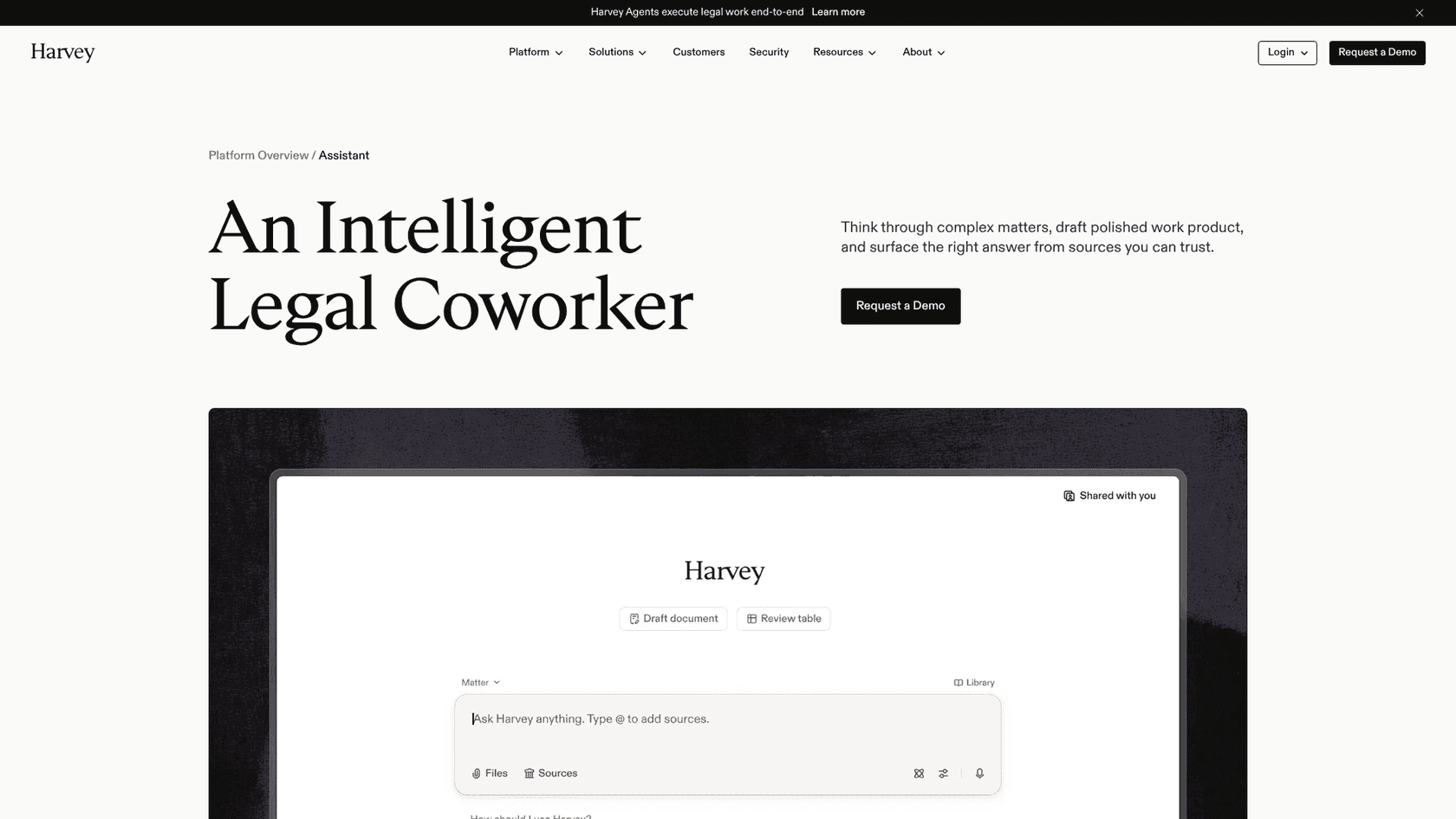
At its core, Harvey AI is a generative AI platform built for professionals doing complex work, mainly in the legal, tax, and advisory fields. Think of it as a version of ChatGPT that went to law school. It is built on OpenAI's models but trained on domain-specific data so it understands legal jargon and workflows.
You can tell who it is for just by looking at its client list: big enterprise players like Am Law 100 firms and the Fortune 500. The company was founded by a former lawyer and a DeepMind AI engineer, and a close relationship with OpenAI gave them a head start in landing major clients. The whole idea is to help with the stuff that usually eats up a lawyer's time, like drafting documents, analyzing contracts, and doing research.
Key features
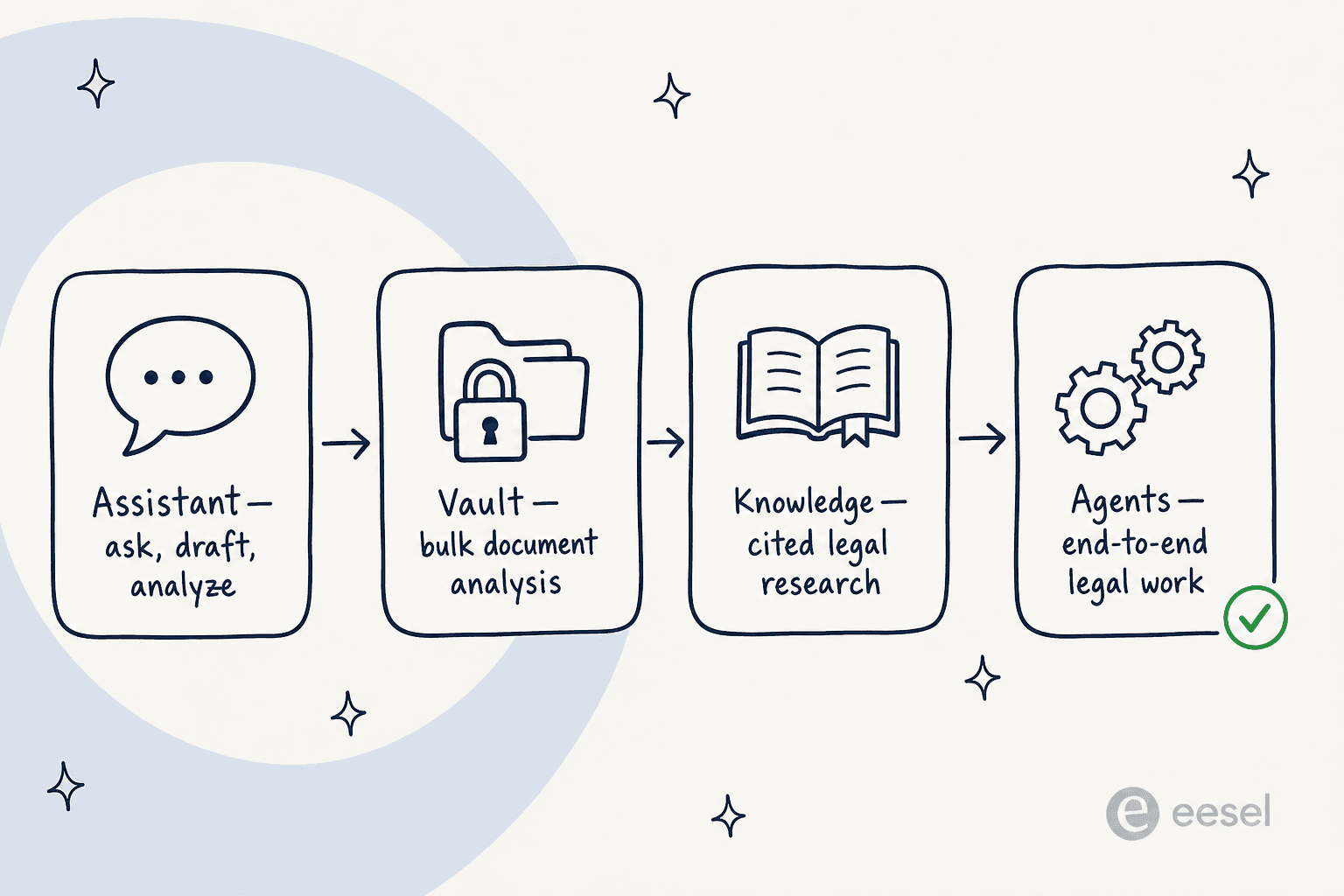
Harvey's platform is broken into a few main parts, each meant to handle a different piece of a professional's workflow. Here is a quick rundown of what is on offer.
The Assistant: The conversational AI
The Assistant is Harvey's main chat window. It is where you can talk to the AI in plain English. You can ask it to research legal precedents, boil down long documents, or draft contracts and emails. It is the front door to most of what Harvey can do, and it is the part that feels most like a polished, legal-tuned AI chatbot.
Vault: The secure document analysis engine
Vault is a secure space where firms can upload and analyze large batches of documents. This is where Harvey uses Retrieval-Augmented Generation (RAG), which lets the AI answer specific questions based on the files you have uploaded. It is handy for due diligence or e-discovery. But users have noted limits, like a reported cap on documents per Vault, which could be a problem in really big litigation cases.
Knowledge: The research tool
This feature is built for deep dives into tricky legal, regulatory, and tax questions. Unlike a general-purpose AI that might pull info from anywhere on the web, Harvey's Knowledge tool tries to give answers grounded in authoritative sources, complete with citations. For legal work, knowing where your information came from is everything, so this is a key part of the package.
Workflows: The automation builder
This is the part Harvey has leaned into hardest lately, now marketed as Agents that "execute legal work end to end." You can use pre-built templates or build custom workflows that fit your firm's way of doing things. For instance, you could set up a workflow to go through a deposition, pull out key themes, and draft a set of cross-examination questions. It is Harvey's shot at moving beyond simple Q&A to more hands-off automation, the same direction the whole AI agent category is moving, and where most of the top AI agents are heading.
The big question: Harvey AI pricing
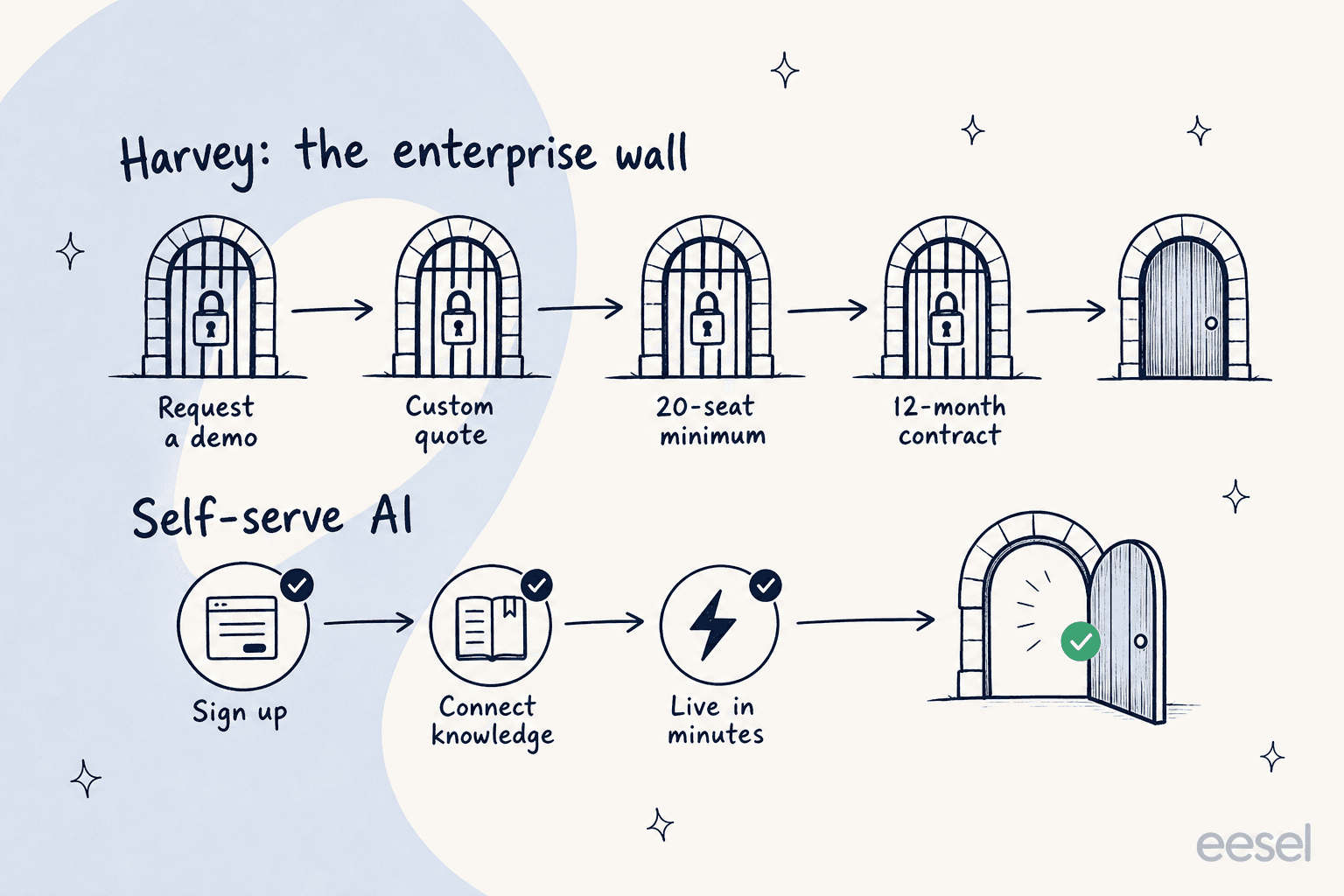
Okay, this is where things get fuzzy. If you are looking for a price tag for Harvey AI, good luck finding one. The company does not list pricing online, and as of June 2026 the pricing page is still a "404 Page Not Found" error, leaving you one option: request a demo.
Anyone who has been through the B2B software ringer knows what that means: a long, hands-on enterprise sales process with custom quotes, minimum seat requirements, and long-term contracts. This model feels increasingly out of touch when most teams just want to try and buy software without a fuss.
Based on what real buyers are saying, the cost is steep. Operators on Reddit's r/legaltech report Harvey quoting around $1,200 per user per month, jumping to $2,400 per seat once you bolt on a Lexis integration. One post on LinkedIn puts a major financial enterprise at $2,500 per seat per month. Add the commonly reported 20-seat minimum and a 12-month contract, and the annual entry point lands near a quarter of a million dollars before a single lawyer logs in.
That wall does not just shut out small and mid-sized firms. It shuts out any team that wants to test a tool and see if it works before committing to a massive annual bill.
The alternative: A transparent approach
Modern AI platforms should give teams power, not lock them into confusing contracts. The best tools let you start small, see the value for yourself, and grow when you are ready.
That is the philosophy behind eesel AI. Unlike Harvey, eesel AI has clear, public pricing with a fixed monthly price from $299 for 500 credits and a free plan of 100 credits, with no hidden fees. You can move up or down any time, or pay a year upfront and get two months free. That transparency puts you in control and cuts out the friction of a traditional sales cycle. If you want to sanity-check the gap, my Harvey AI pricing guide lays the numbers side by side, and this breakdown of AI agent vs human cost is a useful frame for any AI buying decision.
Harvey AI: Pros and cons
Based on what is public and what users are saying, here is a balanced look at where Harvey gets it right and where it misses the mark.
| Aspect | The good | The not-so-good |
|---|---|---|
| Target user | A powerhouse for huge law firms with dedicated AI budgets. | Total overkill and out of reach for small or mid-sized firms. |
| Performance | Specialized models give high-quality, relevant results for legal tasks. | Some users say it feels like a "thin wrapper" over GPT for the price. |
| Onboarding | Enterprise clients get white-glove support and custom setup. | No way to just sign up and start; you go through a long sales process. |
| Pricing | Custom pricing can work for massive enterprise budgets. | Totally hidden, very expensive, and usually a long-term commitment. |
| ROI | Can make a real difference for high-volume, repetitive work. | Some firms are reportedly dropping it over high cost and unproven return. |
they had to negotiate for three weeks just to agree on the number of users for a pilot

Is Harvey AI just for big law? Alternatives for agile teams
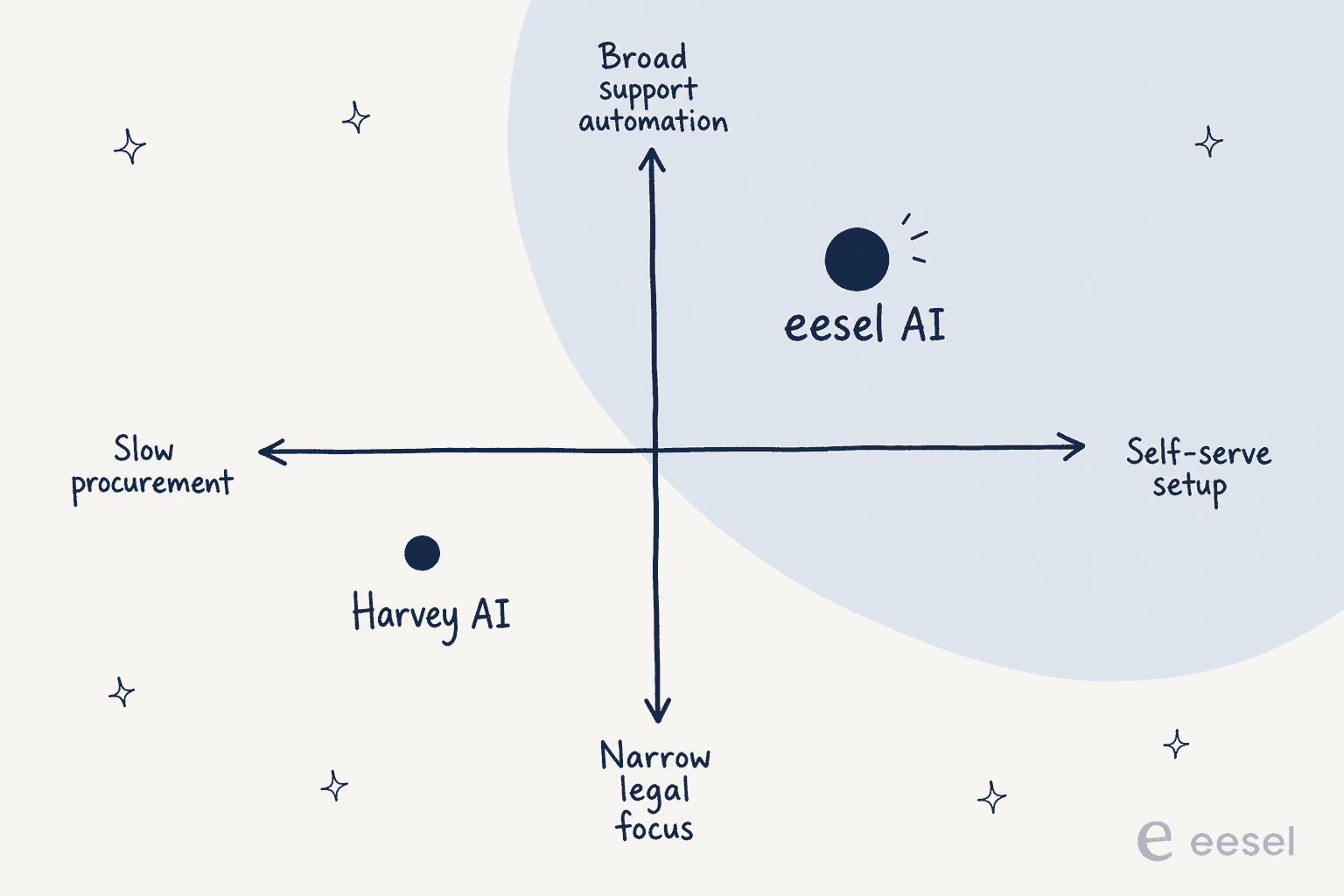
After a close look, the conclusion is pretty clear: Harvey AI is an impressive and powerful platform built almost exclusively for the very top of the market. Its business model, with high costs, hidden pricing, and a long sales cycle, makes it a non-starter for most teams who need to move fast and prove value without a massive budget. That is exactly why my Harvey AI alternatives roundup keeps growing.
Most of us today just need an AI solution that is:
-
Quick to set up: You want to be live in minutes, not stuck in procurement for months.
-
Easy to integrate: It has to play nice with the tools you already use, like Slack, Confluence, and Zendesk.
-
Priced openly: You should know exactly what you are paying for, with no nasty surprises.
-
Flexible and yours to control: You need to be in charge, deciding what gets automated and how.
An alternative: Introducing eesel AI
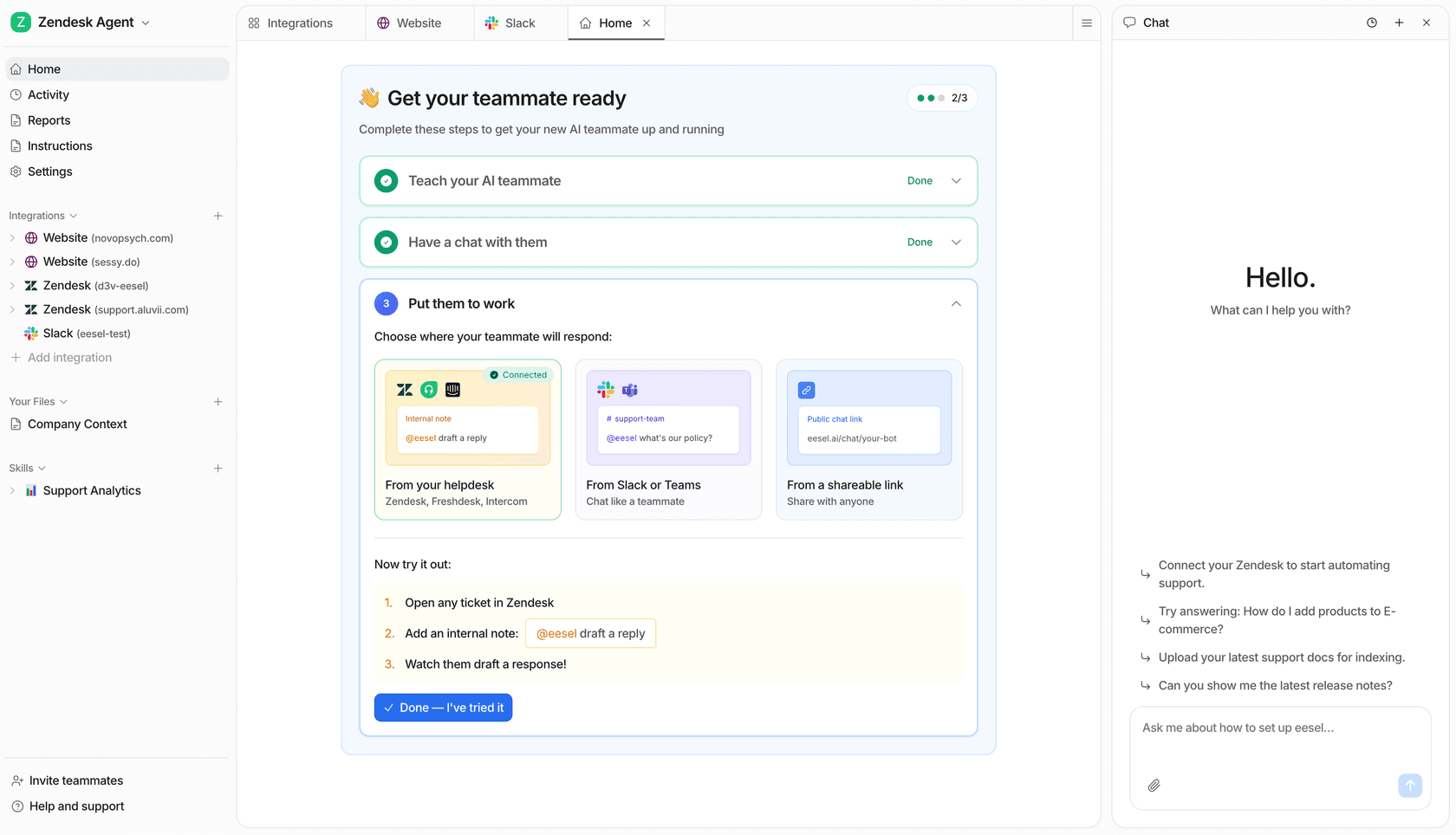
For teams that care about speed and control, eesel AI is a very different option. It is an AI platform that connects directly to your existing knowledge, like Google Docs, past support tickets, and internal wikis, to automate support and give your team instant answers. I have spent the last few years watching AI agents go onto live support queues across thousands of real tickets, and one lesson keeps repeating: a confident-sounding bot that gives the wrong answer is worse than no bot, which is why we simulate every rollout against a customer's own history first.
Here is how eesel AI tackles Harvey's biggest drawbacks head-on:
-
Self-serve from day one: You can sign up, connect your knowledge sources, and set up your AI agents on your own, usually in under ten minutes. No sales calls needed.
-
Test with confidence: eesel AI's simulation mode lets you test your setup on past conversations before you turn it on. It is the same instinct behind every credible AI buying decision: see the resolution rate on your own data first. Kim Simpson at Gridwise put it plainly: "in the first month, eesel is resolving 73% of our tier 1 requests," and they saw results during a 7-day trial.
-
Total control: You get fine-grained control to shape the AI's personality, limit its knowledge to specific topics, and choose exactly which questions it should handle. As Karel at GENERAL BYTES told us, "we could try to write our own LLM application but we didn't want to invest our time into that. We wanted something we would not have to maintain." That build-versus-buy math is why a flexible internal search layer beats a bespoke project for most teams.
Here is a quick comparison of how the two platforms stack up:
| Feature | Harvey AI | eesel AI |
|---|---|---|
| Setup time | Weeks or months | Minutes |
| Pricing model | Hidden, custom quote | Transparent, fixed monthly price |
| Free trial | No | Yes (free plan available) |
| Self-serve? | No, demo required | Yes, fully self-serve |
| Key use case | Bespoke legal research and drafting | Automating support and unifying internal knowledge |
| Integrations | Mostly the enterprise ecosystem | 100+ one-click integrations across help desks, wikis, and chat |
Is Harvey AI right for you?
So, what is the bottom line from this Harvey AI review? It is a powerful, enterprise-level platform made for the world's largest professional services firms. If you are at a global firm with a seven-figure AI budget and you do not mind a traditional, slow-moving procurement process, Harvey could be a solid choice. For a deeper feature-by-feature look, my explainer on what Harvey AI is goes further.
For almost everyone else, the high and hidden costs, lack of flexibility, and mandatory sales process make it impractical. Teams that care about speed, transparency, and control will find that a solution built for immediate value is a much better fit.
Want an AI that works like a new hire instead of a procurement project? eesel AI plugs into your help desk and docs in a few minutes, learns from your past tickets, and you can try it for free before you ever talk to sales.
Frequently asked questions
I'm considering Harvey AI for my large firm. What does this Harvey AI review highlight as its main benefits for enterprises?
Harvey AI is built for large professional services firms doing complex legal, tax, and advisory work. It gives high-quality, domain-trained results for document drafting, contract analysis, and cited legal research. If you have an Am Law 100 budget and a procurement team, that depth is real. For the cheaper, faster end of the market, see my Harvey AI alternatives.
My firm is mid-sized; should I even bother looking at a Harvey AI review for a solution like this?
Based on this Harvey AI review, it is hard to justify for most small and mid-sized firms. The high, hidden costs, enterprise sales process, and 12-month commitments make it impractical without a large budget. A self-serve AI helpdesk agent is usually a better starting point.
This Harvey AI review mentions pricing is a big issue. Can you give me an idea of the estimated cost of Harvey AI?
Harvey AI does not publish pricing. Operators on Reddit and LinkedIn report roughly $1,200 per lawyer per month, climbing to $2,400 with a Lexis add-on and up to $2,500 per seat at some enterprises, usually with 20-seat minimums and annual contracts. My full guide to Harvey AI pricing breaks down the numbers.
What specific features does this Harvey AI review identify that make Harvey AI stand out for legal professionals?
This Harvey AI review highlights the Assistant for conversational AI, Vault for secure bulk document analysis, Knowledge for cited research, and Agents for automating multi-step legal work. For a deeper feature tour, see what Harvey AI is.
I'm concerned about implementation time. What does this Harvey AI review say about the setup and onboarding process for Harvey AI?
Onboarding Harvey AI is a lengthy enterprise sales process, measured in weeks or months, not minutes. There is no self-serve option, so firms go through demos and custom setups. Tools like eesel AI let you connect your knowledge and go live the same day.
Does this Harvey AI review suggest there's a way to test Harvey AI before committing to a long contract?
This Harvey AI review found no easy way to trial Harvey before signing. Users negotiate for pilot programs that still involve seat commitments. By contrast, eesel AI's AI agent has a free plan and a simulation mode so you can forecast results on past tickets first.


Article by
Kurnia Kharisma
Kurnia is a software engineer and writer at eesel AI with two years of SEO experience, writing about AI tools, helpdesk software, and customer support. He pairs a developer's understanding of how these products are built with search-driven research into what actually ranks and resonates with the people searching for them.