
The honest answer: it depends on how they bill you
Whenever someone asks me "how much does an AI support agent cost," they usually want a single dollar figure. I get it. But handing one over would be the same trick a lot of vendors play, and it is how people end up shocked by their first invoice.
The price you pay is almost entirely a function of the billing unit. Two tools can advertise numbers that look close and bill you wildly differently once your tickets start flowing, because one charges per human seat, one charges per resolved conversation, and one charges per ticket touched. So before any number means anything, you need to know which of the three models you are looking at.
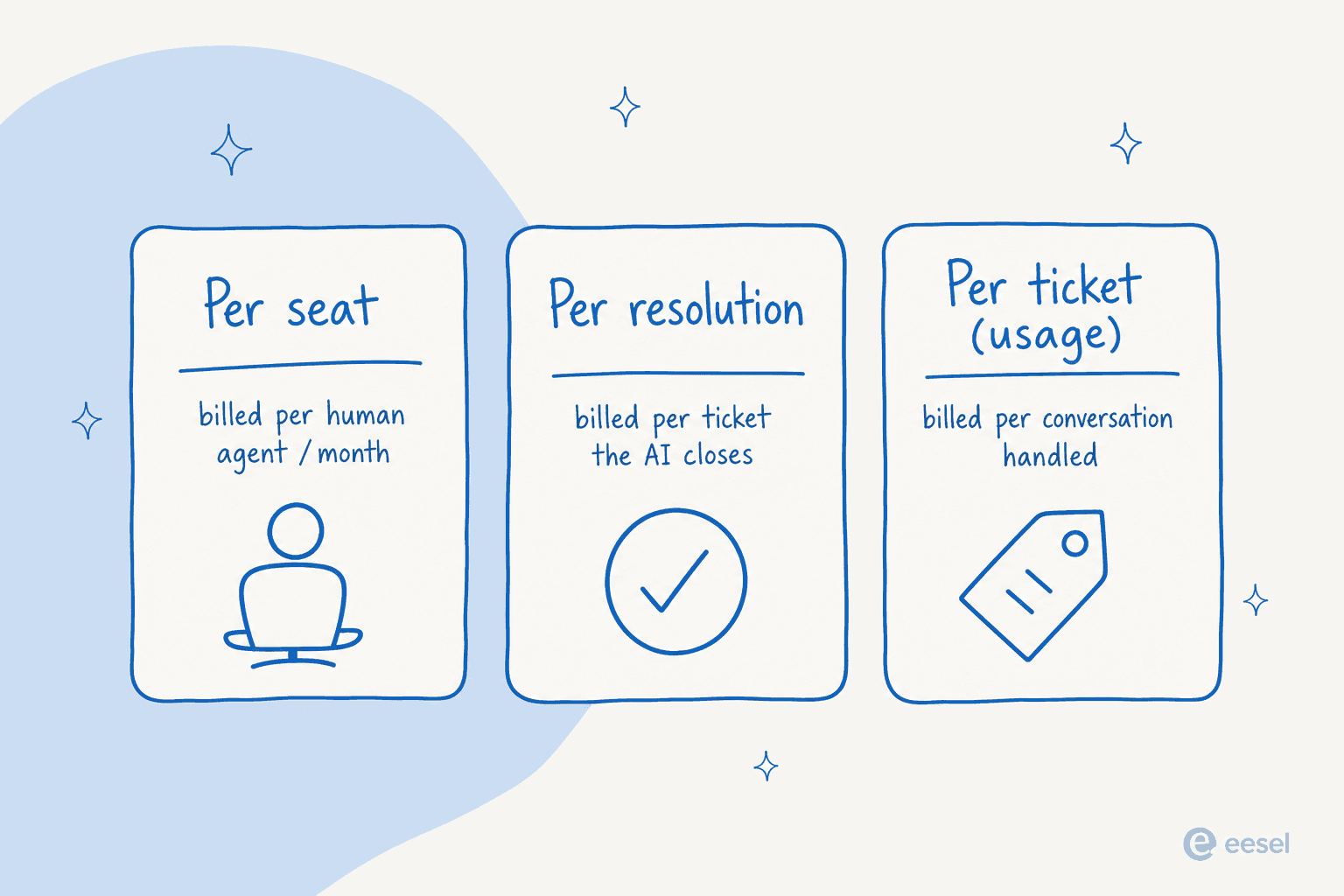
The three ways AI support agents charge
Per seat (native helpdesk AI)
This is the model you get when your AI comes bundled into the helpdesk you already pay for. You are buying per-agent licenses, and the AI features ride on top, sometimes included, often as a paid add-on.
Zendesk is the textbook case. Its Suite Team plan is $55 per agent per month billed annually, Suite Professional is $115, and the cheaper Support Team tier is $19. AI agents are included in the Suite and Support plans, with 5 automated resolutions per agent per month on Team plans and 10 on Professional, then $1.50 each on a commitment or $2.00 pay-as-you-go. (We walk through the real numbers in our guide to Zendesk AI agents.)
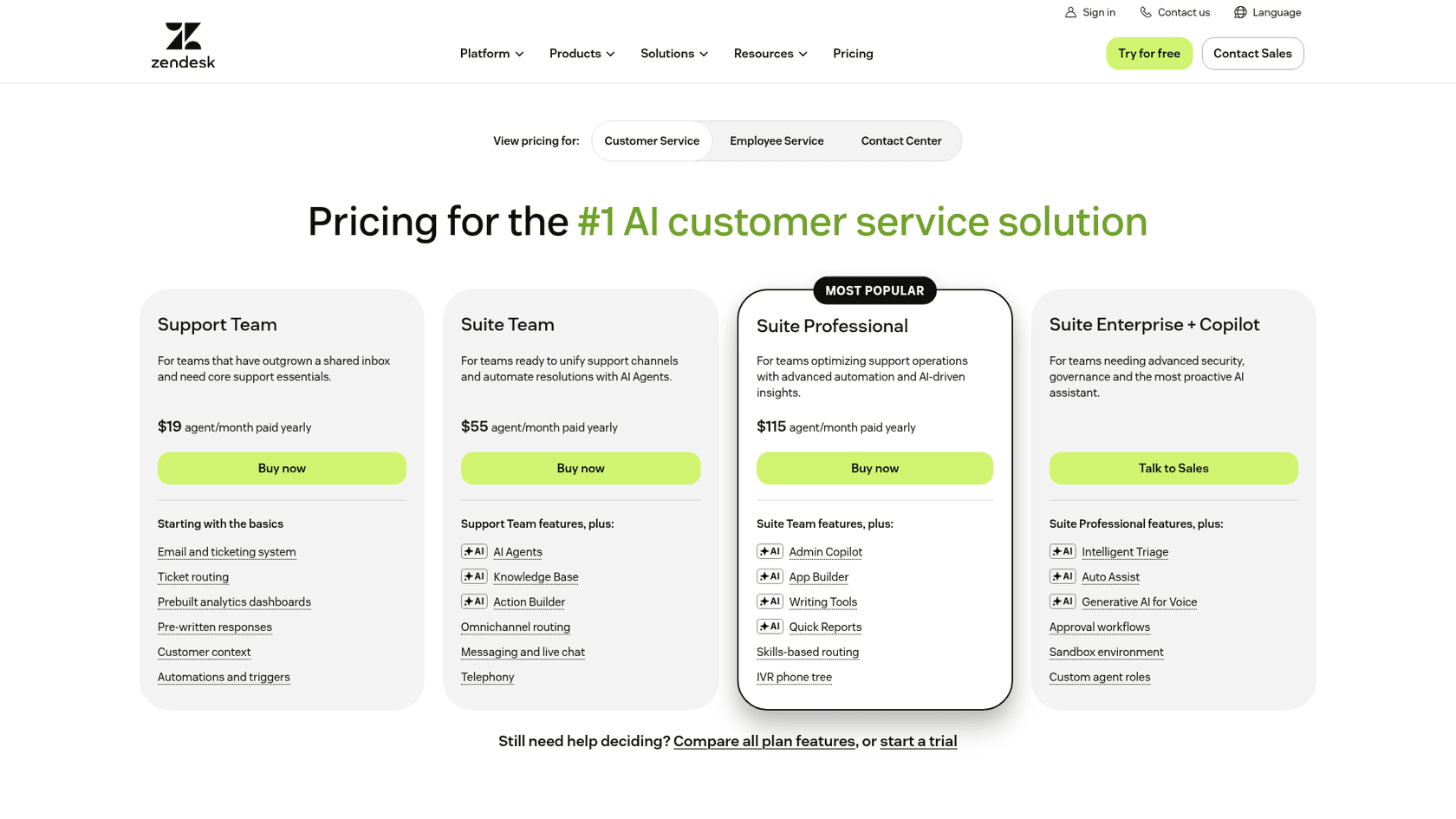
Freshdesk works the same way: Growth at $19 per agent, Pro at $55, Enterprise at $89, with the Freddy AI Agent metered on top. It includes 500 sessions, then charges $49 per 100 sessions, where an email session is a 72-hour window from the customer's first email, and the Copilot assistant is a $29-per-agent add-on. So you are paying for seats and for AI, two meters running at once.
Per resolution (outcome-based)
Here you pay each time the AI successfully closes a conversation. It sounds fair, you only pay for results, and it is the model most of the newer agent-first vendors lead with.
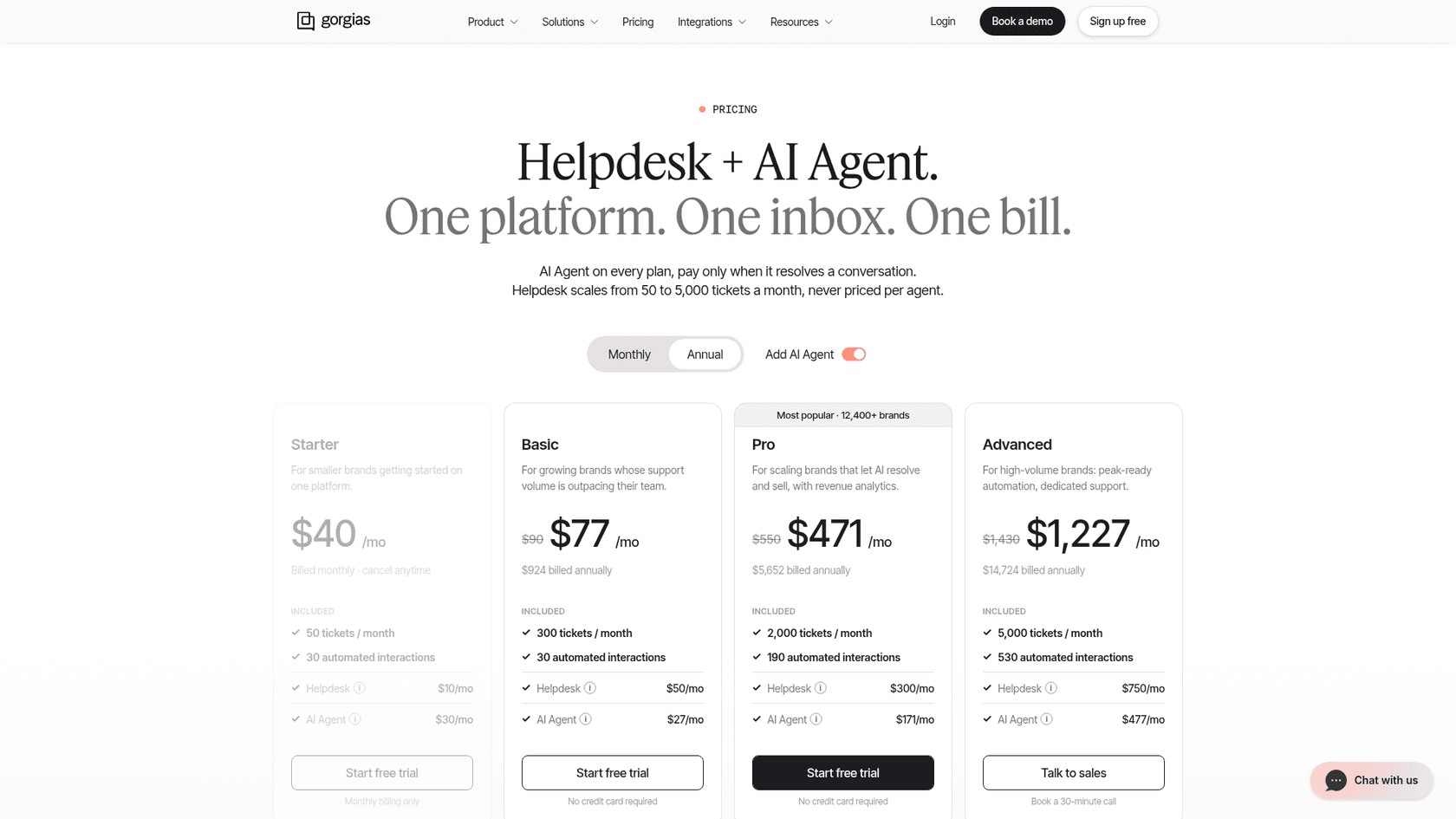
Gorgias publishes its numbers cleanly: its AI Agent runs $0.85 to $1.00 per automated interaction depending on plan (a conversation with no human reply in 72 hours), with extra interactions listed at $1.50 each. The big enterprise players keep the model but hide the price. Ada sends its pricing page straight to a demo form that asks for your expected annual contact volume, so there is no public rate. Sierra bills per "outcome" with no public rate at all, and Forethought, now part of Zendesk, lists tiers without prices. We will come back to why this model bites hardest exactly when you are winning.
Per ticket / credit
The third model charges one unit for each conversation handled, regardless of whether the AI fully resolved it, drafted a reply, or escalated. No seats, ideally no platform fee.
This is how we price eesel AI: one credit per ticket or chat, however many back-and-forth messages it contains, sold as one fixed monthly price from $299 for 500 credits, with no per-seat fee and no platform fee. I will be upfront that this is the model I believe in, but the reasoning behind it is the actual point, and it comes down to the difference between a predictable bill and a clever one.
| Pricing model | How you're billed | Typical 2026 rates | Best for |
|---|---|---|---|
| Per seat (native helpdesk AI) | Per human agent / month, AI on top | Zendesk $55 to $115/agent + $1.50 to $2.00 per extra resolution; Freshdesk $19 to $89/agent + Freddy sessions and Copilot | Teams already locked into a helpdesk suite |
| Per resolution (outcome) | Per ticket the AI closes | Gorgias $0.85 to $1.00; Ada quote-only; Sierra / Forethought quote-only | High-volume brands that can forecast volume |
| Per ticket / credit | 1 credit per conversation, fixed monthly plan | eesel AI from $299/mo for 500 credits, no seat or platform fee | Teams that want a predictable, seat-free bill |
| Enterprise quote-only | Volume-bracketed annual contract | Ada and Decagon custom, no public rate | 250k+ tickets/mo contact centers |
The hidden costs nobody puts on the quote
The sticker price is the tip of the iceberg. The line items that actually move your annual bill are usually the ones you have to ask about.
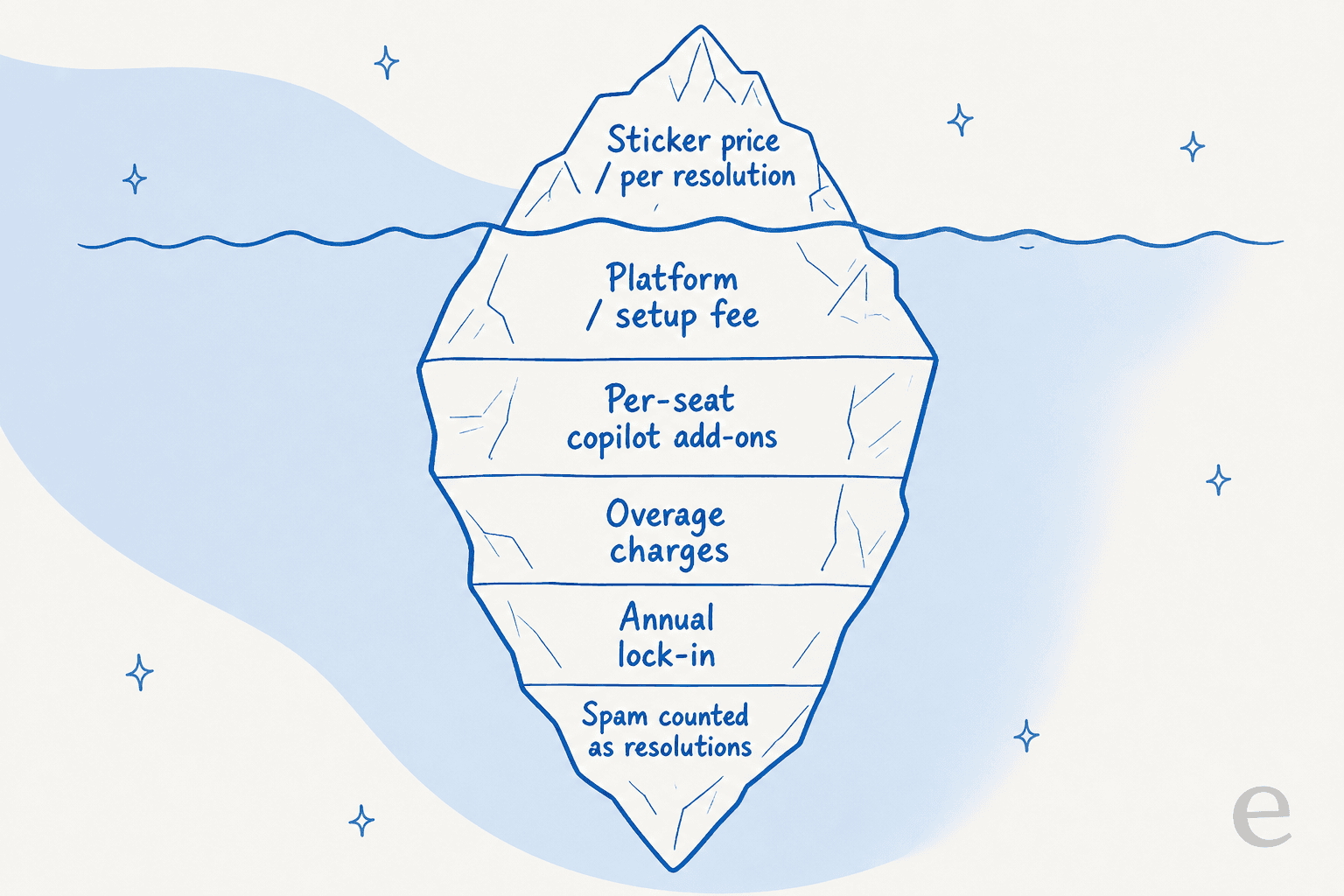
- Platform and setup fees. Outcome-based vendors like Forethought openly fold a "platform access fee" in before a single ticket is resolved. Enterprise deals frequently carry a setup or implementation cost on top.
- Per-seat copilot add-ons. Freddy's Copilot is a separate $29-per-agent charge layered over the per-session AI Agent. You can end up paying for the agent and for the assist.
- Overage charges. Almost every allowance-based model bills harder once you cross the line. Gorgias extra interactions run $1.50 each; Freshdesk sells more session packs once your 500 are gone.
- Annual lock-in. Several buyers I have talked to had been burned by a prior vendor whose price "more than doubled," and now they push for contractual price locks before they sign anything. Predictability is worth real money to them.
- Spam counted as resolutions. This is the sneaky one. If 22% of your inbox is spam (a real figure from one e-commerce account we analyzed) and your vendor auto-closes it as a "resolution," ask whether you are being billed for resolving junk. Always check what counts as a billable resolution before you sign.
Why per-resolution pricing bites hardest when you scale
Per-resolution sounds like the fairest model on the list. Pay for results. The problem is that it charges you more precisely in the two moments you least want a bigger bill: when your AI gets better, and when your volume surges.
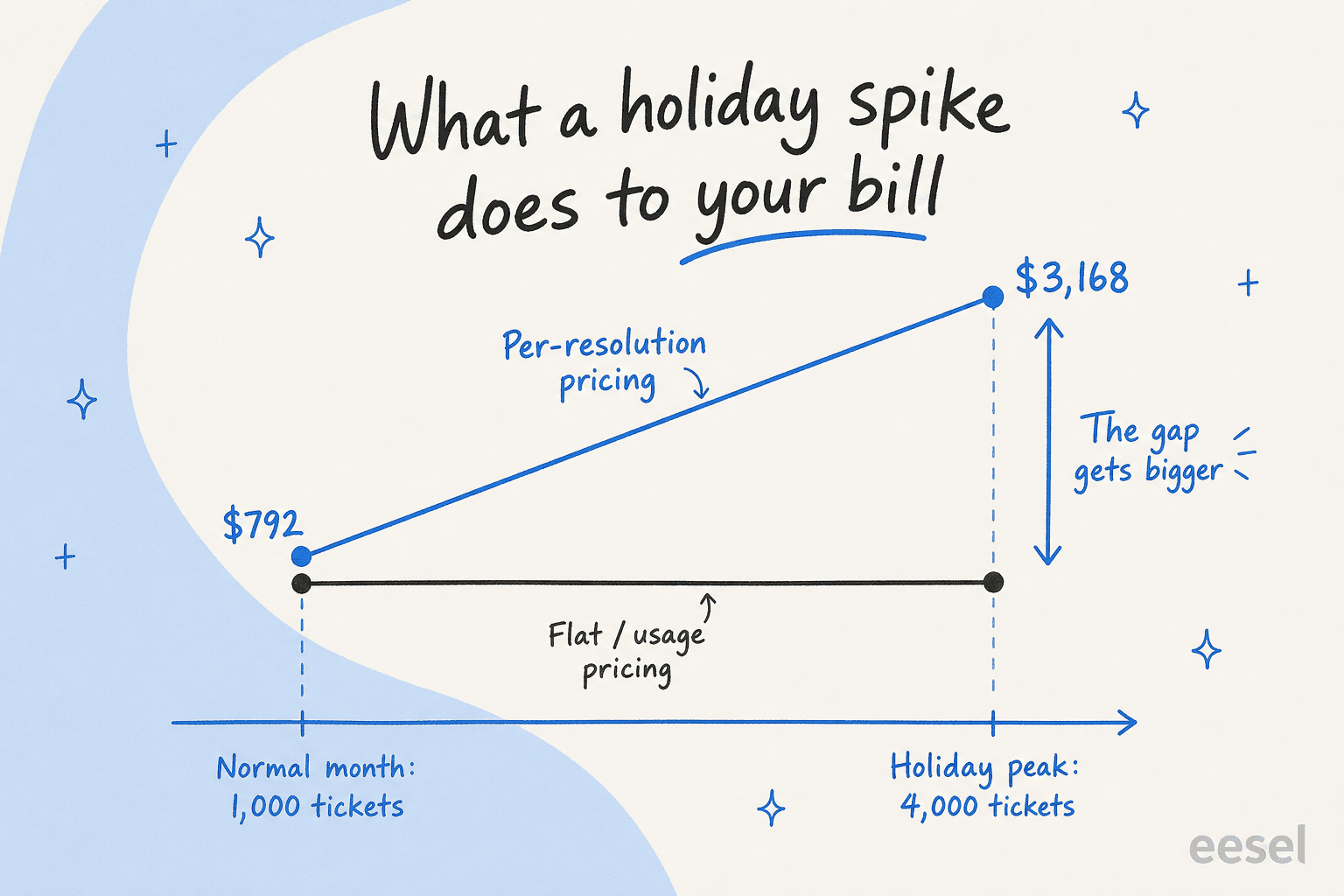
Run the math. We put together a cost analysis for a German e-commerce brand doing about 1,000 tickets a month. On per-resolution pricing at an 80% resolution rate, that is roughly $792 a month. Then Black Friday hits, volume jumps to 4,000 tickets, and at the same 80% the bill jumps to $3,168. A fixed-credit plan would have moved far less, because it is not multiplying your rate against a seasonal spike.
I have watched this play out on sales calls more than once. One ops lead at a payouts fintech doing 7,000 to 8,000 escalated tickets a month told us flatly that per-interaction pricing was a non-starter for him. A very-high-volume operator scaling toward 150,000 tickets a month did the arithmetic live on a call and landed on roughly $30,000 a month, then spent the next ten minutes worried about it. The highest-value, highest-volume customers are exactly the ones per-resolution pricing punishes most.
It cuts the other way too. The clearest pricing shock I have seen came from a swimwear brand on Gorgias who ran 12 successful test chats, loved the results, then opened the billing page and immediately fired off two cancellation requests. The product worked. The pricing model scared them off. That gap, between "this is great" and "I cannot predict what this costs me," is the whole game.
This is the heart of how AI pricing has shaken out, and it is worth being blunt about: a clever pricing model that wins the demo can still lose the renewal. The reason we price eesel per ticket-sized credit rather than per resolution is that customers think in tickets and chats, not in invented units, and they will trade a slightly higher headline rate for a fixed monthly bill that does not ambush them in November.
What a real team actually pays: three worked examples
Abstract rates are useless until you put a team behind them. Here is what the fixed credit plans look like at three sizes, using eesel's published Teammate plans as the worked example (1 credit = 1 ticket or chat).
| Team profile | Tickets / month | Monthly cost (fixed plan) | Notes |
|---|---|---|---|
| Small SaaS, one support person | 500 | $299 (500 credits) | No seats to buy; start on the free 100 credits |
| Growing e-commerce brand | 2,500 | $999 (2,500 credits) | Route a slice first, then expand |
| Mid-market, multi-channel | 5,000 | $1,899 (5,000 credits) | Pay a year upfront for two months free |
The number that matters in this table is not the dollar figure, it is what is missing from it: there is no per-seat line. If you add three support agents next quarter, your AI bill does not change, because the plan is sized to tickets handled, not headcount. And only tickets the agent actually works on count, so spam and auto-replies do not eat credits. During a careful rollout you can route a slice of volume through ticket automation and size the plan to that slice.
Compare that to the per-seat world, where adding people to your support team mechanically raises your software bill whether or not the AI did more work, and to the enterprise quote-only world, where Decagon and Ada will not even talk pricing until you clear a volume threshold. One Reddit operator put the enterprise end of the market plainly:
"Used to work for a company paying ~300k+ for Ada.cx, it's expensive [...] I would stick with Zendesk messaging and answer bot."

So is it actually worth it?
Cost is only half the equation. The other half is what the agent deflects, and this is where the model earns its keep if you have done the setup honestly.
The lever is straightforward: every tier-1 ticket the AI resolves is one a human did not have to. When a real team gets there, the numbers are good. On our own helpdesk agent, a transportation-data company saw the AI resolve 73% of tier-1 requests in the first month, with results showing up during a 7-day trial.
"In the first month, eesel is resolving 73% of our tier 1 requests... results quickly during our 7-day trial."
Kim Simpson, Gridwise, via the eesel AI helpdesk agent page
The honest caveat, after three years of watching rollouts: the worth-it math only holds if the agent answers the tickets it can and cleanly hands off the ones it cannot. An AI that confidently gives wrong answers costs you more than it saves, which is why we simulate every rollout against historical tickets before going live and route on confidence rather than letting the bot reply to everything. If you want the deflection side of this in more depth, our piece on AI customer service metrics covers what to actually measure.
Try eesel AI
If you have read this far, you already know the question that matters is not "what's the price," it is "what's the unit, and what does it do to me at scale." eesel AI is built around the answer I have argued for here: it plugs into Zendesk, Freshdesk, Gorgias, Help Scout and more in minutes, learns from your past tickets and help docs on day one, and runs on one fixed monthly price from $299 for 500 credits (one credit per ticket or chat), with no per-seat fees and no platform fee. You can run it in simulation mode against your real ticket history to see exactly what it would resolve, and what it would cost, before a single customer sees it. It is free to start with 100 credits and no credit card.
Frequently Asked Questions
How much does an AI support agent cost per month?
What is the difference between per-resolution and per-ticket pricing?
Is an AI support agent worth the cost for a small business?
How does eesel AI pricing compare to Zendesk and Gorgias AI?


Article by
Kurnia Kharisma
Kurnia is a software engineer and writer at eesel AI with two years of SEO experience, writing about AI tools, helpdesk software, and customer support. He pairs a developer's understanding of how these products are built with search-driven research into what actually ranks and resonates with the people searching for them.