

LongCat 2.5 is worth testing if you want a cheap coding agent that can also read screenshots and video. It is Meituan's 1.6T-parameter model with native image and video input, priced at $0.30 in and $1.20 out per million tokens, the same as DeepSeek V4.1 Flash at peak. The catch sits in Meituan's own benchmark table: DeepSeek V4.1 Flash wins most of the coding rows at the same price, and LongCat 2.5's weights are still "coming soon". Use it for vision-heavy agent work, and keep customer data out until Meituan publishes a data policy. For support, a helpdesk teammate like eesel that you test on past tickets is safer.
What is LongCat 2.5?
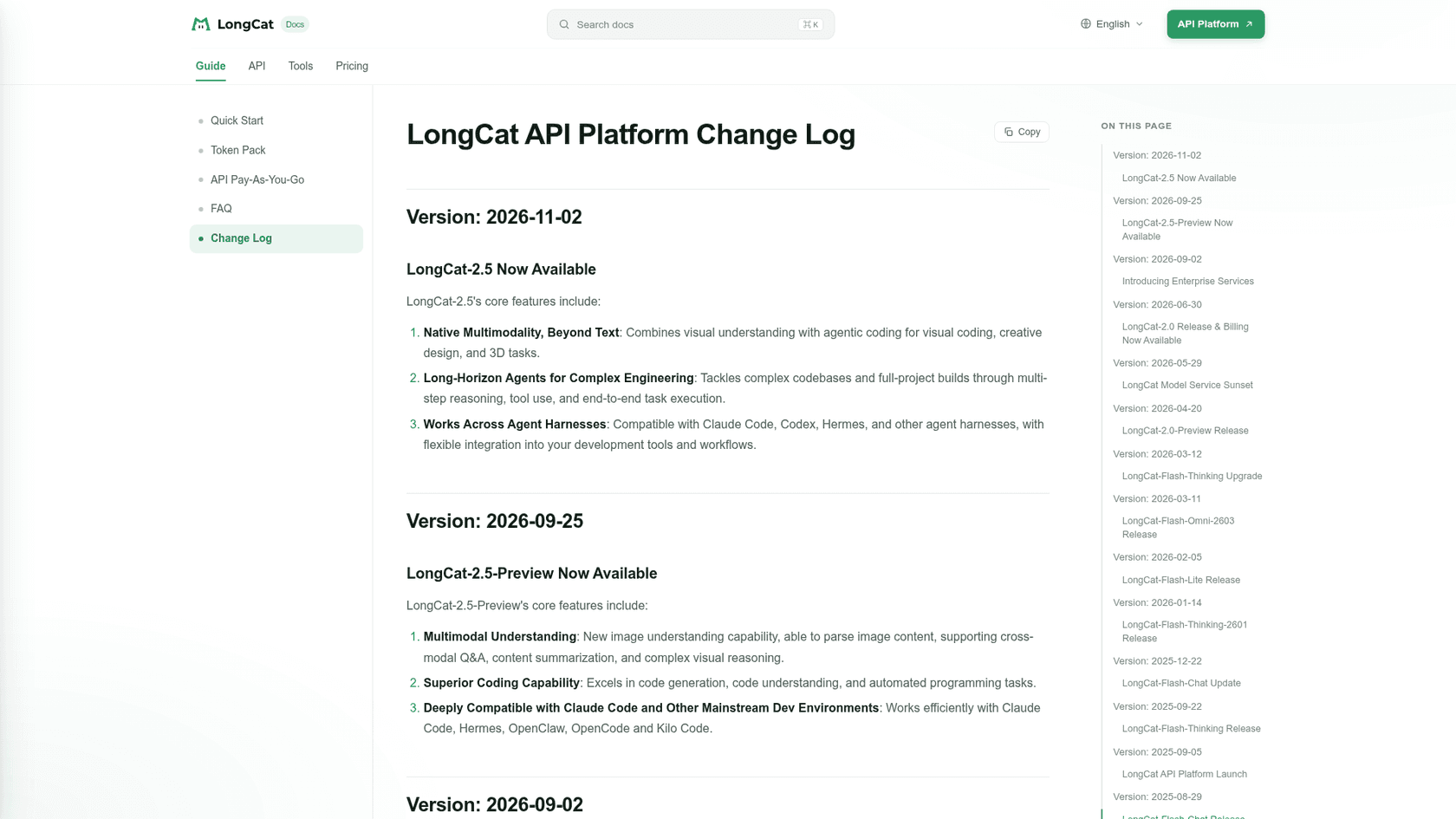
LongCat 2.5 is the newest model from Meituan's LongCat team. It went generally available on the LongCat API Platform on 2 November 2026, five weeks after a preview build landed on 25 September. Meituan's change log gives it three headline features: "Native Multimodality, Beyond Text", "Long-Horizon Agents for Complex Engineering" and "Works Across Agent Harnesses".
If you missed the last round: LongCat 2.0 was a 1.6-trillion-parameter mixture-of-experts foundation model with roughly 48B parameters active per token, released under an MIT licence with weights on Hugging Face. It was a text-only model built for agentic coding work.
I'm a software engineer on the team that builds eesel's AI agents, so I read model launches with one question in mind: what would I have to change to actually run this thing? This post is built from Meituan's LongCat 2.5 tech blog, the platform docs and change log, its launch post on X, and what developers who ran the free preview reported.
What changed from LongCat 2.0?
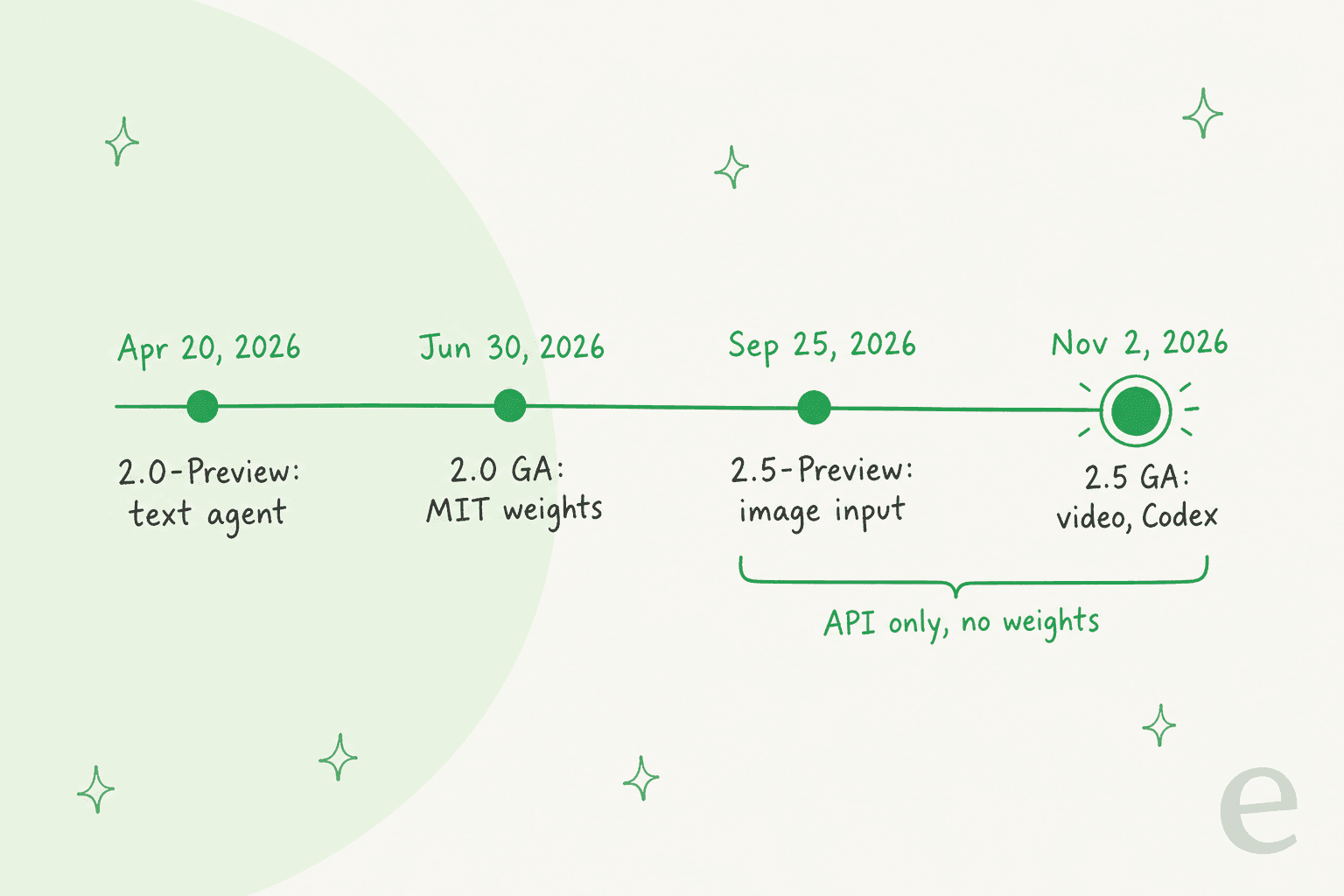
Same body, new senses. Meituan's tech blog says 2.5 has "1.6 trillion total parameters and approximately 48 billion activated per token" and "builds on LongCat-2.0". So this is not a new, bigger model. It is 2.0's mixture-of-experts design with vision added and a lot more agent training on top. Here is the timeline.
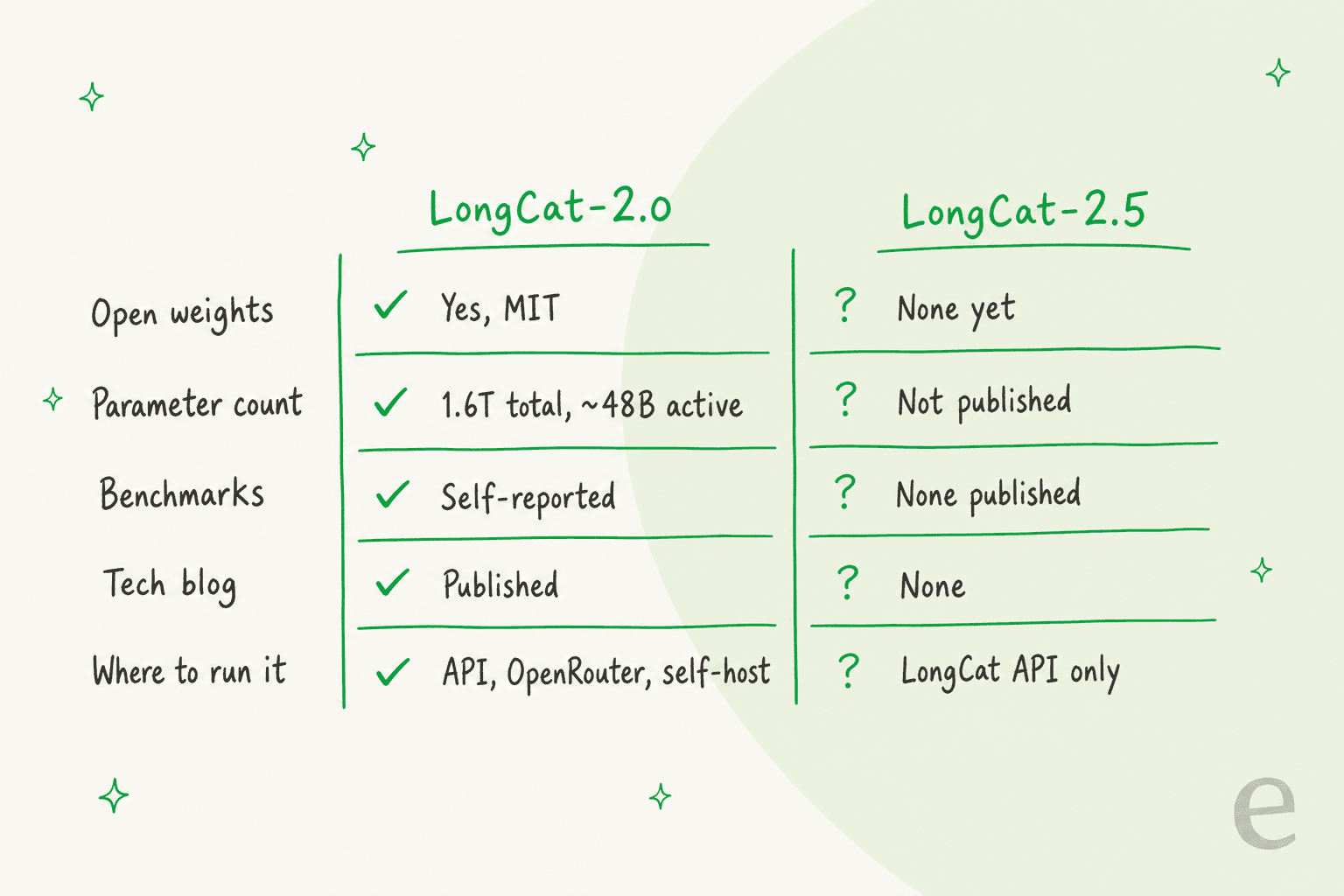
2.0 went from preview to MIT weights in about ten weeks. 2.5 has been out for five weeks across preview and GA. Its tech blog shows "GitHub Coming soon" and "HuggingFace Coming soon", and nothing has appeared yet on Hugging Face or GitHub. "Coming soon" is a label, not a date, and Meituan has given no timeline.
Image and video input
This is the headline feature. The Visual Understanding docs say "The LongCat-2.5 model accepts images and videos alongside text", and the limits are generous:
| Input | Formats | Size limit | Per request | How to send |
|---|---|---|---|---|
| Images | PNG, JPG, JPEG, WebP, GIF | 10 MB each | Up to 50 | Base64 data URL or public URL |
| Video | Not listed | 100 MB each, under 3,600 seconds | Up to 10 | Public URL only |
The preview only claimed image understanding. Video arrived with the GA build. Output is still text only, so this is a model that reads screenshots and screen recordings, not one that makes images. SVG and HEIC files are not supported, and an image with an aspect ratio over 200:1 throws an error. There is also no separate price line for images or video on the pricing page; you pay for the tokens they turn into.
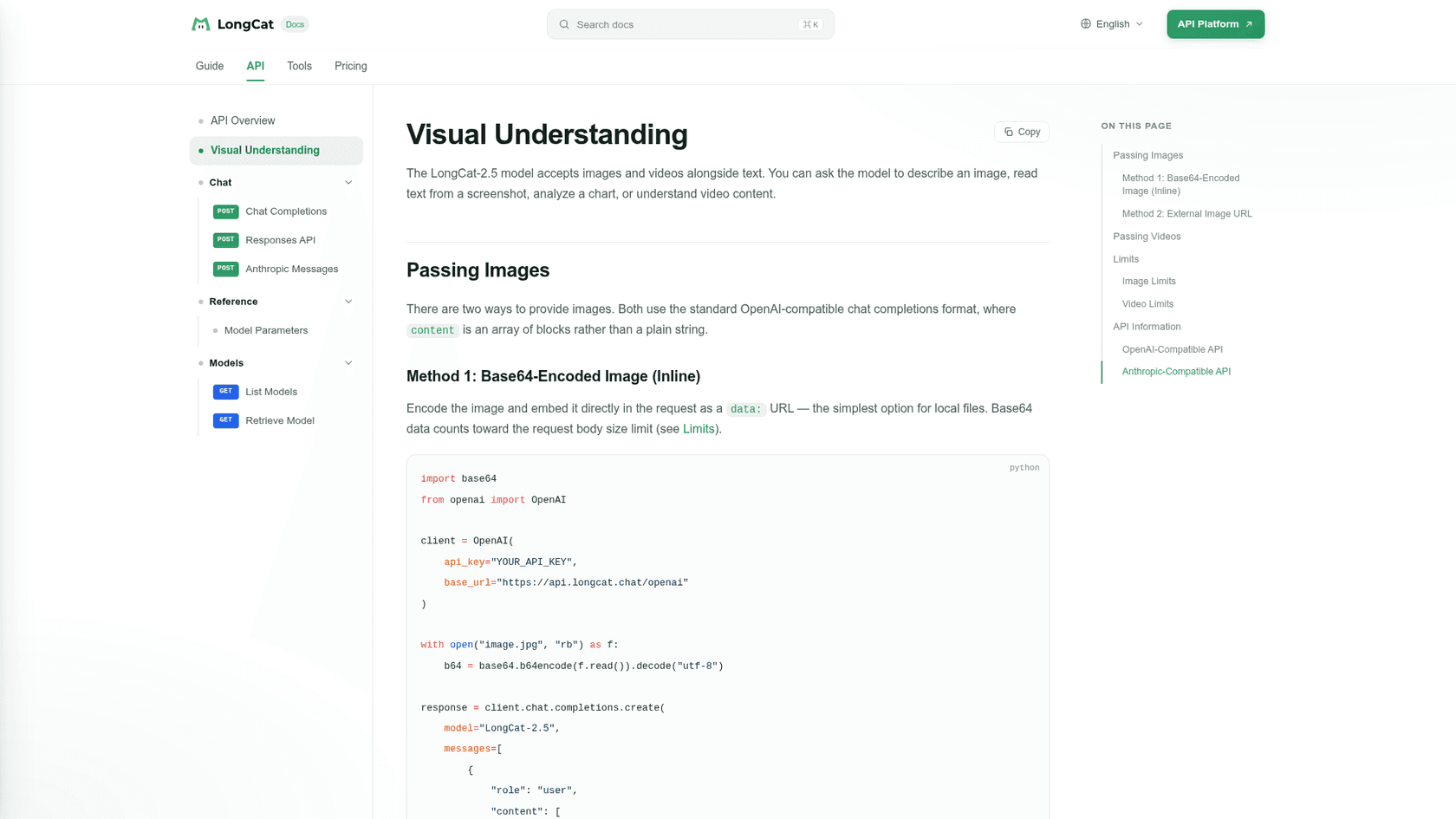
Why it matters for coding: the change log pitches it for "visual coding, creative design, and 3D tasks". In plain terms, you can paste a screenshot of a broken layout and ask the agent to fix the CSS. That is the same direction DeepSeek V4 Flash Vision went, and it is a real gap 2.0 had.
How the vision part works
Most vision models bolt an image encoder onto a text model. LongCat 2.5 turns pictures into the same kind of tokens as words. The tech blog says it "represents visual signals as multi-level discrete tokens", so the backbone reads one mixed stream of text and image tokens. A fixed tokenizer means image tokens can be computed once and cached offline, which is why Meituan could drop the vision encoder from training entirely.
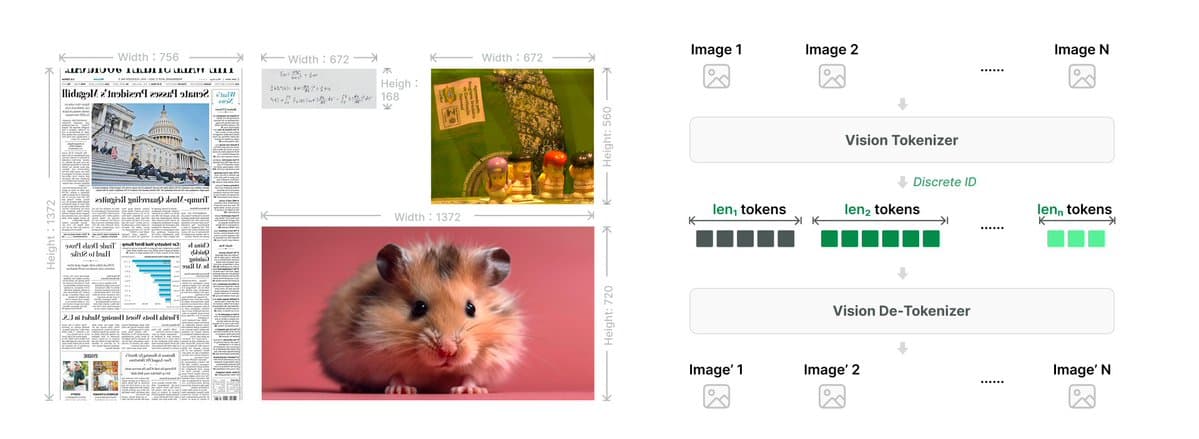
The practical upshot is native resolution: a tall screenshot becomes more tokens rather than a squashed thumbnail. On the agent side, Meituan describes "large-scale long-horizon reinforcement learning" on tasks built from filtered GitHub pull requests, with penalties for "repetitive reasoning and repeated tool calls". Keep that last line in mind for the community section.
Codex joins the harness list
The preview named Claude Code, Hermes, OpenClaw, OpenCode and Kilo Code. The GA release adds Codex, and the docs now carry a new OpenAI-format Responses endpoint (POST /openai/v1/responses) that Codex needs. That endpoint brings effort levels from none to xhigh, parallel tool calls on by default, and JSON schema output. The tools sidebar lists 13 setup guides in total, from Cline to Hermes Agent.
A real 1M context, on paper
2.0's marketing said 1M context while its shipped config capped out at 256K. For 2.5 there is no config to check, only the API, and the Model Parameters page defines the context window as 1,048,576 tokens of input plus output per request. Output is where the docs disagree with themselves:
- The Model Parameters page allows
max_tokensup to 262,144. - The Quick Start and FAQ both say 128K maximum output.
- Meituan's own Claude Code config sets output to
131072, which is 128K.
I'd plan around 128K output and treat anything above it as a bonus you test.
What do LongCat 2.5's benchmarks say?
Meituan's numbers show a big jump over 2.0 and a model that sits close to the 2025-2026 frontier on agent tasks. Its own table tells a less flattering story at its price point. All of the figures below come from the evaluation table in the tech blog, run by Meituan with thinking on.
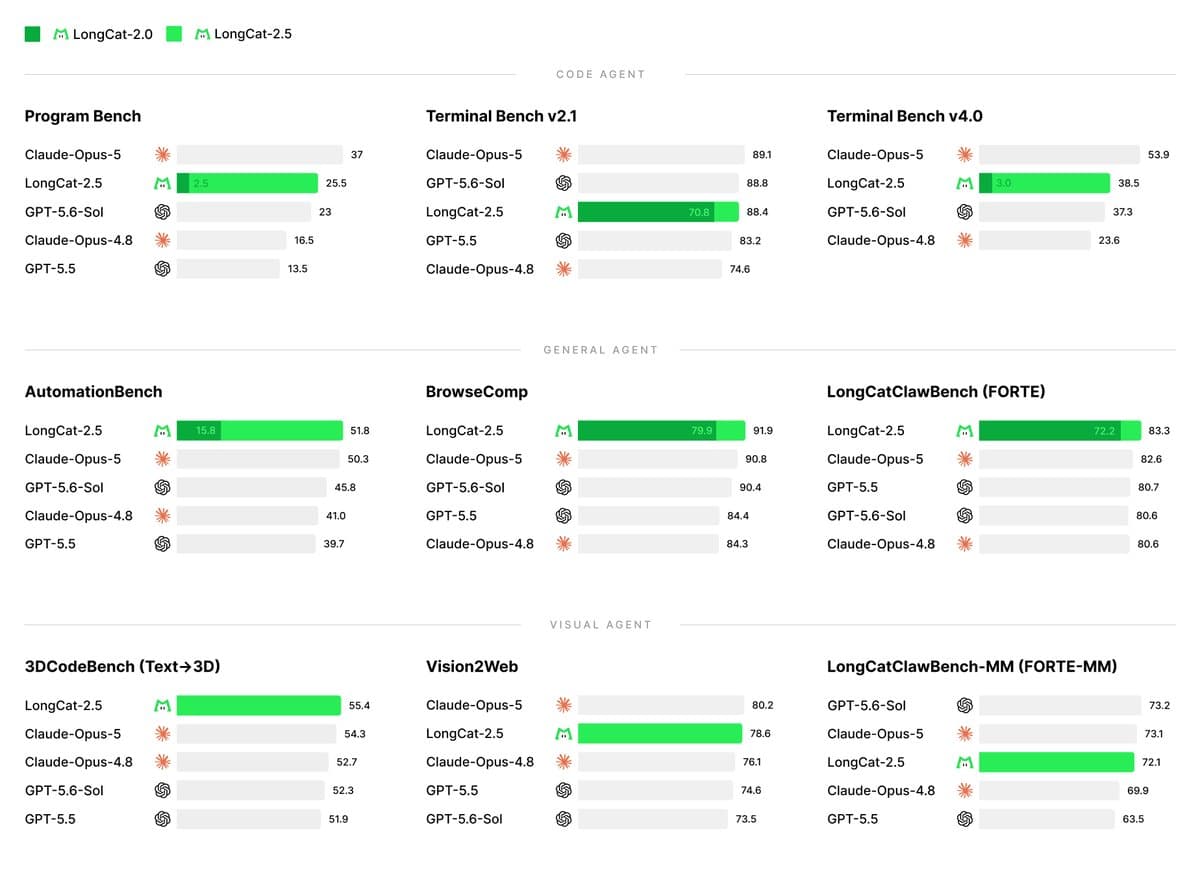
The 2.0 to 2.5 jump is real on paper. Terminal Bench 4.0 goes from 3.0 to 38.5, AutomationBench from 15.8 to 51.8, and DeepSWE v1.1 from 9.7 to 64.6. That is what months of long-horizon agent training buys.
The comparison set is the catch. The headline charts compare against GPT-5.5, GPT-5.6-Sol, Claude Opus 4.8 and Claude Opus 5. There is no Claude Opus 5.5, no GPT-6.1 Sol and no Kimi K3.1 Pro. The full table further down the page does add GLM-5.3, Kimi K3 and DeepSeek V4.1 Flash, and that last column is the one I'd read first, because it is the model at the exact same price.
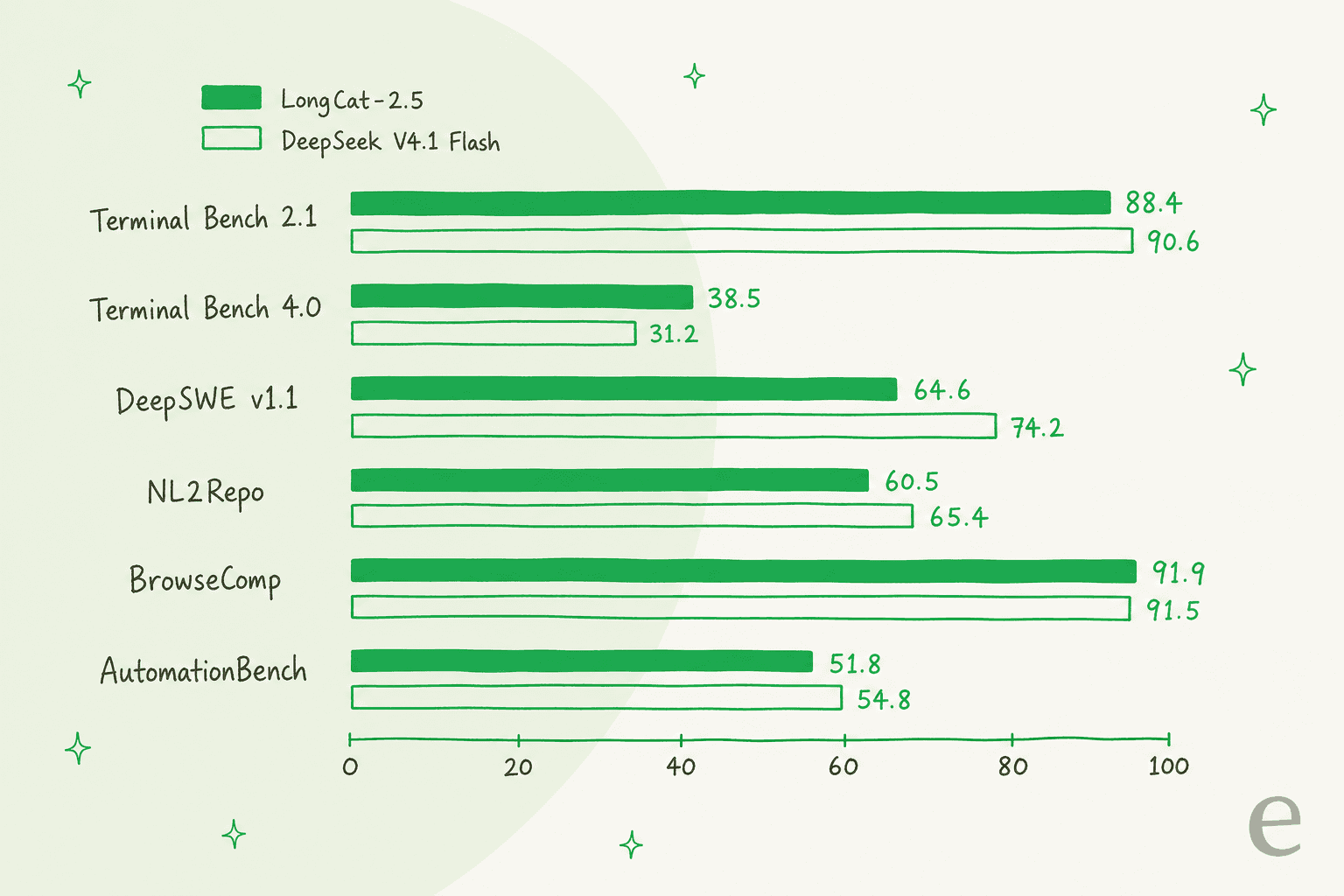
| Benchmark (Meituan's table) | LongCat 2.5 | LongCat 2.0 | DeepSeek V4.1 Flash | Kimi K3 | Claude Opus 5 |
|---|---|---|---|---|---|
| Terminal Bench v2.1 | 88.4 | 70.8 | 90.6 | 88.3 | 89.1 |
| Terminal Bench v4.0 | 38.5 | 3.0 | 31.2 | 12.6 | 53.9 |
| DeepSWE v1.1 | 64.6 | 9.7 | 74.2 | 67.5 | 68.8 |
| NL2Repo | 60.5 | 40.9 | 65.4 | 58.0 | 75.3 |
| BrowseComp | 91.9 | 79.9 | 91.5 | 91.2 | 90.8 |
| MCP Atlas | 83.1 | 61.8 | 84.4 | 84.2 | 85.8 |
| VideoMME | 85.2 | - | - | 90.0 | - |
Source: LongCat-2.5 tech blog. Scores for other models are a mix of figures Meituan took from public reports and its own runs, which the blog says "are indicative only".
Reading it plainly: on Meituan's own coding rows, DeepSeek V4.1 Flash wins more than it loses. LongCat 2.5 leads on Terminal Bench 4.0, Program Bench, SWE Atlas codebase Q&A and BrowseComp, and it is the one of the two with published video scores. On the long-horizon coding tasks that the launch is about, the cheaper-off-peak DeepSeek model is ahead.
Nobody independent has caught up yet. Artificial Analysis lists only LongCat 2.0 and LongCat Flash Lite, and the OpenRouter models API returns one Meituan model, meituan/longcat-2.0. One useful gap check: Artificial Analysis measured LongCat 2.0 at 50.2% on Terminal-Bench 2.1, while Meituan's table gives 2.0 a 70.8. Different harnesses, but a 20-point gap is a reason to run your own test rather than trust either column.
How much does LongCat 2.5 cost?
LongCat 2.5 costs $0.30 per million input tokens and $1.20 per million output tokens, with cached input at $0.006. Every number on the page carries the label "Discounted Price (limited-time)".
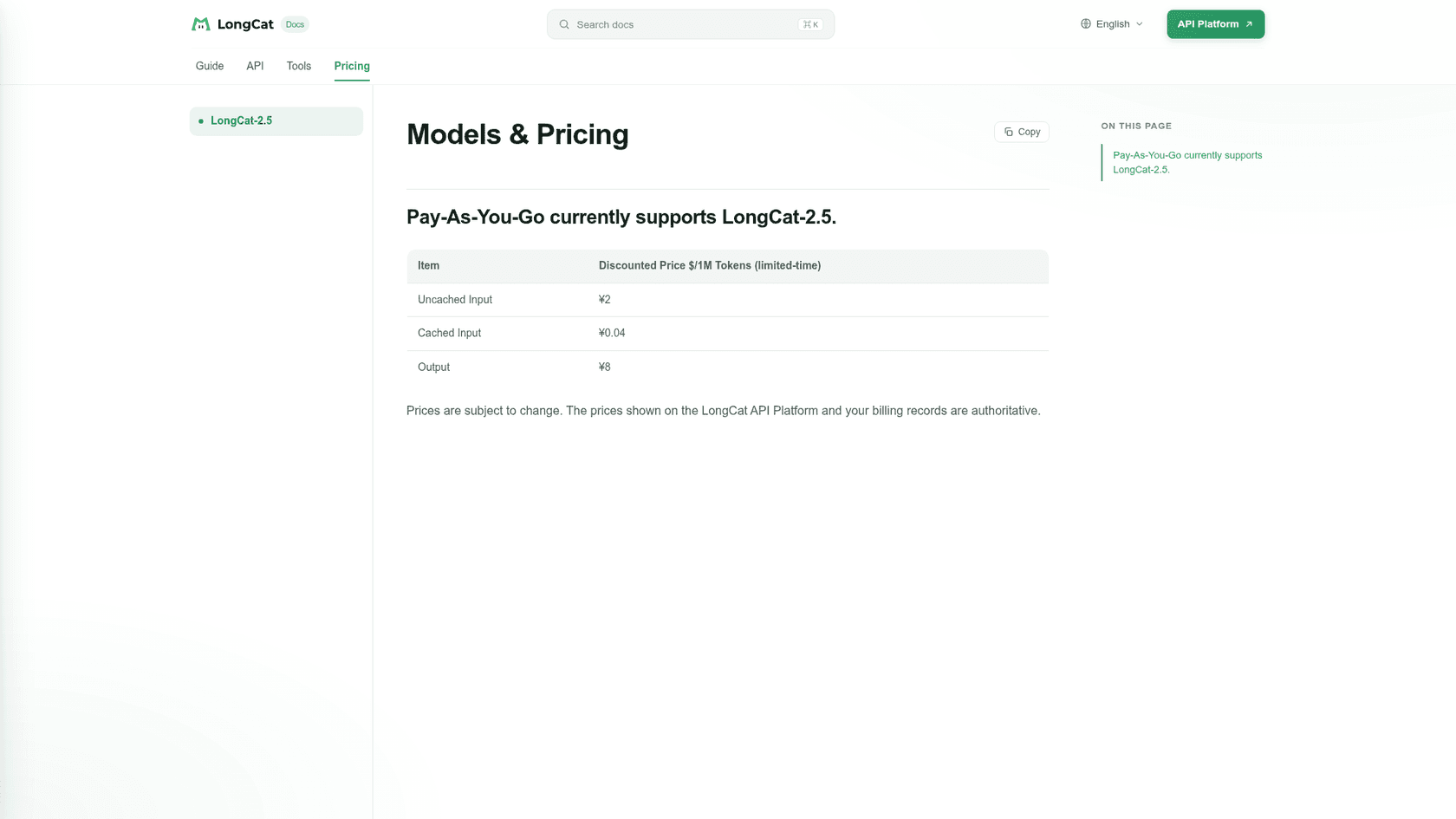
| Item | USD per 1M tokens | CNY per 1M tokens |
|---|---|---|
| Uncached input | $0.30 | ¥2 |
| Cached input | $0.006 | ¥0.04 |
| Output | $1.20 | ¥8 |
| Context-length surcharge | None | None |
| Image or video surcharge | None listed | None listed |
Source: LongCat-2.5 pricing and API Pay-As-You-Go.
Two things stand out. Cached input is 2% of the uncached price, which is a big deal for coding agents that resend the same files every turn. And there is no tiering at any length, so a 900K-token request costs the same per token as a 9K one.
Meituan's own worked example: a request with 600,000 uncached input tokens, 400,000 cached input tokens and 500,000 output tokens costs $0.7824. Only successful (HTTP 200) calls are billed, prepaid balance never expires, and there is no minimum commitment.
What happens when the discount ends?
Nobody knows, and that is the real pricing risk. 2.5's page shows only the discounted column. An old, unlinked LongCat 2.0 pricing page still shows 2.0's list price next to the same discount: $0.75 input, $0.015 cached and $2.95 output. If 2.5 eventually moves to 2.0's list price, output cost goes up about 2.5x. Meituan has not said it will, and has not said it won't.
How it compares on price
| Model | Input / 1M | Cached / 1M | Output / 1M | Context / max output | Vendor price page |
|---|---|---|---|---|---|
| LongCat 2.5 (promo) | $0.30 | $0.006 | $1.20 | 1M / 128K | LongCat |
| DeepSeek V4.1 Flash (peak) | $0.30 | $0.006 | $1.20 | 1M / 384K | DeepSeek |
| DeepSeek V4.1 Flash (off-peak) | $0.15 | $0.003 | $0.60 | 1M / 384K | DeepSeek |
| Qwen 3.8 Max | $2.00 | $0.25 | $6.00 | 1M / 131K | QwenCloud |
| Kimi K3.1 Pro | $2.00 | $0.20 | $10.00 | 1M | Kimi |
| Kimi K3 | $3.00 | $0.30 | $15.00 | 1M | Kimi |
The interesting row is DeepSeek. LongCat 2.5's promo rate is penny-for-penny DeepSeek V4.1 Flash's peak rate, and DeepSeek halves it off-peak. So 2.5 is not cheap in a way nothing else is. It is cheap in the same bracket as the most-used budget model in the category, which has independent scores, longer max output and a published API guide. LongCat's edge over it has to come from video input and the coding quality you measure yourself.
Paying for it got easier
2.0's top-ups were Alipay and WeChat Pay only, which locked out most Western teams. The Pay-As-You-Go page now lists credit and debit cards and Google Pay for the USD site, and outside mainland China you can sign up by email with no identity check. Token Packs (a fixed quota valid 30 days, sold in flash drops at 10:00, 16:00, 21:00 and 23:00 Beijing time) still exist, but their sizes and prices sit behind the logged-in console.
Verified companies also get volume discounts on Pay-As-You-Go spend:
| Monthly spend (USD site) | Monthly spend (CNY site) | Discount |
|---|---|---|
| $75 or more | ¥500 or more | 10% off |
| $300 or more | ¥2,000 or more | 20% off |
| $1,200 or more | ¥8,000 or more | 30% off |
| $6,000 or more | ¥40,000 or more | 40% off |
Source: LongCat FAQ.
How do you run LongCat 2.5 in Claude Code or Codex?
You point the harness at LongCat's Anthropic-format or OpenAI-format endpoint and set the model name to LongCat-2.5. The Claude Code guide puts it in ~/.claude/settings.json:
{
  "env": {
    "ANTHROPIC_AUTH_TOKEN": "your_longcat_api_key",
    "ANTHROPIC_BASE_URL": "https://api.longcat.chat/anthropic",
    "ANTHROPIC_MODEL": "LongCat-2.5",
    "ANTHROPIC_SMALL_FAST_MODEL": "LongCat-2.5",
    "ANTHROPIC_DEFAULT_SONNET_MODEL": "LongCat-2.5",
    "ANTHROPIC_DEFAULT_OPUS_MODEL": "LongCat-2.5",
    "CLAUDE_CODE_MAX_OUTPUT_TOKENS": "131072",
    "CLAUDE_CODE_DISABLE_NONESSENTIAL_TRAFFIC": 1
  }
}
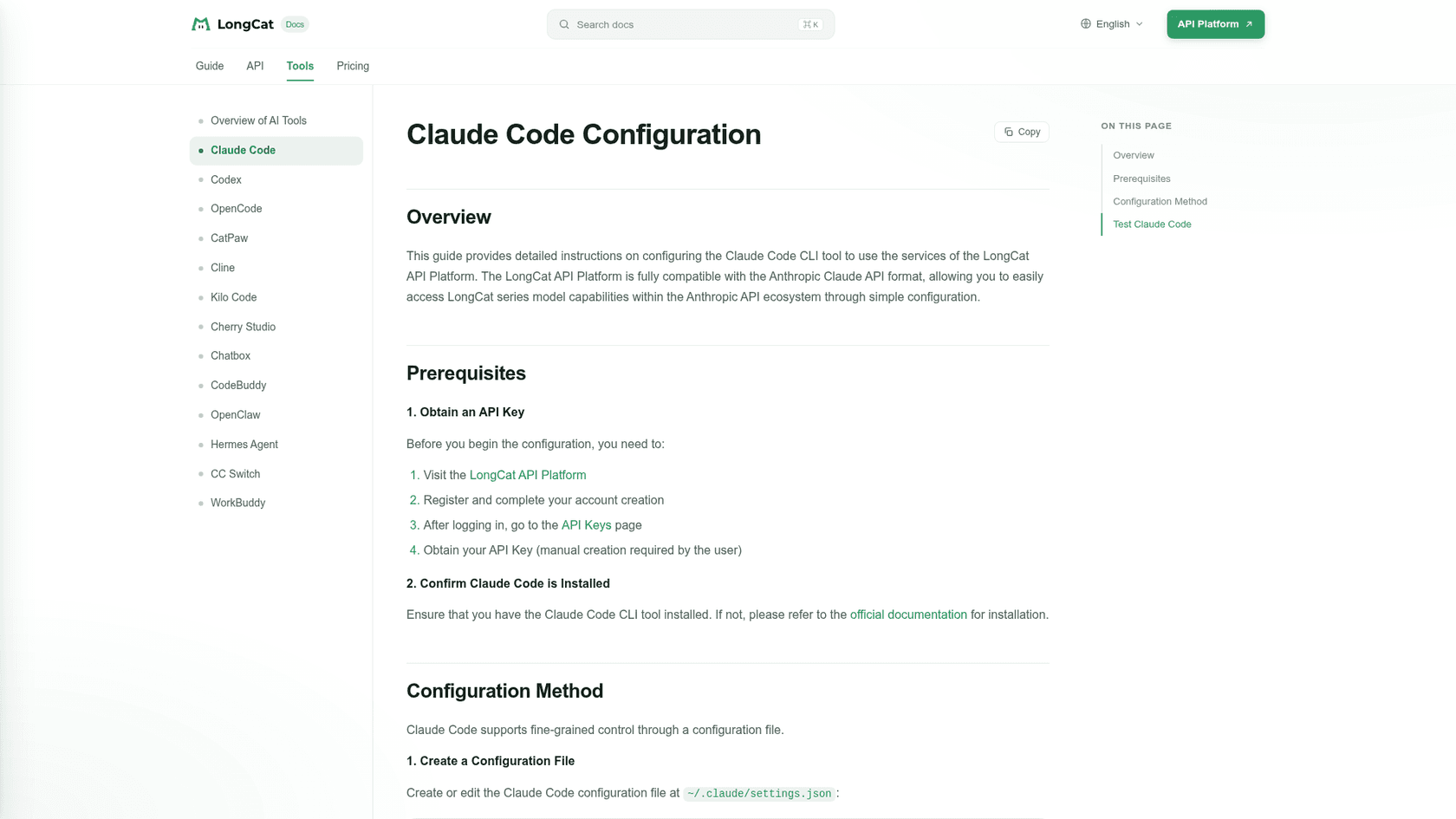
Notice every model slot points at the same model, including the "small fast" one Claude Code normally uses for cheap background calls. That is fine at $1.20 output, but it means you lose the speed split you would get with a real small model.
For Codex, you set model = "LongCat-2.5", model_reasoning_effort = "high", the base URL https://api.longcat.chat/openai/v1 and wire_api = "responses" in ~/.codex/config.toml, with the key in ~/.codex/auth.json.
Three quirks I'd know before the first run:
- Temperature is fixed. It is 1.0 with thinking on and 0.7 with thinking off, and other values are silently overridden rather than rejected (Model Parameters). If your eval harness sweeps temperature, it is not doing what you think.
- Rate limits are unpublished. Limits are per API key and return a 429 with
retry_after: 60, but no requests-per-minute or tokens-per-minute figure appears anywhere in the API overview. - Old model IDs may vanish. LongCat 2.0 and 2.5-Preview have dropped out of every Supported Models table with no dated retirement notice. If you pinned
LongCat-2.0, test it today.
If you want the wider picture of terminal coding agents before you pick one, the agentic coding CLI roundup compares them side by side.
What are developers saying about LongCat 2.5?
The preview ran free inside OpenCode for two weeks, so there is more hands-on feedback than usual for a day-old model. The loudest theme is looping on long tasks.
"Longcat is fantastic until it get stuck in loops. I think around 200k tokens of context it loses it. I have been compacting and continuing."

That lines up with Meituan adding penalties for "repetitive reasoning and repeated tool calls" in training. Whether the GA build fixed it is the first thing I'd test. The fair counterpoint is that people who kept it to a narrow role liked it:
"Longcat is ok as cheap vision agent, tiny tasks, commit. But definitely not as planner, creative writing."
One developer ran the free preview through Terminal-Bench 2.1 themselves and got 48.7% pass@1, the most token-efficient of the four models they tested at about 0.54M tokens per trial (r/opencode). That is a preview, a different harness and a different setup from Meituan's 88.4, so read it as a sanity check, not a verdict.
On Hacker News the launch thread focused on price and the choice of rivals:
"Same price as DS4.1F ... On benchmarks they seem comparable. The wild cards are the cache hit rate and speed."

"LongCat-2.5's chart skips Opus 5.5 and every current frontier model. This always happens, and people defend it because they say it's not fair to compare them. But it absolutely is!"
And a reminder that the consumer chat is rougher than the API: one HN commenter found the longcat.ai chat link redirecting to a login page on another domain and replies defaulting to Mandarin. If you only test through the chat app, you are not testing what the API gives you.
Should you use LongCat 2.5 for customer support?
Not as the model behind a support queue, at least not yet. The reason is not price or quality. It is data. The LongCat FAQ and billing pages say nothing about how long prompts are kept or whether API traffic is used for training. When a prompt holds a customer's name, order and address, that silence is the decision, the same blocker I flagged in the 2.0 write-up.
There is a bigger point, too. A model is infrastructure. To answer tickets well you also need the knowledge base connections, the escalation rules, the tone, and a way to check the answers before customers see them. That is a lot of building on top of an API, which is the trade-off covered in build vs buy for AI support.
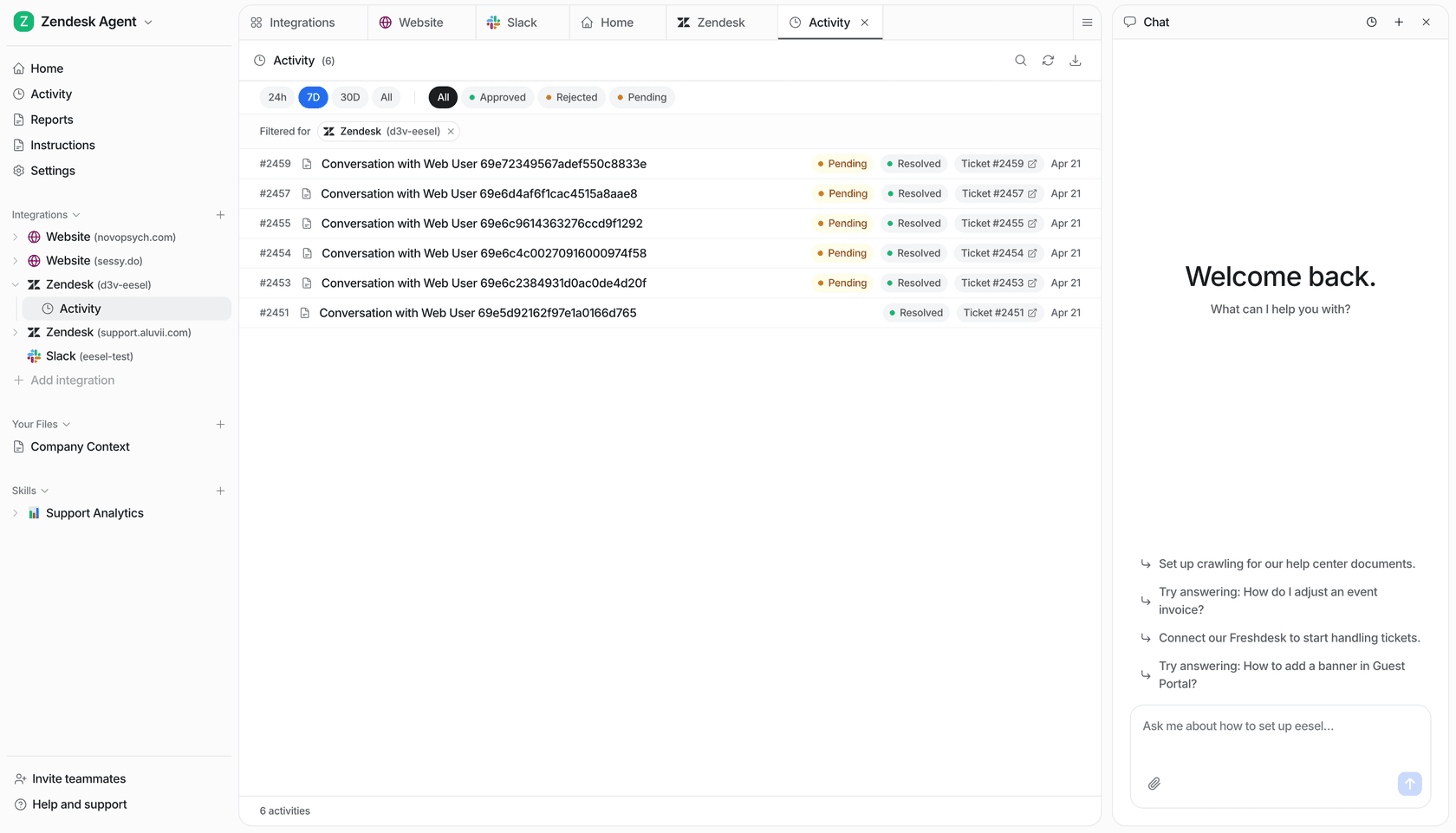
That is the gap eesel fills. eesel is an AI teammate platform, and its AI helpdesk teammate joins your existing helpdesk, learns from your help center and past tickets, and answers in your queue. Before it goes live, it runs against your historical tickets so you can read what it would have said. I've watched confident-sounding bots give wrong answers on real queues, which is exactly why every eesel rollout gets simulated on past tickets before it touches a live one.
SE Ranking is a good picture of what that looks like in practice. It runs three products on Zendesk with one eesel agent each, and in one month those agents handled 4,650 conversations, including 2,100 live chats answered first by eesel, drawing on about 16,800 pages of knowledge. SamCart runs one agent on Freshdesk tickets and another on its website chat, answering from 280 help center articles.
And if the reason you were looking at LongCat 2.5 is that you like working from Claude Code or Codex, eesel meets you there. The eesel CLI (@eesel/cli) lets you connect a helpdesk, read and edit the agent's standing instructions, approve or deny actions, and read what the agent did in each run, all from the terminal. Every command prints JSON and writes support --dry-run, so a coding agent can drive it safely, and each workspace is also an MCP server you can add to Claude Code. The coding agent sets up the support teammate; it does not have to become one.
Who should use LongCat 2.5?
My take, after reading every page Meituan published:
- Try it if you run coding agents on a budget and want one that can read screenshots or screen recordings. At $0.30 / $1.20 with 2% cached input, an afternoon of testing on your own repo costs a few dollars. Compare it head to head with DeepSeek V4.1 Flash at the same price.
- Wait if you need open weights, a licence, or self-hosting. Meituan says weights are "coming soon", and even then a 1.6T model needs a multi-GPU node. Today LongCat 2.0 is the only one of the two you can download.
- Skip it for now if your prompts contain customer or regulated data. No published retention or training policy means no green light, whatever the price.
- Pick DeepSeek instead if long-horizon coding is the whole job. At the same price, Meituan's own table has DeepSeek V4.1 Flash ahead on DeepSWE, NL2Repo and Terminal Bench 2.1, and it is cheaper off-peak. If you need independently measured scores, Kimi K3.1 Pro and Qwen 3.8 Max cost more but have been tested.
The fair summary: LongCat 2.5 is a real upgrade over 2.0, with vision that is built in rather than bolted on, at a price that has not moved. It is just not the obvious pick at its price for pure coding, and its own benchmark table is where you can see that.
Try eesel
If you came to LongCat 2.5 hoping a cheap model would take tickets off your team, skip the plumbing. eesel's AI helpdesk teammate plugs into Zendesk, Freshdesk, Gorgias and the rest in minutes, learns from your past tickets, and shows you how it would have answered them before it goes live. Plans start at $299 a month with a free tier to test on.
Try eesel for free.