

You’ve probably seen some of the hype around Manus AI. It’s one of those new, powerful AI agents that claims it can handle hefty projects, like building an app or whipping up a market analysis, from a single prompt. But as more people have tried it, a different story has started to emerge, filled with complaints about a surprisingly expensive and confusing credit-based pricing model.
Hop on forums like Reddit, and you’ll find stories from early users who burned through their entire credit allowance on one task, often without even getting a usable result. It really makes you wonder: is the raw power of Manus AI worth the unpredictable cost?
Let’s break down the Manus AI pricing structure for you. We’ll get into what you actually receive for your money, weigh whether its performance is worth the high price, and look at a more predictable alternative that’s a better fit for business.
What exactly is Manus AI?
Before we dive into the costs, let’s quickly get on the same page about what Manus AI is. This isn’t your standard chatbot that just answers questions. Manus AI is what’s called an "autonomous agent." Instead of giving it a bunch of small commands, you give it a big-picture goal, and it tries to figure out all the steps on its own.
For instance, you could tell it, "Create a simple website for my new coffee shop," or "Research the top five competitors for my SaaS product and create a presentation." Manus then attempts to break that goal down into smaller tasks, like writing code, designing slides, or searching the web, and gets to work.
Manus resumed independent operations on September 1, 2026, after separating from Meta. The capabilities sound amazing. Based on what users are sharing, it can code simple games, generate working web pages, create images, and do some deep research. It’s a glimpse into AI that doesn't just give you information but actually does things for you. The real question is, at what cost?
Breaking down the Manus AI pricing plans
Alright, here's where it gets a little messy. The way Manus AI makes money has become a major headache for its users, mainly because it’s built on a system that feels both confusing and expensive.
The confusing credit system explained
Instead of a simple monthly subscription for unlimited use, Manus AI runs on a "credit" system. Every single thing the agent does, from writing one line of code to creating one slide for a presentation, eats up a certain number of credits.
The biggest problem people are running into is how unpredictable this whole model is. Users have reported that a single, moderately complex task can blow through over 900 credits. Manus's own credits page lists a complex web app that took 80 minutes at 900 credits, against 4,000 monthly credits on the entry plan. That kind of uncertainty can create a lot of financial stress.
The most frustrating part, which tons of users have pointed out, is that Manus doesn't publish a fixed credit price per task. It says consumption depends on complexity and duration, and gives only three worked examples (200, 360 and 900 credits). That leaves you guessing whether a request will cost a few hundred credits or a big chunk of your monthly pool.
Pricing tiers
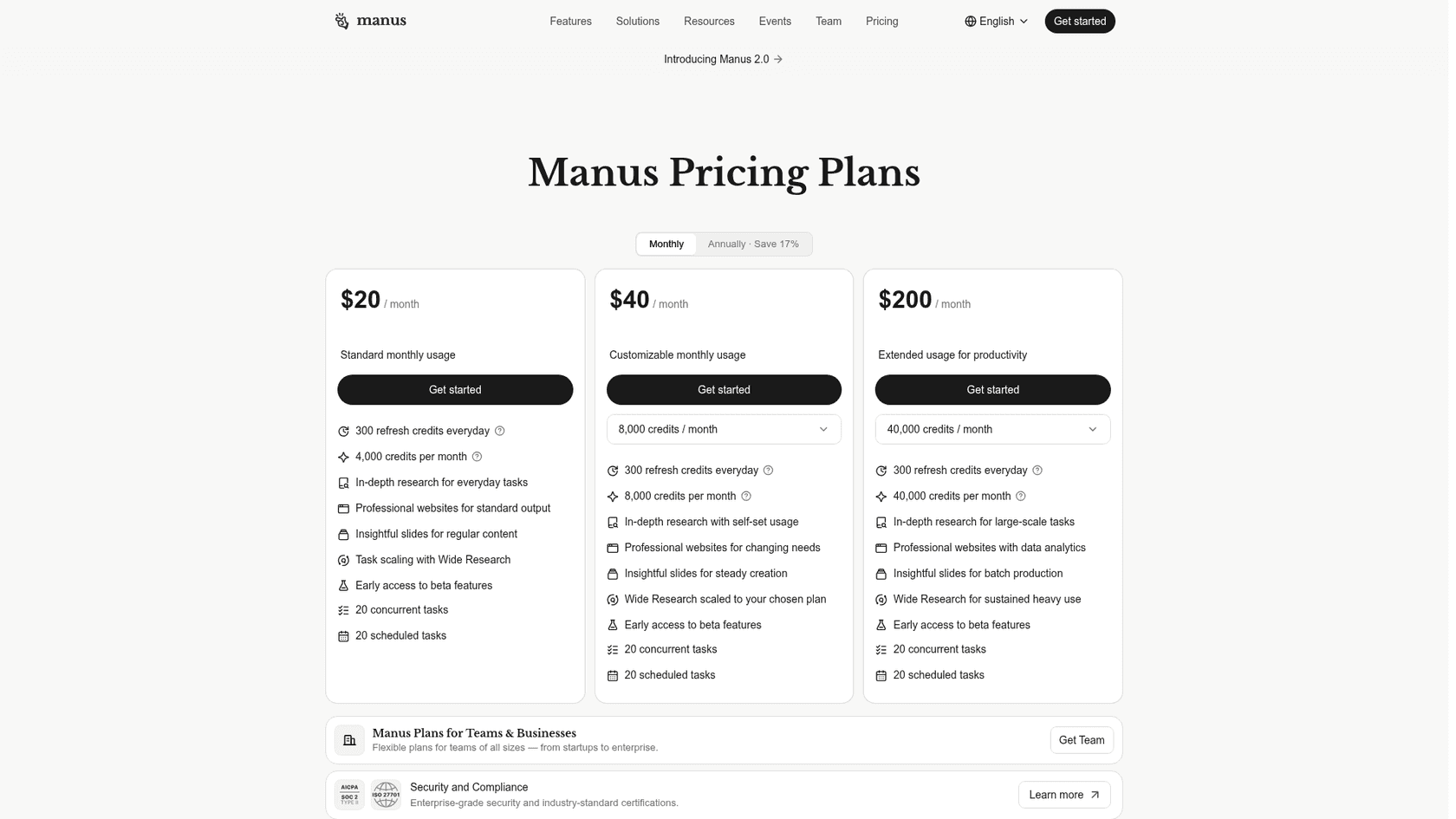
To give you a clearer picture, here are the current plans from Manus's pricing page. The Basic, Plus and Pro tiers first reported by TechCrunch in 2025 have since been renamed, and all three paid plans now share the same 300 daily refresh credits and 20 concurrent tasks.
| Plan | Price (Monthly) | Price (Annual, per month) | Credits Included | Concurrent Tasks | Best For |
|---|---|---|---|---|---|
| Free | $0 | $0 | 300 daily credits (Lite model only) | 1 | Trying out basic tasks |
| Standard | $20 | $17 | 4,000/month + 300 daily | 20 | Light personal use |
| Customizable | From $40 | From $34 | 8,000/month (selector up to 20,000 at $140) + 300 daily | 20 | Solo creators, moderate use |
| Extended | $200 | $167 | 40,000/month + 300 daily | 20 | Power users & small teams |
| Team | From $20/seat | Save 17% | Shared credit pool | Varies | Larger teams |
The hidden costs and user frustrations
Looking at that table, a couple hundred bucks for 40,000 credits on the Extended plan might not sound too bad. But when you hear about the actual user experience, that value starts to crumble.
-
Your credits vanish, fast. The number one complaint is how quickly credits get used up. Even the $20 Standard plan's 4,000 credits covers roughly four tasks the size of Manus's own 900-credit example. For a business trying to manage a budget, this is a nightmare.
-
Use 'em or lose 'em. Any plan credits you have left at the end of the month are gone, though add-on credit packs never expire. This puts pressure on you to use the service even when you don't need to, which doesn't fit how most businesses operate.
-
Tasks left half-finished. This one is a real kicker. Users have said that Manus AI can stop if it runs out of credits mid-task, leaving an unfinished website or a half-baked report. Manus does refund consumed credits for tasks that fail because of technical problems on its side.
-
The math just doesn't add up. When you put this next to something like ChatGPT Plus, which is $20 a month with fixed usage limits, the value proposition looks shaky for anyone who needs predictable spend. Manus's $20 entry plan costs the same, but its usage is metered in credits.
Does Manus AI's performance justify the price?
With such a tricky pricing model, you'd expect the platform's performance to be absolutely mind-blowing. And while it has its moments of brilliance, the truth is, it’s still a young product with flaws users keep pointing out.
The promise: What it can do right
To give credit where it's due, Manus AI can pull off some seriously cool stuff. In one popular example, a user asked it to create a "Google CEO Simulator" game. About an hour later, they had a playable game. Others have used it to get a functional, Linktree-style personal homepage up and running in less than 30 minutes.
When it works, it feels like magic. It shows you the potential of these agents to take on tasks that would normally take a person hours, if not days. This is what gets people excited, but whether you can rely on it is another matter entirely.
The reality: Where it falls short
The cool demos often mask the day-to-day frustrations of using the platform for actual work, making the high price even tougher to justify.
-
The quality is a mixed bag. The output often lacks polish. A generated webpage might have a wild color scheme, or the code might have small bugs that a developer has to fix anyway. It gets you most of the way there, but you’re paying top dollar for something that still needs a human touch.
-
It's still a bit shaky. Users have reported crashes and server overloads, especially when a lot of people are using it. That instability makes it a risky choice for any time-sensitive or important business tasks.
-
It's mostly its own workspace. Manus connects to some services, and Manus 2.0 (September 28, 2026) added automations that start from an email, Slack message or Notion update. It isn't built around your help desk and internal docs the way a support tool is, so its outputs often start from general knowledge.
A better alternative: How eesel AI puts you in control
The unpredictable nature of Manus AI's model just doesn't work for most businesses. When it comes to important stuff like customer support or internal help, you need a tool that’s dependable, transparent, and fits with the systems you already use. This is where a solution like eesel AI comes in with a much smarter approach.
Predictable costs, not credit confusion
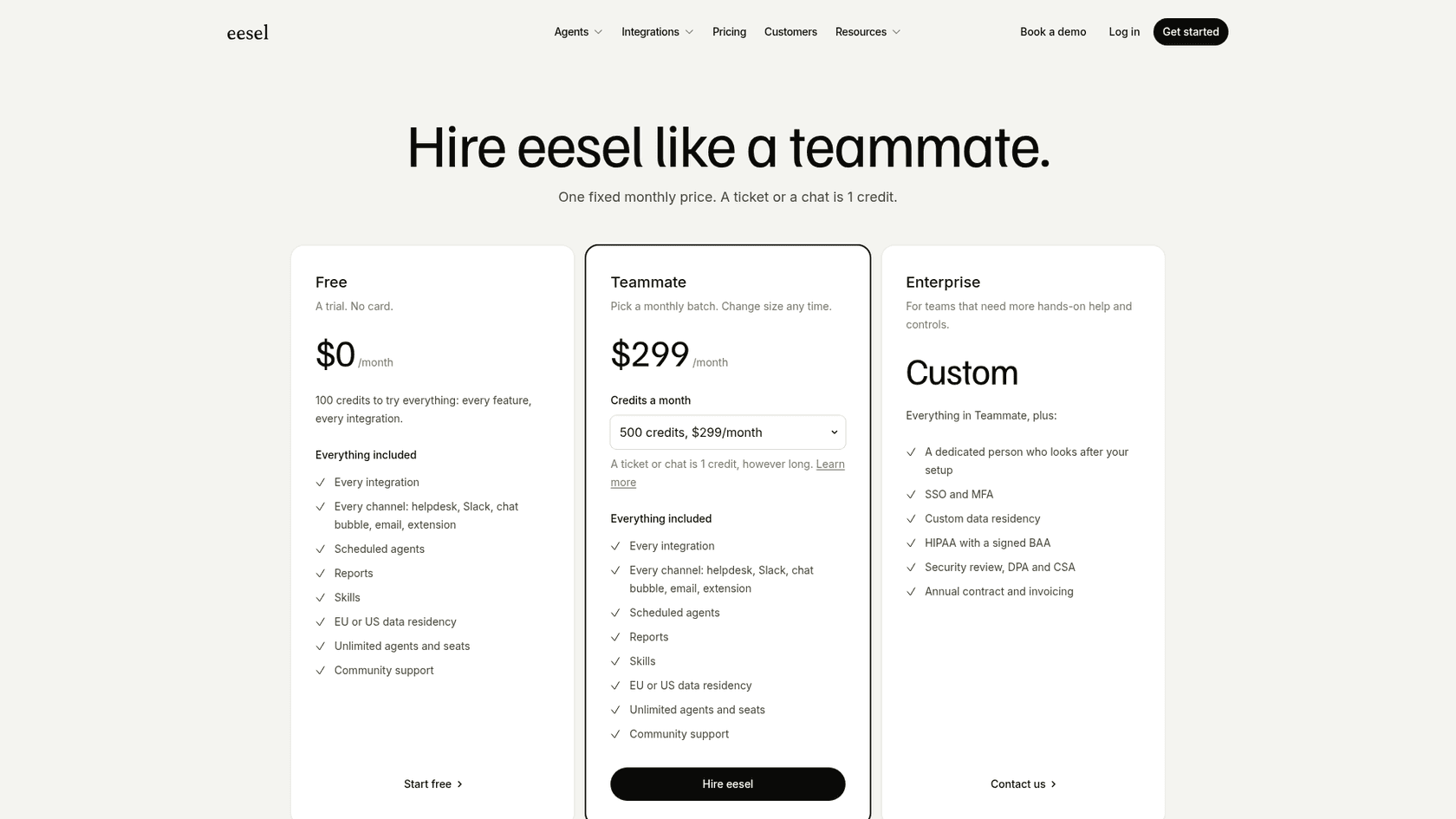
The biggest difference is the pricing. eesel AI also counts usage in credits, but a ticket or a chat is 1 credit, however many replies it takes, and you pick a fixed monthly batch: 500 credits is $299 a month, 1,000 is $499, and 5,000 is $1,899.
And here’s the key part: there are no per-seat fees, and every integration and channel is included. If you run out of credits, agents pause until they reset, or you can turn on overage with a monthly cap you set. That lets you budget with confidence as your AI use grows.
Go live in minutes, not months
While starting a task on Manus feels like a gamble, getting eesel AI set up is quick, easy, and low-risk. It’s a truly self-serve platform you can have up and running in just a few minutes. With one-click integrations for tools your team already uses, like Zendesk and Freshdesk, it slides right into your existing workflows. No developers needed.
Even better, eesel AI connects to the knowledge you already have, your help center, past support tickets, and internal docs in places like Confluence or Google Docs. This means the AI learns from your actual business from day one, so it gives helpful, accurate answers instead of generic ones.
Test with confidence before you pay anything
This is a huge relief compared to the Manus model. Instead of just crossing your fingers and hoping a task works out, eesel AI gives you a powerful simulation mode. It lets you test your AI agent on hundreds of your past support tickets in a safe environment.
You can see exactly how it would have replied, see each answer scored with suggested fixes, and find gaps in your knowledge base before it ever interacts with a live customer. It takes all the guesswork and financial risk out of the equation, so you can deploy AI knowing it will perform as you expect and deliver real value.

Is Manus AI pricing a good fit for you?
Manus AI is an exciting peek into what autonomous AI agents might do in the future. Its ability to handle complex, multi-step projects is genuinely impressive. However, the current Manus AI pricing model is just too volatile, expensive, and risky for most people and nearly all businesses. The mix of hard-to-predict credit costs, no fixed price per task, and a platform users report as shaky makes it feel more like a fun experiment than a dependable tool for work.
For business-critical functions like customer support, you need predictability, control, and reliability. While Manus AI might be entertaining to try on a personal project, businesses that need a scalable and cost-effective AI solution should look for platforms built with their needs in mind.
Take back control of your AI spending
Stop guessing at per-task costs. eesel AI offers a powerful, fully customizable AI agent platform with one fixed monthly price you can actually rely on.
Ready to see how you can automate support with confidence? Start free with 100 credits.
Frequently asked questions
How does the Manus AI pricing model work, and what are its main components?
Manus AI operates on a credit-based system where every action an autonomous agent performs consumes a certain number of credits. Users purchase plans that include a fixed amount of credits, which are then used up as the AI completes various tasks.
Is Manus AI pricing predictable, or can I expect unexpected costs when using the platform for complex tasks?
The Manus AI pricing model is hard to predict, with users reporting that complex tasks can quickly consume a significant number of credits. Manus publishes worked examples (200, 360 and 900 credits) but no fixed price per task, so budgeting takes some guesswork.
Does Manus AI pricing offer any way to estimate credit usage before starting a new project?
Not as a fixed number. Manus says a task's credit use depends on its complexity and duration, and it lists three worked examples on its credits page, but I could not find a per-task quote before you start.
What happens to unused credits within the Manus AI pricing structure at the end of a billing cycle?
Plan credits reset each month, so unused plan credits do not roll over. Purchased add-on credit packs and free credits never expire, per Manus's own documentation.
Why is the current Manus AI pricing model often considered unsuitable for business-critical applications?
Variable credit consumption and the chance of a task stopping when credits run out make Manus AI pricing hard to budget for businesses. Critical operations usually want stable costs and predictable task completion.
How does the value proposition of Manus AI pricing compare to alternatives offering unlimited usage for a fixed fee?
Manus's $20 entry plan costs the same as ChatGPT Plus, but Manus meters usage in credits while ChatGPT Plus has fixed usage limits, so costs are easier to predict there. Which fits better depends on whether you need Manus's agent-style tasks.


Article by
Rama Adi
Rama is a software engineer at eesel AI with two years of experience writing about B2B SaaS, AI tools, and customer support technology. Based in Bali, Indonesia, he brings a developer's perspective to product comparisons — cutting through marketing copy to what the integrations and APIs actually do.