


You’ve probably seen the buzz around high-performance AI platforms, and SambaNova Cloud is often right in the middle of it. They make a big promise: incredible speed for running some of the most powerful open-source AI models out there. And while the performance sounds amazing, trying to figure out how much it all costs can feel like you’re being asked to solve a riddle. For any business trying to set a budget for AI, that kind of complexity and unpredictability is a huge problem.
That's why I put this guide together. I'm going to pull back the curtain on Sambanova Cloud pricing. I'll break down the different plans, explain what you’re actually paying for, and point out some of the hidden costs that can catch you by surprise. I'll also look at a simpler, more predictable alternative for businesses that just want to automate work like customer support without the financial guesswork.
What is SambaNova Cloud?
Before we get into the price tags, it’s good to know what SambaNova Cloud actually is (and isn’t). This isn't a tool you just buy off the shelf, like an AI chatbot or a helpdesk assistant. It’s better to think of it as a supercharged engine for developers and researchers who need to run massive, open-source large language models (LLMs).
Its main claim to fame is its custom hardware. Instead of using the same GPUs everyone else does, SambaNova designed its own chips called Reconfigurable Dataflow Units (RDUs). According to their AWS marketplace page, this special hardware can churn out AI responses up to 10 times faster than standard GPUs for some tasks.
This makes it a really potent option for a very specific crowd: developers building custom AI from scratch, data scientists running complex experiments, or huge companies that need blinding speed for things like real-time financial market analysis. It's a powerful toolkit for builders, not a ready-made solution for your average business team.
Sambanova Cloud pricing models
SambaNova has a few different ways you can pay, but it's mostly a pay-as-you-go party. The plans page and the per-model rate card live on separate pages, so it takes a couple of clicks to put the full picture together. Here’s how it works as of October 2026.
Pay-as-you-go: The per-token model
The main way you’ll be charged is based on "tokens." A token is just a small piece of text, roughly four characters long, that the AI model processes. SambaNova charges you one rate for every million tokens you feed into the model (the input) and a different rate for every million tokens the model generates back to you (the output).
This pricing model is pretty common for raw AI infrastructure, but the costs can rocket up surprisingly fast, especially if you’re using the big, powerful models. Here's a peek at what they charge for a few of their popular models, straight from their official pricing page:
| Model Family | Model Name | Input Price / 1M tokens | Output Price / 1M tokens |
|---|---|---|---|
| DeepSeek | DeepSeek-V3.1 | $3.00 | $4.50 |
| DeepSeek | DeepSeek-V3.2 | $3.00 | $4.50 |
| MiniMax | MiniMax-M3 | $0.60 | $2.40 |
| Meta | Meta-Llama-3.3-70B-Instruct | $0.60 | $1.20 |
| gemma-4-31B-it | $0.38 | $1.15 | |
| OpenAI | gpt-oss-120b | $0.22 | $0.59 |
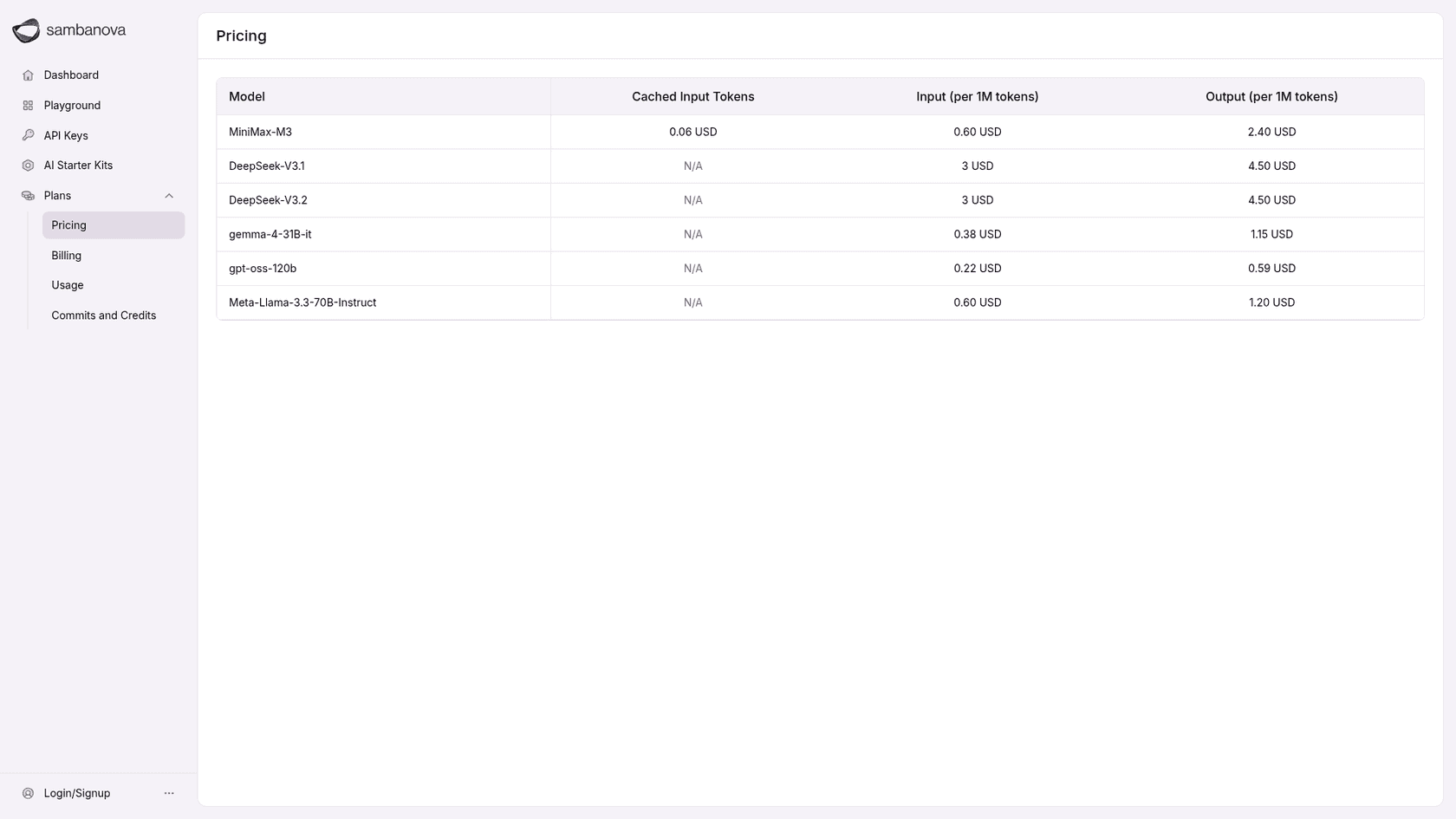
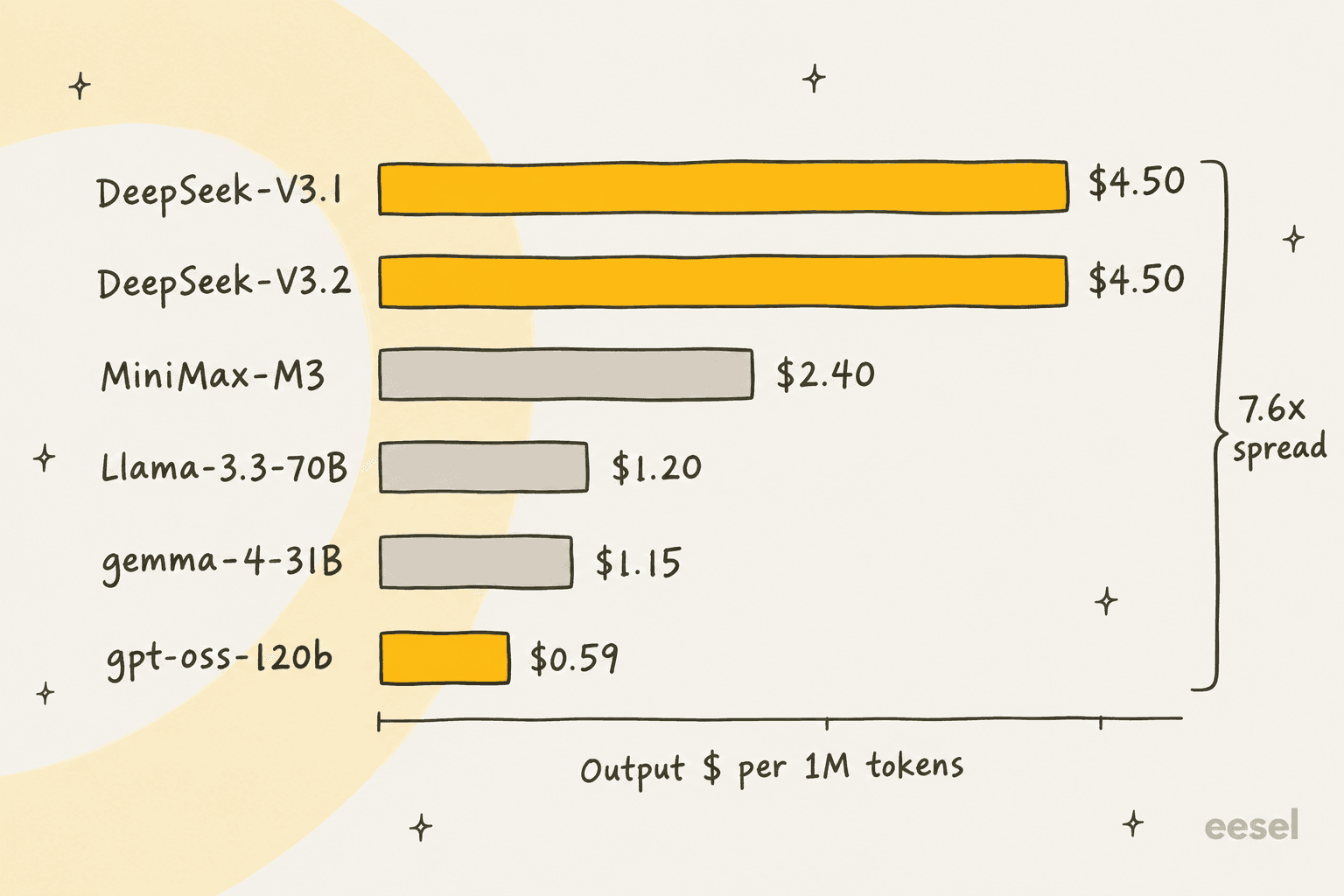
The spread between models is wide: the top output rate is about 7.6x the bottom one, so which model you pick matters as much as how many tokens you burn. MiniMax-M3 also lists a cached-input rate of $0.06 per 1M tokens.
The Free tier asks you to add a payment method and purchase credits before you run your first requests, so there is no no-card trial. Once a card is linked you move to the Developer tier, which docs.sambanova.ai caps at 20M tokens per day across all models. The free-tier limits are tight.
That tells you the free trial is really just enough to kick the tires for a moment before you have to get your credit card out.As one user on Reddit pointed out, they 'hit the free rate-limit after 3 messages.'

Enterprise pricing: Subscription-based access
For bigger companies, SambaNova has an "Enterprise" plan. This is a custom subscription designed for organizations that need to handle a huge volume of requests. It lists production rate limits and standard support, and add-ons such as on-request models, BYOC and custom rate limits are Enterprise-only. Beyond that, little is public.
The price isn't listed anywhere. Instead, you get the classic "Contact Sales" button. This is normal for enterprise software, but it means you can't even get a ballpark estimate of your costs without jumping through hoops in a sales process, which can be a real drag.
Marketplace pricing: AWS and Azure
SambaNova is also available through major cloud marketplaces, which is how many large companies prefer to buy their software.
-
AWS: The AWS Marketplace listing just adds another layer to the confusion. It lists a usage fee of "$0.01/unit" but gives absolutely no definition of what a "unit" is. Is it a token? A single API call? An hour of processing time? Without that simple definition, you’re basically signing up for a bill of unknown size.
-
Azure: Their page on the Microsoft Azure Marketplace is similar. It shows they’re focused on fitting into existing enterprise setups, but again, pricing is a complete mystery.
Key models, performance, and cost
With SambaNova Cloud, you get access to some seriously powerful open-source models from names like DeepSeek, MiniMax, Google (Gemma), Meta (Llama), and OpenAI's gpt-oss. These aren't just simple chatbots; they're designed for heavy-duty tasks like complex reasoning, deep data analysis, and creating sophisticated content.
The high price tag is all tied to their core promise: speed. For very specific situations where every millisecond matters, paying that premium might actually make sense. Imagine a hedge fund analyzing market news in real-time, or a research lab crunching massive datasets. In those cases, getting results faster can give them a real edge.
But this brings up the age-old dilemma: cost versus performance. While SambaNova is fast, it’s not the only game in town.
One person noted that when SambaNova asked $5.00/$7.00 per million tokens for DeepSeek-R1, you could find alternatives for as low as "$0.8/$2.4." This really paints SambaNova as a luxury product for those who need top-tier speed and have the deep pockets to pay for it.Users on Reddit were quick to comment that other providers offer similar models for much, much less.
The problem with per-token pricing for businesses
For a developer running a quick experiment, paying by the token is fine. But if you’re a business trying to automate something essential, like customer support, it’s a recipe for budget chaos.
Think about a typical support conversation. It's rarely just one question and one answer. There's often a back-and-forth, the AI needs to pull context from past tickets, and it might have to reference several help articles. Every single one of those steps eats up tokens. A single complicated ticket could easily burn through thousands of them. At the end of the month, you’re left with a shockingly high bill and no good way to predict the next one.
Even worse, this model punishes you for growing. As your business succeeds and more customers contact you, your AI costs go up right alongside your ticket volume. It makes budgeting a nightmare and can turn what was supposed to be a cost-saving tool into a growing expense.
For business automation, pricing should be tied to the value you get, not the raw resources you use. A platform designed for business workflows should package the technology into a solution with predictable costs, not just give you access to a raw engine with a meter running.
eesel AI: A predictable alternative
This is exactly the problem that platforms like eesel AI are built to solve. It’s an AI platform designed specifically for business tasks like customer service and internal IT support. It’s not just an API you have to build on top of; it’s a complete solution that plugs right into the tools you already use, like Zendesk, Slack, and Confluence, to start automating support right away.
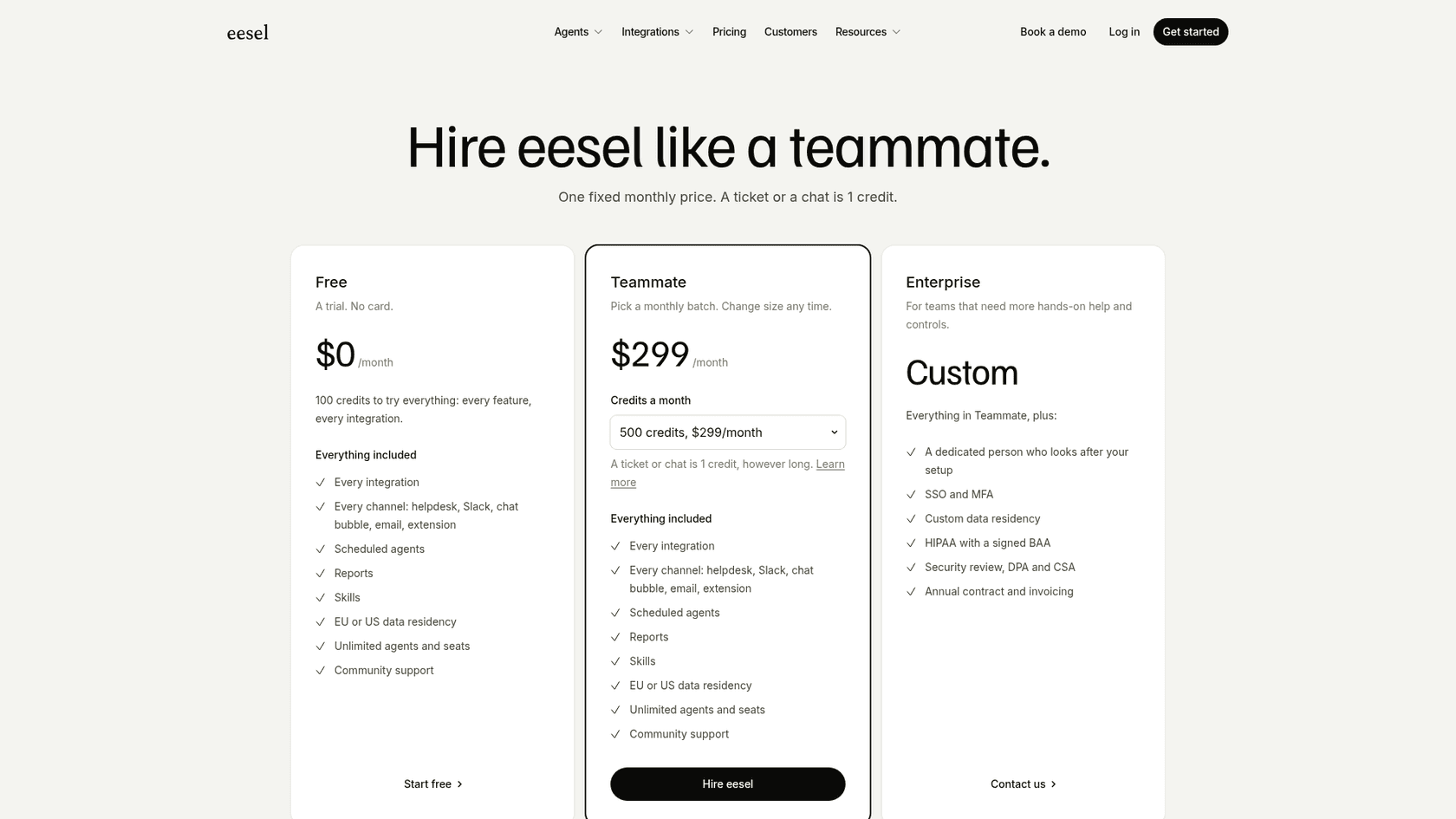
eesel sells fixed monthly credit plans: the Free plan has 100 credits with no card, and paid plans start at $299/month for 500 credits. A ticket or a chat is 1 credit, however long it runs.
This business-first thinking shows up in other ways, too:
-
Get started in minutes, not months. SambaNova is a developer's tool that requires a lot of technical skill to use. On the other hand, eesel AI is designed to be completely self-serve. You can connect your helpdesk, let the AI learn from your existing knowledge base, and have it running in minutes, all without having to talk to a salesperson.
-
Test without the risk. With a pay-as-you-go model, every little test costs you real money. eesel AI includes a simulation mode that lets you test your setup on your own past tickets. You can see how it would have answered before you ever turn it on for your customers. This takes the risk out of launching a new AI tool.
Is the Sambanova Cloud pricing model right for you?
SambaNova Cloud delivers some truly impressive speed for running massive AI models. But Sambanova Cloud pricing is metered per token, so the bill follows usage. That makes it a good choice for highly specialized, developer-led projects where speed is everything and the budget is flexible.
For most businesses that just want to use AI to automate work like customer support, a solution-focused platform is a much more practical choice. The fixed monthly credit plans and the quick, self-serve setup of a tool like eesel AI offer a faster, safer, and more reliable way to get real value from AI without breaking the bank.
Ready to see how AI can automate your support with costs you can actually predict? Try eesel free with 100 credits.
Frequently asked questions
How does Sambanova Cloud pricing typically work for users?
Sambanova Cloud primarily uses a pay-as-you-go model based on "tokens." You're charged a rate per million input tokens and a different rate per million output tokens processed by the AI models.
Why is Sambanova Cloud pricing considered unpredictable for many businesses?
Its per-token model makes costs unpredictable because the number of tokens consumed varies widely with usage and complexity of requests. For business automation, this can lead to unexpected and rapidly escalating monthly bills.
Who would benefit most from the current Sambanova Cloud pricing model?
It's best suited for developers, researchers, or large enterprises needing extreme speed for custom AI builds or highly specialized, performance-critical tasks. These users typically have flexible budgets and deep technical expertise.
Are there options for enterprise-level Sambanova Cloud pricing?
Yes, SambaNova offers an "Enterprise" plan for high-volume needs, which is subscription-based. However, specific pricing for this plan is not publicly listed and requires contacting their sales team.
Can I test out the service before committing to Sambanova Cloud pricing?
SambaNova's Free tier needs a payment method and purchased credits before your first requests, and the plans page points to its developer community for chances to earn more credits. Users report hitting the free rate limit quickly, so treat it as a brief initial trial.
How does Sambanova Cloud pricing compare to the alternatives mentioned for business automation?
Unlike Sambanova Cloud pricing, alternatives like eesel AI sell fixed monthly credit plans, where a ticket or a chat is 1 credit. A Free plan includes 100 credits with no card, and paid plans start at $299/month for 500 credits, so you can budget without a token meter.