

Disclosure: This article is published by eesel AI, a competitor of Sierra. We encourage you to read Sierra's own materials for their perspective.
The short version. Sierra is an enterprise AI agent platform founded by Bret Taylor and Clay Bavor. Its agents handle customer conversations across voice, chat, email and WhatsApp in 59 languages, and they take real actions in your systems: processing a return, changing a subscription, verifying a customer's identity. It is used by more than 40% of the Fortune 50 (Sierra).
There is no public price, no free trial and no signup button. Pricing is outcome-based and quoted per deal, deployment runs weeks not minutes, and third-party analysts put year one somewhere past $200,000. If you run a large contact centre and have an engineering team to point at it, Sierra is a serious platform. If you have an existing helpdesk and want automation running this week, it is the wrong shape.
Sierra AI has become one of the more prominent names in enterprise customer support automation. Founded in 2023 by Bret Taylor and Clay Bavor, the company raised a $950M round led by Tiger Global and GV in May 2026 at a post-money valuation above $15 billion, and reached $150M ARR by February 2026. In July 2026 it launched Horizon and announced it is acquiring Takeoff.
This guide covers what Sierra actually is, how its platform works, what businesses are using it for, what the pricing model looks like, where it falls short, and what a faster-to-deploy alternative looks like for teams outside the enterprise tier.
What is Sierra AI?
Sierra is an enterprise AI platform for customer experience automation. The company describes its product as an Agent Operating System (Agent OS): a platform for building, deploying, and optimizing AI agents across chat, voice, SMS, WhatsApp, email, and ChatGPT. Its stated goal is not to sit on top of an existing helpdesk, but to serve as the primary customer-facing system for tier-1 support.
Sierra's target market is large enterprises. The company reports that 40% of Fortune 50 companies are customers, and that one in four customers generates over $10B in annual revenue. The current customer list includes SiriusXM, ADT, Rocket Mortgage, Brex, Ramp, and Minted, across 48 case studies.
As of July 2026 Sierra describes Agent OS as powering "phone calls and chats for hundreds of companies, from Santander to Rocket Mortgage and Cigna, including almost half of the Fortune 50" (Sierra).

The platform is built around a core thesis: customer support should be automated at the outcome level, not just the conversation level. Agents that resolve issues and complete real transactions, not just chat and escalate to humans.
Who owns Sierra AI, and who funds it
Sierra is a private company. It is not owned by Salesforce, Google or OpenAI, though the founders' résumés make that a common assumption.
Bret Taylor co-founded Sierra after serving as co-CEO of Salesforce. Before that he founded Quip, was CTO of Facebook, and began his career at Google where he co-created Google Maps. He also chairs the board of OpenAI (Sierra).
Clay Bavor spent 18 years at Google, most recently leading Google Labs. Earlier he started Google's AR/VR effort and Project Starline, ran Google Lens, and led product and design for Google Workspace (Sierra). The two met while working together at Google.
Funding. The most recent round is $950 million led by Tiger Global and GV, announced 4 May 2026, taking post-money valuation above $15 billion and giving the company more than $1 billion on the balance sheet (TechCrunch). Sequoia is a listed investor (Sequoia).
Revenue. Sierra said it passed $100M ARR in late November 2025 and $150M ARR in early February 2026 (TechCrunch, Sierra).
Where they are. Offices in New York, Atlanta, London, Singapore, Tokyo, Paris, Madrid, Toronto and San Francisco (Sierra).
Why this matters to a buyer: a company at this valuation with this much cash is not going anywhere, so vendor risk is low. But it also means Sierra is under no pressure to serve small teams, and its pricing and sales motion reflect that.
How Sierra AI works
Sierra's platform has several distinct layers that work together: a no-code builder for CX teams, a developer SDK for engineers, a memory and personalization layer, and a set of observability and optimization tools.
Agent Studio and Agent SDK
Agent Studio is Sierra's no-code interface for building and managing agents. With Agent Studio 2.0, released at Sierra Summit in November 2025, CX teams describe customer experience goals in plain English through a feature called Journeys -- the system generates the underlying instructions, guardrails, tone, and integrations. A GitHub-style Workspaces environment supports version control so multiple team members can edit agents in parallel without overwriting each other's changes.
Sierra's Agent SDK is the programmatic layer for developers who need full control. It supports composable skill modules -- triage, respond, confirm, custom -- that combine into multi-step workflows. Developers can write customer journeys as code, track changes, inspect API calls, and trace agent logic through built-in debugging tools. The SDK ships with pre-built integrations and skills to accelerate development.
Both paths can coexist in the same deployment. CX teams iterate on agent behavior through Agent Studio while engineers manage system integrations through the SDK.
Ghostwriter
Ghostwriter, launched March 25, 2026, is a conversational agent builder -- an AI that builds other AI agents through conversation. Instead of clicking through a configuration UI, a support manager describes the agent they need in plain English, and Ghostwriter generates it. It can create agents from standard operating procedures, customer call transcripts, audio recordings, and even photos of whiteboard sketches, then deploy them across voice, chat, email, and 59 languages.
Ghostwriter also runs an automatic improvement loop: it analyzes real customer interactions, identifies failures, validates fixes in a sandboxed environment, and queues approved changes for deployment.
Agent Data Platform and real-time integrations
Agent Data Platform (ADP), launched November 2025, gives Sierra agents persistent memory: access to customer history, CRM records, real-time order status, and behavioral signals. Unlike a stateless chatbot that starts each conversation without context, ADP-powered agents retain information across sessions, so returning customers do not need to repeat themselves.
Sierra's system integrations connect agents to internal and external systems via API and let agents take real actions mid-conversation. An agent can process a refund, update a subscription, check an account balance, or verify a customer's identity without handing off to a human. In April 2026, Sierra added PCI-compliant payments, allowing agents to handle financial transactions directly.
Omnichannel and brand personas
Sierra agents deploy across chat, SMS, WhatsApp, email, voice, and ChatGPT from a single agent configuration, in 59 languages, 24/7/365. Agent OS 2.0 added a ChatGPT integration that surfaces a Sierra agent as a ChatGPT plugin in one step.
Brand personas and guardrails let organizations define the agent's voice, tone, formality level, and policy boundaries -- what it can and cannot say or do. The goal is an agent that sounds like the brand, not a generic bot. Wilson achieved 77% containment while maintaining its brand heritage voice. Minted reached 65% resolution on the cases its agent is designed to handle, with 95% CSAT.
Observability and optimization
Sierra's Explorer agent analyzes patterns across thousands of conversations to identify failure points and surface optimization opportunities. Experiments supports multivariate testing to measure the impact of agent changes on resolution rate, CSAT, and escalation rate. Since 30 June 2026 Experiments also reports statistical confidence on each A/B test and supports gradual rollout of a winning variant. Live Assist provides real-time guidance to human agents mid-conversation, capturing details automatically as they work.
Horizon: agents that work a goal over days or weeks
On 16 July 2026 Sierra announced Horizon, which it calls "the most significant expansion of Sierra since we launched in 2024" (Sierra).
Agent OS handles a conversation. Horizon handles a goal that spans many conversations over days, weeks or months: originating a loan, getting prior authorization for a procedure, or scheduling a specialist referral. Sierra's own example is a healthcare provider where booking one appointment takes dozens of texts and calls across the patient, the specialist and the referring physician. Horizon adds a context engine that stitches those interactions together and long-horizon planning so the agent decides what to do next between engagements.
A week later, on 23 July 2026, Sierra announced it is acquiring Takeoff, a three-person team that had built a long-horizon agent runtime from zero to close to $10 million in revenue in seven months. The two teams are building Horizon together.
On cost, Sierra's Horizon announcement says "with Horizon, you don't pay for tokens, you pay for business outcomes delivered." That is the same outcome-based model Sierra already sells on, not a change of billing.
Sierra AI use cases and results
Sierra publishes 48 case studies with specific metrics across financial services, healthcare, retail, telecom, and enterprise software:
| Customer | Use case | Reported outcome |
|---|---|---|
| Ramp | Financial services support | 90% case resolution |
| Brex | Customer service | 90% faster |
| Rocket Mortgage | Mortgage inquiry support | 4x higher lead-to-application conversion |
| Airtable | Product support | 80% resolution rate |
| Minted | E-commerce support | >65% resolution; 95% CSAT |
| Casper | Product and order support | 74% resolution; >20% CSAT increase |
| CLEAR | Member support | 4.7/5 CSAT |
| Madison Reed | Subscription retention | 50% reduction in cancellations |
| SiriusXM | Listener support | 34 million subscribers served |
| Sonos | Device setup and troubleshooting | 15 million customers |
| ADT | Security system inquiries | 2 million inquiries/month |
| Wilson | Consumer email support | 77% resolution rate |
| SoFi | Financial services | +33 NPS points |
| Singtel | Telecom customer care | Live in under 10 weeks |
These are Sierra's published case studies, which reflect best-case deployments. Results depend on agent design, integration depth, and training data quality.
Sierra AI pricing
Sierra pricing is not publicly disclosed. All pricing is custom-quoted through a direct sales process. There is no public pricing page, no self-serve tier, and no free trial.
Sierra's pricing model is outcome-based: customers pay when the agent successfully resolves a customer issue, not per message or per conversation. In practice, contracts blend a platform subscription fee with per-successful-outcome charges.
Sierra is unusually candid about how that works in practice. In a July 2026 follow-up on the model, Sierra writes that outcome-based pricing "is more complex than seat-based or consumption pricing -- operationally, contractually, accounting-wise," and that it "only works where the software is highly autonomous and highly attributable." The company adds that it is "not dogmatic about it" and does "consumption-style work where it fits the shape of the problem." Read plainly: a real Sierra contract is a blend, with some steps billed per outcome and others per usage, and which is which is negotiated.
What Sierra does not publish is any number: no dollar amount per outcome, no minimum, no commitment length, no volume tiers, and no statement of how a partial or disputed outcome is handled. Figures circulating in third-party pricing roundups are not Sierra's and are not verifiable, so they are not repeated here.
Implementation adds further cost. Sierra's own case studies document go-live timelines from under four weeks at Vivid Seats to less than ten weeks at Singtel, both of which involved a CSM-guided deployment rather than self-serve setup.
For teams that need pricing transparency before entering a sales process, Sierra is not a fit. For teams actively evaluating it, a direct conversation with Sierra's sales team is the only path to actual numbers.
What "outcome-based" does and does not cover
Sierra's pricing post is more specific than the marketing line, and the details are where budgeting gets hard.
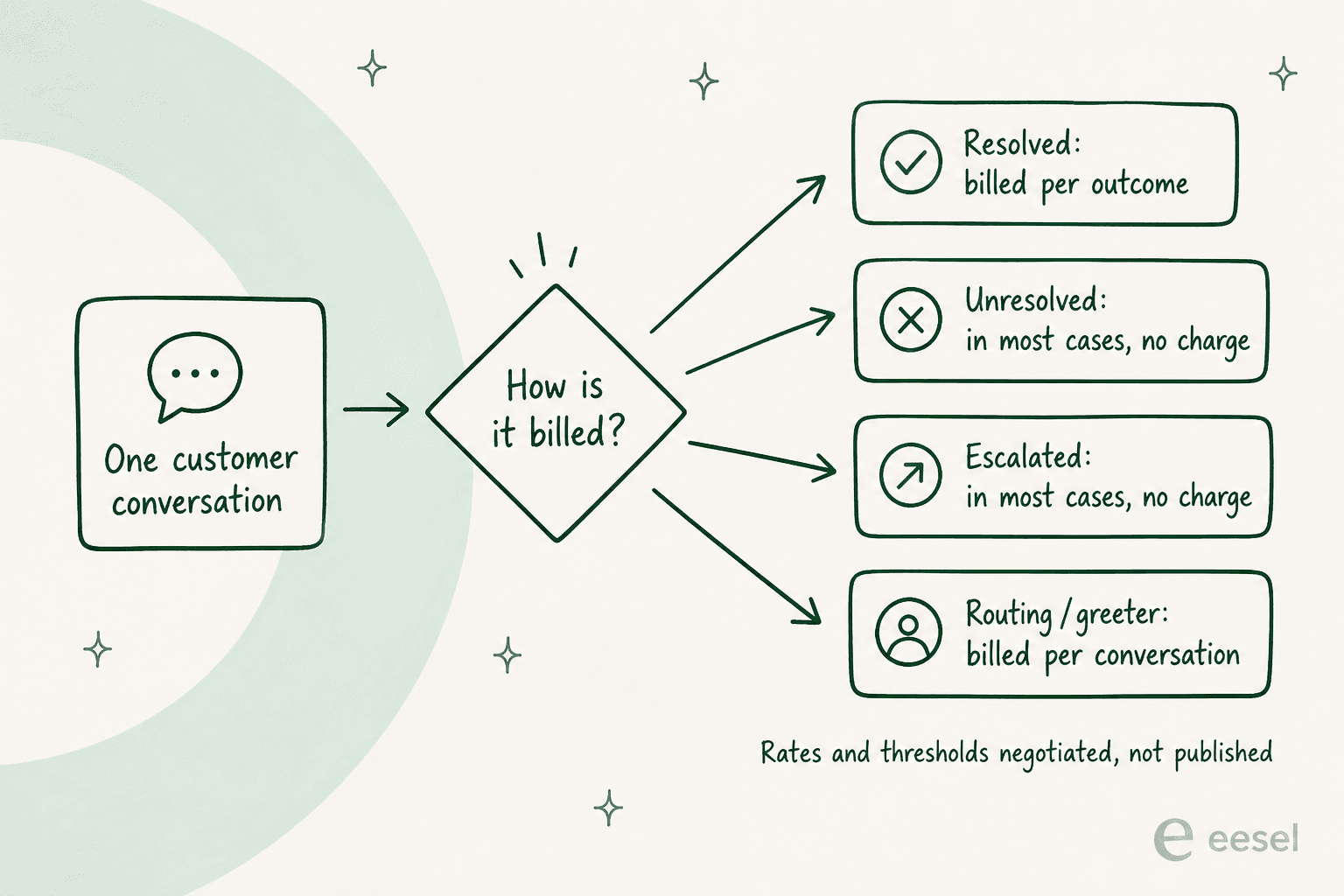
- Unresolved conversations. "If the conversation is unresolved, in most cases, there's no charge." Note "in most cases". The exceptions are defined in your contract, not published.
- Escalations. "If a case needs to be escalated, in most cases, there's no charge." Same caveat.
- Not everything is outcome-priced. Sierra says outcome-based pricing "may not always be the best fit" and that it will "create a blended pricing approach". Its own example: "routing or greeter-style interactions may align better with consumption-based pricing, where payment is based on conversation count, regardless of the outcome."
- Outcomes are not uniform. Answering a question and resolving something that would have taken a 20-minute L2 call are both outcomes, and they are priced differently. Criteria are "clear, agreed-upon" but negotiated per customer.
So the honest summary is: outcome-based on the resolutions, consumption-based on the traffic that never had an outcome to reach, and every threshold negotiated behind an NDA. That is a defensible model. It is just not one you can model in a spreadsheet before you talk to sales.
For the full cost breakdown, see our Sierra AI pricing guide.
Limitations worth knowing
Sierra's enterprise focus comes with real tradeoffs that are worth understanding before starting a sales process.
Implementation requires engineering. Every deployment goes through a custom sales and CSM-guided implementation process. The no-code Agent Studio reduces barriers for CX teams, but system integrations require engineering involvement. G2 reviewers note a steep initial learning curve and flag that many changes require vendor involvement rather than customer self-service.
Context loss in extended conversations. G2 reviews document that AI agents can lose context in longer conversations, sometimes repeating themselves or giving generic answers mid-session. This is a limitation particularly visible in complex, multi-turn interactions.
Pricing opacity complicates budgeting. Because all pricing is privately negotiated, it is difficult to model ROI before committing to a multi-month sales cycle and deployment. One G2 reviewer noted that cost uncertainty made it hard to assess long-term value.
Bugs and performance variability. Some users report the platform has occasional bugs and can be slow compared to more mature platforms. Sierra launched publicly in February 2024, and some rough edges reflect that early stage.
There is no way in without a sales call. There is no signup button on sierra.ai. The site offers "Learn more" and "Sign in", nothing else. Every deployment starts with a form, a demo, a discovery session and a scoped pilot. Sierra's own case studies put time-to-live between four weeks (Vivid Seats) and under ten weeks (Singtel). Its product page promises "deploy in weeks" (Sierra). Weeks is fast for enterprise software. It is still weeks.
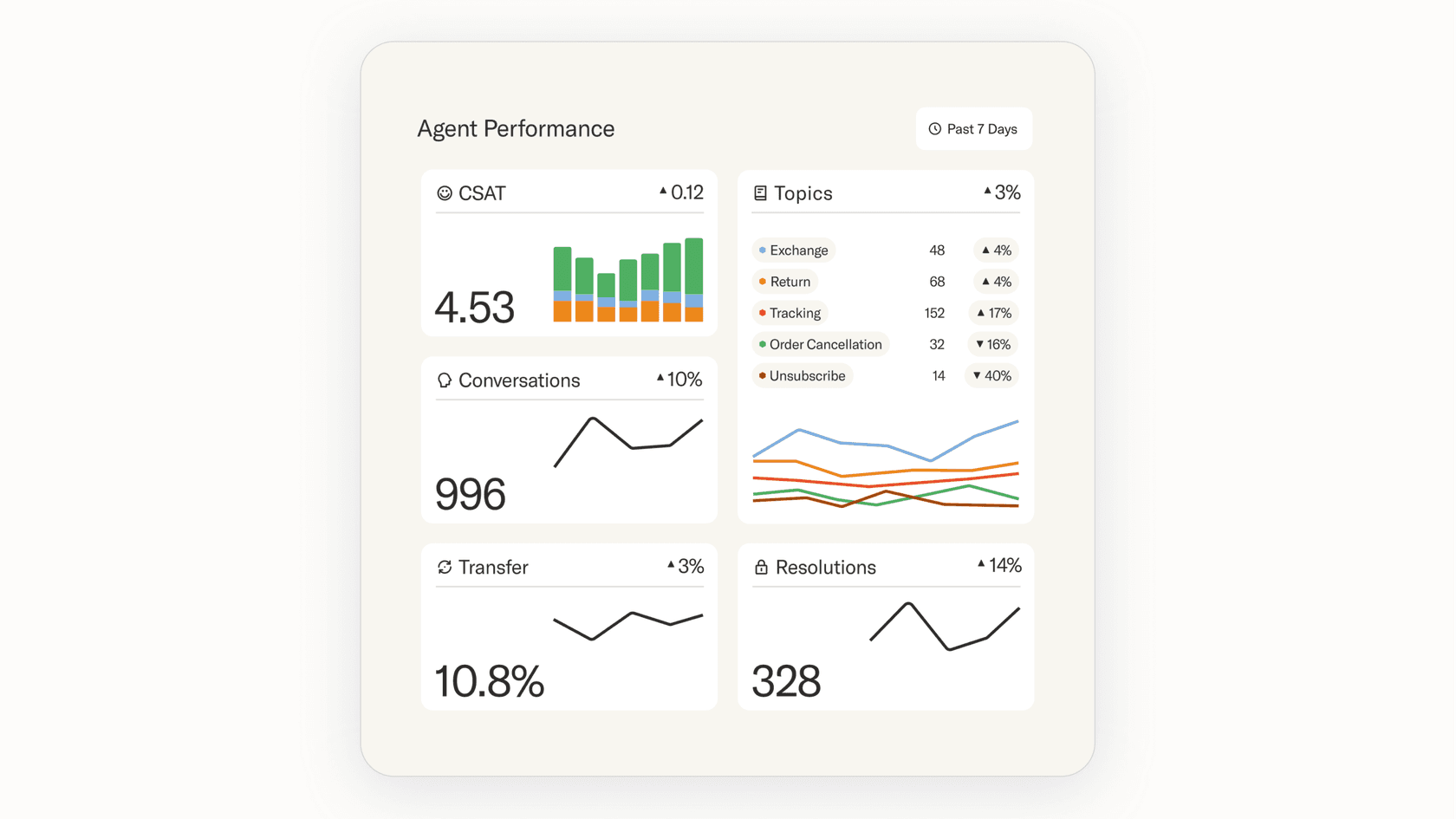
How to evaluate Sierra before you start a sales cycle
A Sierra evaluation is a multi-week commitment before you see a number. Six questions to get answered in the first call, so you are not three weeks in before you learn something disqualifying.
1. Which of my interaction types are outcome-priced and which are consumption-priced? Sierra says routing and greeter interactions may bill per conversation regardless of outcome. Ask for the split against your own volume mix, not a generic example.
2. What exactly counts as a resolved outcome, in writing? Sierra prices simple answers and complex multi-step resolutions differently. Get the tiers and the criteria before the pilot, not at renewal.
3. What are the "in most cases" exceptions on escalations? Sierra's public wording is "in most cases, there's no charge" for escalations and unresolved conversations. Ask which cases are not most cases.
4. What is the first-year total, including services? Third-party analysts put entry pilots near $150,000 and year-one all-in at $200,000 to $350,000 or more. Sierra has not confirmed these. Ask for licensing and professional services as separate line items.
5. How mature is my channel? Sierra now covers voice, chat, email and WhatsApp, but the case studies skew toward chat. Ask how many production deployments exist on your specific channel, in your industry.
6. Who owns changes after go-live, me or Sierra? Agent Studio is pitched as no-code for CX teams, while system integrations run through the Agent SDK. Ask what a typical change request costs in days, and who does the work.
If the answers to 1, 2 and 4 are not available before a pilot, you are being asked to budget without inputs. That is a legitimate reason to look at a tool that publishes its price.
Sierra AI alternatives, summarized
Sierra is one shape of AI support: vendor-built, enterprise-priced, deployed over weeks. Four other shapes exist. Full detail and five more picks are in our 8 best Sierra AI alternatives.
| Alternative | Pick it if | How it bills | Time to live |
|---|---|---|---|
| eesel AI | You have a helpdesk and want automation running today | From $299/mo (500 credits), published | Minutes to hours |
| Decagon | You want enterprise omnichannel and are already shortlisting Sierra | Custom, six figures | Weeks, engineering-led |
| Ada | You run 300k+ conversations a year | Platform fee plus usage | Weeks to months |
| Salesforce Agentforce | Your CRM is already Salesforce | Per action or per conversation | Weeks |
| Gorgias | You are a Shopify or ecommerce brand | From $10/mo plus usage | Same day |
Two head-to-heads worth reading if Sierra is on your shortlist: Decagon vs Sierra and Sierra vs Zendesk. If you want the user-reported view rather than the feature list, see our Sierra review.
eesel AI: a practical alternative for teams not at Fortune 50 scale
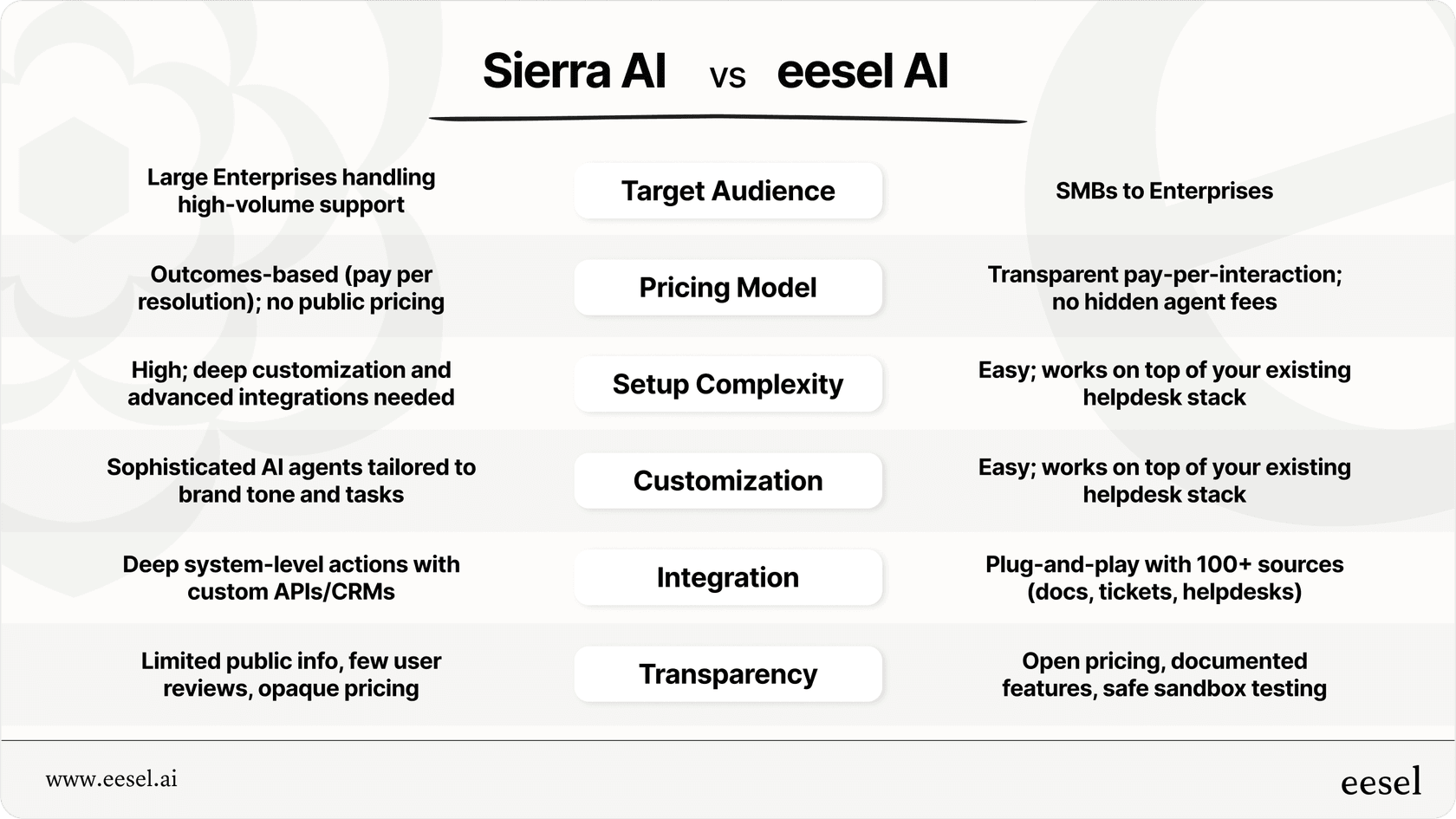
Sierra is purpose-built for large enterprises with high ticket volumes, dedicated CX engineering teams, and the procurement capacity for a negotiated enterprise contract. For teams outside that profile, the setup requirements and the sales-led pricing model are generally prohibitive.
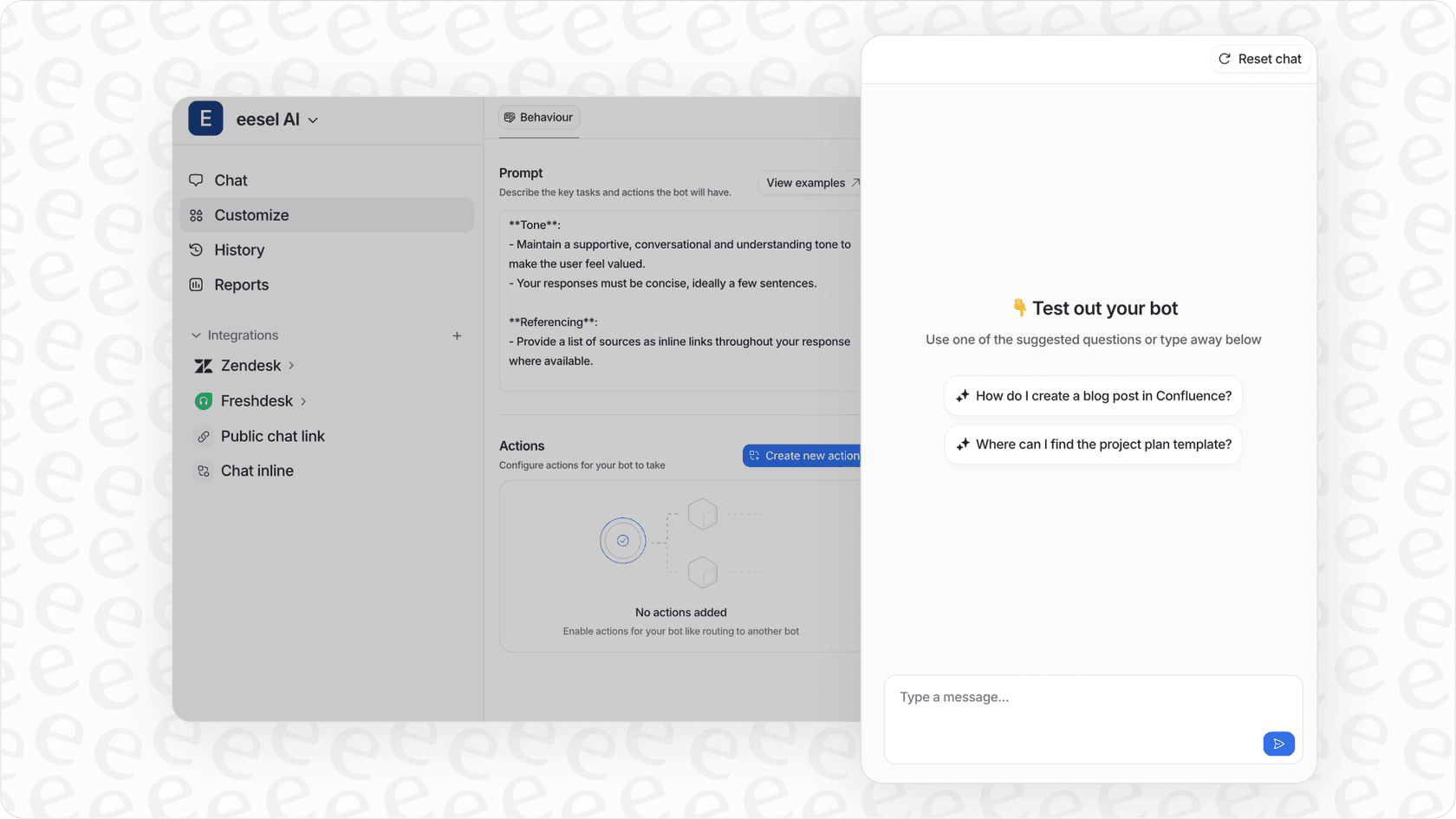
eesel AI is built for teams that want AI-powered support without an enterprise contract. It connects to Zendesk, Freshdesk, and other helpdesks with a single connection -- and starts learning from past tickets, help center articles, Google Docs, and Confluence immediately. Setup takes minutes, not months.
A few areas where the approach differs:
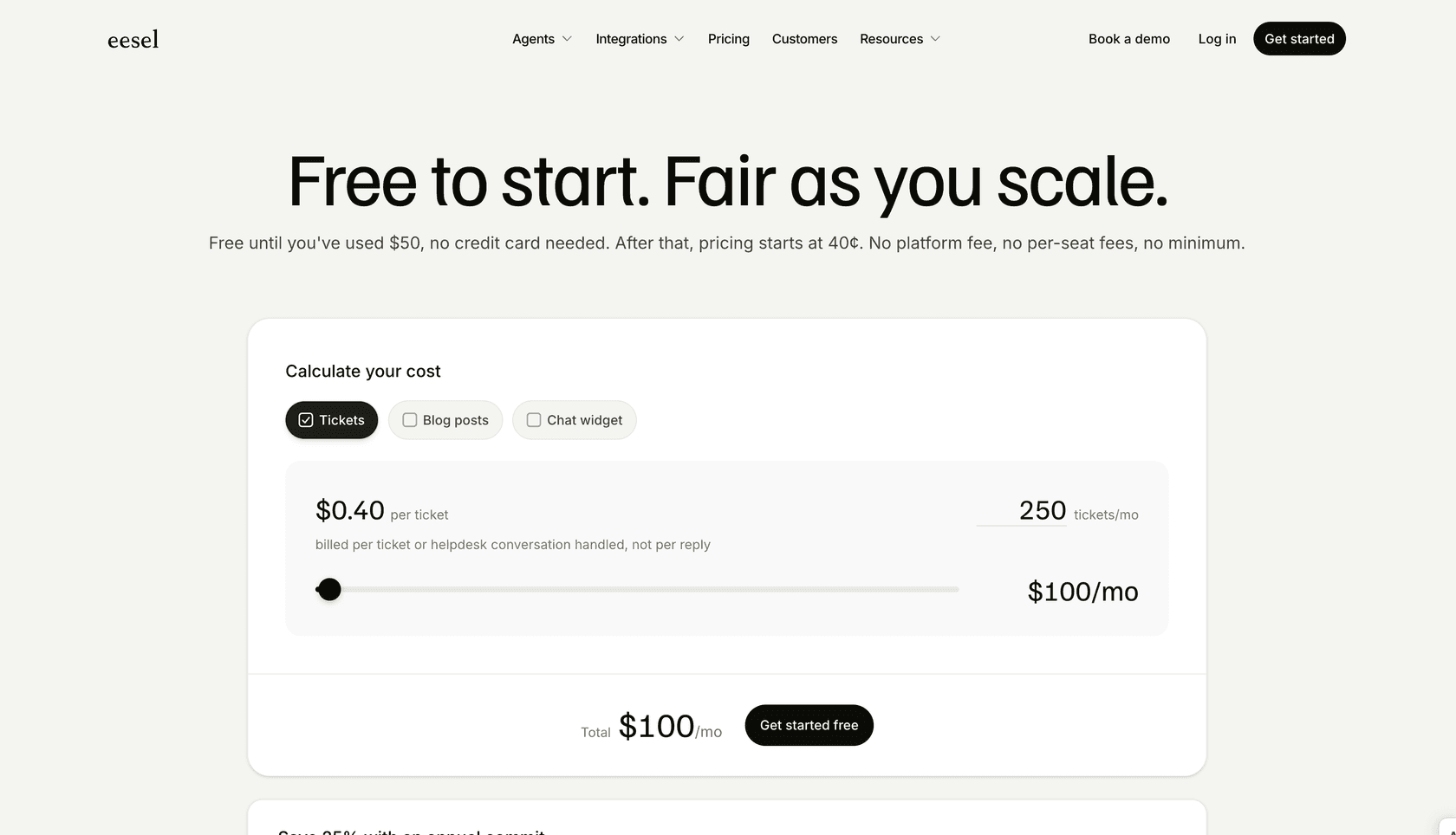
- Transparent pricing. eesel publishes its rates. One fixed monthly price starts at $299 for 500 credits, and 1 credit covers a ticket or chat however many replies it takes. Blog posts are $4 each. There is no platform fee and no per-seat fee, and you start with 100 free credits without a credit card (eesel pricing).
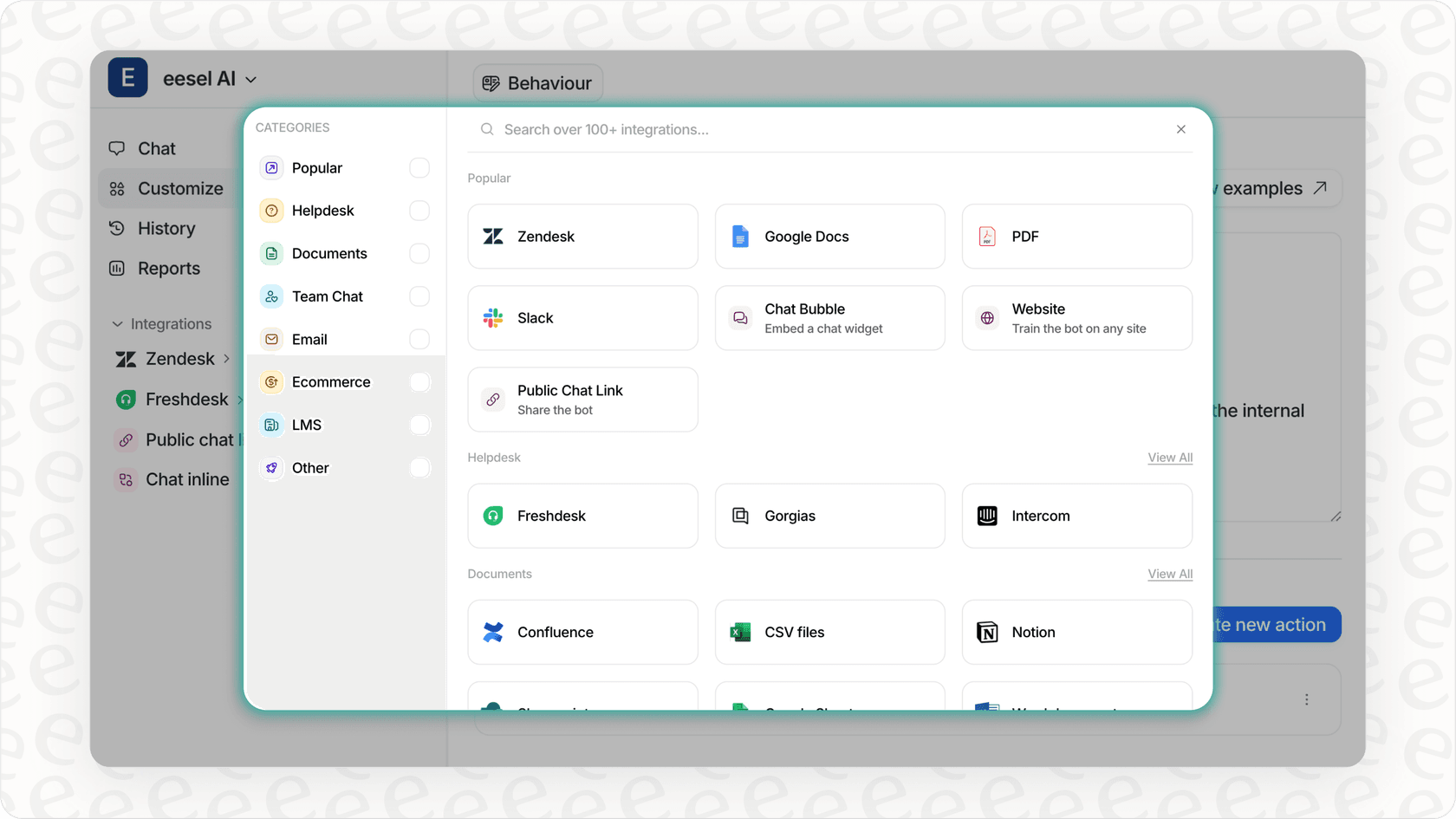
- Knowledge sources. Train bots on help docs, past tickets, Google Docs, Confluence, and more -- all auto-synced to stay current without manual updates.
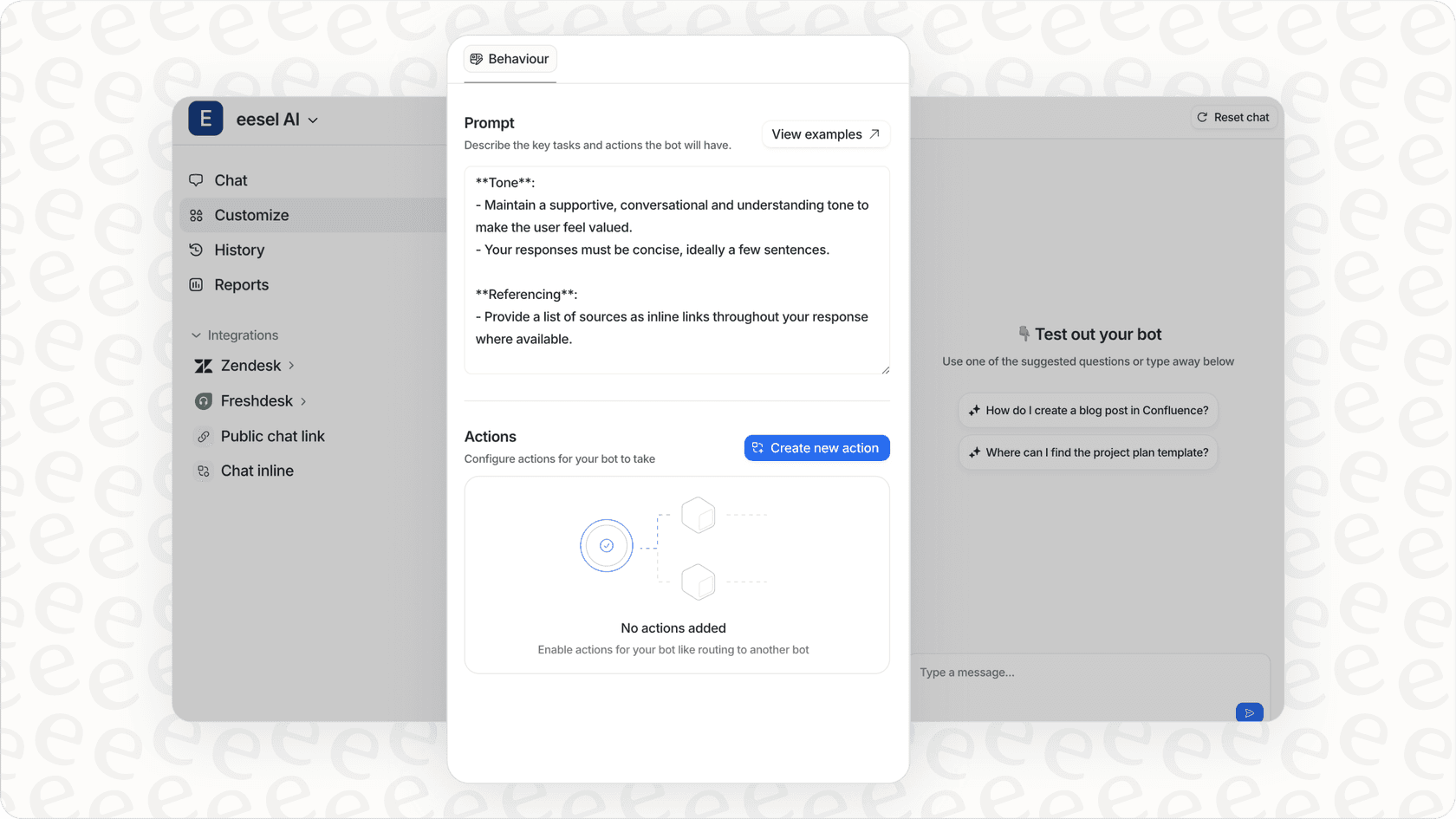
- Multiple specialized agents. Build separate agents for different products, brands, or channels. A Tier-1 support bot, an internal Slack agent, and a sales assist agent can all run under the same account.
- Safe testing before launch. Simulate responses against real past tickets, fine-tune behavior, and roll out gradually to reduce risk before going live.
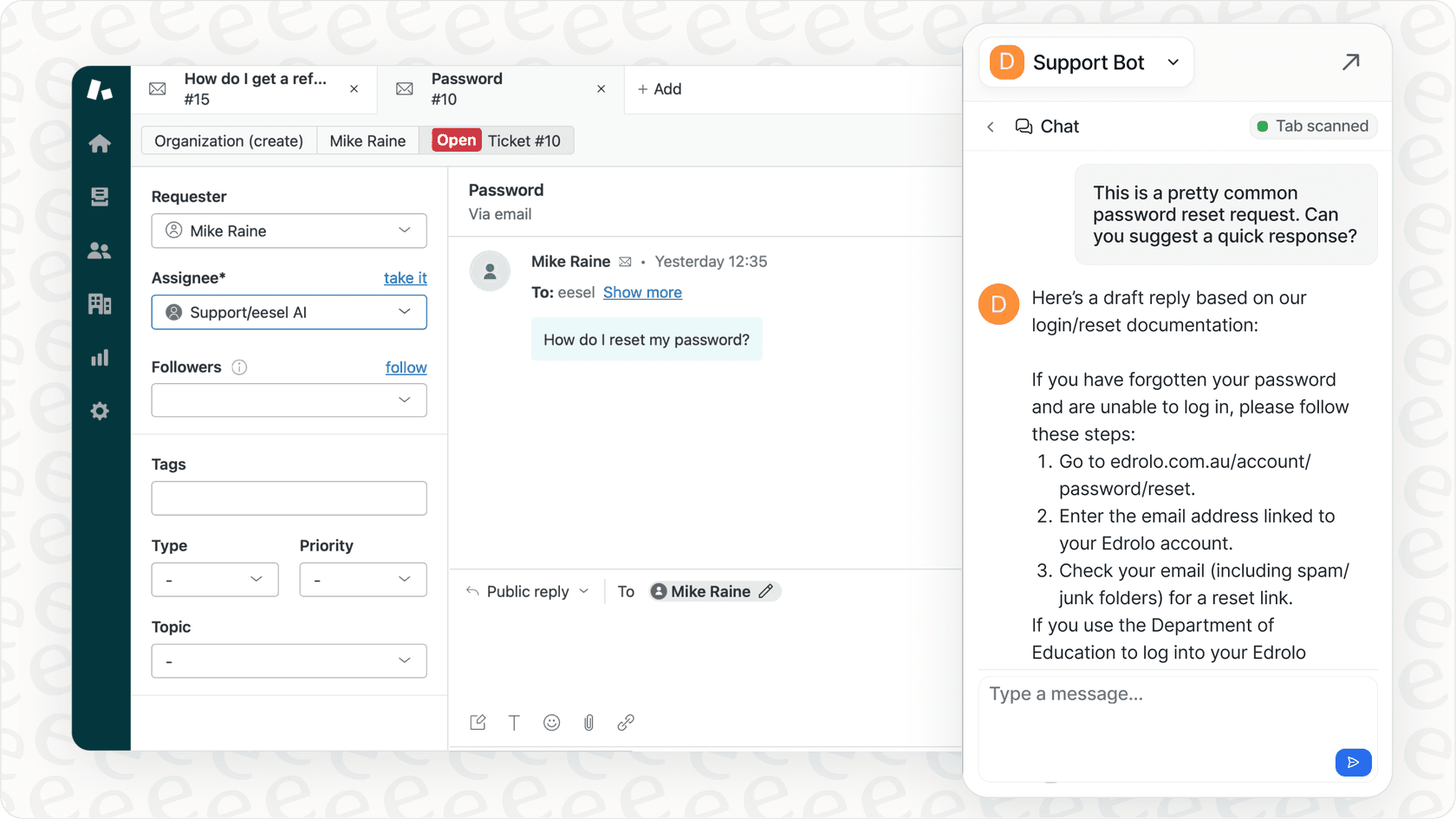
- Copilot for human agents. The eesel Copilot extension surfaces suggested replies and relevant knowledge directly in the agent's browser window as they work.
To be fair to Sierra: its model has a real advantage. If an agent fails to resolve a conversation, in most cases you are not billed. eesel does not work that way. eesel counts a credit for every ticket or chat the agent works on, regardless of the outcome (eesel pricing). The trade is transparency for outcome alignment. You can calculate an eesel bill from your ticket volume in ten seconds and start today. You cannot calculate a Sierra bill at all until you have been through discovery, and eesel's fixed monthly plan means agents simply pause when credits run out, unless you turn on overage with a cap you set.
The verdict: who should buy Sierra
Buy Sierra if you run a large contact centre, have an engineering team you can point at an integration, can absorb a six-figure annual contract plus services, and want a vendor that builds and operates the agent with you. Its depth is real: brand persona controls, deep backend integrations, 59 languages, PCI-compliant payments, and now long-horizon agents that work a goal across weeks. Forty percent of the Fortune 50 did not pick it by accident.
Do not buy Sierra if you need a price before a sales call, want to be live this quarter rather than next, or want to add AI on top of the helpdesk you already run rather than in front of it. None of those are edge cases and Sierra does not pretend to serve them.
The uncomfortable middle is the team that is big enough for automation to clearly pay, but too small for Sierra's sales motion to prioritise. That is the gap eesel was built for.
The right choice depends on your team size, existing infrastructure, technical resources, and time to value. If you want to explore what a faster, transparent AI support setup looks like, start a free trial with eesel AI -- or book a demo to walk through it against your actual support data.
Frequently asked questions
What is Sierra AI and who founded it?
Sierra AI is an enterprise Agent Operating System for customer experience automation, built to deploy AI agents across chat, voice, email, SMS, and WhatsApp. It was founded in late 2023 by Bret Taylor (former co-CEO of Salesforce, current chair of OpenAI's board) and Clay Bavor (former head of Google Labs). The company reached $150M ARR by February 2026, counts more than 40% of the Fortune 50 among its customers, and in July 2026 launched Horizon for agents that work a goal across days or weeks.
What core features does Sierra AI offer?
Sierra's platform includes Agent Studio (a no-code builder for CX teams), Agent SDK (a developer-facing programmatic layer), Ghostwriter (a conversational agent builder launched March 2026), Agent Data Platform for persistent cross-session memory, and omnichannel deployment across chat, SMS, WhatsApp, email, voice, and ChatGPT in 59 languages. Agents can take real actions during conversations, including processing refunds, updating account status, and as of April 2026, handling PCI-compliant payments. In July 2026 Sierra added Horizon, which extends agents from single conversations to goals that span days or months.
How does Sierra AI pricing work?
Sierra pricing is not publicly disclosed. All pricing is custom-quoted through a direct sales process. Sierra's model is outcome-based: customers pay when the agent successfully resolves a customer issue, not per message or per interaction. Sierra has since written that the model is more complex than seat or consumption pricing and that it also does consumption-style work where that fits the problem, so a real contract blends the two. Contact sierra.ai directly for actual pricing.
What are the main limitations of Sierra AI?
Common issues reported by G2 reviewers include context loss in extended conversations (agents can repeat themselves or give generic answers mid-session), a steep initial learning curve, limited ability for customers to self-edit agents without vendor involvement, and occasional performance bugs. The lack of published pricing also makes it difficult to model ROI before committing to a multi-month sales and deployment cycle.
What are good Sierra AI alternatives for smaller teams?
Teams that need AI-powered support without an enterprise contract can explore Sierra AI alternatives. eesel AI connects to Zendesk, Freshdesk, and Slack with credit-based pricing from $299/month for 500 credits (1 credit per ticket or chat session, however many replies), with no sales call or multi-month deployment required. It trains on existing tickets, help docs, and internal documents and can be set up in minutes rather than weeks.
Who owns Sierra AI?
Sierra is a private company co-founded in 2023 by Bret Taylor and Clay Bavor, who remain its owners alongside investors including Tiger Global, GV and Sequoia. It is not owned by Salesforce, Google or OpenAI, despite the founders' backgrounds at all three. Its most recent round, announced in May 2026, was $950 million at a post-money valuation above $15 billion.
Is Sierra AI worth it?
It depends entirely on scale. For enterprises with high ticket volume, engineering resources and a six-figure automation budget, the published customer results are strong: 90% case resolution at Ramp, 80% at Airtable, 77% at Wilson. For teams below that scale the maths rarely works, because the floor on a Sierra contract is higher than the entire annual automation budget of most mid-market support teams. There is no free trial and no self-serve tier to test the assumption cheaply.


Article by
Kurnia Kharisma
Kurnia is a software engineer and writer at eesel AI with two years of SEO experience, writing about AI tools, helpdesk software, and customer support. He pairs a developer's understanding of how these products are built with search-driven research into what actually ranks and resonates with the people searching for them.