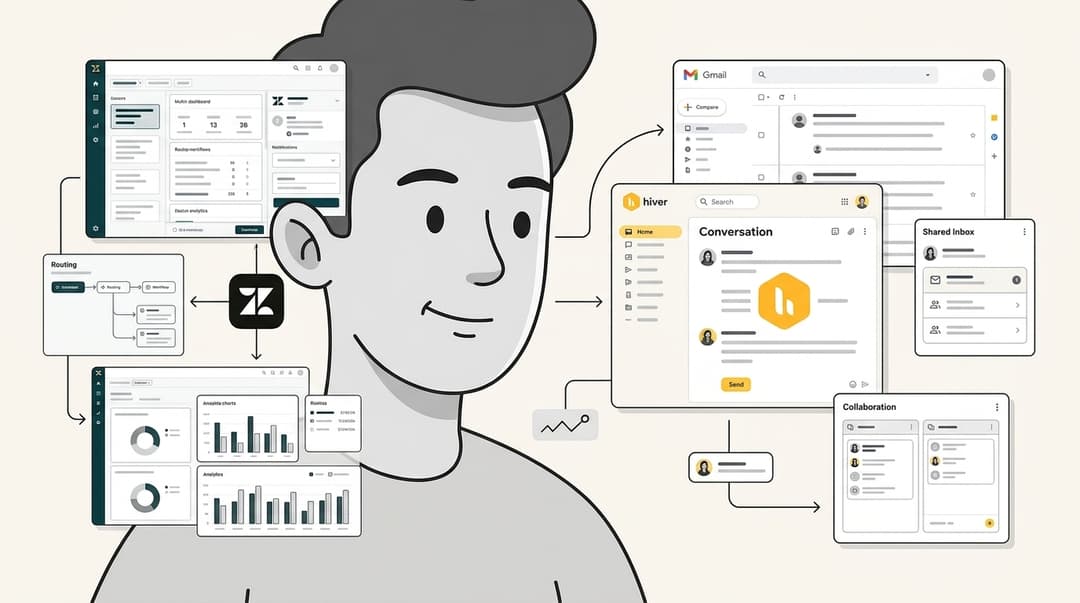

The 30-second decision
| Your situation | Best fit | Why |
|---|---|---|
| Small email and chat team with limited admin time | Freshdesk | Lower cost, simpler setup, and enough automation for straightforward queues |
| Complex routing across teams, brands, or regions | Zendesk | Deeper triggers, skills-based routing, permissions, and reporting |
| Voice-heavy contact center | Zendesk | More mature native telephony and omnichannel controls |
| Ecommerce team that wants pre-built AI workflows | Freshdesk | Freddy includes ready-made agents for tools such as Shopify, Stripe, and PayPal |
| Your current help desk works, but its AI does not | Keep it and test a separate AI layer | Avoid rebuilding the desk just to replace its AI |
How we compared them: Pricing and product details were checked against vendor pages in June and July 2026. Community pricing estimates are labeled as estimates, while user sentiment comes from linked G2, Capterra, and Reddit sources. eesel sells an AI agent that works with both platforms, so the final section is a product recommendation from eesel, not a neutral third-party verdict.
Zendesk vs Freshdesk at a glance
| Capability | Winner | Why |
|---|---|---|
| Ticketing and complex routing | Zendesk | More granular triggers, skills-based routing, side conversations, and multi-brand controls |
| Reporting and analytics | Zendesk | Explore is deeper for custom dashboards and large, complex operations |
| Omnichannel and voice | Zendesk | Broader native channel support and a more mature contact-center product |
| Integrations | Zendesk | 1,800+ marketplace apps versus Freshdesk's 1,200+ |
| Ease of setup and administration | Freshdesk | A simpler interface and lighter configuration burden for smaller teams |
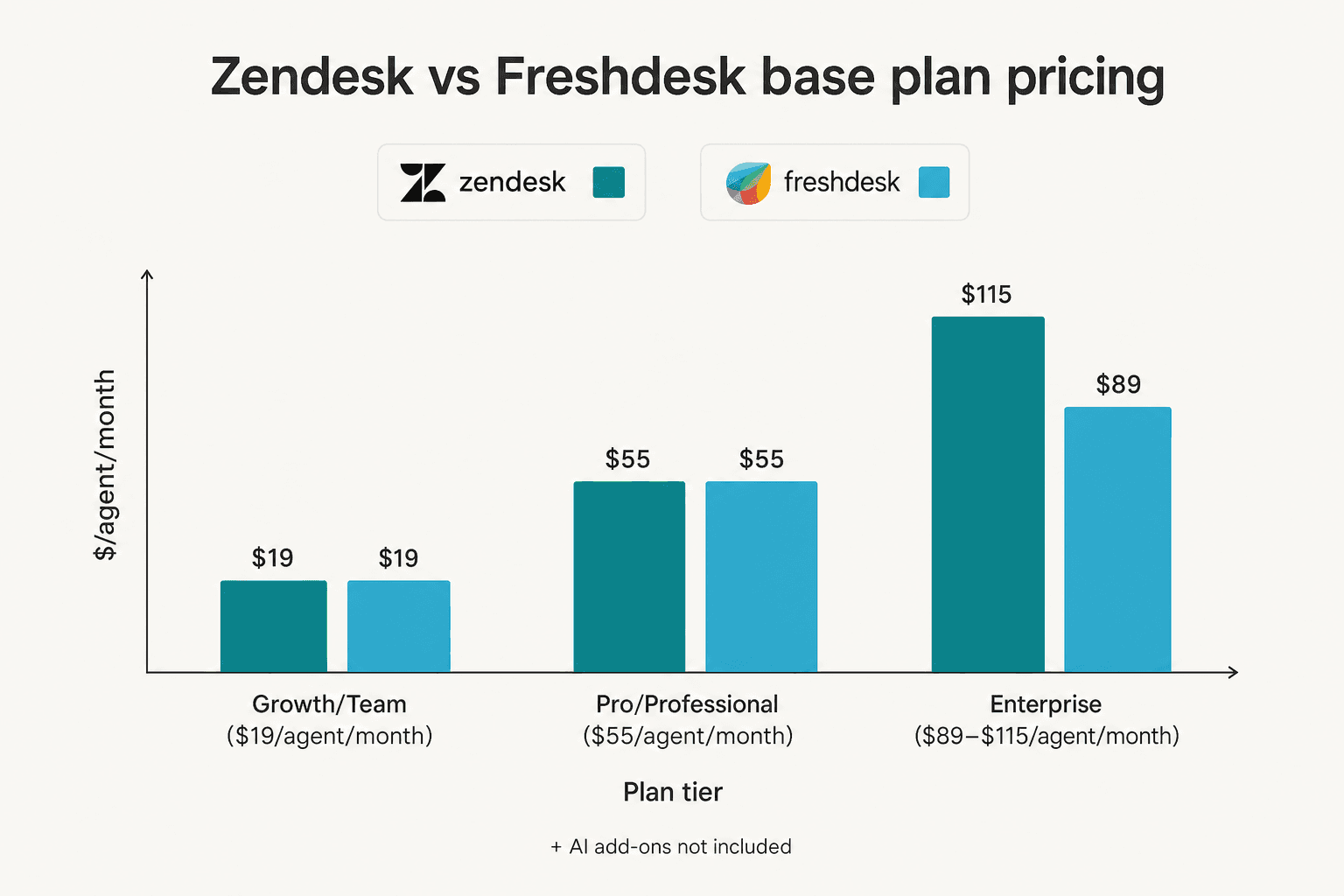
| Base-plan value | Freshdesk | Comparable entry and mid-tier prices, but a lower $89 Enterprise tier |
| AI workflow depth | Zendesk | Advanced AI supports scripted dialogues, authorized actions, and API integrations |
| Pre-built ecommerce AI | Freshdesk | 50+ vertical agents reduce setup for common commerce workflows |
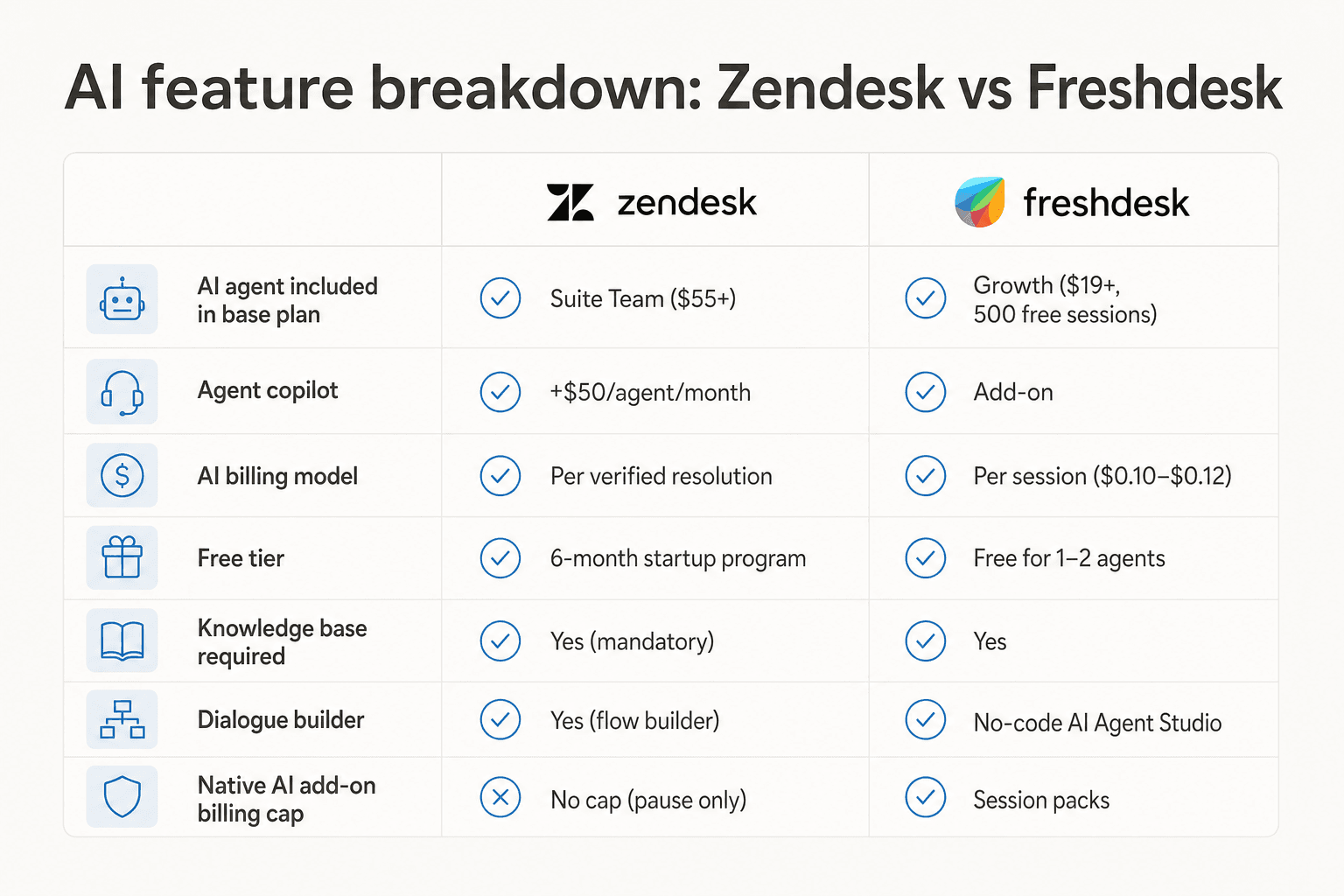
| AI cost predictability | Freshdesk | Session packs have a public price; Zendesk's current resolution allowance requires a quote |
| Knowledge base requirement | Tie | Both AI products depend on current, well-structured source content |
The base prices start close: both have a $19 entry plan and a $55 mid-tier plan. Freshdesk's upper tier is $89 per agent per month, while Zendesk Suite Professional is $115. Their AI costs cannot be compared from seat prices alone: Zendesk combines seats, a Copilot add-on, and a quoted resolution allowance; Freshdesk combines seats, a Copilot add-on, and public session packs.
Worked cost example: the same 10-agent workload
This illustrative model assumes 10 agents, 3,000 monthly AI attempts, and a 60% successful-resolution rate. That produces 1,800 Zendesk automated outcomes but 3,000 Freshdesk sessions because the billing units differ. Suite Professional and Pro are used as common mid-market choices; they are not feature-equivalent plans. Replace every assumption with a written vendor quote before buying.
| Monthly cost | Zendesk Suite Professional | Freshdesk Pro |
|---|---|---|
| 10 seats | $1,150 | $550 |
| Agent-assist AI | $500 Copilot estimate | $290 Freddy Copilot |
| Autonomous AI usage | 1,800 outcomes draw from the quoted resolution allowance | 3,000 sessions: $1,225 after the one-time 500-session credit, then $1,470 in later cycles |
| Known monthly total before discounts | $1,650 + quoted resolution allowance | $2,065 initially; $2,310 after the credit |
The table deliberately leaves Zendesk's autonomous-AI cost open because its current public documentation explains resolution tiers and allowances but does not publish a simple dollar rate. Ask both vendors to model the same incoming volume, AI attempt rate, successful-resolution rate, allowance, billing cycle, and required feature set in writing.
Why every Freshdesk vs Zendesk comparison quotes a different price
If you read three of these comparisons you will see three different price sets, which makes it hard to know what to budget. Here is what the pages we checked in July 2026 actually publish for the same two plans:
| Source | Freshdesk entry plan | Zendesk Suite Professional |
|---|---|---|
| Freshdesk pricing page (annual billing) | $19/agent/mo | n/a |
| Zendesk pricing page (annual billing) | n/a | $115/agent/mo |
| Freshworks' own comparison page | $29/agent/mo | $115/agent/mo |
| Zapier | $23/agent/mo | $149/agent/mo |
| Pipedrive | $15/agent/mo | $115/agent/mo |
Freshworks publishes $19 on its own pricing page and $29 on its own comparison page in the same week. Nobody is wrong; they are quoting different things. Three causes explain nearly all of the spread:
- Monthly versus annual billing. Annual is the discounted number and the one most vendors show by default. Monthly runs meaningfully higher on both platforms, which is where figures like $149 for Zendesk Suite Professional come from.
- Freshdesk versus Freshdesk Omni. Freshworks sells the email-and-ticketing help desk and the wider omnichannel product, Freshdesk Omni, as separate SKUs with their own plan ladders. A comparison that quotes Omni is not quoting the plan a ticketing-only team would buy.
- Whether AI is folded into the headline number. Some comparisons quote the seat price alone and some quote the seat plus the AI add-on. Freshdesk Pro is $55 without Freddy AI Copilot and $84 with it, so the same plan appears under two prices depending on the writer's choice.
The practical rule: before comparing any two numbers, confirm the billing term, the exact SKU, and whether AI add-ons are included. Every figure in this article is the annual-billing seat price with AI add-ons listed separately.
Zendesk: depth, control, and quote-based AI usage
Zendesk positions itself as "the Resolution Platform" - a phrase that doubles as a product ambition and a pricing model, since everything eventually connects back to how many resolutions you're generating. Founded in Copenhagen in 2007, it serves mid-market and enterprise CX teams globally and was named a 2025 Gartner Magic Quadrant Leader for CRM Customer Engagement Center.
The platform bundles five things: a ticketing core, an omnichannel messaging layer, AI Agents for autonomous customer resolution, Copilot for agent-side AI assistance, and a marketplace of 1,800+ apps. That breadth is both its selling point and its complexity: autonomous outcomes consume a resolution allowance, while the full Copilot remains a separate per-agent add-on below the Enterprise + Copilot bundle.
Zendesk pricing
All prices are per agent/month, billed annually. Source: Zendesk pricing page.
| Plan | Price | What you get |
|---|---|---|
| Support Team | $19/agent/mo | Email ticketing, shared inbox - AI Agents not included |
| Suite Team | $55/agent/mo | Multi-channel + AI Agents (Essential) + Knowledge Base |
| Suite Professional | $115/agent/mo | Everything in Team + AI writing tools, basic Admin Copilot, App Builder |
| Suite Enterprise + Copilot | Contact sales | Full Copilot (Auto Assist, Intelligent Triage, AutoQA) bundled |
The $19 Support Team plan has no AI Agents. AI Agents only start at Suite Team ($55). This trips up buyers who compare entry prices without reading the tier breakdown.
Copilot - the agent-side AI that suggests replies and autonomously executes actions inside Zendesk - is a separate $50/agent/month add-on below the Enterprise tier, or bundled at Enterprise. A 10-agent team on Suite Professional adds $500/month for Copilot before AI usage fees touch the bill.
AI usage is funded through a resolution allowance. Zendesk's resolution tiers, introduced May 18, 2026, distinguish assisted escalations, contained resolutions, and verified resolutions. Only verified resolutions draw from the account's allowance. Zendesk does not publish a simple current dollar-per-resolution list price, so obtain a quote for the expected mix of outcomes.
A free Zendesk startup program covers up to 50 agents for 6 months for qualified early-stage companies - the most generous free access in this comparison.
Zendesk AI: how it works
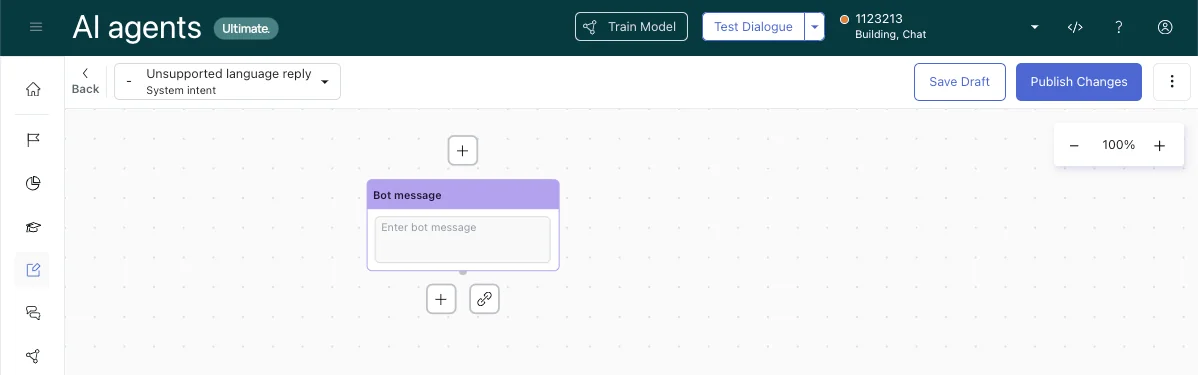
Zendesk's AI layer divides into two tracks: AI Agents (customer-facing autonomous resolution) and Copilot (human agent assistance).
AI Agents can generate knowledge-based replies, run scripted dialogue flows, follow procedures, capture entities, call APIs, and take authorized actions. In May and June 2026, Zendesk rolled the former Advanced capabilities out across Suite and Support plans. Access no longer depends on buying an "Advanced AI Agents" add-on, but automated outcomes still consume the account's resolution allowance.
The dialogue builder shown above is a drag-and-drop canvas for scripting conversation flows. It's powerful but has a reputation for friction: one reviewer called it "the most annoying interface in the world", and the rollout of Ultimate.ai-derived agents at one company stretched well past timeline even with consultant involvement.
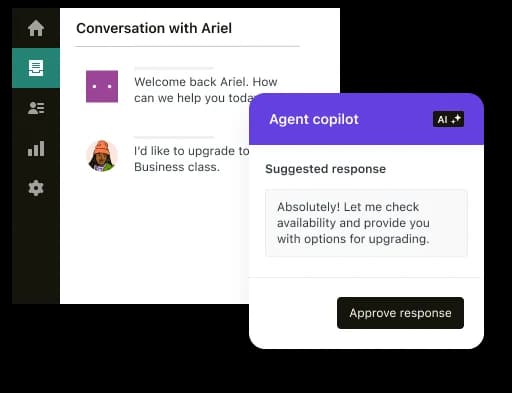
Copilot works with human agents rather than replacing them. Auto Assist surfaces suggested replies with a confidence score, Intelligent Triage auto-classifies tickets by intent and sentiment, and Admin Copilot optimises workflows. The r/SaaS consensus on Copilot: "very much a copilot approach, making agents faster rather than replacing them. Not flashy, but sometimes boring and reliable wins."
The hard constraint on both products: knowledge base quality is the real ceiling. Teams without a clean, comprehensive Zendesk KB typically see around 20% automation in the first month, climbing toward 70% only after sustained KB cleanup - per multiple independent analyses of Zendesk AI deployments. AI Agents can't browse external pages or follow links; everything must live in the connected help center. A sparse KB produces vague, deflecting replies.
What Zendesk users say
Zendesk holds a 4.3/5 on G2 from 6,837 reviews and a 4.4/5 on Capterra from 4,079 reviews. Reviewers consistently praise ticket routing, omnichannel depth, and the marketplace. Friction concentrates in AI onboarding and billing.
"I think Zendesk is adding a lot of new features, especially with all of the AI integrations and their copilot. I think that the way that they are set up is a little burdensome to actually onboard."
G2 reviewer, Zendesk for Customer Service

"Pricing is a bit of a con and setting up add ons can add more to it and could feel like a full time job in the backend."
Vibhore S., Logistics Lead, Capterra, April 2026

These reviews point to a consistent trade-off: Zendesk gives teams more control, but the setup and add-on burden grows with that control. Treat individual reviews as examples, not representative performance data.
Freshdesk: faster setup and lower base cost
Freshdesk is Freshworks' customer service helpdesk - trusted by 74,000+ businesses including Bridgestone, Tata Digital, Klarna, and PepsiCo. The pitch is "People-first AI" under the Freddy AI brand: autonomous resolution, agent-side assistance, and proactive analytics all in one platform.
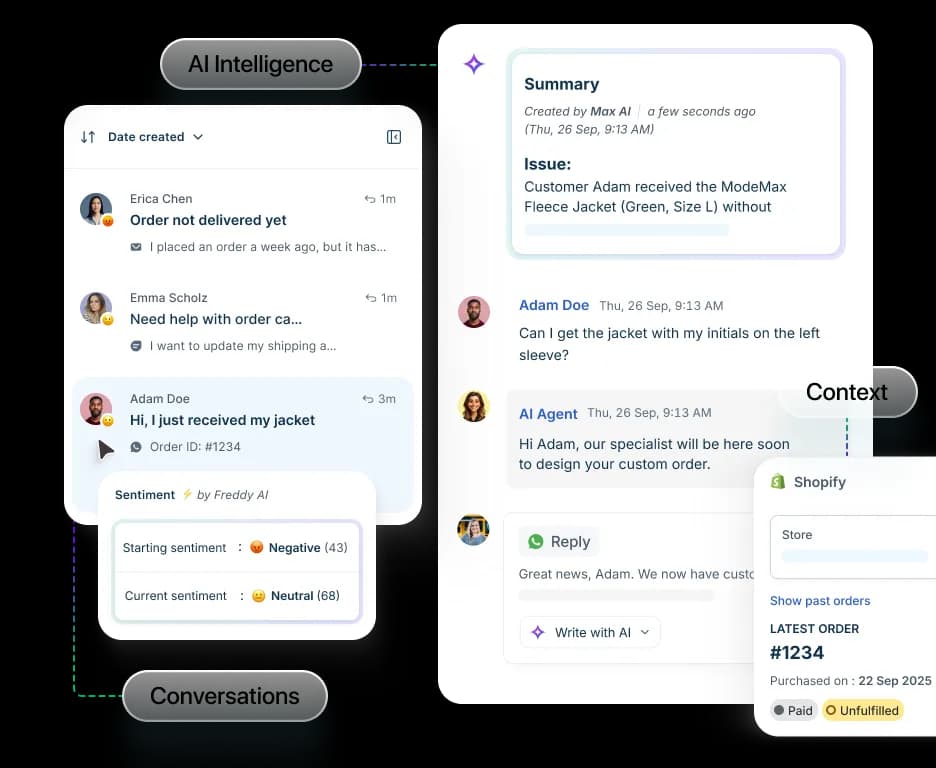
Where Zendesk feels like a platform with AI bolted on, Freshdesk was built with Freddy AI tightly embedded from the interface up. The Freshdesk Command Center merges ticket context, AI intelligence, and customer data (including live Shopify order status) into a single view - so an agent handling a post-purchase complaint sees ticket history, sentiment score, and order status without switching windows.
Freshdesk pricing
All prices are per agent/month, billed annually. Source: Freshdesk pricing page.
| Plan | Price | AI inclusions |
|---|---|---|
| Free | $0 (1 to 2 agents, 6 months) | Ticketing and KB only, no AI |
| Growth | $19/agent/mo | Email AI Agent (500 one-time complimentary sessions for new customers) |
| Pro | $55/agent/mo | Freddy AI Agent (500 one-time complimentary sessions for new customers), 5,000 collaborators |
| Enterprise | $89/agent/mo | Everything in Pro + audit logs, approval workflows, skills-based routing |
Additional AI agent sessions cost $49 per 100 sessions, or $0.49 per session. The 500 complimentary sessions are a one-time offer for new paid customers, not a monthly allowance. Freddy AI Copilot (agent-side reply suggestions, summaries, live translation) is a separate $29/agent/month add-on on Pro and Enterprise. Sources: Freshworks session FAQ and Freshdesk pricing.
The pack price is public, which makes the unit cost easy to model. But sessions expire at the end of the billing cycle, unused sessions do not roll forward, and online-billing customers can enable auto-recharge. Model both expected usage and unused capacity.
Freshdesk AI: how it works
Freddy AI is Freshdesk's AI backbone with three distinct layers:
Freddy AI Agent handles up to 80% of queries on chat, messaging apps, and email. The real standout: 50+ pre-built vertical agents for specific workflows like Shopify order updates, Stripe refunds, and PayPal transactions - ready to launch without custom scripting. For e-commerce support teams, this is a meaningfully faster path to live AI than Zendesk's dialogue builder. The AI Agent Studio provides no-code tooling for building custom agents when the pre-built ones don't fit.
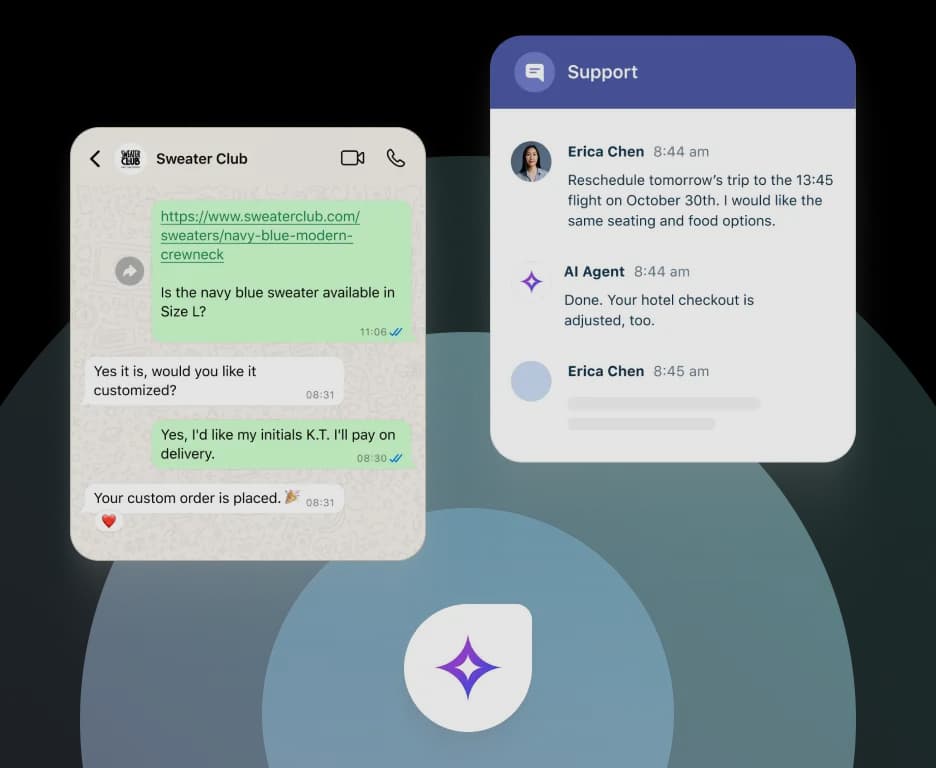
Freddy AI Copilot is built directly into the ticket workspace. It surfaces reply suggestions based on conversation context, generates conversation summaries to onboard agents mid-ticket, and translates customer messages in real time. Unlike Zendesk's Copilot, it doesn't execute autonomous actions inside external systems - it's an assist layer, not an agent layer.
Freddy AI Insights gives support leaders proactive analytics: CSAT dips, SLA breach trends, and performance issues surfaced before they escalate, with a conversational query interface. Asking "why did CSAT drop this week?" is more accessible than building a custom Zendesk Explore query.
One community note on AI quality - a real user who tested Freshdesk AI in production, from a February 2026 thread on r/AiAutomations:
"We tested an ai integration in freshdesk and had almost the exact same experience. it worked for very simple tickets but anything slightly complex got misclassified. agents ended up spending more time fixing errors than before, so we had to rethink our approach."
u/Timely_Aside_2383, r/AiAutomations, February 2026

This is the common pattern across both platforms: AI resolution quality is excellent on FAQ-class tickets and degrades on anything requiring product-specific judgment. The honest mental model is "first-line deflection engine" rather than "full support replacement" - which Freshdesk's smaller teams often accept more readily than Zendesk's enterprise buyers do.
What Freshdesk users say
Freshdesk rates 4.4/5 on G2 from roughly 3,750 reviews and approximately 4.5/5 on Capterra. Recurring positives: clean onboarding, fast time-to-value, and solid omnichannel support. Recurring friction: Freddy AI being expensive relative to what it delivers at lower tiers, and session-based billing that accumulates faster than expected.
A January 2026 post on r/sysadmin surfaced the most common Freddy criticism: "I do like the UI of Freshservice seems easy to use. The freddy AI is an add on so expensive for what it can do and only available at enterprise." That last point - Freddy AI Copilot being effectively Enterprise-gated without the add-on - is a real friction point for Growth and Pro teams who assume AI is included in their plan.
What changes day to day
One platform or a set of connected apps. This is the structural difference behind most of the others. Zendesk is one product: tickets, chat, and calls land in the same interface, and an agent works the whole queue from one place. Freshdesk is a family of Freshworks apps that connect, so chat and ticketing can present as separate interfaces depending on which SKU you buy. Agents who switch between live chat and email all day feel this every shift; teams that live in email mostly do not.
Threads inside a ticket. Zendesk supports multiple side conversations on a single ticket, each on its own channel, so an agent can loop in a warehouse over email and engineering over Slack without leaving the ticket. Freshdesk keeps one thread per ticket, which is simpler to read but means cross-team investigation happens outside the ticket record. If your hardest tickets routinely need a second team, this is a real difference.
Routing and collaboration. Zendesk gives large teams more control over skills-based routing, side conversations, ticket forms, and multi-brand queues. Freshdesk's dispatch rules and shared ownership are easier to learn, but teams with many regions or specialist groups can reach their limits sooner.
Reporting. Zendesk Explore is the stronger option when leaders need custom datasets and detailed operational dashboards. Freshdesk Analytics is quicker to use for standard support reporting, and Freddy AI Insights can answer plain-language questions, but it offers less depth for complex analysis.
Voice and channels. Zendesk is the safer choice for a voice-heavy contact center because telephony and channel routing are more mature. Freshdesk handles common email, chat, social, and messaging workflows well, but teams should verify whether their required channel is native to the selected plan or needs a Freshworks add-on.
Integrations. Zendesk has the larger marketplace and is more likely to support an enterprise tool directly. Freshdesk covers mainstream support stacks and connects naturally to other Freshworks products. Before buying either, list the systems that must read or update ticket data and verify whether each connection is native, marketplace-based, or custom API work.
Administration. Freshdesk is generally faster for a support manager to configure without a dedicated administrator. Zendesk's extra control becomes valuable when the operation is complex enough to justify ongoing ownership of triggers, roles, routing rules, and reporting.
The support you get from the vendor. This is the criterion buyers forget until something breaks at 11pm. Freshworks claims on its own comparison page that Freshdesk includes 24/7 email support plus 24/5 phone and chat, along with free onboarding and migration assistance, while Zendesk's standard support is 8/5 over email and chat with 24/7 coverage and onboarding sold separately. That is a vendor making its own case, so treat it as a claim to verify rather than a fact: ask each rep to put support hours, response-time targets, and the cost of onboarding and migration help into the written quote. If the answer is that onboarding is a paid professional-services engagement, add that number to your first-year total before comparing seat prices.
Trying each one before you commit
You can get real hands-on time with both without signing anything, and the two free routes are shaped differently.
| Freshdesk | Zendesk | |
|---|---|---|
| Free plan | Yes, up to 2 agents, free for 6 months | No |
| What the free tier includes | Ticketing and knowledge base, no AI | n/a |
| Free trial | Standard trial on paid plans | Standard trial on paid plans |
| Startup offer | n/a | Startup program: up to 50 agents free for 6 months for qualified early-stage companies |
The catch on both sides: neither free route gives you the AI agent, which is usually the thing you most want to test. To judge AI quality before buying, ask each vendor for a scoped pilot on your own tickets, or test a third-party AI layer on the help desk you already run.
Head-to-head: where each platform wins
Where Zendesk wins
Enterprise-depth AI. AI Agents Advanced - with scripted dialogue flows, multi-step authorized actions, and API integrations - handles complexity that Freshdesk's AI Agent Studio can't match. For teams running intricate support workflows across multiple systems, Zendesk has a meaningfully higher ceiling.
Omnichannel breadth. 1,800+ marketplace apps, native voice, WhatsApp, Messenger, Instagram, and Sunshine Conversations for API-based messaging. The integration footprint is significantly deeper than Freshdesk's.
AI on the phone line. Zendesk sells AI voice agents that answer calls and handle them end to end, and voice conversations are tracked as their own channel inside the same resolution model. Freddy AI Agent covers chat, messaging apps, and email; Freshworks does not sell its own autonomous voice agent for Freshdesk, only third-party voice apps such as Synthflow and SquawkVoice through the Freshcaller marketplace. For a team where the phone queue is the expensive one, this is the clearest single reason to choose Zendesk.
Intelligent triage. Zendesk's Intelligent Triage auto-classifies every ticket by intent, entity, sentiment, and language simultaneously - enabling routing and reporting granularity that Freshdesk's triage doesn't yet match.
Scale infrastructure. 80+ native languages, 6,837 G2 reviews worth of community knowledge, enterprise security certifications, and the 2025 Gartner Magic Quadrant Leader designation. For procurement-driven buying at 500+ agents, Zendesk is the lower-risk choice.
Where Freshdesk wins
Pricing visibility. Freshdesk publishes its session pack price, so teams can model the cost directly. Zendesk explains how resolution tiers consume an allowance but requires a quote to turn the expected outcome mix into a dollar figure.
Upper-tier seat price. The compared mid-tier plans both cost $55 per agent per month, while Freshdesk Enterprise is $89 versus Zendesk Suite Professional at $115. The Freshworks ecosystem also gives you a path to IT service management (Freshservice), sales CRM (Freshsales), and live chat (Freshchat) under one vendor.
Pre-built vertical AI. Freshdesk's 50+ vertical agents for e-commerce (Shopify, Stripe, PayPal) can be live in minutes without custom flow-building. Zendesk's Advanced AI can do more, but it takes configuration effort to get there.
Simpler onboarding. Multiple G2 reviewers and case studies cite Freshdesk's fast time-to-value ("deployed on multiple teams with no pushback" - Bryce Young, Hired). Zendesk's admin-side AI configuration is repeatedly flagged as burdensome.
Before switching: what migration actually involves
Changing help desks is not just a data import. Tickets, contacts, users, attachments, and knowledge base articles can usually be mapped into the destination. The harder work is rebuilding the operational logic around them.
- Audit before exporting. List ticket fields, statuses, groups, tags, automations, SLA policies, integrations, and reports. Decide what should move and what should be archived.
- Expect configuration work. Zendesk triggers and Freshdesk automations use different models. Routing rules, macros, permissions, custom reports, and marketplace apps need to be rebuilt and tested.
- Protect historical references. Ticket IDs and links may change. Confirm how the migration method preserves attachments, timestamps, requester relationships, and audit history.
- Run a test migration. Validate record counts and a sample of open, closed, old, and unusual tickets before the final cutover.
- Plan the agent transition. A technically correct migration can still fail if agents do not know the new inbox, escalation path, and reporting workflow.
The direction-specific guides cover the full process: moving from Zendesk to Freshdesk and moving from Freshdesk to Zendesk. If the current help desk already handles ticketing well and AI is the only problem, test a separate AI layer before taking on this migration work.
Who should pick which
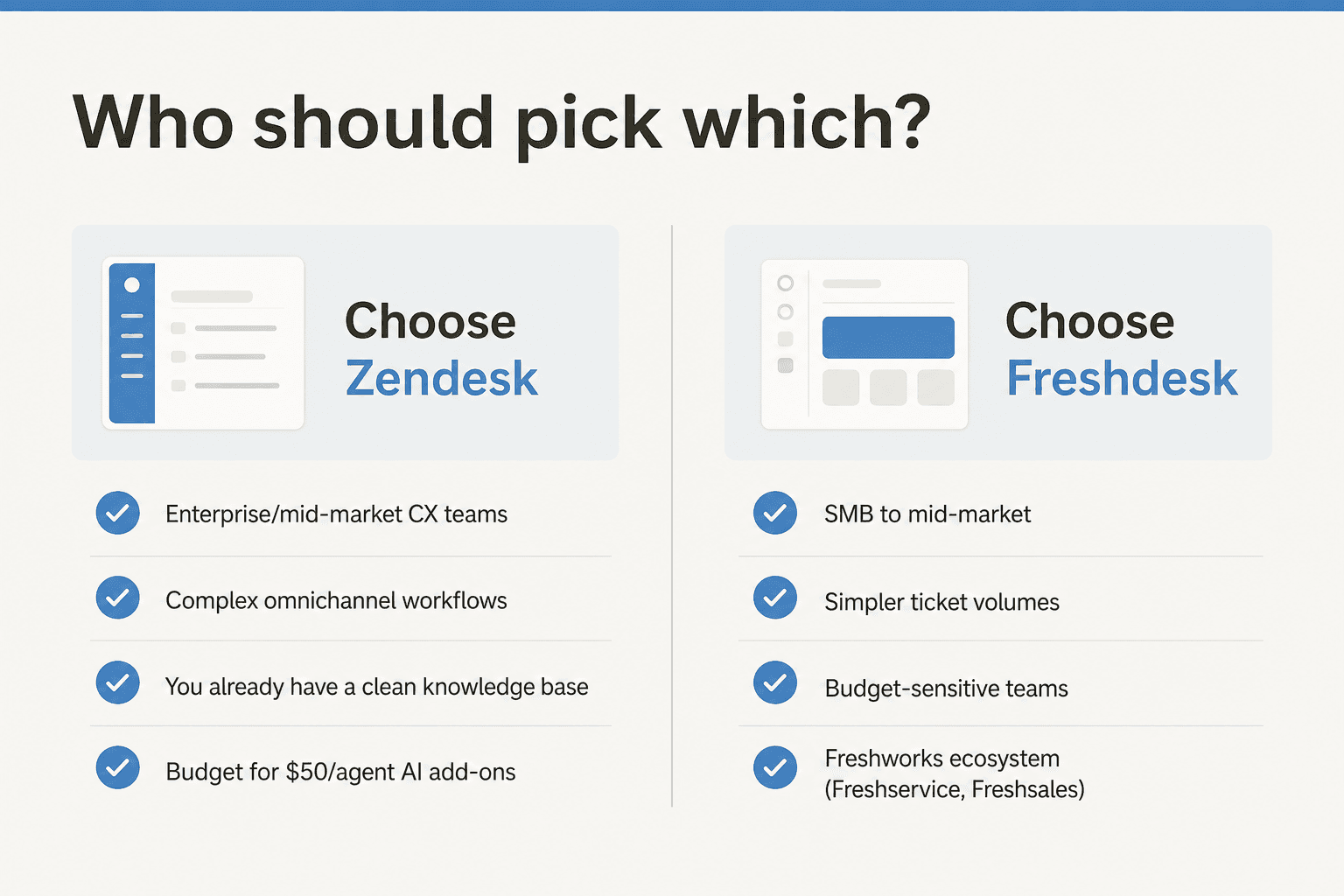
Pick Zendesk if:
- You're a mid-market or enterprise CX team (50+ agents) with complex multi-channel workflows
- You already have - or are willing to build - a comprehensive, well-maintained knowledge base
- You need advanced AI: scripted dialogues, authorized actions, multi-system API integrations
- You want the widest marketplace ecosystem (1,800+ apps)
- You have budget for the full stack: Suite Professional ($115) + Copilot ($50/agent) + the quoted resolution allowance
Pick Freshdesk if:
- You're SMB to mid-market (5 to 200 agents) and want solid AI without billing complexity
- You're running e-commerce on Shopify, Stripe, or PayPal and want vertical AI agents ready in minutes
- You're already on the Freshworks suite (Freshservice, Freshsales, Freshchat)
- You want a public AI usage price - session packs are easier to model than a quoted resolution allowance
- Your support volume is primarily FAQ-class tickets where Freddy's deflection rate is strong
If neither feels like an exact fit: both platforms share a limitation - their native AI quality is gated by KB hygiene, their billing can surprise teams at volume, and their AI configuration takes real admin effort. For teams that want AI-in-the-helpdesk without rebuilding their KB or managing resolution billing, third-party AI helpdesk tools like eesel can plug into either platform.
The part of this decision you can remove
Notice how much of the comparison above is AI pricing rather than help desk quality. That is the trap in this choice: the AI layer is the hardest part to model, so it ends up driving a decision that should be made on ticketing, routing, channels, reporting, and admin load.
You can split the decision in two. Choose the help desk on desk criteria alone, using the day-to-day section above: does your work need side conversations and skills-based routing, or is a simpler single-thread queue enough? Then choose the AI layer separately, on its own evidence.
Two practical consequences. First, you can test AI on the desk you already have. If your current help desk handles ticketing fine and only its AI disappoints, run an AI layer on it for a month before committing to a migration you may not need. Second, a flat per-ticket AI layer keeps the same unit on both platforms, so the AI line in your budget does not change if you later move from one desk to the other. That makes a Freshdesk quote and a Zendesk quote genuinely comparable, because you are only comparing seats and features rather than two incompatible AI billing models.
Try eesel
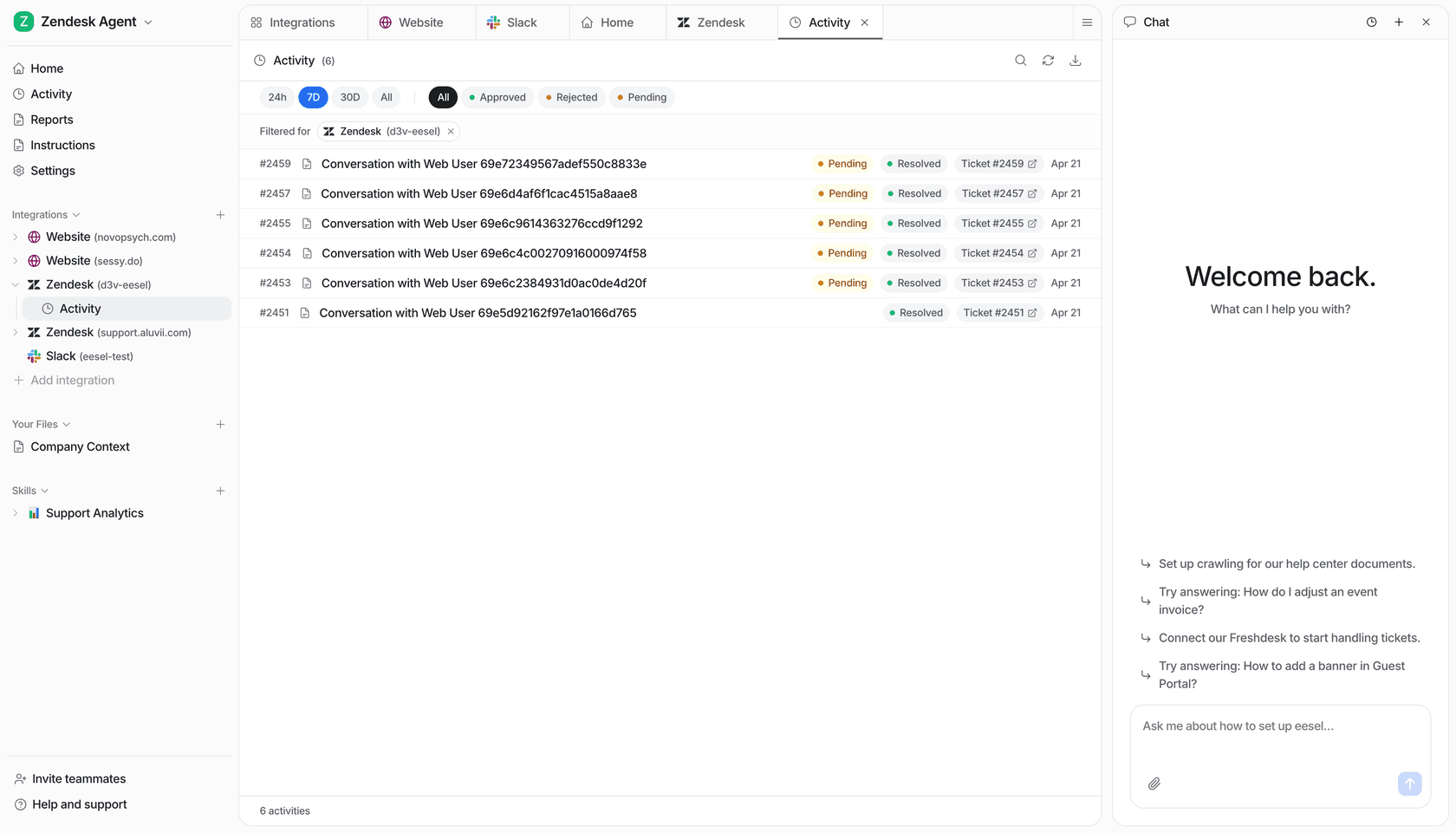
If you've settled on Zendesk or Freshdesk and want AI that sidesteps the billing model entirely, eesel runs as a native AI agent inside both platforms from $299/month for 500 credits (1 credit per ticket or chat) - no platform fee, no per-seat pricing, no resolution-billing model to track.
eesel reads incoming tickets, drafts public replies (or internal notes), updates ticket fields, routes escalations, and manages SLA timelines exactly like a human agent would - all inside your existing Zendesk or Freshdesk workspace without a new interface to adopt. It learns from your existing ticket history and help center on setup, with no manual training or data labeling required.
Smava handles 100,000+ tickets/month in German using eesel inside Zendesk. Ecosa achieves 75% tier-1 resolution on 10,000+ tickets/month with under one hour of setup.
"In the first month, eesel is resolving 73% of our tier 1 requests. eesel offers easy Zendesk implementation and setup. Our team implemented and achieved results quickly during our 7-day trial. Responses are simple to fix and adjust. The platform even includes automations for ticket tagging, assignment, and status updates!"
Kim Simpson, Gridwise, via eesel.ai/integrations/zendesk
Try eesel free - no credit card required. It takes under 30 minutes to connect to Zendesk or Freshdesk and start handling tickets.
Frequently Asked Questions
Is Freshdesk better than Zendesk?
Is Freshdesk free?
How much does Zendesk cost compared to Freshdesk?
Does Freshdesk have AI?
Which is better for small businesses, Zendesk or Freshdesk?
What is the main difference between Zendesk and Freshdesk?


Article by
Riellvriany Indriawan
Riell is a designer and writer at eesel AI with about two years of experience researching CX platforms, AI chatbots, and helpdesk software. She combines her design background with a sharp eye for how these tools actually look and feel in practice — making her comparisons unusually visual and user-focused.