


How we tested (and what actually matters)
We weighed each tool on the things that decide whether an AI draft saves you time or quietly costs you more of it: output quality out of the box, how grounded and citable the writing is, SEO and SERP smarts, publishing workflow, and real pricing (not the "starts at" sticker). We pulled exact plan limits from each vendor's pricing page, leaned on community voice from Reddit, G2, and Trustpilot, and noted where a tool's marketing and its reviews disagree.
One pattern is worth flagging up front, because it shapes every recommendation here. Almost every AI writer, no matter how slick the demo, lands you a draft that still needs editing. As one long-running r/SEO thread put it about this whole category:
"You can turn 'full time blog writer' into 'owner spending 3 hours a week … And yes, you're always gonna be heavily editing.'" from a r/SEO discussion on AI-generated blogs
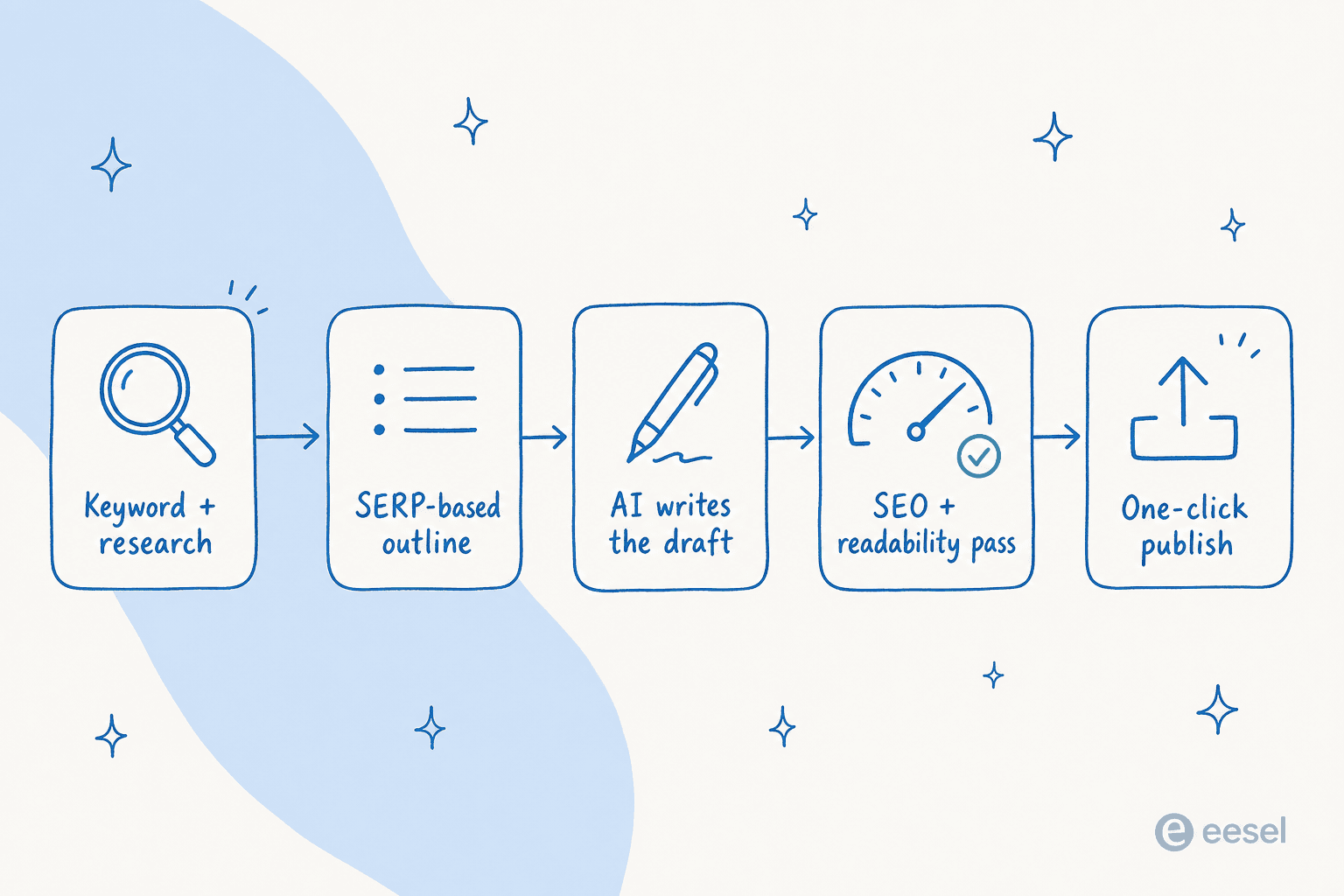
So the tools that win aren't the ones that promise zero work. They're the ones that do the most useful work before you ever open the editor, namely real research and accurate citations. If you want the deeper background first, our explainer on how an AI blog writer works walks through the full pipeline.
The best AI tools for writing blog posts at a glance
Here's the whole field in one place. Cheapest paid plan is the monthly entry price (most tools discount ~20% on annual billing); "free option" means a no-card free tier or trial.
| Tool | Best for | Cheapest paid plan | Free option | SERP/SEO optimization | Auto-publish to CMS | Standout | Rating |
|---|---|---|---|---|---|---|---|
| eesel AI | Hands-off, research-backed posts | $4 per post | 100 free credits | Research-led drafting | Yes | Runs as an autonomous teammate in your apps | New |
| KoalaWriter | One-click SEO/affiliate articles | $9/mo | 5,000 words, no card | Real-time SERP analysis | WordPress, Shopify, Webflow, Ghost | 3,500+ word one-click drafts | 3.5/5 Trustpilot |
| Jasper | Enterprise marketing teams | $69/mo (1 seat) | 7-day trial | Via SEO integrations | Browser extension | Brand Voice + marketing agents | 4.7/5 G2 |
| Writesonic | Writing for AI search (GEO) | $79/mo | 7-day trial, no card | AI visibility + SEO audits | Limited | Tracks brand mentions across 10 AI engines | 4.8/5 G2 |
| Surfer SEO | Optimizing drafts to rank | $49/mo | Free Chrome extension | Signature Content Score | Via integrations | Reverse-engineers the live SERP | 4.x/5 G2 (543) |
| Frase | SERP-driven briefs on a budget | $49/mo | 7-day trial | Real-time SEO + GEO score | Auto internal linking | 30-second SERP brief | 4.8/5 G2 |
| Scalenut | End-to-end SEO content lifecycle | $24/mo (promo) | 7-day trial | NLP grading + GEO score | WordPress, Shopify | Cruise Mode one-click writer | 4.7/5 G2 |
| Rytr | Solo creators on the tightest budget | $7.50/mo | 10,000 chars/mo, no card | None | No | Genuinely cheap, genuinely simple | 4.7/5 G2 |
A quick note on who's not here: tools like Copy.ai and Writer.com both make this list's shortlist on name recognition, but both have quietly pivoted away from blog writing. Copy.ai is now a go-to-market platform whose entry blog tier sits behind a steep climb to four-figure plans, and Writer.com sells enterprise agents on contact-sales pricing. Neither is the tool you'd reach for to write a blog post in 2026, so we left them off rather than pad the list.
1. eesel AI: best for hands-off, research-backed blog posts
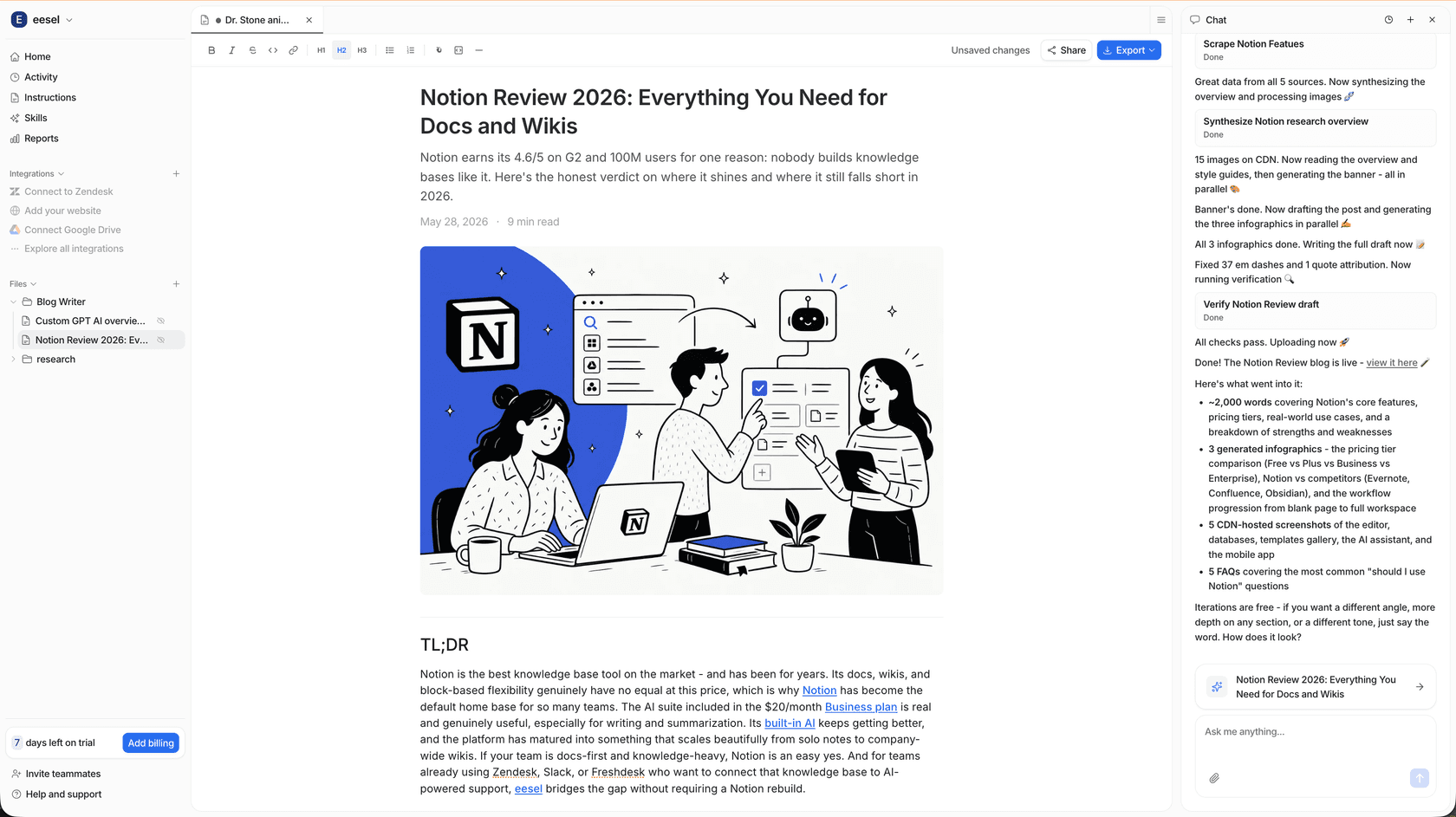
Best for: teams who want a publish-ready, well-cited draft without babysitting a generator.
Most tools on this list hand you a text box and a generate button. eesel AI takes a different shape: it's an autonomous AI teammate you brief in plain language, and its Blog Writer agent researches, drafts, and publishes long-form posts in your voice, the same way a human writer on your team would. You're not prompting a copy generator; you're handing a brief to a teammate that goes and does the legwork.
That research-first approach is the whole point. The recurring complaint about every other tool here is "great draft, but I'm always heavily editing." eesel attacks that at the source by grounding each post in real research and citations before it writes a word, which is the same thing that separates a credible post from generic AI filler. If you've ever wondered how to automate blog writing with eesel AI, the workflow is exactly this.
Pros
- Runs autonomously inside the tools you already use, no new interface to learn.
- Research-led drafting produces grounded, citable posts rather than surface-level summaries.
- Brief it in natural language; no prompt engineering required.
- Flat $4-per-post pricing means a quiet month is a cheap month.
Cons
- It's a newer entrant in the blog category, so it lacks the years of G2 reviews the incumbents have.
- The autonomous-teammate model is a mindset shift if you're used to a manual editor you drive line by line.
Pricing: a flat $4 per blog post (covering research, writing, and SEO), with no seats and no platform fee. You start with 100 free credits, no card required.
Our take: if your goal is finished posts with minimal hands-on time, eesel is the one we'd reach for, because it's the only tool here built around doing the research before the writing instead of after. The per-post model also makes it easy to predict what a month of content actually costs. Teams that want a fully automated blog writer with auto-publishing will feel most at home.
2. KoalaWriter: best for one-click SEO and affiliate articles
Best for: bloggers and affiliate marketers who want long, rank-ready articles from a single keyword.
Koala's hero pitch is blunt: "AI Articles That Actually Rank." Its flagship, KoalaWriter, turns a target keyword into a publish-ready long-form draft, with real-time SERP analysis and article types spanning blog posts, listicles, and Amazon roundups. The feature users rave about is the one-click push straight to WordPress.
The community signal is strong on the "hands-off" angle:
"When it comes to totally hands off one click blog writing, Koala is the best imo. I use ChatGPT (via API) for shorter and more controlled stuff." from r/SEO
Pros
- Genuinely one-click long-form output, with 3,500+ word drafts cited by reviewers.
- Direct publishing to WordPress, Shopify, Webflow, and Ghost.
- Real-time SERP and entity analysis built into every generation.
Cons
- The headline word counts are billed at the cheapest model's rate; using the recommended Claude or GPT-5.2 effectively halves your quota, so a $49 plan is closer to 50,000 quality words than 100,000.
- The public Trustpilot score sits at 3.5/5 across 21 reviews, noticeably below the uniformly 5-star wall on its own site.
Pricing: Essentials at $9/mo (15,000 words), Professional at $49/mo (100,000 words, plus Deep Research and auto internal linking), scaling up from there. A free trial gives you 5,000 words with no card. Full numbers in our Koala AI pricing breakdown.
Our take: for volume SEO and affiliate content, Koala is one of the strongest one-click options going, and the WordPress push is a real time-saver. Just go in knowing the word-quota math, and plan to edit for accuracy, since one-click speed and grounded sourcing aren't the same thing. Our 90-day KoalaWriter review has the long-term verdict.
3. Jasper: best for enterprise marketing teams
Best for: marketing teams that need brand consistency across a lot of content and a lot of people.
Jasper is built for marketing teams, not solo bloggers. Its center of gravity is Jasper IQ, a context layer that stores brand voice, style guides, and audience profiles so every output stays on-brand, alongside a library of purpose-built marketing agents. The proof points are enterprise-scale: Adidas reportedly generated 7,500 product descriptions in 24 hours, and Jasper holds a 4.7/5 on G2 across 1,270 reviews.
It's well-loved for speed, but the recurring knock is output that feels generic, and one paying customer was pointed about it:
"The output quality was very very bad. We ended up using chatGPT (using 4o) to create our landing page and other pages because it could follow our brand voice perfectly." from a 0/5 G2 review
Pros
- Best-in-class brand governance once Brand Voice and Style Guide are set up.
- Deep marketing-agent library beyond blog posts (SEO, campaigns, social).
- Consistently praised for ease of use and time savings across reviews.
Cons
- Output can read generic on complex topics and needs editing.
- Pricing is steep for SMBs, and the Pause Plan cuts off prepaid access immediately, per a dated 1.5-star review.
Pricing: Pro at $69/mo ($59 annual) for a single seat; Business is custom-quoted and adds unlimited brand voices, Style Guide, API, and SSO. A 7-day trial is available without a sales call. See the full Jasper AI pricing guide.
Our take: if you're an enterprise marketing org that lives or dies on brand consistency, Jasper earns its price. If you're a solo blogger or small team, the value math is harder, and you'll find cheaper tools that draft just as well. We rounded up the strongest Jasper AI alternatives if that's you.
4. Writesonic: best for writing that targets AI search
Best for: teams who care less about ranking #1 on Google and more about getting cited inside ChatGPT and Perplexity.
Writesonic has repositioned hard. It used to be a straight AI writer; today it markets itself as an "AI Search Growth Engine" for GEO (Generative Engine Optimization). It tracks your brand's visibility across 10 AI search surfaces, surfaces a ranked Action Center of fixes, and still includes a metered AI Article Writer (15 to 50 articles a month depending on plan). It claims 10,000+ marketing teams and a 4.8/5 G2 rating across 2,000+ reviews.
Pros
- Genuinely forward-looking on AI search visibility, a real and growing channel.
- Fast drafting with broad template variety, consistently praised for ease of use.
- Strong audit and citation tooling for the GEO use case.
Cons
- The article writer is now a side feature, not the main event, so pure bloggers may pay for tracking they don't need.
- The most useful AI platforms (Perplexity, Claude, Grok) and the full Action Center are gated to Enterprise.
Pricing: Starter at $79/mo (15 articles, ChatGPT tracking only), Basic at $199/mo, Growth at $399/mo. A 7-day trial needs no card. The full tier map is in our Writesonic pricing guide.
Our take: Writesonic is the pick if your 2026 content strategy is explicitly about showing up in AI answers, not just blue links. If you only want to write blog posts, you're paying for a visibility platform wrapped around the writer, which is a worse deal than a dedicated tool. Our full Writesonic review digs into whether the pivot is worth it.
5. Surfer SEO: best for optimizing drafts to actually rank
Best for: writers who already draft well and want a data-driven score telling them exactly how to rank.
Surfer SEO is less an AI writer and more an optimization layer. Its signature is the Content Score, a single 0 to 100 number derived from reverse-engineering the live SERP, and its Content Editor gives you real-time guidelines as you write. Surfer AI can also auto-write a draft in under 20 minutes. It's used by 150,000+ marketers and is a long-standing favorite for on-page optimization.
The honest caveat from the community is over-optimization:
"Surfer sucks. It pushes you to super over-optimize and recommends way too much content." u/lefty121, r/WebsiteSEO
Pros
- The Content Score and SERP Analyzer are genuinely best-in-class for on-page SEO.
- Excellent for non-SEO writers who want concrete, actionable guidance.
- One-click internal linking and content audits on higher tiers.
Cons
- Follow its recommendations too literally and you get "SEO soup": too many headings, too much word count.
- Surfer AI's auto-writing is weak for technical, how-to, or review content; reviewers use it for a skeleton, then write the rest.
Pricing: Discovery at $49/mo, Standard at $99/mo, Pro at $182/mo (recommended), Peace of Mind at $299/mo. There's a free Keyword Surfer Chrome extension to try the data layer. Full plans in our Surfer SEO pricing breakdown.
Our take: pair Surfer with a strong drafting tool and it's a powerhouse; lean on its auto-writer alone and you'll be disappointed. It's an optimizer first, a writer second, and it's best in the hands of someone who can tell when "add 4 more H2s" is bad advice. Our 30-day Surfer SEO review covers the real-world results.
6. Frase: best for SERP-driven briefs on a budget
Best for: content teams who want Surfer-style SERP research and outlines without the Surfer price tag.
Frase scrapes the top 10 SERP results for a keyword in about 30 seconds, identifies the gaps competitors miss, and turns them into an SEO-optimized outline and draft, all with real-time SEO and GEO scoring. Every plan includes full AI Agent access, so the difference between tiers is volume, not capability. It holds a 4.8/5 on G2 and its positioning in community threads is consistent:
"SurferSEO is great for detailed content optimization but pricey. Frase is a solid cheaper alternative, better for content creation and outlines." from a r/SEO comparison thread
Pros
- Outstanding brief and outline generation, the most-cited strength in reviews.
- Cheaper than Surfer for a similar SERP-driven workflow.
- Every plan includes the full feature set, including GEO tracking and auto internal linking.
Cons
- It's a research and optimization tool at heart; the raw AI writing still needs your shaping.
- Plan article caps (10/40/100 per month) bite faster than they look if you publish at volume.
Pricing: Starter at $49/mo (10 articles), Professional at $129/mo (40 articles), Scale at $299/mo (100 articles). A free trial is available. See the full Frase AI pricing rundown, or the head-to-head in Frase vs Surfer SEO.
Our take: if you want the SERP-research-to-outline pipeline that makes posts rank but Surfer's pricing stings, Frase is the value pick, and the briefs alone justify it for a lot of teams. Just treat it as a research engine with a writer attached, not a one-click magic button.
7. Scalenut: best for the full SEO content lifecycle
Best for: solo creators and small teams who want keyword research, writing, and optimization in one tool.
Scalenut bundles the whole content lifecycle: keyword planning and clustering, a one-click long-form writer called Cruise Mode that produces 1,500+ word drafts in under five minutes, NLP-graded optimization, and AI visibility tracking. Reviewers like that it "replaces 2 to 3 tools," and it carries a 4.7/5 on G2 from 315 reviews. The usual caveat applies: output can run repetitive and needs a human pass.
Pros
- Cruise Mode plus the all-in-one workflow is the most-praised strength.
- Keyword planner and clustering are genuine standouts.
- Aggressive promo pricing makes it one of the cheaper full-suite options.
Cons
- AI output skews repetitive without editing, the dominant complaint.
- Reviewers flag billing and cancellation friction, and there are no published security certifications.
Pricing: Starter at $24/mo (promo, $59 list), Plus at $36/mo (promo), Professional at $80/mo (promo). A 7-day trial is included. Our Scalenut overview and the Scalenut vs Surfer SEO comparison have the details.
Our take: Scalenut is a strong value all-rounder for one person doing everything, since you get research, writing, and optimization under one login for less than a single Surfer seat. Watch the billing terms before you commit annually, and budget time for editing.
8. Rytr: best for solo creators on the tightest budget
Best for: freelancers and hobbyists who want a simple, genuinely cheap writing assistant.
Rytr doesn't pretend to be an SEO suite. It's a freemium writing assistant with 40+ templates, 20+ preset tones, and a free-forever tier, aimed squarely at solo creators. With 8 million+ users and a 4.7/5 on G2 from 819 reviews, it's the budget anchor of this list. Reviewers are clear about why they pick it:
"I find Rytr incredibly valuable because it is free, which makes it accessible and budget-friendly … The initial setup was exceptionally simple, with the software up and running within minutes." Adrian C., G2 review
Pros
- A real free tier (10,000 characters/month) with no credit card.
- Dead-simple, near-zero learning curve, works right in the browser.
- The cheapest paid plan on this list at $7.50/mo.
Cons
- Output reads generic and "lacks SEO depth" when used end-to-end; it shines as an augment, not a one-click publisher.
- Character caps are the #1 complaint, and custom tone-of-voice is paywalled.
Pricing: Free at $0 (10,000 chars/mo), Unlimited at $7.50/mo, Premium at $24.16/mo (yearly-equivalent rates; monthly billing runs higher). Full breakdown in our Rytr pricing guide.
Our take: for a solo creator who wants to speed up their own writing rather than fully outsource it, Rytr is hard to beat on price. Try to publish its raw output unedited, though, and you'll see exactly why "budget-friendly" is the headline and "SEO depth" isn't. If you've outgrown it, here are the best Rytr alternatives.
How to choose the right one for you
The eight tools sort cleanly along two axes: how much SEO optimization is baked in, and how hands-off the whole thing is. Map your own situation onto this and the choice mostly makes itself.
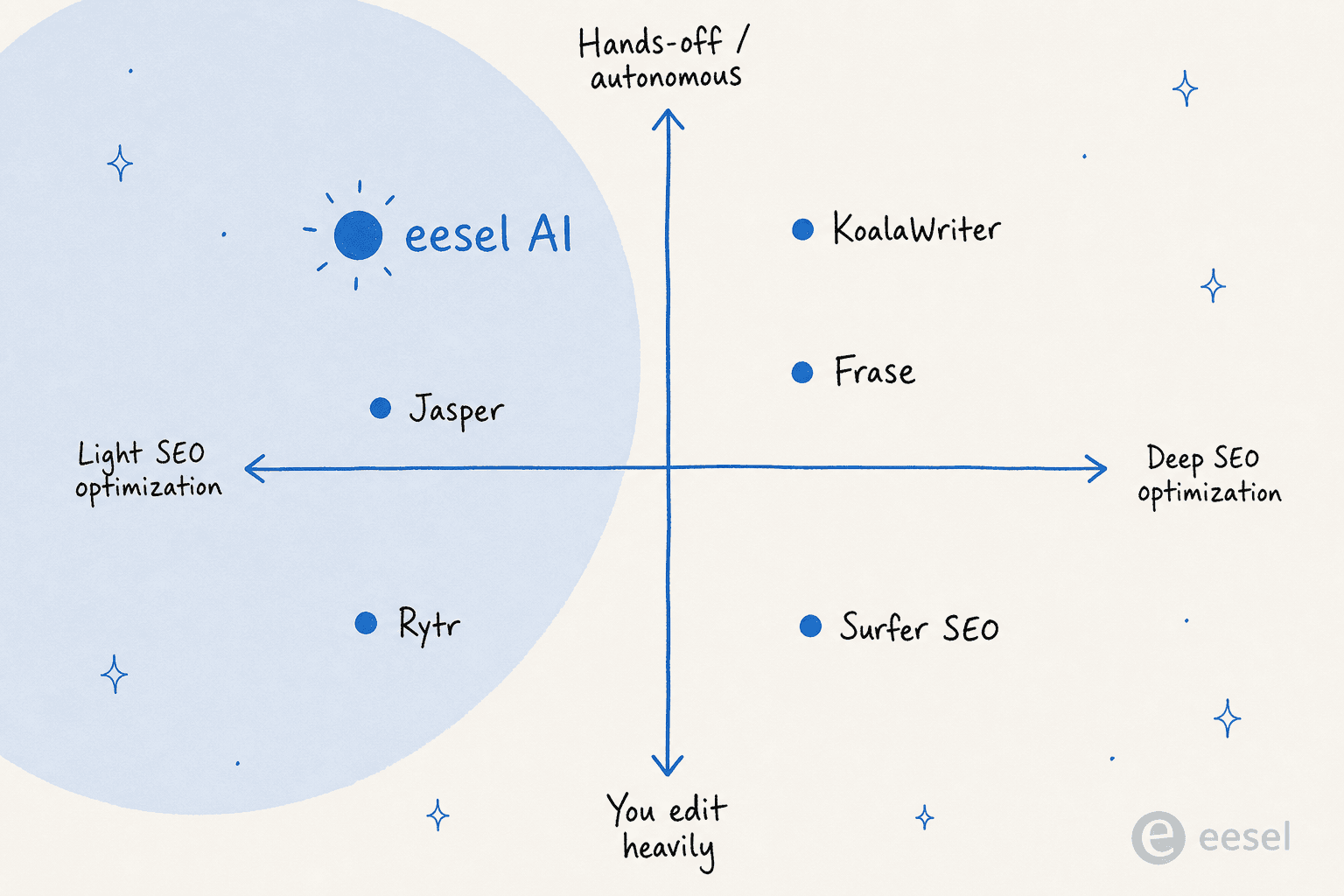
A few decision shortcuts:
- You want finished posts, not a drafting tool: go with eesel AI. It's the only option built to research and write autonomously, so you're editing for taste, not rebuilding from scratch.
- You publish high volume and live in WordPress: KoalaWriter or Scalenut.
- You already write well and just need an SEO score: Surfer SEO or, on a budget, Frase.
- You're an enterprise marketing team: Jasper for brand control, Writesonic if AI-search visibility is the goal.
- Price is the only thing that matters: Rytr.
If you're picking the underlying model rather than a full tool, our test of the best LLM for blog writing is a useful companion read, as is the broader best AI writing tools roundup.
What these tools actually cost
Sticker prices hide a lot. A "$49/month, 100,000 words" plan that secretly halves your quota on the good model isn't really $49 for 100,000 words. Here's the entry-level paid plan for each subscription tool, side by side, with eesel's per-post model noted separately since it doesn't fit the monthly-seat mold.
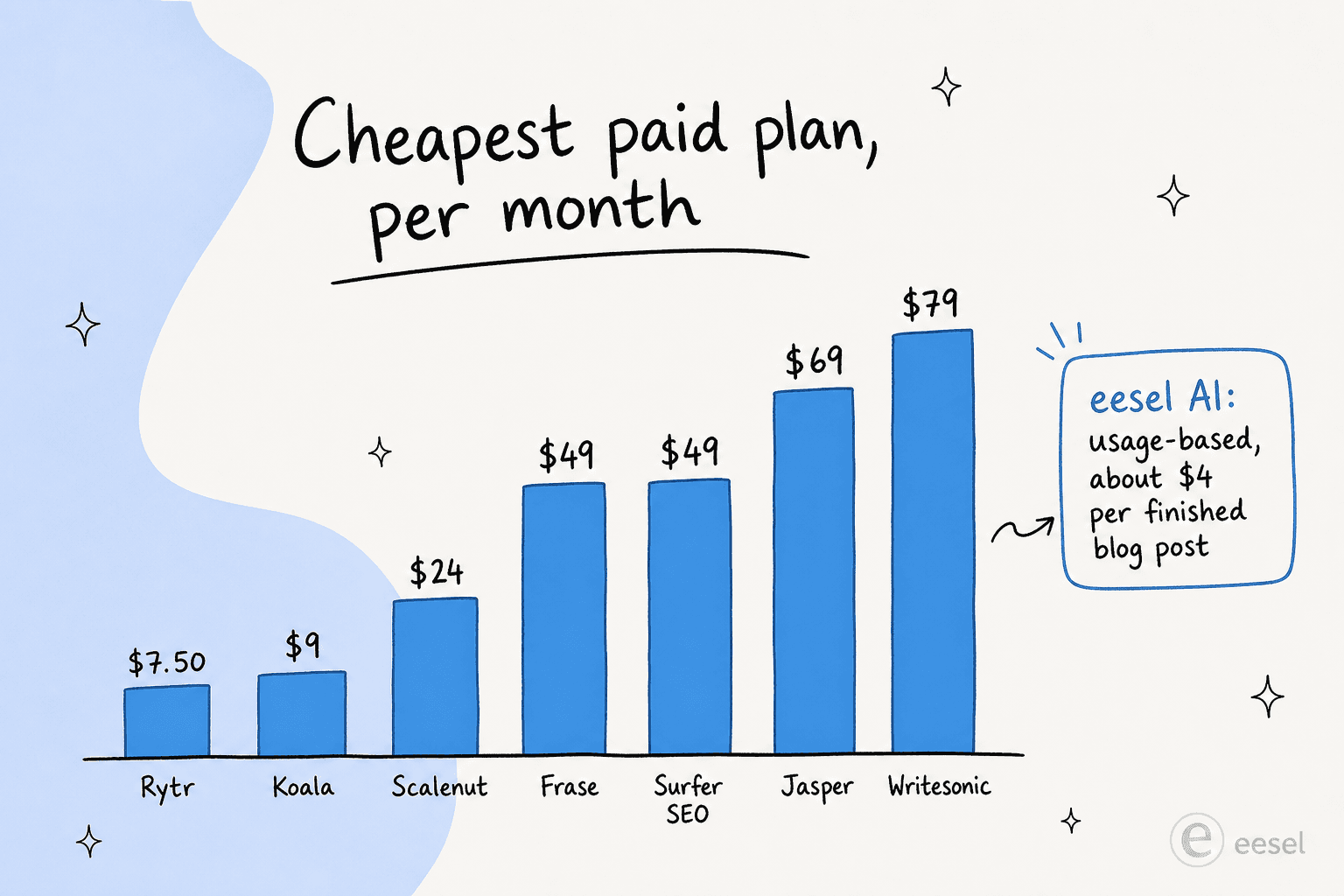
A worked example makes the difference concrete. Say you publish 10 posts a month. On a subscription tool, you're paying the monthly fee whether you hit your quota or not, and the cheaper tiers will cap you well before 10 solid long-form pieces. With eesel's $4-per-post pricing, 10 finished posts is about $40, and a slow month where you publish two is about $8. Per-post pricing turns content from a fixed subscription into a variable cost that tracks what you actually produce. For the full picture across models, see our guide to AI blog writer cost.
The other hidden cost is your time. Every tool here except the research-led agents assumes you'll spend hours editing and fact-checking. That editing time is the real price, and it's why "cheapest plan" and "cheapest tool to actually get a publishable post" aren't the same question.
Try eesel AI
If the theme of this whole list is "great draft, shame about the editing," eesel AI is our answer to it. Its Blog Writer agent does the research first and writes second, so you get a grounded, citable, publish-ready post instead of a fast first draft that needs an afternoon of cleanup. It runs autonomously inside the apps your team already uses, you brief it in plain English, and it works out to roughly $4 per finished post with no seats or platform fees.
You can start with 100 free credits, no credit card required. Take a look at how eesel AI handles content, or see the full pricing to map it to your own publishing cadence. Try eesel.