

How Gorgias pricing actually works
Before the numbers, the model. Gorgias doesn't charge per agent seat the way most legacy helpdesks do. Its tagline is "pricing that scales with your growth, not your headcount," and that's the literal billing logic: you pay for billable tickets per month, and most plans hand you unlimited or very high user caps on top.
That's genuinely good for a growing ecommerce helpdesk team. You can add seasonal agents during Black Friday without your bill moving, because the bill tracks conversations, not people. The flip side is that your costs are now tied to something you only partly control, support demand, which is exactly the tension small teams run into.
A "billable ticket" here is one conversation on any channel (email, live chat, Instagram, WhatsApp, and so on) that gets a reply from a human agent, a Rule, or the AI Agent. One conversation counts once no matter how many messages bounce back and forth, though a reply after an inactivity gap (more than 10 days on email, more than 3 days on chat) opens a new ticket that can be billable. Inbound tickets that never receive a reply from your helpdesk, such as spam and newsletters, don't count.
One quirk to flag before you do any math: Gorgias' own pricing page now leads with Helpdesk plus AI Agent bundles ($40 / $77 / $471 / $1,227 a month on annual billing, with Starter monthly-only), then splits each into a helpdesk line ($10 / $50 / $300 / $750) and an AI Agent line ($30 / $27 / $171 / $477). The helpdesk-only monthly-billing rates are $10 / $60 / $360 / $900, and the gap is the annual discount, roughly two months free. We'll use the annual figures as the baseline below and call out the monthly rate where it matters.
The Gorgias plan tiers in 2026
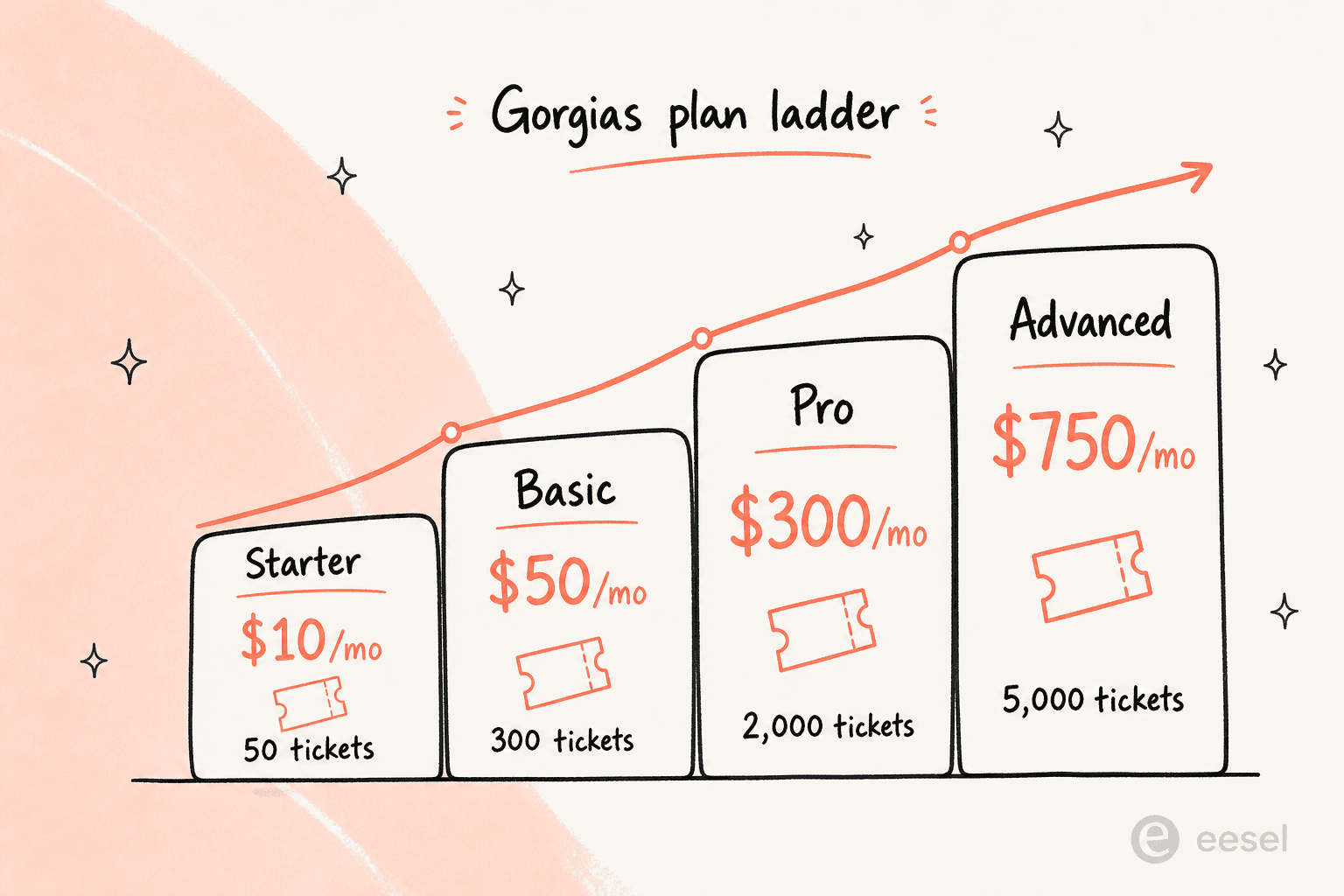
Here's the full self-serve lineup, plus the custom tier above 5,000 conversations a month. These are the annualized prices straight from Gorgias pricing.
| Plan | Helpdesk only (annual / monthly) | With AI Agent (annual / monthly) | Tickets/mo | Helpdesk overage | Automated interactions included | AI Agent rate | User seats |
|---|---|---|---|---|---|---|---|
| Starter | $10 / $10 | $40 monthly only | 50 | $0.40 / ticket | 30 | $1.00 | 3 |
| Basic | $50 / $60 | $77 / $90 | 300 | $40 / 100 tickets | 30 | $0.90 | 500 |
| Pro (recommended) | $300 / $360 | $471 / $550 | 2,000 | $36 / 100 tickets | 190 | $0.90 | 500 |
| Advanced | $750 / $900 | $1,227 / $1,430 | 5,000 | $36 / 100 tickets | 530 | $0.85 | 500 |
| Custom plan | Custom | Custom | 5,000+ | Custom | Custom | Custom | Custom |
A few things worth knowing that the table can't show on its own. Starter is the only plan capped at 3 user seats, and it is monthly-billing only, so it's really a solo-founder or tiny-team tier. From Basic up you get 500 seats. Revenue attribution arrives at Pro, and things like unlimited Help Centers and a higher API rate limit (4 requests/sec versus 2 on the self-serve plans) appear only on the custom plan.
The thing the grid hides is how steep the jumps get. You go from $77 to $471 to $1,227 (annual, AI Agent included) as the ticket allowance climbs from 300 to 2,000 to 5,000. There's no gentle middle, so a brand doing 600 tickets a month is stuck choosing between paying Pro money for capacity it won't fully use or living on Basic and eating overages.
If you want to map your own volume against the tiers, the Gorgias plans comparison and Gorgias basic plan guides break each one down line by line.
Gorgias AI Agent pricing: the part that catches people out
This is the section to read twice. The Gorgias AI Agent is a separate line on your plan. The pricing page now shows it as an AI Agent toggle layered on top of whatever tier you're on, and it's billed per automated interaction:
- $1.00 per automated interaction on Starter, $0.90 on Basic and Pro, $0.85 on Advanced
- Each plan bundles a block of interactions (30 / 30 / 190 / 530), which is the AI Agent line on the plan card ($30 / $27 / $171 / $477 a month)
- You're only charged for interactions the AI fully handles with no human in the loop. If a shopper reaches a human within 72 hours of an automated resolution, it's billed as a regular helpdesk ticket only, not as an AI resolution.
- Extra interactions beyond your plan's bundle list at $1.50 each.
- Flows, Order Management and Article Recommendations also count as automated interactions when they resolve a request without a human, per the billing docs, but those carry the automation fee only, with no ticket fee.
The AI Agent itself is capable. It's pre-trained on 18+ ecommerce verticals, answers pre- and post-sale FAQs, handles returns and refunds, edits orders and subscriptions, generates dynamic discounts, and makes product recommendations, with configurable tone and guardrails. Gorgias docs now list email, chat, SMS, and social channels (Instagram DMs and Messenger in open beta, plus WhatsApp) as places it can answer.
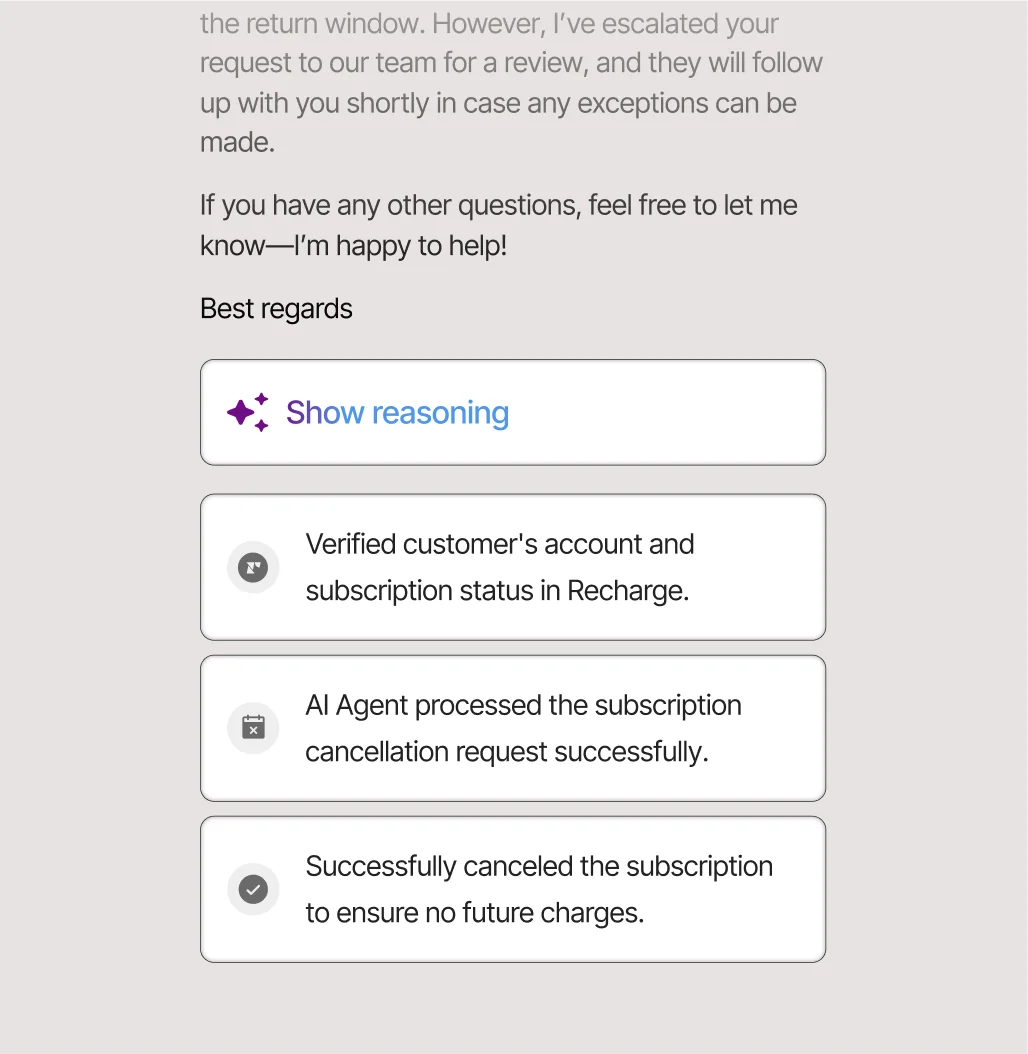
Now the part that quietly inflates the bill. Each AI Agent resolution also counts as a billable helpdesk ticket. So one automated answer hits two meters: it consumes an automated interaction at $0.85 to $1.00, and it eats into (or over) your plan's ticket allowance at the same time. It's not a hidden fee exactly, it's in the docs, but it's the single most common thing buyers miss when they sketch out their budget.
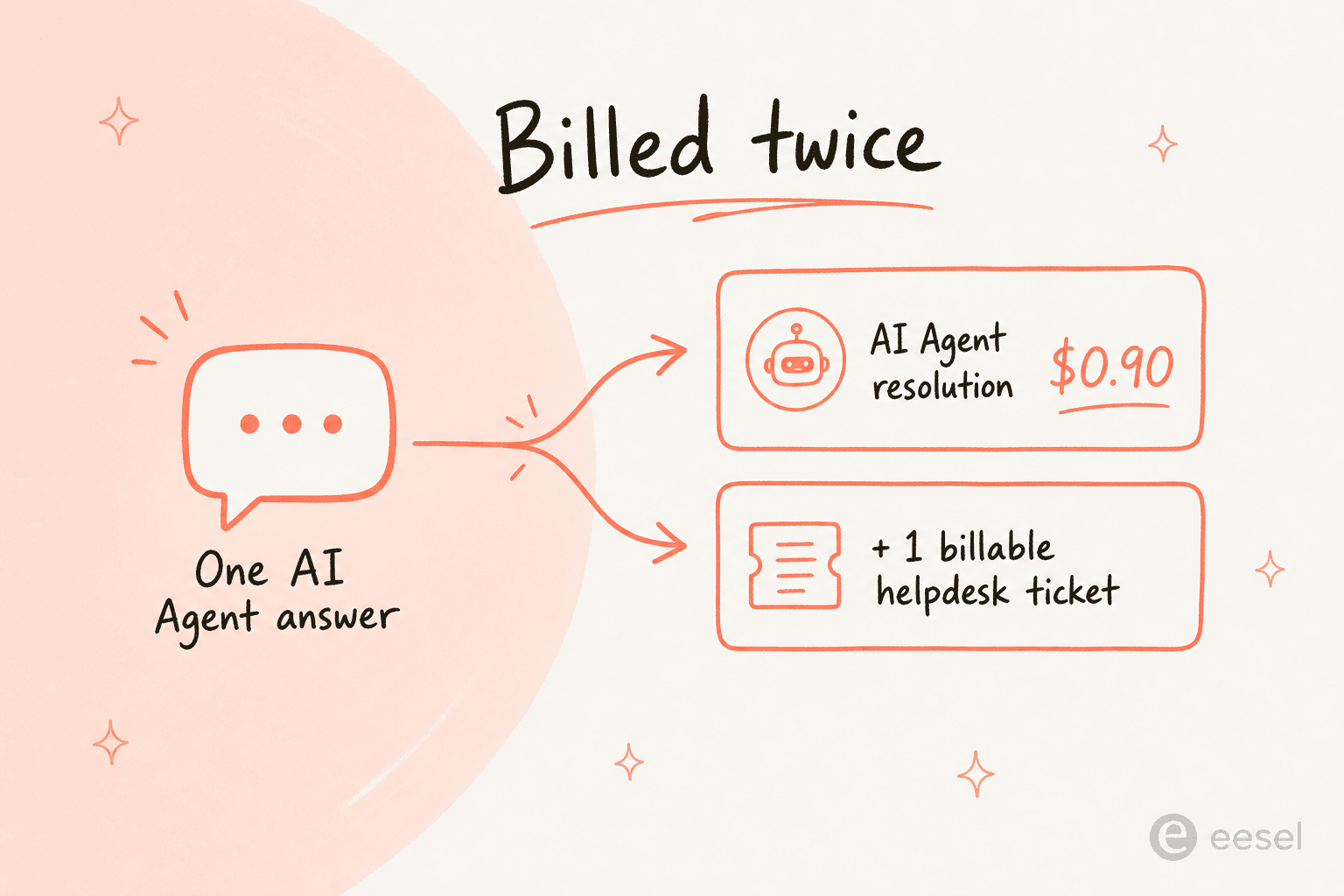
This double-counting is the structural difference between Gorgias' AI pricing and the flatter, per-resolution models you'll see elsewhere. It's also why a Gorgias AI pricing calculator is worth running before you commit, the headline $0.90 is only half the story.
What you'll actually pay: worked examples
Sticker prices are easy; real invoices are what matter. Let's run three realistic scenarios on annual billing, with the AI Agent included on each plan card and extra interactions at $1.50.
Scenario 1, small store, light AI. You're a founder-led brand doing ~250 tickets a month, automating maybe 100 of them with AI. Basic ($77/mo with AI Agent, 300 tickets, 30 interactions bundled) covers the tickets, but 70 extra interactions at $1.50 add $105. Rough monthly total: ~$182/mo.
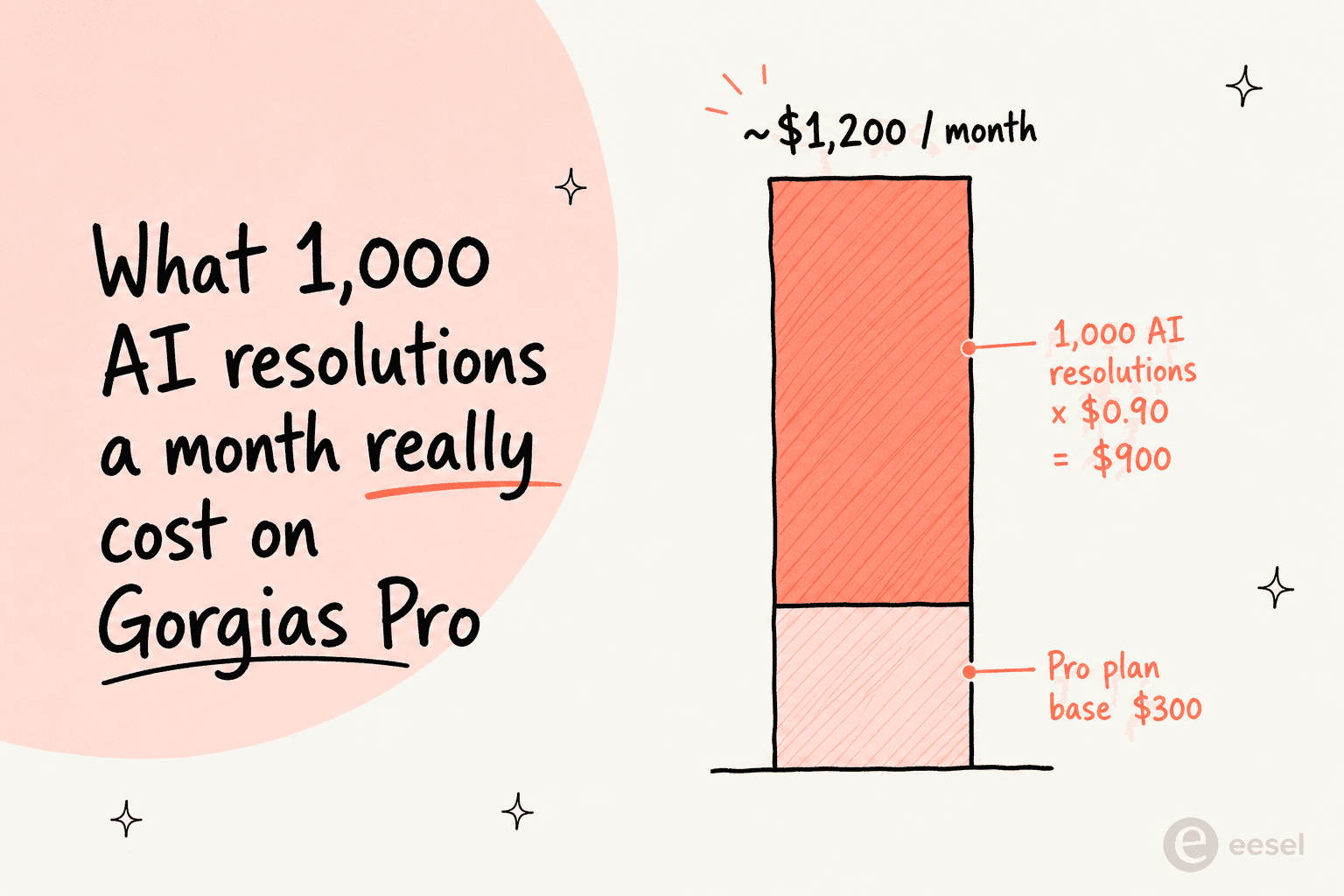
Scenario 2, growing brand, heavy AI. You're doing ~1,000 tickets a month and you want the AI to handle all 1,000. Pro ($471/mo, 2,000 tickets, 190 interactions bundled) leaves 810 extra interactions at $1.50 = $1,215. That's ~$1,686/mo, and the 1,000 resolutions sit comfortably inside your 2,000-ticket allowance.
If you price every interaction at the $0.90 Pro list rate with no extra-interaction premium, 1,000 × $0.90 = $900 on top of the $300 helpdesk fee lands near $1,200. That is the floor, and either way the AI is the line item that dominates.
Scenario 3, scaling team. At ~4,000 tickets a month with aggressive automation, you're on Advanced ($1,227/mo, 5,000 tickets, 530 interactions bundled). Automate 3,000 and you've got 2,470 extra interactions at $1.50 = $3,705. Total: ~$4,930/mo, before SMS, Voice, or any add-ons.
The pattern is consistent: the plan fee is the small number, and AI resolution volume is what actually sets your bill. The more successful your automation, the more you pay, which is the right incentive for Gorgias and a budgeting headache for you.
Overages, add-ons, and the costs that aren't on the plan card
A few more line items that belong in any honest Gorgias pricing estimate:
- Helpdesk overages. Beyond your ticket allowance, you pay $0.40 per ticket on Starter, $40 per 100 on Basic, and $36 per 100 on Pro and Advanced. Gorgias will nudge you to upgrade if a higher tier would be cheaper than your overage run-rate.
- SMS and Voice. Both are add-on channels priced by the ticket volume you select, on top of your base plan. If phone or text is core to your support, budget for them separately, the Gorgias phone integration guide covers what Voice involves.
- The automation features. Flows and Order Management (see the automation add-on guide) sit under the AI Agent subscription, and a self-serve order status bot answer bills only the automation fee, not a ticket fee as well, so it costs less than an AI-resolved ticket if you set it up well.
Speaking of which: not everything has to be a paid AI resolution. Gorgias' Order Management and self-serve widgets let shoppers track orders, start returns, and cancel without creating a helpdesk ticket, though a completed self-serve interaction still counts as one automated interaction. Leaning on these for the highest-volume "where is my order" questions is one of the few levers you have to keep the AI bill down.
What you get for the money: support tiers
Every tier gets 24/7 email and chat support, and the level of service scales up the ladder. The pricing page's comparison table now maps support tiers to plans, and Gorgias' older plan guide ties the same tier names to store revenue, so confirm which applies to your account when you sign up.
| Plan | Support tier (pricing page) | Onboarding | Dedicated CSM |
|---|---|---|---|
| Starter | Community | Self-serve | No |
| Basic | Standard | Self-serve | No |
| Pro | Specialist | 1:1 onboarding | No |
| Advanced | Dedicated | White-glove | Yes |
Gorgias' older plan guide describes the same names by store revenue (GMV): Standard under $3M a year, Specialist at $3M to $20M, and Dedicated at $20M+ or a $40k+ contract. Either way, the dedicated CSM sits at the top tier.
On compliance, Gorgias covers the basics buyers ask about: GDPR and CCPA, SSO via Google and Microsoft on every plan, and audit logs from Pro. Gorgias also announced SOC 2 Type II certification, so if procurement needs the audit report, ask for the current one before you sign. Our Gorgias GDPR guide has more on the data side.
Calculate your monthly Gorgias costs
Understanding the model in real-world scenarios is the only way to budget properly. Let's run the numbers on annual billing throughout.

Start with your ticket volume
Review your past support data to estimate monthly tickets, and separately estimate how many of those you actually want the AI to close. Those are two different numbers now, and the second one is the one that moves your bill. Ticket types that automate cleanly, like order tracking and refund handling, are where the count climbs fastest.
Sample cost breakdown

Scenario 1, small store, light AI. A founder-led brand doing ~250 tickets a month, automating 100 of them. Basic covers the tickets (300 included) but only 30 automated interactions, so 70 overage interactions at $1.50 add $105.
| Cost component | Calculation | Estimated cost |
|---|---|---|
| Basic plan (annual) | Fixed monthly rate | $77 |
| Automated interaction overage | 70 x $1.50 | $105 |
| Total estimated monthly cost | $182 |
Scenario 2, growing brand, heavy AI. ~1,000 tickets a month, automating all 1,000. Pro covers the tickets (2,000 included) and 190 automated interactions, so 810 overage interactions at $1.50 add $1,215.
| Cost component | Calculation | Estimated cost |
|---|---|---|
| Pro plan (annual) | Fixed monthly rate | $471 |
| Automated interaction overage | 810 x $1.50 | $1,215 |
| Total estimated monthly cost | $1,686 |
Scenario 3, scaling team. ~4,000 tickets a month, automating 3,000. Advanced covers the tickets and 530 automated interactions, leaving 2,470 overage interactions at $1.50, or $3,705, on top of the $1,227 base. That lands near $4,930 a month before Voice, SMS, or any add-ons.
The pattern is consistent: the plan fee is the small number, and automated interaction volume is what actually sets your bill. The more successful your automation, the more you pay, which is the right incentive for Gorgias and a budgeting headache for you.
How to maximize your AI support ROI
Start by identifying the right performance metrics: ticket deflection rate, average resolution time, and CSAT. Then prioritise automating high-volume, routine tickets, which creates immediate efficiency and lets your team focus on complex work. Ticket tagging and routing are usually the safest first two.
The specific lever that matters under the 2026 model is knowing your automated-interaction count before you commit to a tier, not after. Model the number, compare it against the included block, and check whether stepping up a tier costs less than the overage run-rate. That's a five-minute exercise that regularly saves four figures a month. Pairing it with stronger self-service is the other reliable lever.

Is Gorgias AI pricing actually worth it?
Here's where we land after digging through the model: Gorgias is excellent, and it's expensive, and both of those are true for the same reason. The deep Shopify integration is the best in the category, and you're paying for it.
The community converges on a clean rule. As one operator with a decade in ecommerce put it on a Reddit thread weighing Gorgias against Zendesk:
"I've been around ecommerce for 10+ years and this is honestly how I'd choose: 40%+ tickets need Shopify actions → I'd lean Gorgias. Mostly conversational support → Zendesk is fine."
That's u/cavalry18 in r/CRM, and it's the most useful framing we found. If a real chunk of your tickets are refunds, cancellations, address changes, and order edits, having the agent do that work inside the ticket with live Shopify context is worth the premium. If your tickets are mostly "do you ship to Canada," you're paying for a Ferrari to do the school run.
The price pushback is just as consistent. The same threads are full of it:
"Gorgias is awesome if you're super deep into Shopify workflows... The downside is the price adds up quick once your volume grows."
That's u/ShoddyPut8089, and "adds up quick once your volume grows" is precisely the AI-resolution dynamic we mapped above. On G2, Gorgias still sits at a strong 4.6 out of 5 across 580+ reviews, with praise centering on ease of use and the Shopify integration, so the love is real. The friction is almost always the bill.
We've seen the sticker shock land hard, too. One US swimwear brand we came across ran 12 successful AI test chats, was happy with how the agent performed, then visited the billing page and immediately filed two cancellation requests. The product worked; the pricing math didn't survive contact with reality. The lesson isn't that Gorgias is overpriced, it's that you need to model the AI-resolution cost before you fall in love with the demo.
A more predictable model: Gorgias vs eesel AI
If the per-resolution-plus-ticket double-counting is what worries you, it's worth seeing how a fixed monthly plan compares. eesel AI is an AI helpdesk agent that layers onto your existing stack (including Gorgias, Zendesk, Freshdesk, and Shopify) and charges one fixed monthly price sized to your volume, with 1 credit per ticket or chat.
| Gorgias AI Agent | eesel AI | |
|---|---|---|
| Pricing model | Ticket-based plan + per-resolution AI add-on | Fixed monthly Teammate plan, no platform or per-seat fee |
| Entry point | $40/mo Starter with AI Agent ($10 helpdesk + $30 AI Agent) | Free plan with 100 credits, then from $299/mo (500 credits) |
| Cost per AI resolution | $0.85 to $1.00 by plan, $1.50 beyond the bundle | About $0.50 to $0.60 at plan volume (1 credit per ticket) |
| Double-counting | Each resolution also bills as a ticket | 1 credit per ticket or chat, however long |
| 1,000 AI resolutions/mo | ~$1,686 (Pro $471 + 810 extra at $1.50) | $499 (1,000-credit plan) |
| Per-seat fees | None | None |
At 1,000 resolutions a month, that's roughly $499 versus ~$1,700. The trade-off is honest: Gorgias gives you the tightest native Shopify helpdesk experience as one unified product, while a tool like eesel is the better value when AI volume is your dominant cost and you're happy to keep your current helpdesk. For a full field of options, our best Gorgias alternatives and cheapest AI helpdesk apps guides lay them side by side.
Try eesel for predictable AI support costs
If the Gorgias AI bill is the thing giving you pause, eesel AI is built around the opposite instinct: one fixed monthly price from $299 for 500 credits, no per-seat fees, and no double-counting, so your invoice tracks one number instead of two. It plugs into your existing helpdesk (Gorgias included) and your knowledge sources, and you can run a simulation on your past tickets to see exactly what it would have deflected, and how many credits it would have used, before going live. There's a free plan with 100 credits to start, no credit card required.
It won't replace Gorgias' native Shopify inbox if that unified experience is what you're buying. But if you want AI ticket automation with costs you can predict to the dollar, it's the cleaner model. You can see the full breakdown on the eesel pricing page.
Frequently Asked Questions
How much does Gorgias cost per month in 2026?
How is Gorgias AI Agent priced?
Is Gorgias AI pricing worth it for a small Shopify store?
What are Gorgias overage charges?
Is there a cheaper alternative to Gorgias AI pricing?


Article by
Riellvriany Indriawan
Riell is a designer and writer at eesel AI with about two years of experience researching CX platforms, AI chatbots, and helpdesk software. She combines her design background with a sharp eye for how these tools actually look and feel in practice — making her comparisons unusually visual and user-focused.