


Mistral AI has definitely shaken things up in the AI world, dropping powerful, efficient, and often open-source models that have everyone talking. But if there's one thing I know after years of putting AI on live support queues, it's that this space moves ridiculously fast. The perfect tool for your project yesterday might not be the right one today, which is why it pays to keep an eye on the best Mistral alternatives.
Whether you're a developer who wants a raw large language model (LLM) to build something new, or a business leader looking for a tool that's ready to go for something like customer support, you have more choices than ever. This guide is here to help you skip the hype and get a real look at the top alternatives so you can pick the right tool for what you actually need to do.
- There's no single "best" Mistral alternative, there's a best one for your job. For deep reasoning, Claude Opus 4.8. For full control and self-hosting, open-weight Llama 4. For multimodal analysis with a huge context window, Gemini 3. For real-time, cited answers, Perplexity AI. For enterprise RAG, Cohere's Command.
- If your goal is customer support automation, a raw model is the wrong tool. Handing your team an LLM API is like handing them a pile of bricks and asking for a house. A platform like eesel AI is the finished house, it learns from your past tickets and goes live in minutes, not months.
- Prices moved a lot since this guide first ran. Most alternatives charge per token; eesel AI now charges one fixed monthly price from $299/month for 500 credits, with no per-seat fees and 100 free credits to start.
What is Mistral AI and this new wave of LLMs?
Let's quickly get on the same page. Mistral AI is a company that builds the "brains" behind AI tools you might use, kind of like ChatGPT. These brains are called Large Language Models (LLMs). Mistral got a lot of attention early on by creating models (like its Mistral 7B and Mixtral series) that are not just smart, but also super efficient, meaning they run faster and cost less than many of the giant models out there. Its newer lineup, like Mistral Large 2 and the Magistral reasoning models, pushes that same efficiency-first idea further. If you want the cost detail, our Mistral AI pricing breakdown has the numbers.
Mistral is also a big player in the open-source community, often releasing its models for anyone to use and tweak. This is part of a larger trend that's making AI accessible to more people. Companies don't have to build these incredibly complex models from the ground up anymore. Instead, they can plug into foundational models like Mistral's through an API or even run them on their own servers. That's great, but it also means you have to choose carefully. Different models have different superpowers, whether it's logical reasoning, writing code, enterprise-level security, or understanding different languages. Our Mistral AI reviews piece digs into where it shines and where it falls short.
Why look for Mistral alternatives?
Mistral's models are great, but they aren't the perfect solution for every single problem. Your project has its own quirks and demands, and another model might just be a better match.
Here are a few solid reasons to check out some Mistral alternatives:
- You need a specialist. Some models are just built differently. Anthropic's Claude, for example, is a powerhouse for complex reasoning, while Google's Gemini is in its own class when it comes to understanding images and video alongside text. You can see the trade-offs in our Mistral vs Claude and Mistral vs Gemini comparisons.
- You want full control. If your goal is to build something completely custom, a fully open-weight model like Meta's Llama 4 essentially hands you the keys to the car. You can fine-tune it on your own private data and deploy it anywhere you like.
- Ease of use actually matters. Honestly, using a foundational model like Mistral requires serious developer know-how. For business teams without a dedicated AI engineer, wiring up an API is a non-starter. A fully managed platform is often a much better option.
- It's all about cost vs. performance. You need a tool that's fast enough, accurate enough, and doesn't drain your budget. The only way to find that balance is to shop around, and our Mistral vs Perplexity and Mistral vs ChatGPT write-ups are a good place to start.
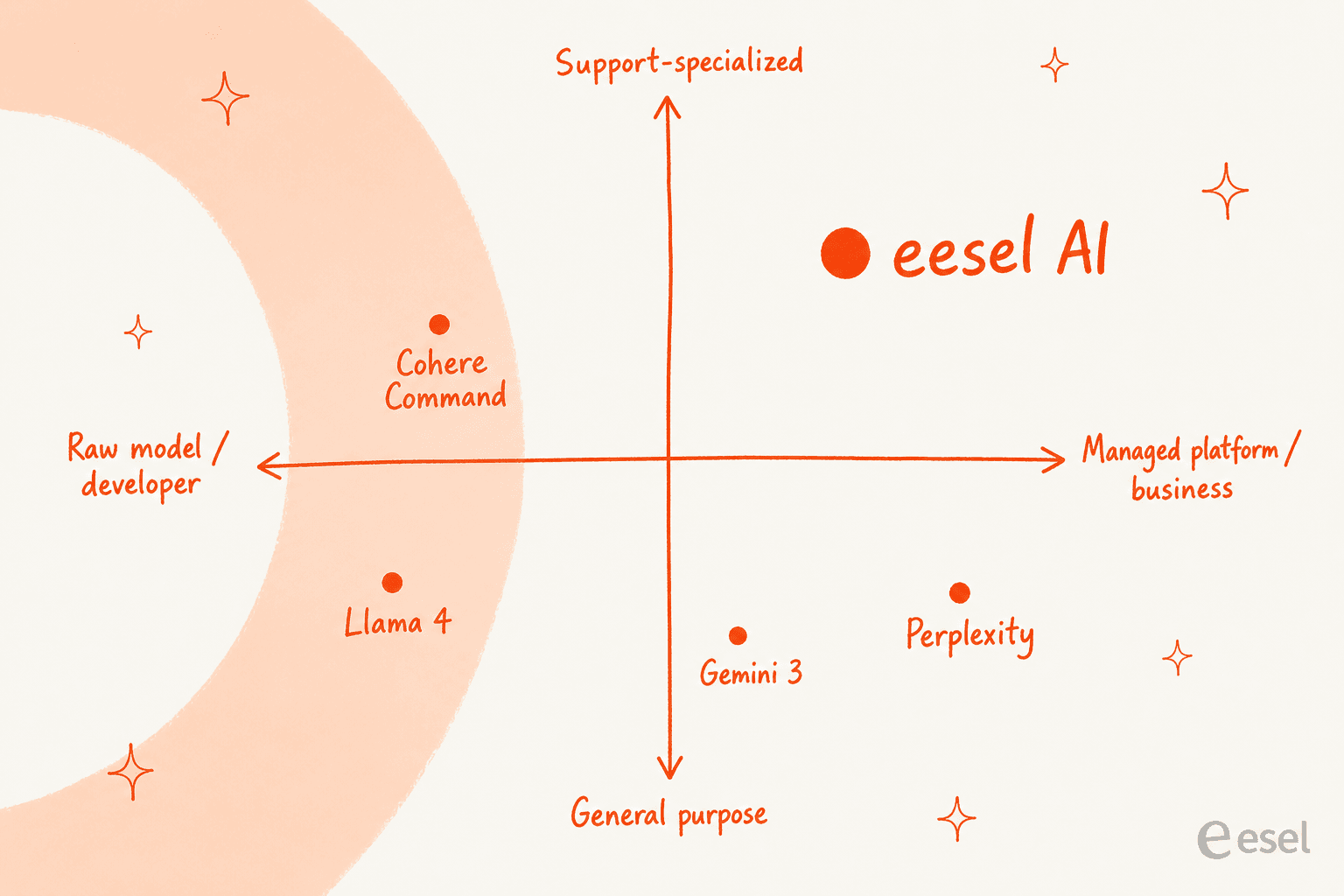
How I picked the top Mistral alternatives
To make this list actually helpful, I didn't just pull names out of a hat. I looked at each alternative with a critical eye to see if it really held up.
Here's what I focused on:
- Performance: How good is it, really? I checked how each model performs on standard industry benchmarks that test reasoning, knowledge, and language skills.
- Implementation: Can a normal person actually use it? I looked at whether it's an API-first tool for developers or a user-friendly platform a business team can get running without writing code.
- Key features & specialization: What's its unique selling point? I looked for standout strengths, like a massive context window for reading huge documents, the ability to understand images, or a strong focus on enterprise security.
- Cost-effectiveness: Is the price fair? I examined the pricing model to see if it delivers good value for its performance.
- Community & support: Is there help if you get stuck? I considered the ecosystem around each model or platform, because good support can make all the difference.
Mistral alternatives comparison table
For a quick overview, here's how my top picks for Mistral alternatives stack up.
| Tool | Best For | Licensing | Key Feature | Pricing Model |
|---|---|---|---|---|
| eesel AI | Customer support automation | Proprietary (SaaS) | Go-live-in-minutes helpdesk integration | Fixed monthly, from $299/mo (500 credits) |
| Anthropic Claude 4.5 Sonnet | Complex reasoning & safety | Proprietary | Up to 1M token context window | Per-token API & subscriptions |
| Meta Llama 4 | Customization & control | Open weights | State-of-the-art open model | Free (hosting costs apply) |
| Google Gemini 3 | Multimodal analysis | Proprietary | 1M token context window | Per-token API & subscriptions |
| Perplexity AI | Conversational search | Proprietary | Real-time web access with citations | Freemium & Pro subscriptions |
| Cohere Command | Enterprise RAG & tool use | Proprietary | Retrieval Augmented Generation | Per-token API |
The 6 best Mistral alternatives in 2026
Alright, let's get into the details. Here's my breakdown of the best Mistral alternatives out there today, each with its own distinct advantages.
1. eesel AI
Instead of thinking of eesel AI as just another LLM, think of it as the business-ready alternative. Giving your support team access to a raw model API is like handing them a pile of bricks and telling them to build a house. eesel AI gives them the finished house, keys in hand. It's a platform designed specifically to automate customer support by connecting directly to the tools your team already uses, like Zendesk, Freshdesk, and your company's knowledge base.
This is the build-vs-buy call I hear teams wrestle with constantly. One customer, Karel at GENERAL BYTES, summed up why they didn't roll their own: "We could try to write our own LLM application but we didn't want to invest our time into that. We wanted something that we would not have to maintain." That's the whole point, the raw Mistral or Llama API is the easy 20%; the data plumbing, guardrails, and maintenance are the 80% you don't see coming.
What really makes eesel AI different is its "go live in minutes, not months" approach. While getting a raw LLM into production is a major project, eesel AI is a self-serve platform you can set up in an afternoon. It instantly learns from your past support tickets, help articles, and internal docs to give customers answers that are accurate and sound just like your team.
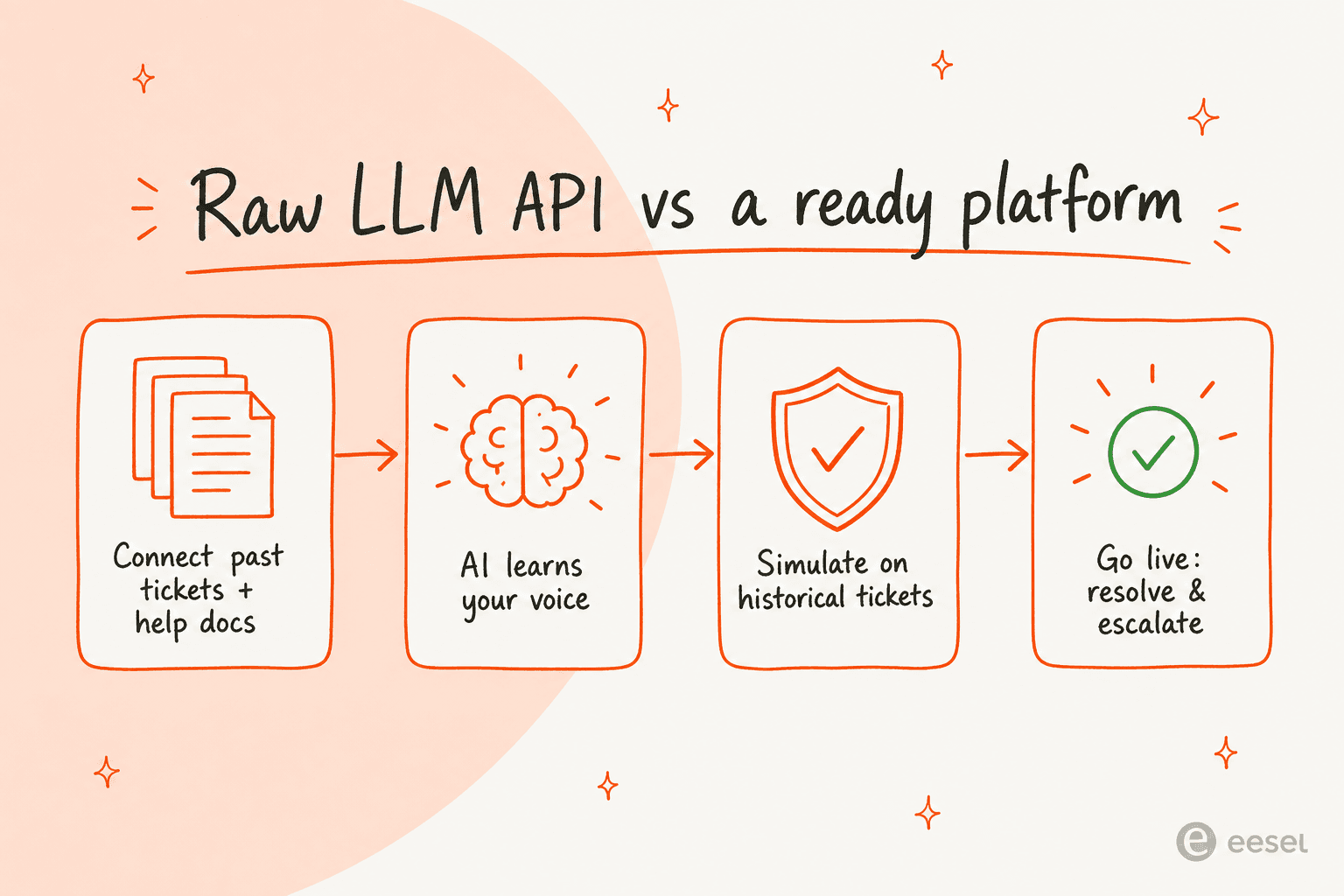
Key Features:
- One-click helpdesk integration: It slots right into your current workflow, so you don't have to ditch the tools your team knows and loves.
- Powerful simulation mode: You can safely test the AI Agent on thousands of your past tickets. This shows you exactly how it will affect your resolution rates and costs before you ever let it talk to a live customer, the same discipline we apply to every rollout because we've watched confident-sounding bots quietly give wrong answers.
- Customizable workflow engine: You're in complete control. You decide precisely which tickets the AI handles and what actions it can take, from tagging and closing to making API calls to look up a customer's order information.
Pricing: eesel AI has transparent, fixed monthly pricing with no per-seat fees and no surprise per-resolution charges. 1 credit covers one ticket or chat, however long, and plans start at $299/month for 500 credits ($499 for 1,000, $999 for 2,500, $1,899 for 5,000). You start with 100 free credits, no credit card required, and there's no platform fee.
2. Anthropic's Claude 4.5 Sonnet
Claude comes from Anthropic, a company that puts a huge emphasis on AI safety and building responsible technology. It has built a reputation for top-tier reasoning, making it a favorite for tasks that require deep analysis and nuanced writing.
It's a great alternative to Mistral because it often comes out on top in head-to-head comparisons on complex, graduate-level reasoning tests. Its enormous context window, now up to 1 million tokens in beta for Claude 4.5 Sonnet, is another huge plus, letting it read and analyze incredibly long documents, legal contracts, or dense financial reports all at once. For the most demanding reasoning, Claude Opus 4.8 sits at the top of the lineup.
Key Features: Excellent reasoning, strong image analysis, and a genuine commitment to producing responses that are helpful and harmless.
Pricing: Claude is available through a pay-per-token API, and its web chatbot has a subscription plan.
3. Meta's Llama 4
Llama 4 is Meta's latest contribution to the open-weight community, and it has quickly set a new standard for freely available LLMs. It's a powerful, all-around family that's built to handle pretty much anything you throw at it.
Being open-weight, Llama 4 gives you a level of flexibility that proprietary models just can't offer. That makes it one of the best Mistral alternatives for developers who want to be in the driver's seat. You can fine-tune it with your own private data, customize its behavior to match your brand's voice, and run it on your own servers. The trade-off? You need the in-house technical skills to actually do all of that.
Key Features: It comes in different sizes to fit different needs and has much-improved reasoning and coding skills. Its license allows for commercial use.
Pricing: The model itself is free, but you'll need to pay for the cloud computing costs to host and run it.
4. Google's Gemini 3
Gemini is Google's multimodal AI, designed from the start to understand and process information across text, images, audio, and video seamlessly. You can read more in our Gemini overview.
Its native ability to handle different media types and its almost unbelievable 1 million token context window are what make it so impressive. You can give Gemini an hour-long video, a 300-page PDF, or a huge codebase and ask it to find specific details or summarize the key takeaways. It's an incredible tool for making sense of unstructured data.
Key Features: Unmatched multimodal skills, an enormous context window, and easy integration with the Google ecosystem you probably already use, like Google Docs and Vertex AI.
Pricing: You can get it through the Google AI Pro subscription for $19.99/month or use a pay-per-token API for custom projects. See our Gemini pricing guide for the full plan breakdown.
5. Perplexity AI
Perplexity calls itself a "conversational answer engine," which is a pretty accurate description. It's more than just a chatbot; it blends the power of LLMs with a real-time search engine to give you up-to-date answers that include citations.
If you need current information, Perplexity is one of the best Mistral alternatives you can find. While many models have a knowledge cut-off date, Perplexity is constantly scanning the web. It provides its sources, which makes it much more trustworthy for research, fact-checking, and creating content. The Mistral vs Perplexity comparison breaks down when each one wins.
Key Features: Real-time web access, direct citations for its answers, and a "Focus" feature that lets you limit your search to specific sources like academic papers, Reddit, or YouTube.
Pricing: Perplexity has a generous free tier, and a Pro version at $20/month that unlocks more powerful models like Claude 4.5 Sonnet and GPT-5.2.
6. Cohere's Command
Cohere is focused on building LLMs for businesses, and its Command family is designed for serious enterprise workflows.
It's a strong alternative because it's built for Retrieval-Augmented Generation (RAG). That's a technical term for a method where the AI model pulls information directly from a company's private data to provide answers that are accurate and fact-based. This makes it extremely useful for building internal knowledge search tools and company-wide AI assistants that don't just make stuff up. For more on the vendor, see our Cohere overview.
Key Features: Advanced RAG capabilities, can handle multi-step tasks to run complex automated workflows, and offers strong multilingual support.
Pricing: Cohere uses a pay-per-token model built for large-scale business use. See our Cohere pricing guide for details.
How to choose the right Mistral alternatives for you
Feeling a bit lost in all the options? Don't worry. Here are a few practical tips to help you decide.
- First, define what you're actually trying to do. Are you a developer building a new app from scratch? A raw LLM like Llama or Claude is your playground. Are you a support manager trying to reduce ticket volume? A platform built for that specific job is what you need.
- Be realistic about your technical resources. Do you have a team of AI engineers ready to fine-tune and deploy a model? Or do you need a tool you can set up yourself that just works? An honest read on your team's skills will save you a lot of headaches.
- Balance cost with performance. The newest, most powerful model isn't always the best choice. Try a few options to find the one that gives you the quality you need without costing a fortune, and check which LLM is best for support if that's your use case.
- Don't forget the user experience. For business tools, a clean interface, good analytics, and easy integrations matter just as much as the AI model running behind the scenes.
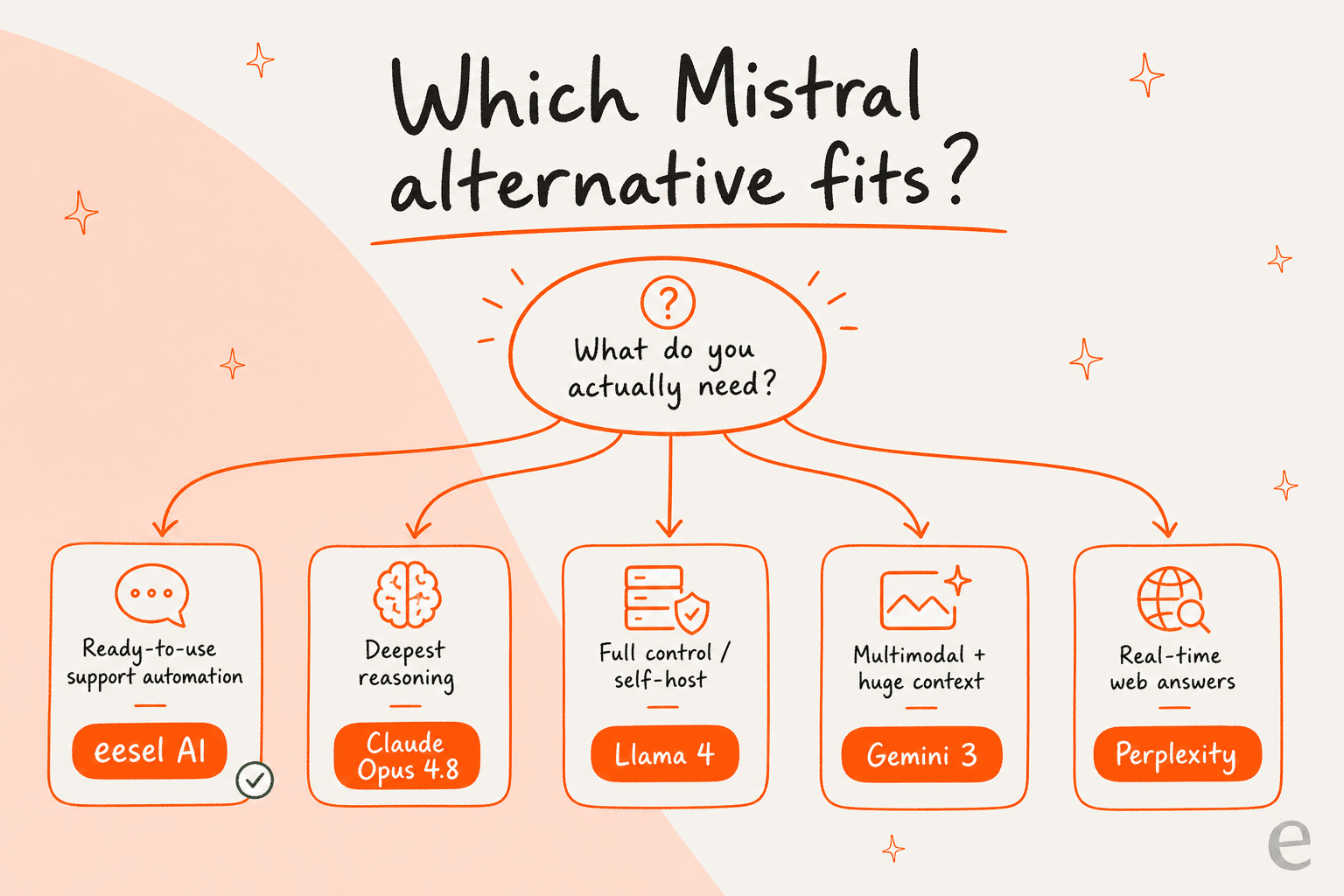
The smart choice among Mistral alternatives for your business
Choosing an AI tool isn't about picking the LLM with the best score on a benchmark test. It's about finding the right solution to your specific problem. The Mistral alternatives I've walked through show there's a tool for almost any need, from open-source sandboxes for builders to powerful platforms for businesses.
But for functions like customer support, IT help desks, and managing internal knowledge, the best alternative isn't another raw model, it's a platform designed for the job. eesel AI bridges that gap, combining top-tier LLMs with an intuitive, self-serve platform. You get all the benefits of advanced AI without the complexity, and you can simulate it on your own historical tickets before it ever talks to a customer.
Ready to see how a purpose-built AI for customer support can change your support workflows? Try eesel free, or book a demo to see it in action.
Frequently asked questions
If our team isn't very technical, what are the best Mistral alternatives for us?
For non-technical teams, the best options are fully-managed platforms that don't require any coding. A tool like eesel AI is designed for business users to set up quickly for customer support, while Perplexity AI offers an easy-to-use interface for research and search tasks.
For a project that needs deep analysis of long documents, are there any Mistral alternatives that really stand out?
Yes. For handling large volumes of text, your best bets are Google's Gemini 3 with its 1 million token context window and Anthropic's Claude 4.5 Sonnet, which now runs up to a 1 million token window in beta. Both are built to read and reason over entire reports, books, or codebases in a single go.
What are the most cost-effective Mistral alternatives if my main goal is to keep costs low?
If raw cost-per-token is the goal, open-weight Llama 4 is the cheapest because the model is free, you only pay for hosting. For a managed support workflow, eesel AI charges one fixed monthly price from $299/month for 500 credits (1 credit per ticket or chat) with no per-seat fees, which is easier to predict than per-token API math.
My project requires full control and customization. Which Mistral alternatives should I be looking at?
If you need maximum control, focus on open-weight models. Meta's Llama 4 is the top recommendation, as it lets you fine-tune the model on your own private data and deploy it on any infrastructure you choose. Cohere's Command family is the enterprise-RAG option if you want control plus vendor support.
How do I choose between different Mistral alternatives if I need answers that are always up-to-date?
For tasks requiring the most current information, Perplexity AI is the clear winner. Unlike models with a fixed knowledge cutoff date, it functions as a "conversational answer engine" that actively searches the web in real-time and provides citations for its sources.
Are some Mistral alternatives better suited for large businesses and enterprise needs?
Yes, some models are built specifically for enterprise use. Cohere's Command family is a strong choice, as it excels at Retrieval-Augmented Generation (RAG), which lets it connect securely to your company's internal data for accurate, context-aware answers. For support specifically, an AI helpdesk platform layered on top of these models is usually the faster route to production.
How does Mistral pricing compare to these alternatives?
Mistral is one of the cheaper frontier APIs, which is a big part of its appeal. For the full breakdown, see our Mistral AI pricing guide and the head-to-head Mistral vs Claude comparison. Most alternatives here charge per token, while a managed platform like eesel AI charges a fixed monthly price sized to your ticket volume instead.