

What is Mistral AI?
Mistral AI is a French company that popped up in early 2023, started by a team of researchers who came from Google’s DeepMind and Meta. Their main goal is to make generative AI more accessible. They do this by developing large language models (LLMs) that are both powerful and efficient.
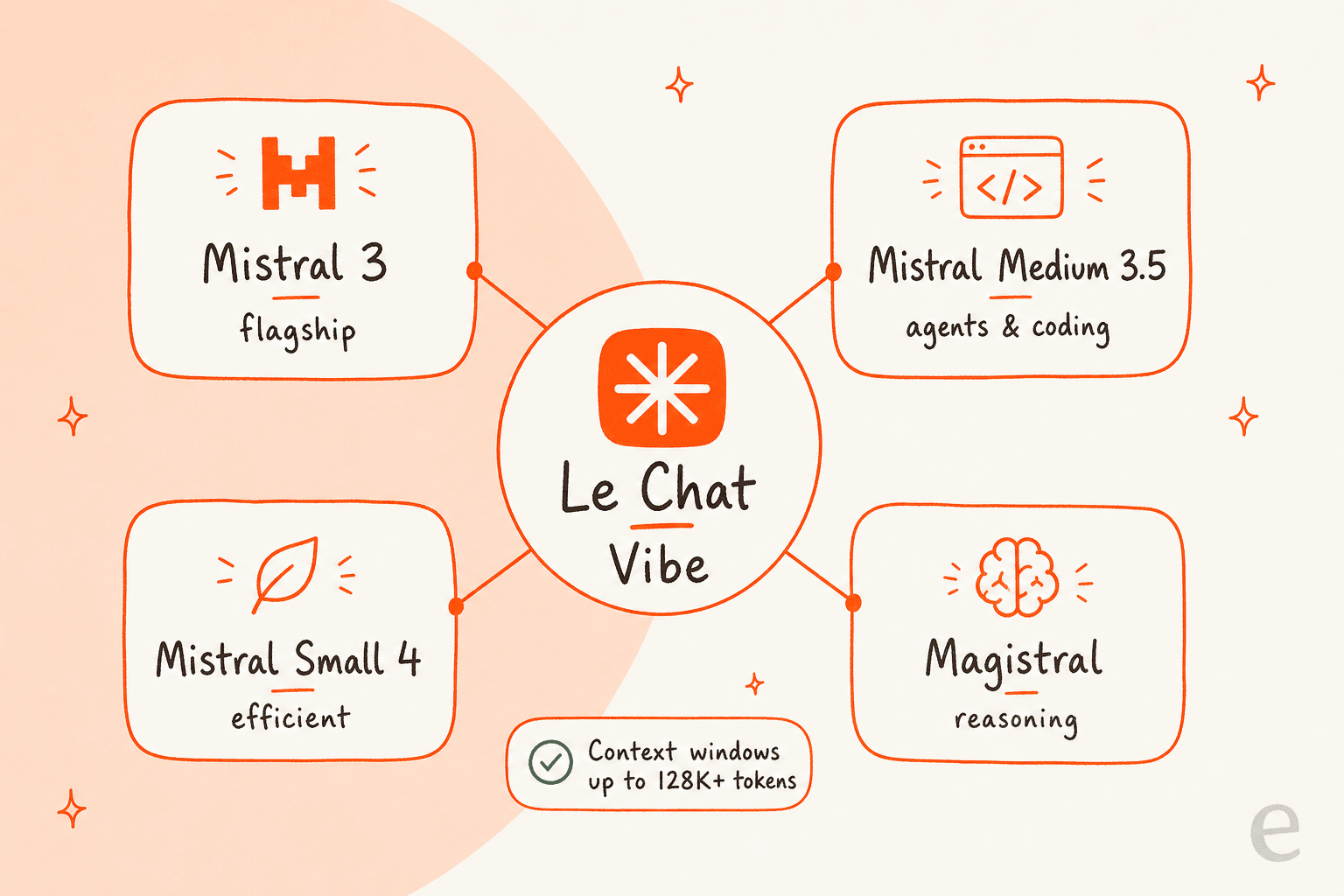
They offer a mix of open-source models that anyone can download and mess with, alongside more powerful commercial models you can access through an API. The early models that built the brand, Mistral 7B and Mixtral 8x7B, are still around, but the 2026 line-up has moved on a lot: the flagship Mistral 3, the agent-and-coding-focused Mistral Medium 3.5, the efficient Mistral Small 4, and the Magistral reasoning models. Most people meet them through Le Chat (Mistral's assistant) or Vibe (its coding agent). They're often seen as high-quality alternatives that don't need a supercomputer to run, and if you want the full cost picture, I broke that down separately in my Mistral AI pricing guide. With a boatload of funding and a smart team, Mistral AI has quickly become a big name, proving you don’t have to be in Silicon Valley to build top-tier AI.
Key features of Mistral AI models: Insights from reviews
To make sense of the Mistral AI reviews, you have to know what the tech actually does. It's not just another chatbot; its design has a few key features that users talk about a lot.
- Open-weight models: A huge part of Mistral's appeal is that many of its models are "open-weight." This just means developers can get under the hood and see the model's inner workings. This allows them to tweak and customize it for very specific tasks, a level of control you just don't get with the closed-off, "black box" models from other big names.
- Performance and efficiency: Mistral’s models are built to be lean but powerful. They’re designed to provide excellent reasoning and text generation without needing a massive amount of computing power. For a business, that means faster response times and lower server bills.
- Large context windows: The current models, like Mistral 3 and Mistral Medium 3.5, can handle context windows of up to 128,000 tokens and beyond. In plain English, that means they can read and "remember" incredibly long documents or complex conversations without losing track. This is a big deal for any task that needs a deep understanding of context.
- Multilingual capabilities: These models aren't just for English. They perform well across several languages, making them a solid choice for global companies building apps for an international audience.
The pros: What users like in Mistral AI reviews
Looking through technical blogs and community forums, you start to see a few positive themes mentioned over and over in Mistral AI reviews. These are the things that really get developers excited.
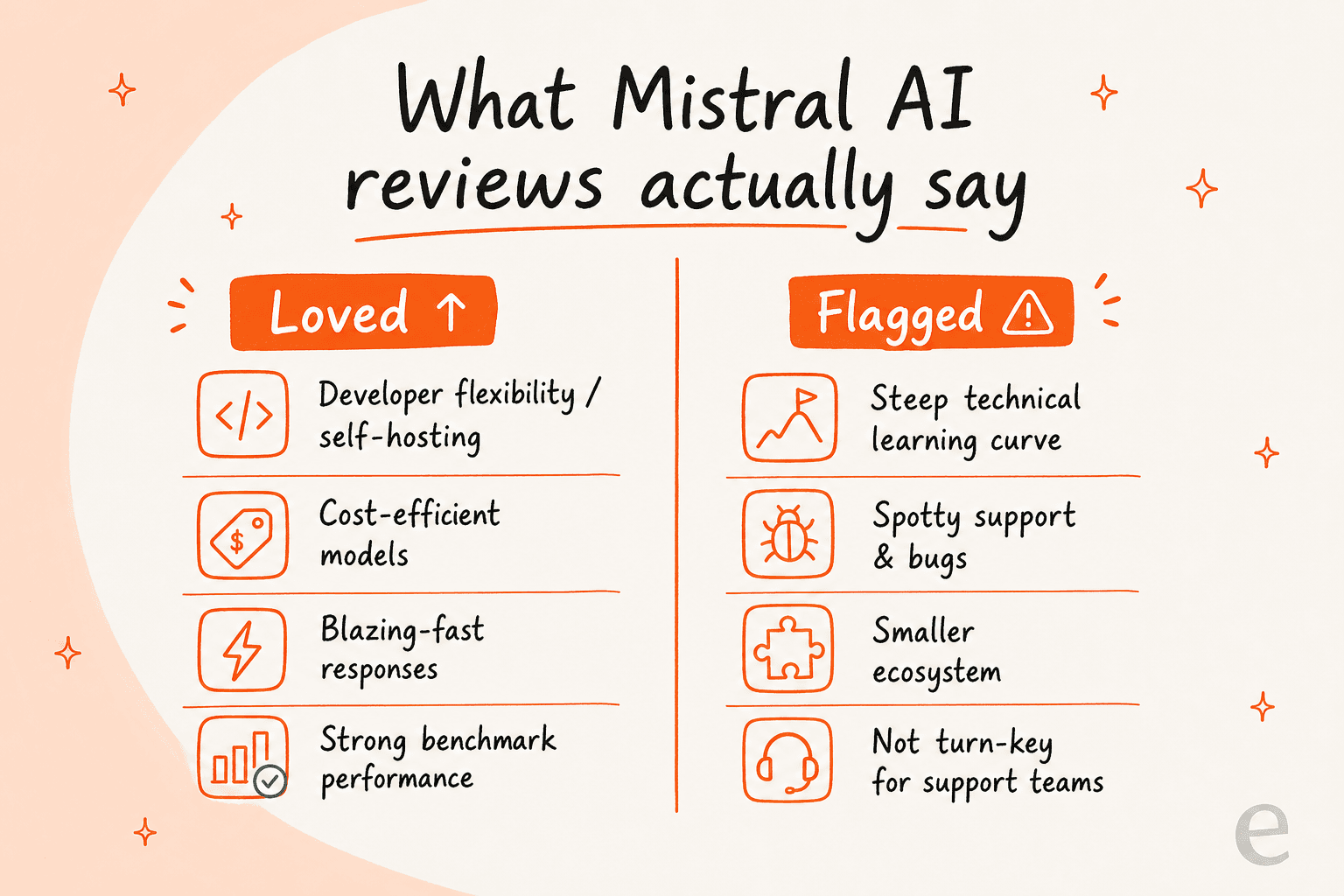
First up is the flexibility for developers. People constantly praise the freedom Mistral provides. You can run their models wherever you want, on your own servers, in a public cloud, anywhere. This helps companies avoid getting stuck with one vendor, giving them total control over their data and how they use the tech.
Then there's the cost. The efficiency of these models is a major plus. Since they don't demand as much computing power, businesses can get high-quality AI without the shocking price tag that usually comes with bigger, more demanding models.
Users also talk about the impressive speed. In one detailed review, a developer called one of their reasoning models "blazing fast." For real-time tools like an interactive support chatbot, this is huge. A few seconds of lag can completely ruin the experience for a customer.
Finally, the models deliver strong technical performance. When you look at standard industry tests for reasoning, coding, and language skills, Mistral’s models are right up there with their more established competitors, and sometimes they even come out ahead. If you want the head-to-heads, I've compared it directly in Mistral vs Claude and Mistral vs Perplexity.
When you stack up all the Mistral AI reviews, the same handful of themes show up on each side:
The cons: A closer look at Mistral AI reviews and limitations
Okay, but no tool is perfect. When you dig into user feedback, some real drawbacks start to appear. While developers might love the raw power, the story can be very different for business users.
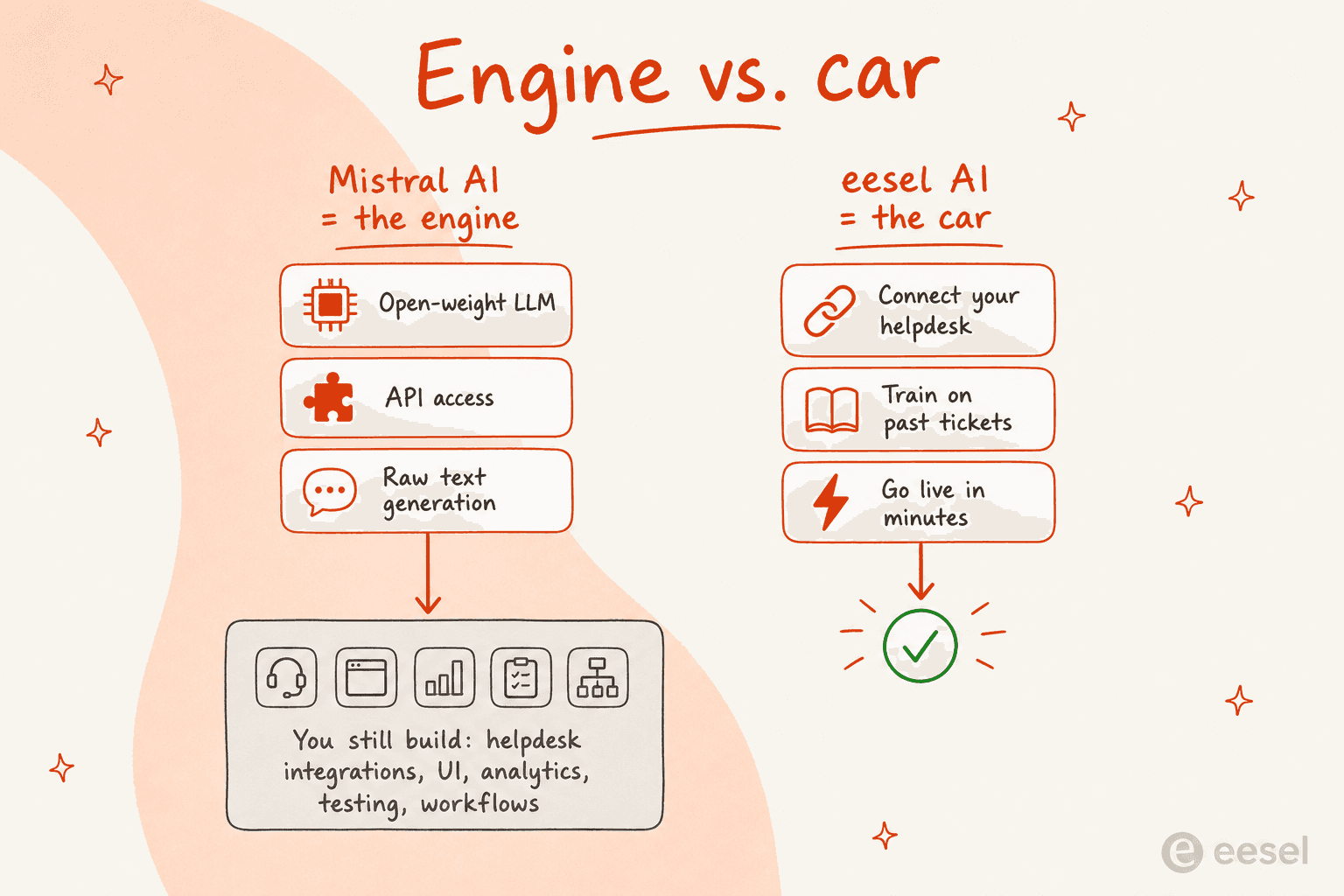
The biggest complaint is the steep technical learning curve. Mistral AI basically hands you a very powerful engine, but it’s on you to build the car around it. To use it well, you need a dedicated team that knows its way around AI, software development, and server management. You're responsible for all the integration, customization, and upkeep, which is a massive project.
This is made worse by what some users call spotty support and bugs. Some reviews on Trustpilot mention that sales and support teams can be slow to respond. Other developers have reported annoying issues where a model gets stuck in an "infinite thinking loop" and just times out, which can obviously bring any process to a screeching halt.
The ecosystem is also still growing. Compared to a behemoth like OpenAI, Mistral has fewer pre-built tools, third-party integrations, and community guides out there. So if you hit a snag, finding a quick fix or a ready-made connector is a lot tougher. If that trade-off worries you, it's worth weighing the best Mistral alternatives before you commit, or seeing how it stacks up in Mistral vs ChatGPT.
This developer-first focus is a major roadblock for business teams, like customer support departments, who just need a solution they can set up and run themselves. It's exactly this gap that platforms like eesel AI are built to fill. Instead of signing you up for a months-long development project, eesel AI gives you a tool that a support manager can connect to their help desk and have a working AI agent running in minutes, no coding needed.
Is Mistral AI the right choice for customer support automation?
This brings us to the big question: if your goal is to automate customer support, should you build your solution on top of Mistral AI? The answer really depends on if you're shopping for a raw ingredient or a finished meal.
Think of it this way:
- Mistral AI is the engine. It's incredibly powerful, efficient, and you can tweak it however you want. But to use it for customer support, you need a team of engineers to build the entire car around it. They'll have to build the frame (integrations with Zendesk or Freshdesk), the steering wheel (a way to build workflows), the dashboard (analytics), and all the safety features (testing and quality control). It's a huge, expensive, and long-term custom job.
- eesel AI is the car. It's a complete, ready-to-drive solution designed specifically for customer service teams. It has everything you need included from the start, and it’s built for the people who actually manage your support operations.
This is the exact moment I see teams stall. The "we'll just build it ourselves on a raw model" plan sounds cheap until the maintenance bill arrives, which is why one eesel customer, GENERAL BYTES, told us they chose a managed AI agent precisely because they "would not have to maintain" it. This table puts the differences side-by-side:
| Feature | Mistral AI | eesel AI |
|---|---|---|
| Setup Time | Weeks to months | Go live in minutes |
| Technical Skill | Requires dedicated AI/dev team | Fully self-serve, no code needed |
| Knowledge Sources | Manual integration required | 1-click connection to helpdesks, wikis, & past tickets |
| Core Function | General-purpose text generation | Pre-built for support: AI Agent, Copilot, Triage & more |
| Testing | Requires custom-built test harnesses | Built-in simulation on historical tickets before going live |
| Pricing Model | Usage-based (API calls) | Predictable, flat monthly/annual fee. No per-resolution costs. |
Here’s where a purpose-built platform like eesel AI really shines:
Unify your knowledge, instantly A raw model from Mistral starts as a blank slate. You have to feed it information piece by piece. eesel AI, on the other hand, automatically trains on your past tickets and connects to all your knowledge sources, like Confluence, Google Docs, and your help center, in a few clicks. It learns your brand's voice, common customer problems, and what solutions have worked before, right from day one.
Test with confidence Letting an untested AI loose on your customers is a scary thought. If you build a custom solution, you also have to build your own testing setup. eesel AI comes with a powerful simulation mode that shows you exactly how it would have handled thousands of your past tickets. You get a clear picture of its performance and potential resolution rate before it ever talks to a real customer.
Total control for support teams Building custom rules with a raw model means writing code. With eesel AI, support managers get a simple, visual workflow builder. You can decide exactly which tickets the AI should handle, when it needs to pass a conversation to a human, and what special actions it can take (like checking an order status in Shopify or adding a tag), all without touching a line of code.
Mistral AI reviews: Powerful tech, but not a one-size-fits-all solution
The general takeaway from Mistral AI reviews is pretty clear: Mistral AI is offering some incredible technology. It's powerful, efficient, and flexible. For companies that have a full technical team ready to build custom AI tools from scratch, it’s an amazing option.
But for business teams trying to solve a specific problem like customer support automation, it's just not practical. The complexity, cost, and lack of ready-made tools mean you’ll spend all your time building the tool instead of seeing results.
The future of AI in business isn't just about who has the most powerful engine; it's about having cars that are accessible, practical, and reliable. If you’re looking for a solution that can deliver value right away without the engineering headache, a purpose-built AI helpdesk is the clear winner.
Want Mistral-grade AI for your support queue without standing up an engineering team to babysit it? eesel connects to your helpdesk, trains on your past tickets, and simulates itself on real conversations before it ever replies to a customer, all in a few minutes. Try eesel free, or book a demo to see it on your own tickets.
Frequently asked questions
What's the general consensus I should take away from all the Mistral AI reviews?
The consensus is that Mistral AI offers incredibly powerful and efficient technology, especially praised by developers for its flexibility and open-source models. However, these same reviews often highlight that it's a raw tool, not a ready-made business solution.
Based on Mistral AI reviews, who is this really for, developers or regular business users?
The reviews make it clear that Mistral AI is primarily for technical teams with engineering resources. Business users, like support managers, will likely find it too complex as it requires significant custom development to be useful.
I've seen conflicting Mistral AI reviews on pricing; is it actually cheaper than competitors?
Yes, a common theme is that Mistral's models can be more cost-effective because they are efficient and require less computing power. However, you must factor in the high cost of the engineering team needed to build and maintain a solution with them.
Are there any common complaints that pop up a lot in Mistral AI reviews?
The most frequent complaints revolve around the steep technical learning curve, making it inaccessible for non-developers. Some users also report slow customer support and occasional bugs that can disrupt workflows.
How do the Mistral AI reviews compare it to something more established like OpenAI?
Mistral is often praised for its speed, open-source models, and efficiency, sometimes outperforming competitors on specific benchmarks. However, OpenAI has a much more mature ecosystem with more third-party tools, integrations, and community support.
If I'm just looking for customer support automation, what do the Mistral AI reviews suggest is the biggest roadblock?
The biggest roadblock mentioned is that Mistral is just an "engine," not a complete solution. Your team would have to build everything else from scratch: help desk integrations, a user interface, analytics, and testing frameworks.


Article by
Kira
Kira is a writer at eesel AI with a Computer Science background and over a year of hands-on experience evaluating AI-powered customer service tools. She focuses on breaking down how helpdesk platforms and AI agents actually work so that support teams can make better buying decisions.