

Separate the products and evidence
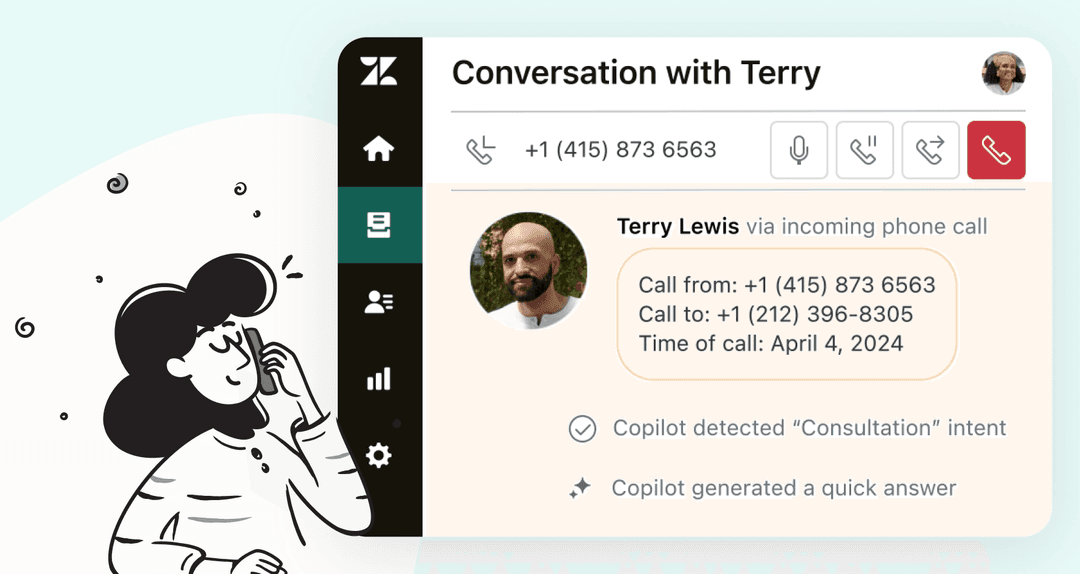
Zendesk AI agents work with customers. Copilot assists a human working a ticket. Review each against its own outcome: an AI agent needs accurate answers, safe actions, and a working escalation; Copilot needs appropriate sources, usable suggestions, and a human who remains accountable for the reply.
| Area | Evidence | Decision |
|---|---|---|
| Customer job | Request, approved source, allowed action | Whether automation fits |
| Channel | Messaging, email, or voice setup | Whether the right queue is covered |
| Handoff | Destination, availability, fallback copy | Whether a person can take over |
| Outcome | Ticket event, conversation, resolution tier | Whether it helped the customer |
| Cost | Plan, allowance, usage, overage terms | Whether the account owner accepts the basis |
New AI agents are single-channel. Zendesk’s creation guide documents separate messaging, email, and voice workflows. Do not infer email coverage from a messaging test.
Use a method that can be checked
This article reviews product documentation and offers an account-level evaluation method. It is not a survey of customer reviews or a report of hands-on testing. Record the plan, enabled channels, allowance model, connected knowledge, actions, and escalation destination. Then sample one job: a normal resolution, missing information, an escalation, and a failure or complaint. Compare the reply with the approved source and inspect the actual ticket event and handoff.
Zendesk’s 2026 reporting update defines AR% as (Contained + Verified) / (Unassisted + Assisted escalation + Contained + Verified). Zendesk's resolution-tier guide says only Verified resolutions consume the allowance. Use the mix to find conversations to review; do not treat containment or a high rate as proof of quality. Ask the account owner for its plan, allowance, and overage terms in writing; a public feature list is not a quote.
Ask a coding agent to prepare an eesel review
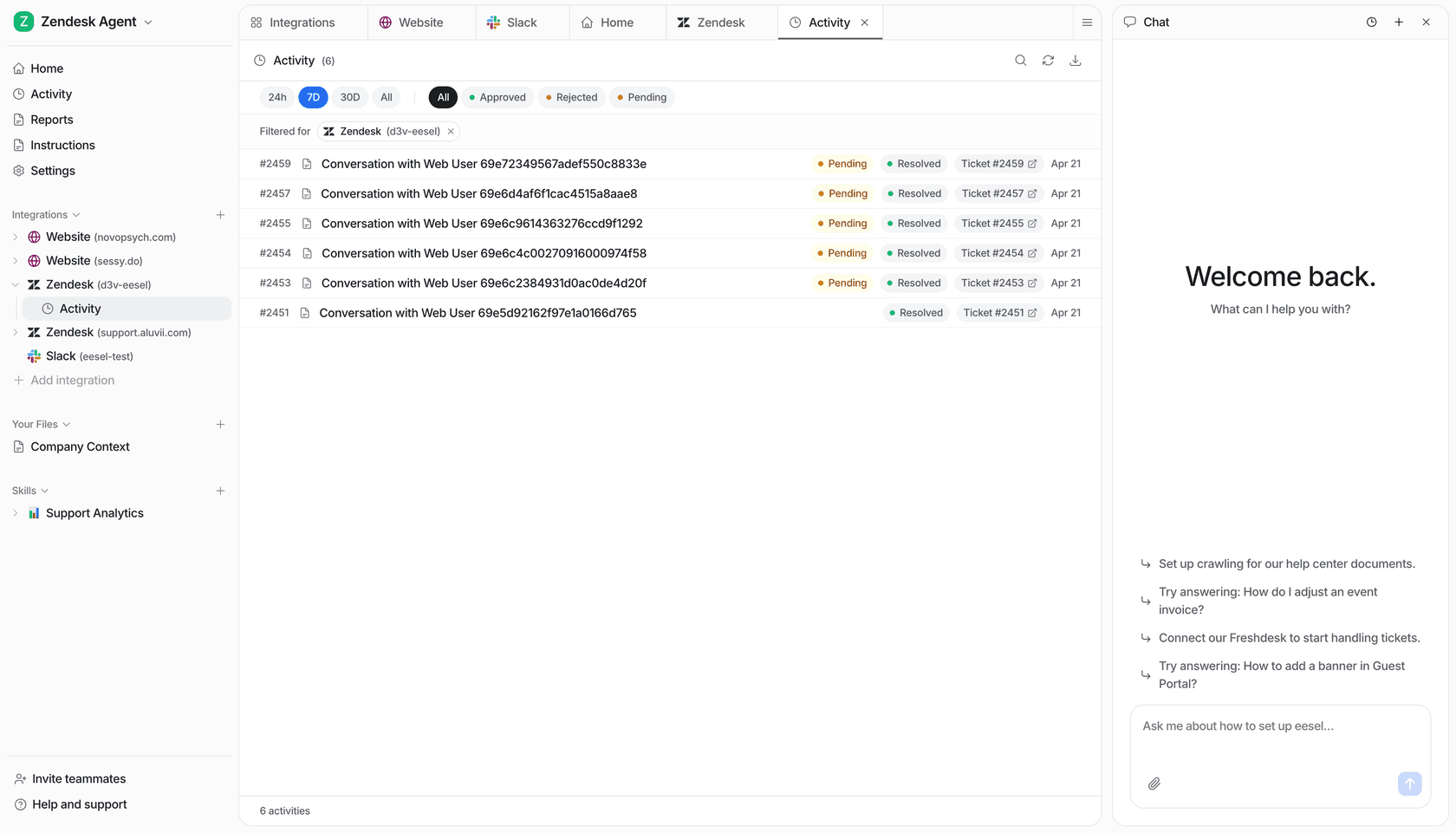
eesel’s CLI operates the same workspace teammate as the dashboard. Ask Claude Code to read the selected teammate's instructions and source status, then prepare a scorecard proposal. Before a real chat, get the workspace owner's approval for the fictional brief and review the teammate's action permissions; chat can perform real, billed work. Do not upload ticket exports or change Zendesk configuration in this review.
npx @eesel/cli whoami
npx @eesel/cli status --agent "Zendesk support"
npx @eesel/cli integrations --agent "Zendesk support"
npx @eesel/cli instructions --agent "Zendesk support"
npx @eesel/cli new --name "review-scorecard-proposal" --agent "Zendesk support"
npx @eesel/cli chat "Fictional review brief: the job is answering delivery-status questions after an approved identity check; missing order references and failed lookups go to Support Operations. Propose a scorecard covering identity, source accuracy, missing information, and handoff. Flag facts the brief does not establish. Do not change configuration, send a message, or act on a ticket." --agent "Zendesk support"
Node.js 18.17+ is required and commands return JSON. A support lead can run this from a terminal; scripts and coding agents such as Claude Code, Codex, and Cursor can run the same workspace teammate with its existing permissions. Keep the proposal with the brief. The owner should check that it names the correct policy, missing facts, escalation destination, and human verdict. It is a plan, not a Zendesk result, price estimate, or permission to change anything. If the review finds an instruction gap, have the coding agent propose the exact edit and the case it should fix. Inspect help and use --dry-run where supported before an owner-approved write, confirm the saved instructions, then rerun the normal and exception cases.
Verdict
Use eesel CLI to inspect and improve an existing support teammate while keeping the review decisions with its owner. Zendesk is a good fit only when the native queue, sources, actions, and handoff match a defined job. The useful review question is whether that job is accurate, safe, inspectable, and worth expanding.
Frequently asked questions
What should a Zendesk AI agents review cover?
Review one customer job at a time: its channel, approved knowledge, allowed action, customer wording, escalation destination, outcome, and account cost model.
Are Zendesk AI agents the same as Zendesk Copilot?
No. AI agents interact with customers. Copilot helps a human agent research, summarize, and draft while that person remains responsible for the reply.
How is Zendesk AI-agent resolution rate calculated?
AR% is (Contained + Verified) divided by (Unassisted + Assisted escalation + Contained + Verified).
Which Zendesk AI-agent resolutions use the allowance?
Only Verified resolutions consume the allowance. Contained resolutions count in AR% but are not billable under that definition.
Can the contributing-resolutions CSV calculate Zendesk AR%?
No. The CSV excludes Unassisted conversations, which are part of the AR% denominator.
How should a team test a Zendesk AI agent?
Test a normal case, missing information, a failed action, a request for a person, and a repeat contact. Check replies, ticket state, handoff, and source.
How can eesel CLI help with this evaluation?
A person, script, or coding agent such as Claude Code can inspect the same eesel teammate and workspace as the dashboard, prepare a topic-specific review, and propose configuration changes. Owners approve writes and test outcomes; a CLI proposal does not prove Zendesk-native routing or resolution rates.