


What "ChatGPT for financial services" means now
Until this month, the phrase mostly meant "using regular ChatGPT for finance work." Now it means two overlapping things, and it helps to keep them straight.

The first is the new vertical product. OpenAI describes it as "a tailored ChatGPT Work experience that combines built-in financial data with GPT-6 Astra's reasoning," shaped with Morgan Stanley and Evercore. Its early focus is deliberately narrow: investment banking and equity research, because "reliable access to data and high quality artifact creation proved to be the biggest pain points for their teams." It ships with built-in datasets from Daloopa, PitchBook, LSEG News and Crunchbase, indexed and hosted by OpenAI, plus shared sign-in with entitlements you already hold from S&P Capital IQ, LSEG, MSCI, Dow Jones Factiva and Moody's.
The second is the broader reality: ChatGPT Enterprise deployed across a finance function, from FP&A and monthly close to buy-side research to customer support. OpenAI runs a separate finance-team solutions page for the corporate CFO side, and fintechs like Klarna have gone org-wide. Both run on the same model family, so the security and pricing below apply to either path.
One more bit of naming to file away: OpenAI's tiers shifted. The individual ladder is now Free, Go, Plus and Pro, and the old "Team" plan is now "ChatGPT Business," with ChatGPT Enterprise sitting on top and citing over 5 million business users.
What it can actually do across a finance team
This is where the vertical product earns its keep. The single most important feature for a regulated firm is not the reasoning, it is traceability: every figure the model produces can be traced back to its source.

In OpenAI's own example, an analyst reconciling a company's adjusted EBITDA gets the answer with each claim linked straight to the line in the earnings-call transcript it came from. That "show your working" behaviour is the difference between a tool a banker can defend to a committee and a tool they cannot use at all.
On the corporate-finance side, the workflows look more like operations. ChatGPT Work can connect to Excel, Snowflake, Salesforce, Stripe and Ramp and run a monthly close, reconcile budget-versus-actual, or build a live dashboard from the numbers.

The proof points behind all this are unusually concrete for enterprise AI. Morgan Stanley reports over 98% adoption of its internal "AI @ Morgan Stanley Assistant" among advisor teams, with document access jumping "from 20% to 80%" and advisors going from answering 7,000 questions to effectively any question across a corpus of 100,000 documents.

On the fintech side, Klarna's OpenAI-powered assistant handled 2.3 million conversations in its first month, roughly two-thirds of the company's customer-service chats, doing the equivalent work of 700 full-time agents and driving an estimated $40M profit improvement in 2024. That last number is the one every support leader remembers, and it is worth being precise about how Klarna got there, because it is not "we turned on ChatGPT." It was a governed deployment with guardrails, not a raw chatbot pointed at customers.
The part finance leaders actually care about: security and compliance
Here is the good news, and it is real. On the business tiers, OpenAI's data posture is built for regulated buyers.

The load-bearing facts, all from OpenAI's business-data page and enterprise-privacy commitments:
- No training on your data by default. Inputs and outputs from ChatGPT Enterprise, Business and the API are not used to train models unless you explicitly opt in. This was the deciding factor here: "The OpenAI team's willingness to ensure zero data retention has been really impactful," per Morgan Stanley's David Wu, its Head of Firmwide AI Product & Architecture Strategy.
- Certifications. SOC 2 Type 2, ISO/IEC 27001, 27017, 27018 and 27701, and a CSA STAR listing, with a signable DPA for GDPR and CCPA.
- Encryption and key control. AES-256 at rest, TLS 1.2+ in transit, and Enterprise Key Management so you can hold your own keys.
- Data residency. Content at rest in the US, Europe, UK, Japan, Canada, South Korea, Singapore, Australia, India and the UAE, with in-region inference options in the US and Europe.
- Auditability. Deleted conversations are removed within 30 days, and admins get an audit log of conversations and agent activity through the Enterprise Compliance API.
The one caveat worth naming plainly: HIPAA-style handling via a BAA is scoped to ChatGPT for Healthcare and the API, not the general Business or Enterprise tiers. For most banks and insurers that is not the binding constraint, but if your use case touches protected health information, check it before you assume.
All of this only holds on the governed tiers, and that distinction is the one practitioners actually lose sleep over. The nightmare is not Enterprise, it is an analyst pasting a client statement into the free consumer app from a personal account. Security operators are blunt about the risk:
"Just worked w/ @CNN on a piece about why I wouldn't upload full financial docs (tax docs, statements, etc) to AI tools due to leakage & hacking risk. I don't recommend connecting bank accounts to AI tools. It becomes a 1 stop shop for attackers looking to drain your accounts."
That is a caution about consumer tools, not the enterprise product, and it is exactly why the governed tier exists. So if the question is "will the security team sign off on the model," the answer for Enterprise is usually yes. The harder question comes next.
Pricing: what a finance team actually pays
OpenAI does not publish a single price for "ChatGPT for financial services," because it is a configuration layered on Enterprise, sold through financial services sales. Here is the full ladder a finance buyer chooses between.
| Plan | Price | Best for in finance | What you get |
|---|---|---|---|
| Free | $0 | Casual individual use | GPT-5.6 Luna text chats, limited uploads and tools |
| Go | Below Plus | Light individual use | More messages, uploads and memory than Free; may include ads |
| Plus | $20/month | An individual analyst | GPT-6 Astra reasoning, Projects, custom GPTs, ChatGPT Work |
| Pro | From $200/month (confirmed) | A power user | 5x usage, Pro reasoning, maximum deep research and Codex |
| ChatGPT Business | Per seat (self-serve) | A small finance team | Dedicated workspace, SAML SSO, MFA, GPT controls, analytics |
| ChatGPT Enterprise | Custom / contact sales | A regulated firm, org-wide | Everything in Business plus SCIM, RBAC, spend controls, Compliance API, SLAs |
| ChatGPT for Financial Services | Custom quote | Investment banking, equity research | Enterprise controls plus built-in market data and native GPT-6 Astra |
Two things are easy to miss. First, Enterprise billing is not seat-only: OpenAI documents centralized spend controls with "workspace defaults, group limits, individual overrides" for ChatGPT Work and Codex usage, which means the agent products carry governed, variable usage on top of seats. Second, if your engineering team would rather build than buy, the API platform is billed per token and priced separately. The startup Endex built an autonomous financial analyst on the API rather than buying seats, which is the right call for some teams and overkill for most. My full ChatGPT pricing breakdown has the live per-plan numbers, since OpenAI renders them client-side and they move.
The catch: a chatbot is not a compliant worker
Everything above is about research, analysis and internal productivity, and for those jobs ChatGPT for financial services is a strong buy. But the phrase "ChatGPT for financial services" also gets typed by support leaders at banks, fintechs and insurers who want AI answering customer questions. For that job, the shape of the tool matters more than the model behind it.

ChatGPT, even the finance vertical, is fundamentally an assistant a person drives. It waits for a prompt, serves one user at a time, and does not sit inside your helpdesk watching tickets arrive. A human is still the one deciding when to ask and whether to send. That is the correct design for an analyst building a model. It is the wrong design for a support queue, where the point is to handle volume without a person in the loop for every message.
There is a deeper issue too, and it is the one I have watched bite hardest. A large language model will, now and then, produce a confident, well-written, completely wrong answer. In a research draft, a person catches it. Pointed straight at a customer of a regulated firm, that same behaviour is a mis-statement about fees, eligibility or a payment, exactly the class of error a compliance team exists to prevent. This is not a knock on OpenAI's model; it is true of every raw LLM. It is why, across years of putting AI on live support queues, I learned to never let a model answer a real customer until it has been tested on your own tickets first and scored on how it would have replied.
Practitioners who have tried it feel this directly. One engineer's write-up of wiring ChatGPT into a finance job is worth reading before you scale it anywhere near customers:
"Tried integrating chatgpt into my finance job to see how far I can get. Mega jikes... millions of dollars of hallucinated mistakes... You basically need to walk through everything it did to figure out what's real and what's hallucinations. Basically fails silently."

"Fails silently" is the whole problem in three words. Code gives you a compile error; a wrong support answer gives you a satisfied-looking customer and a complaint two weeks later.
Where this leaves customer-facing support in finance
So which surface do you actually reach for? It depends entirely on the job, and mixing them up is the common mistake.

For drafting a pitch or a model, the new financial services product is the sharp tool. For closing the books and FP&A, ChatGPT Enterprise with Work connectors does the operational lifting. For everyday analyst questions, Business or Plus is plenty. But for answering customer tickets inside your helpdesk, you want a teammate built for that queue, one that connects to the tools your agents already live in.

The good news is you do not have to choose the model to get the governance. A support teammate can run on GPT, Claude or Gemini underneath and add the parts a regulated support desk needs on top: sensitive data redacted on the way in, a dry run over your real ticket history before go-live, and a human approval step on anything risky. That is the layer between "a powerful model exists" and "I can safely put it in front of my customers," and it is where a purpose-built AI helpdesk does the work ChatGPT was never meant to.
Try eesel for financial services support
If you got here because you run support at a bank, a fintech or an insurer, here is the honest positioning. Use ChatGPT for the research and modelling it was built for. For the support queue, eesel is the AI teammate that plugs into your existing helpdesk, Zendesk, Freshdesk, Salesforce or Front, and starts working the tickets itself.
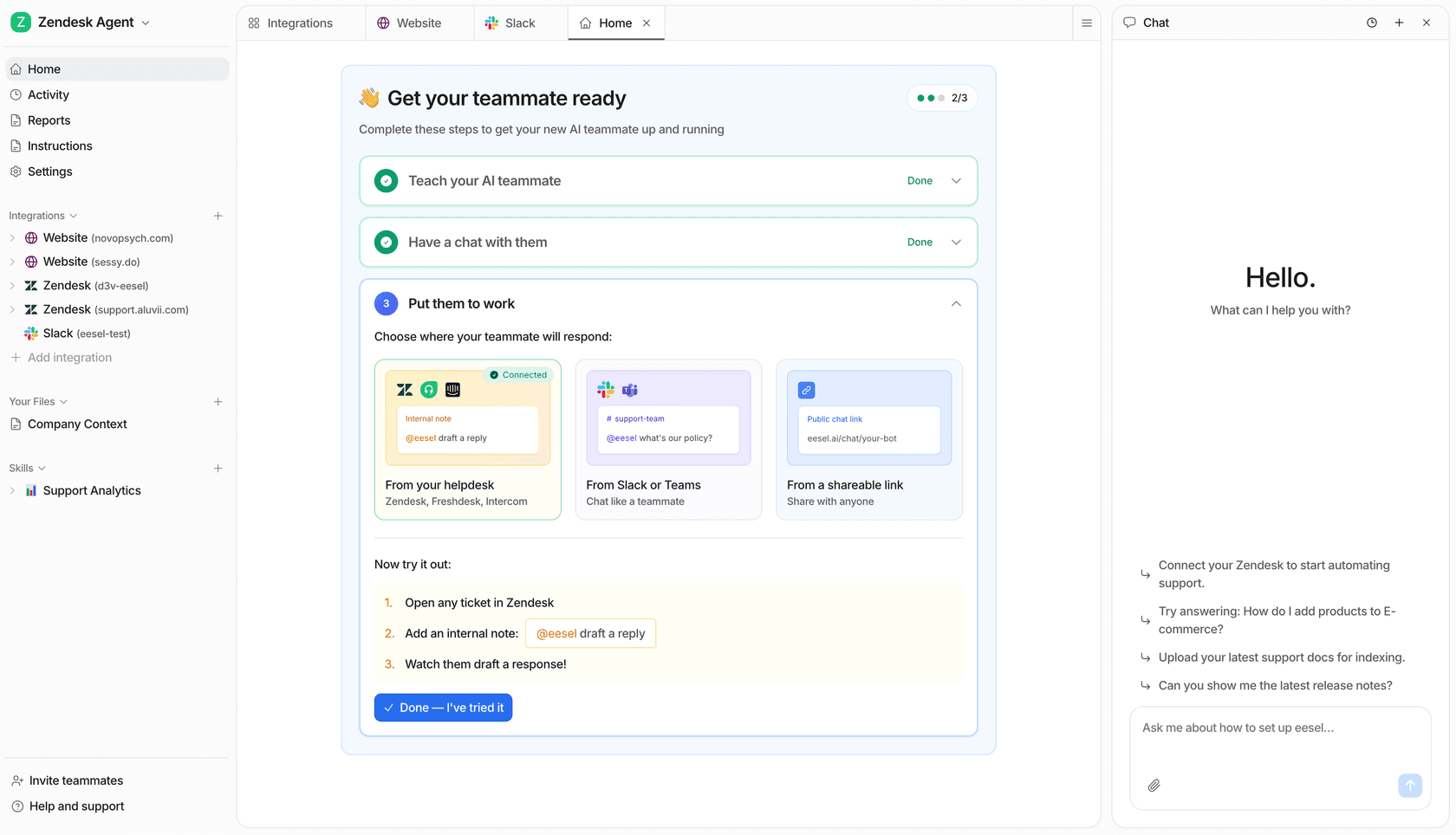
The part that matters for a regulated firm is what happens before it goes live. eesel simulates the agent on hundreds of your past tickets and scores its answers against what your team actually sent, so you see how it will behave before a single customer is affected. PII is redacted at ingestion, models never train on your data, and you can hold a human approval step on sensitive actions. Pricing is one fixed monthly price from $299 a month for 500 credits (1 credit per ticket or chat), with a free plan of 100 credits and no per-seat fees, so the cost is predictable whatever your headcount. It is free to try, and you can point it at your own tickets in an afternoon.