


Why most customer service goals are measuring the wrong thing
Here's the uncomfortable part. Walk into most performance reviews and the goals read like a stopwatch: handle more tickets, cut handle time, keep occupancy high. Those made sense when a human touched every single ticket. They make much less sense now.
At Gridwise, a gig-economy driver analytics company, an AI agent resolved 73% of their tier-1 requests in the first month. Think about what that does to a volume goal. If most of the "how do I reset my password" and "where's my order" tickets never reach a human, then a goal that rewards raw ticket throughput is rewarding an agent for competing with automation, and losing, on the tickets they shouldn't be spending time on in the first place.
"In the first month, eesel is resolving 73% of our tier 1 requests. The platform even includes automations for ticket tagging, assignment, and status updates."
Kim Simpson, Gridwise (eesel case study)
The tickets left for humans are the hard ones: the angry customer, the edge case, the refund that doesn't fit policy, the bug nobody's seen. Those need judgment, empathy, and problem-solving, and none of them show up cleanly in a tickets-per-hour number. So the first move in modernizing your review goals is to retire the metrics that only measured volume.
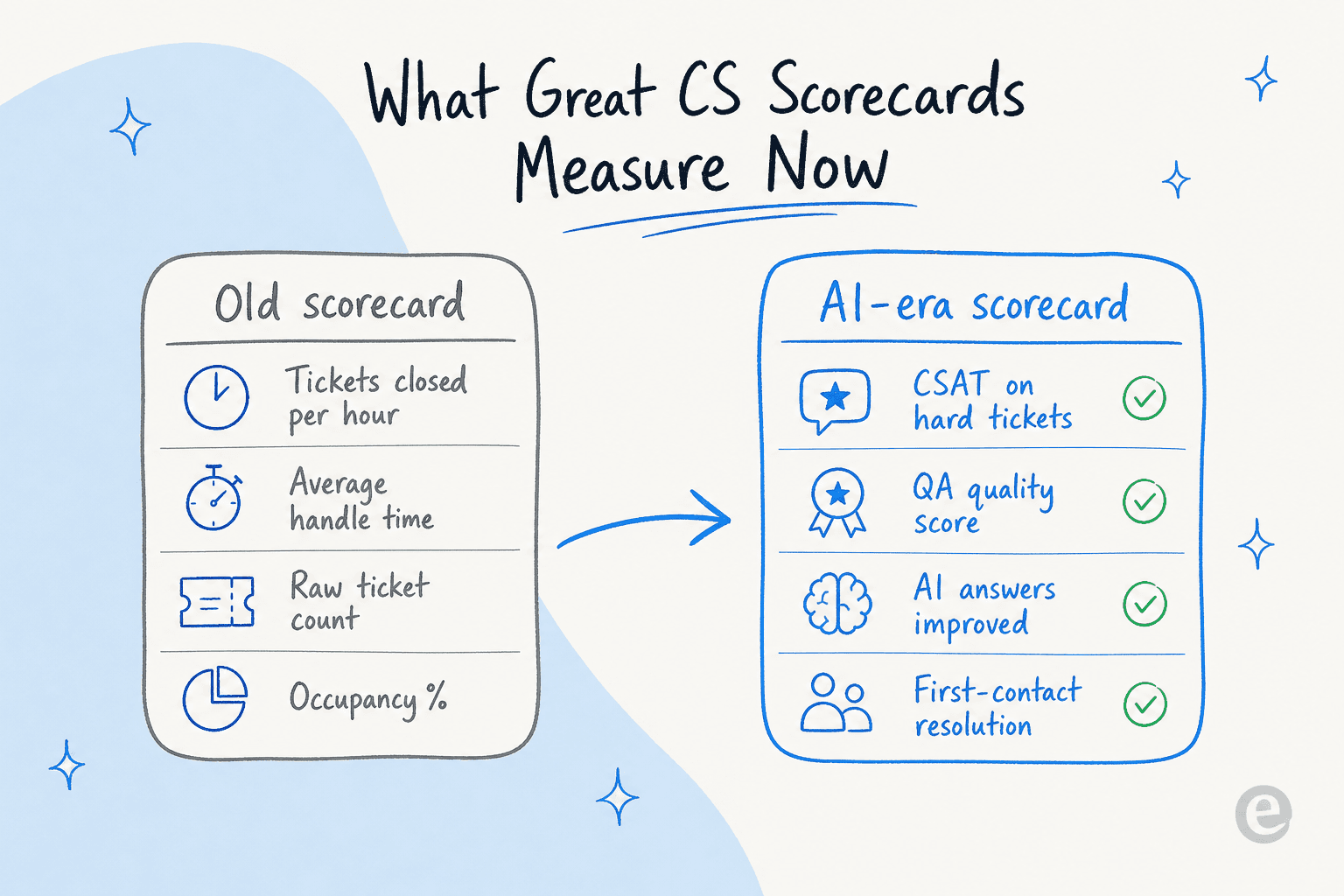
This isn't a case against efficiency. Speed still matters to customers. It's a case against making speed the whole scorecard, when the human's real value is now concentrated in the tickets that are hard to measure and easy to get wrong.
What makes a customer service goal actually good
Before the examples, the shape. A goal that survives a performance review has four things going for it.
It's tied to a number you already track. If the goal references a metric that isn't in your reporting, you won't be able to score it in six months, and it quietly dies. Anchor every goal to a live figure from your customer service KPIs.
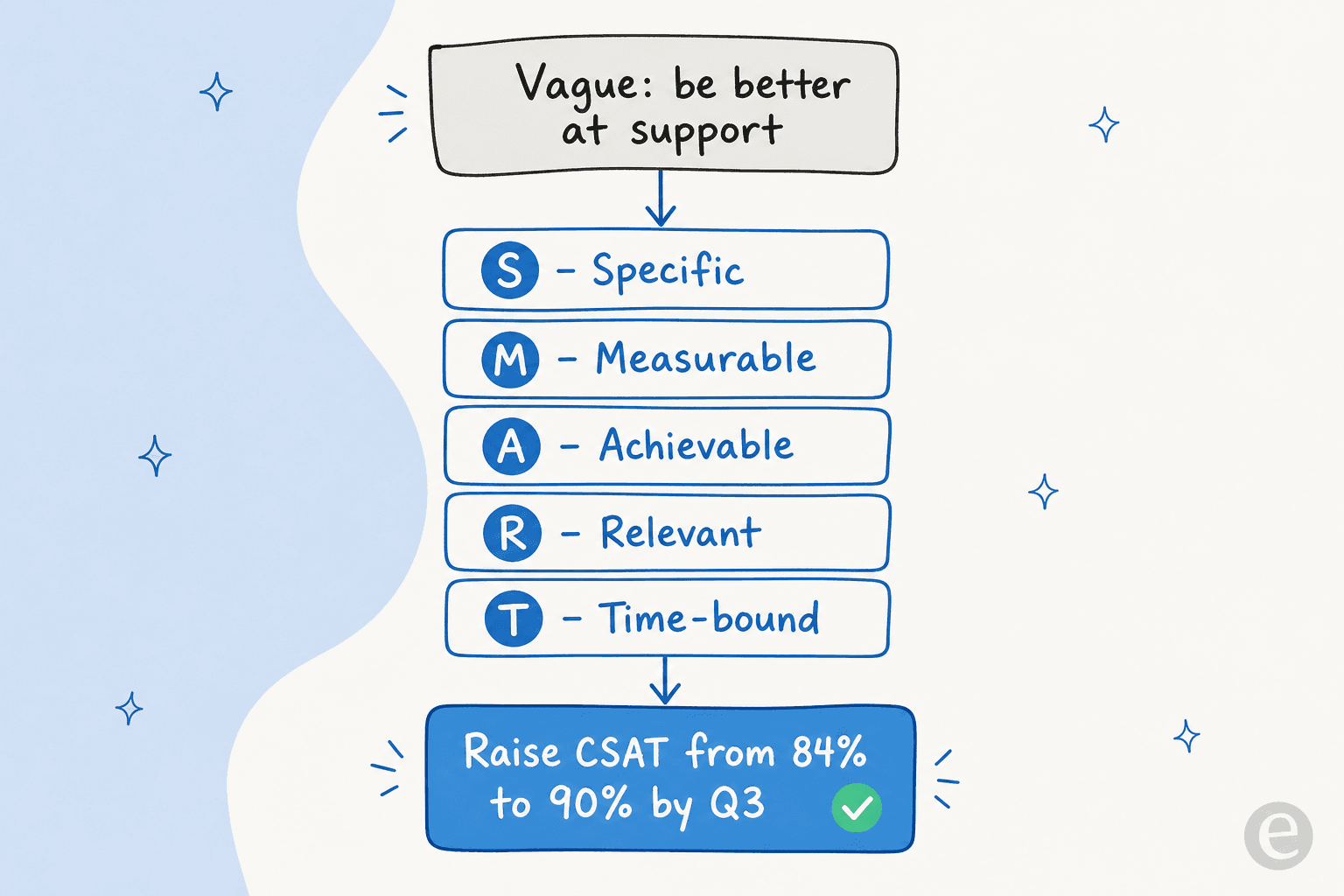
It's SMART, which is the least exciting acronym in management and also the one that keeps goals honest. Specific, Measurable, Achievable, Relevant, Time-bound. "Be more helpful" fails every letter. "Raise my CSAT from 84% to 90% by the end of Q3" passes all five.
It's within the agent's control. CSAT is fair game because an agent's replies drive it. "Reduce company-wide churn" isn't, because a dozen things the agent can't touch feed into it. Tie goals to the part of the outcome the person actually owns.
And there should be three to five of them, balanced across categories. Stack three speed targets and you've built a stopwatch again. A good set spreads across efficiency, quality, satisfaction, growth, and AI collaboration, which are the five buckets below.
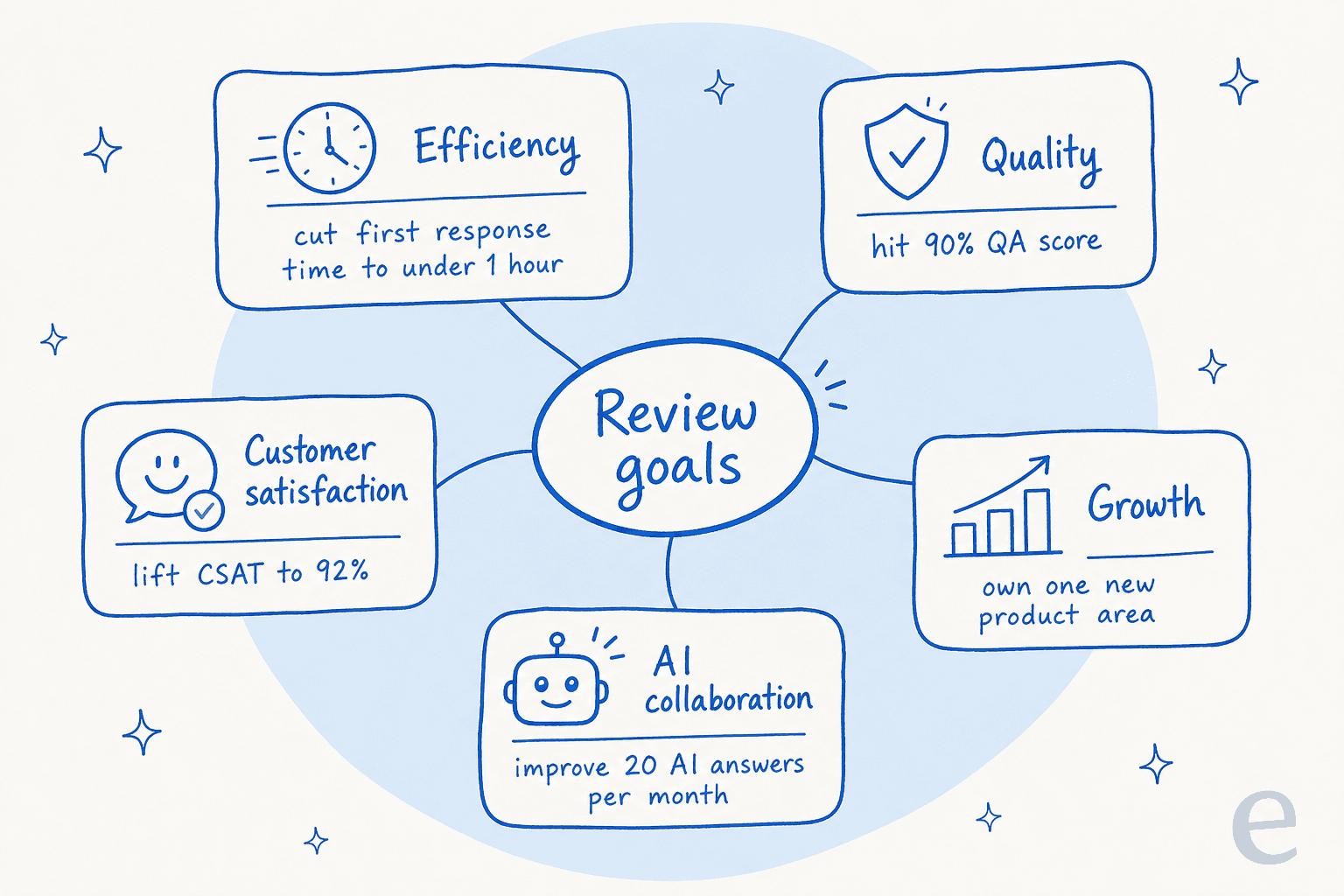
Customer service goals by category (with examples)
Here are the five categories, each with real, copy-ready goals and the metric you'd score them against. Mix and match to build a set of three to five per agent.
1. Efficiency and productivity goals
These are about doing the work faster without cutting corners. Keep one, maybe two, not the whole review.
- Cut personal first response time from 4 hours to under 1 hour on email tickets by Q3. Measured against first response time.
- Handle 15% more chat conversations per shift while keeping QA score above 90%. The QA guardrail is what stops this from becoming a pure speed goal.
- Reduce reopened tickets by 20% this quarter by resolving issues fully on the first pass, measured through first-contact resolution.
The trick with efficiency goals is to always pair them with a quality metric. A speed goal on its own tells an agent to rush; a speed goal fenced by a QA floor tells them to get faster at good work. That distinction is the whole game, and it's why agent productivity goals should never live alone on a review.
2. Quality goals
Quality is what efficiency goals are supposed to protect. This is where a proper QA program earns its keep.
- Reach a 90% average QA score across reviewed tickets by year-end. Scored from your internal customer service evaluation rubric.
- Score 100% on tone and empathy checks on escalated tickets. The hard tickets are exactly where tone slips, so this targets the highest-risk conversations.
- Reduce factual errors flagged in QA to under 3% of sampled replies. Accuracy is the quiet killer; a confident wrong answer does more damage than a slow right one.
If you don't have a QA rubric yet, that's the prerequisite. Our roundup of customer service standards examples is a decent starting point for what "good" looks like before you turn it into a scored goal.
3. Customer satisfaction goals
This is the category customers actually feel. It's also the fairest to score, because it's a direct read on the agent's output.
- Raise personal CSAT from 84% to 90% by Q3, tracked through CSAT surveys sent after resolution.
- Keep CES (customer effort score) responses in the "easy" band on 85% of surveys. Effort predicts loyalty better than raw satisfaction on transactional support.
- Turn 10 pieces of negative survey feedback into documented fixes this quarter, using your customer feedback tools to close the loop instead of just logging the complaint.
One caution: don't set a CSAT number without also looking at survey response rate. If only 5% of customers respond, the score is noise. Our guide to measuring customer satisfaction covers how to get a read you can actually trust before you attach a review goal to it.
Goal builder
Pick a focus area, get a ready-to-paste goal
Cut my email first response time from 4 hours to under 1 hour by the end of Q3, while keeping QA score above 90%.
Reach a 90% average QA score across reviewed tickets by year-end, with factual errors under 3% of sampled replies.
Raise my personal CSAT from 84% to 90% by Q3, on a survey response rate of at least 25%.
Become the team's subject-matter expert for billing tickets and write two knowledge base articles that cut billing escalations by 15%.
Improve 20 AI answers per month by correcting drafts and flagging knowledge gaps, lifting the AI's resolution rate on my ticket types.
4. Growth and development goals
These keep the job from feeling like a treadmill, and they're where you retain your best people. They're less about this quarter's number and more about the agent's trajectory.
- Become the team's subject-matter expert for billing tickets and write two knowledge base articles that cut billing escalations by 15%.
- Shadow a senior agent on 10 escalated tickets and lead the next 5 solo by end of quarter.
- Complete a de-escalation training track and apply it, measured by improved CSAT on tickets that started with a negative sentiment flag.
Development goals are also the natural home for the softer skills that don't fit a KPI: judgment, ownership, the customer service mindset that separates a good agent from a great one. You can't put a number on all of it, and that's fine, some of the best review goals are qualitative with a clear "done" line.
5. AI collaboration goals (the new category)
This is the one most review templates are missing, and it's the one that will matter most over the next few years. As AI absorbs more tier-1 work, an agent's job increasingly includes making the AI better. That's a real skill, and it deserves a real goal.
- Improve 20 AI answers per month by correcting drafts and flagging knowledge gaps, so the AI's resolution rate on your ticket types goes up.
- Reduce incorrect AI escalations by tightening handover rules, tracked through containment and escalation quality.
- Own the knowledge base for your product area so the AI has accurate source material, because an AI is only as good as the docs it reads.
If that sounds unfamiliar, it's worth reading how AI vs human support splits the work in a modern team. The agents who thrive aren't the ones who out-type the bot; they're the ones who make the bot trustworthy on the easy stuff so they can own the hard stuff. That mental shift belongs on the review.
How to actually track these goals
The reason review goals rot is measurement friction. If scoring a goal means exporting three CSVs and reconciling them by hand, it won't happen, and the goal becomes a vibe.
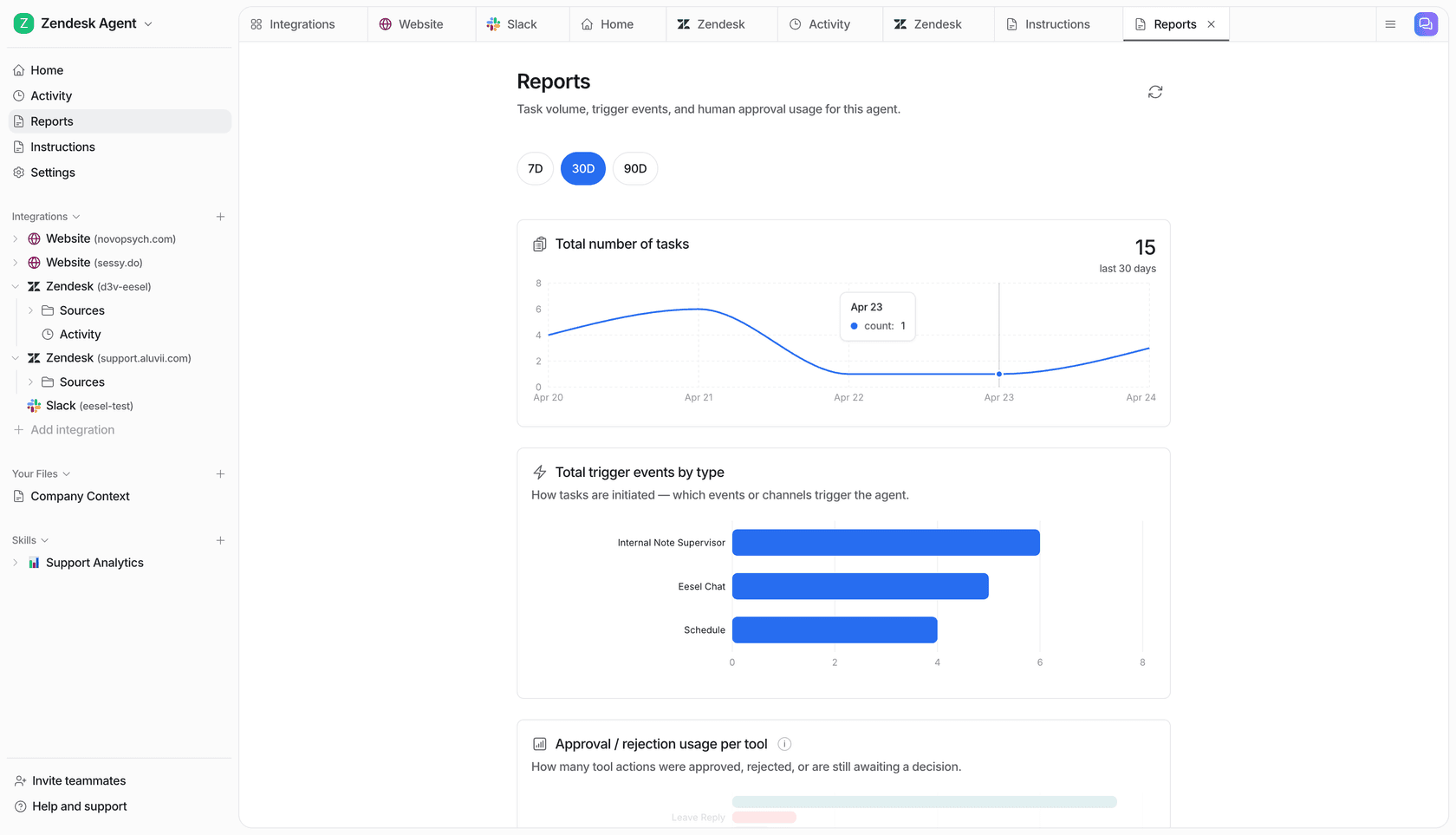
This is where your reporting has to do the work for you. Whatever helpdesk or AI customer service tool you run, the goal-relevant numbers, CSAT, resolution rate, QA outcomes, response times, per agent, should be one dashboard away, not a quarterly reconstruction project.
One more thing I've learned the hard way: goals need a review cadence, not just a review date. A colleague at eesel, Amogh, put it bluntly when we dug into why customers churn, that the common thread was "zero proactive outreach for 6+ months. No 30/60/90 day check-ins." The same is true of agent goals. A goal set in January and looked at in December is a goal you failed to coach. Check in monthly, adjust when the ground shifts, and the review becomes a summary of conversations you already had, not an ambush.
Common mistakes to avoid
A few patterns I see over and over, worth naming so you can skip them:
- All-efficiency scorecards. Three speed goals and nothing on quality. This trains agents to close fast and reopen often. Always fence speed with a quality floor.
- Goals with no owned metric. "Improve customer loyalty" isn't scorable by one agent. Tie every goal to a number the person controls.
- Copy-pasting the same goals for everyone. A new hire and a five-year veteran need different targets. Personalize at least the growth and AI goals.
- Setting and forgetting. No mid-cycle check-ins means no coaching, which means the review is a verdict instead of a summary.
- Ignoring the AI entirely. If your review form doesn't mention how the agent works with automation, it's describing a job that's already changing under your feet.
Bring your goals and your metrics into one place with eesel
Writing good customer service goals is half the battle; the other half is being able to see whether they're being hit without a spreadsheet marathon. That's where eesel fits. eesel is an AI agent for customer support that plugs into your existing helpdesk, resolves the repetitive tier-1 tickets on its own, and gives you a reporting view of resolution rate, CSAT, and QA outcomes per agent, the exact numbers your review goals are built on.
Because eesel handles the volume tickets, your team's goals can focus on the hard tickets and on coaching the AI, which is where human value now lives. You can run it against your historical tickets first to see how it'd perform before it touches a live customer, and it's free to try. It's the difference between review season being a data-archaeology project and being a five-minute pull from a dashboard you already trust.
Frequently Asked Questions
What are good customer service goals for a performance review?
How do you write SMART goals for customer service agents?
What customer service KPIs should a performance review measure?
How many goals should a customer service agent have per review?
How does AI change customer service performance review goals?


Article by
Riellvriany Indriawan
Riell is a designer and writer at eesel AI with about two years of experience researching CX platforms, AI chatbots, and helpdesk software. She combines her design background with a sharp eye for how these tools actually look and feel in practice — making her comparisons unusually visual and user-focused.