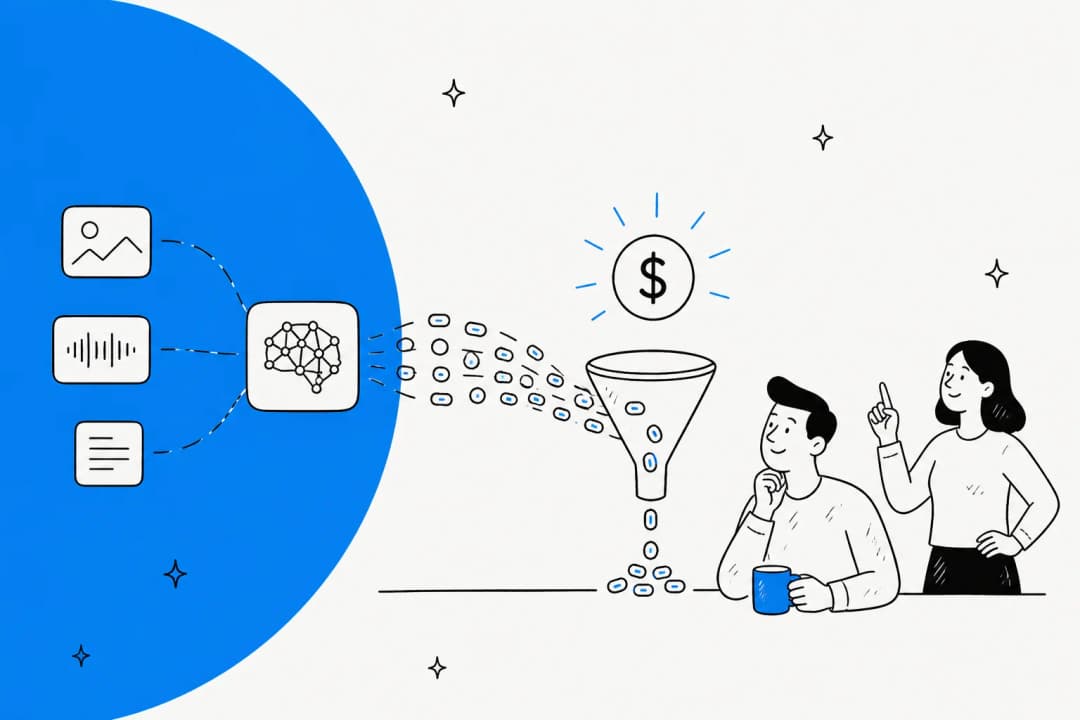


Gemini 3.8 Flash pricing at a glance
Here is every published rate for gemini-3.8-flash on the Gemini API, standard paid tier, per 1M tokens. I have put the 2027 column right next to today's so the promo is impossible to miss.
| Meter | Through 31 Dec 2026 | From 1 Jan 2027 |
|---|---|---|
| Input | $0.75 | $1.50 |
| Output (includes thinking) | $3.75 | $7.50 |
| Context cache, read | $0.075 | $0.15 |
| Context cache, storage (per 1M/hr) | $0.50 | $1.00 |
| Batch and Flex, input | $0.375 | $0.75 |
| Batch and Flex, output | $1.875 | $3.75 |
| Priority, input | $1.35 | $2.70 |
| Priority, output | $6.75 | $13.50 |
A few things that are easy to miss reading Google's page top to bottom:
- Output pricing includes thinking tokens. You pay the $3.75 rate for the model's reasoning, even though the API only returns a summary of it. On a model tuned to reason more, that is the line that moves your bill.
- Batch and Flex are exactly half price. If your work is not interactive, an overnight batch job halves every token you spend.
- Grounding is metered separately. Google Search as a tool gives you 5,000 free requests a month, shared across every Gemini 3.x model you run, then $14 per 1,000. Google Maps grounding uses the same allowance.
- There is a real free tier. Input, output and caching are free of charge for standard use, which is enough to prototype before you spend anything.
Try the numbers on your own workload
The headline rate only tells you so much. What matters is your monthly volume, your input-to-output ratio, and which tier you run on. Plug your own numbers in below to see the monthly cost today versus what the same workload costs after the January 2027 increase.
The hidden cost: 3.8 Flash is verbose on purpose
The number that changes the buying decision is not on the pricing page. It is in how many tokens the model spends to do a task.
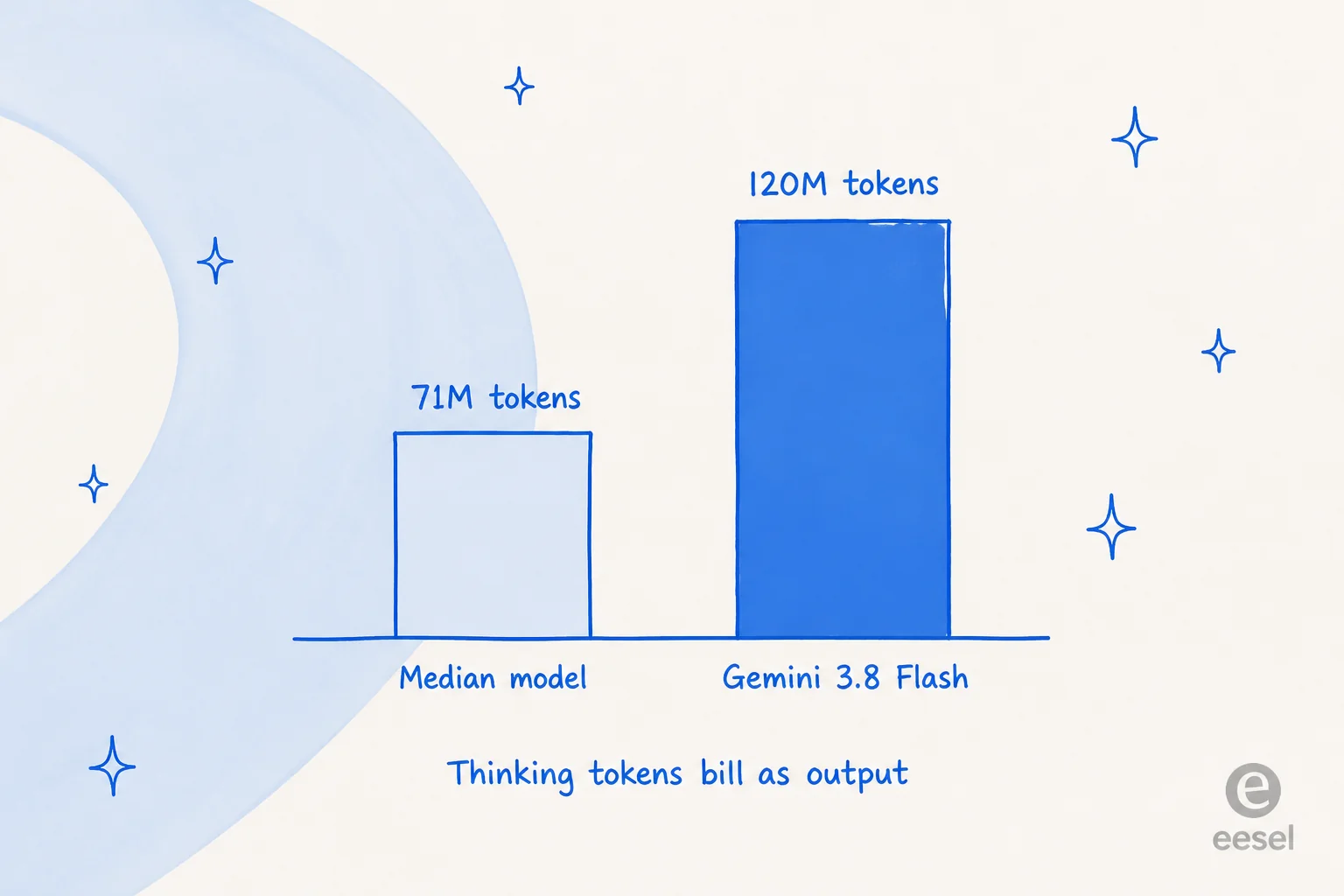
Google states the tradeoff openly in the launch post: 3.8 Flash "works harder," executing extra reasoning steps and calling tools iteratively, and "at times, the model might use more tokens to maximize performance." That is a feature for quality, and a cost for your invoice, because thinking tokens bill at the $3.75 output rate.
The independent measurement backs it up. Artificial Analysis needed 120M output tokens to run its whole Intelligence Index against 3.8 Flash, against a 71M median for the class. AA's own one-word verdict was "very verbose."
On Hacker News, one commenter put a sharper number on it than the marketing did:
"On artificial analysis it's only equal to opus 5 medium effort. Opus 5 max scores 63. Further, opus 5 medium outputs 4x fewer tokens to achieve the same result, negating a lot of the speed difference."

So the real cost per unit of work is higher than $3.75 per 1M suggests, because 3.8 Flash spends more units per task. Artificial Analysis put the blended cost at $0.58 per task on its index, which lands it 59th of 195 models on cost efficiency, not near the top where the raw token rate would imply. If you want to keep an eye on this on your own traffic, that is exactly what LLM tracking tools are for.
Same price as 3.7 Flash, so which do you buy?
This is the actual decision, and Google answers it for you. Since 3.8 and 3.7 Flash cost the same to the cent, price cannot break the tie. Google's own guidance does: for workloads "where compute efficiency is the primary constraint," developers should "continue to rely on Gemini 3.7 Flash, which remains fully supported for efficiency-first workloads."
Put plainly:
- Long agentic coding, quality over cost: 3.8 Flash. It beats 3.7 on every benchmark Google published, and switching is free. If you are shopping the wider category, my AI coding assistant roundup has the field.
- High-volume, latency-sensitive, cost-first: stay on 3.7 Flash. It burns fewer tokens for the same rate, and a Googler on the launch thread confirmed 3.8's extra token usage is the intended behaviour, not a bug.
There is a latency wrinkle too. 3.8 Flash ranks 3rd of 195 for raw output speed, but its time to first token is 13.30 seconds against a 2.99 second median. For anything a human waits on, the "fast" model is the slow one to start responding. That is throughput, not responsiveness, and it is easy to misread from the speed headline.
How the rate compares to other frontier models
If you are cross-shopping, here is where Gemini 3.8 Flash sits against the models it actually competes with on price, per 1M tokens, standard tier, today.
| Model | Input | Output | Note |
|---|---|---|---|
| Gemini 3.8 Flash | $0.75 | $3.75 | Doubles Jan 2027 |
| Gemini 3.7 Flash | $0.75 | $3.75 | Identical, fewer tokens per task |
| Claude Opus 5 | ~$5.00 | ~$25.00 | 4x fewer output tokens per task |
| Claude Sonnet 5 | lower than Opus | lower than Opus | Cheaper Claude tier |
The honest framing from the same HN thread: one developer noted that Gemini Flash, alongside a couple of other cheap models, delivers "90% of the performance for a small fraction of the cost" of the frontier tier. That is the real pitch, and it is a fair one. Just remember the fraction is measured on the raw rate, before you add the verbosity tax and the January increase. My roundup of Gemini alternatives covers the rest of the field, and if you are weighing Google against OpenAI, the ChatGPT vs Gemini comparison is the place to start, with the full OpenAI models list for the other side of that.
Where you can actually run it
- Free tier: input, output and caching free through Google AI Studio. Enough to prototype.
- Default in Antigravity: 3.8 Flash is the default model in Google Antigravity, with generous quotas, which several developers on HN flagged as the cheapest way to put it through real work.
- Consumer apps: the Gemini app, AI Mode in Search and Gemini in Sheets, but only on Google AI Pro or Ultra. If you are deciding between those, see Google AI plans.
- How to turn it on or off: if you are managing Gemini access across a Workspace, here is how to enable and disable Gemini.
What this means if you are pricing a support bot
I spend most of my time thinking about how buyers search for and price AI for the helpdesk, so here is the part that matters if the reason you are reading a model pricing page is to automate customer support.
A per-token rate of $0.75 looks irresistible next to a per-ticket helpdesk add-on. But three things break that comparison. A support model is answering short, high-volume tickets where the 13.30 second time to first token is felt on every reply. The verbosity that makes 3.8 Flash good at long coding jobs is the wrong shape for ticket deflection, and it bills at the output rate. And the token rate is a small slice of the real cost of running support automation, which is dominated by the retrieval and testing work around the model, not the model call itself.
I have spent the last three-plus years watching AI agents run on live support queues, and the pattern is consistent: a confident-sounding model can quietly give wrong answers, and no per-token price fixes that. It is why every eesel rollout is simulated against your real past tickets before it ever replies to a customer, so you see the resolution rate and the cost per ticket up front instead of discovering both on the invoice.
If you are picking a model to build support automation yourself, price it honestly with the verbosity tax and the 2027 rate baked in. If you would rather not hand-wire a model to your helpdesk at all, eesel packages an AI helpdesk teammate that plugs into your existing tools, learns from your past tickets, and is free to try, no per-token math required. It is the difference between buying an engine and hiring someone who can already drive.
Frequently Asked Questions
How much does Gemini 3.8 Flash cost?
Is Gemini 3.8 Flash pricing the same as 3.7 Flash?
Why does the Gemini 3.8 Flash price double in January 2027?
What are the batch and priority prices for Gemini 3.8 Flash?
Is Gemini 3.8 Flash cheaper than Claude Opus 5?
Is there a free tier for Gemini 3.8 Flash?
Is Gemini 3.8 Flash pricing good for customer support?


Article by
Kurnia Kharisma
Kurnia is a software engineer and writer at eesel AI with two years of SEO experience, writing about AI tools, helpdesk software, and customer support. He pairs a developer's understanding of how these products are built with search-driven research into what actually ranks and resonates with the people searching for them.