
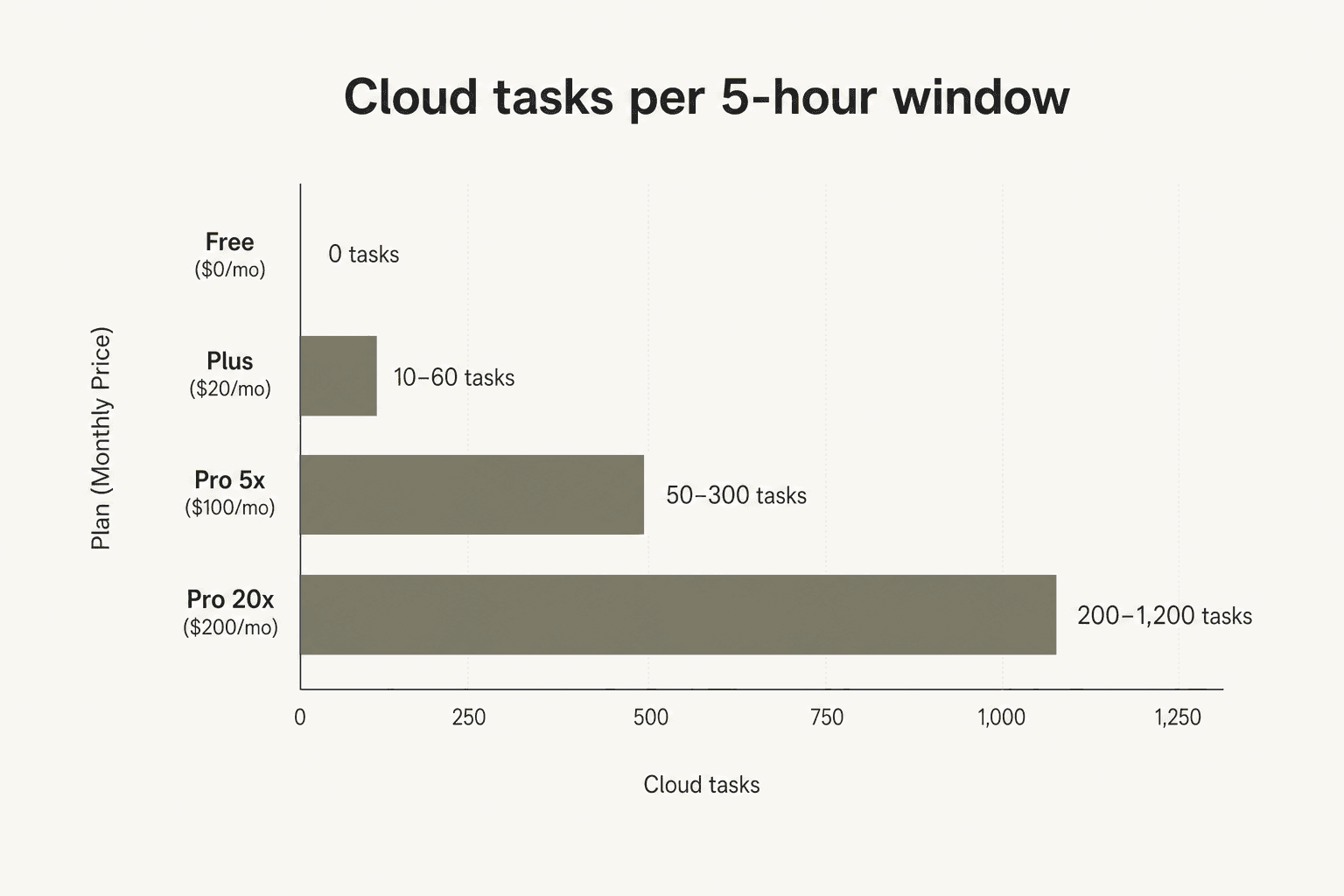
OpenAI Codex pricing spans $0 to $200+/month, bundled into ChatGPT plans rather than sold separately. The $20/month Plus plan is genuinely useful for hobbyists - 10–60 cloud tasks per 5-hour window, full GPT-5.3-Codex access. The $100/month Pro 5x is the sweet spot for active developers who regularly hit Plus limits. OpenAI's own published estimate puts typical real-world spending at $100–$200/developer/month for power users. The April 2026 switch to token-based credit billing makes costs more granular - and for most developers, lighter tasks now cost less than they did under per-message pricing.
What OpenAI Codex actually is
OpenAI Codex (launched May 2025) is an agentic software engineering product - not to be confused with the original 2021 Codex model that powered early GitHub Copilot and was deprecated in March 2023. The current Codex is a cloud-based autonomous coding agent powered by GPT-5 family models, running multi-step software tasks in isolated sandboxes, able to work in parallel across many projects. It's available as a VS Code extension with 9.8 million installs, a CLI (@openai/codex) with 88,600+ GitHub stars, a web app, iOS app, and since June 2026, on Amazon Bedrock.
The core metaphor is delegating to a junior-to-mid engineer: you assign the task, Codex works asynchronously, and comes back with a diff, terminal logs, and citations. GPT-5-Codex hits 85.5% autonomous task completion on SWE-bench - versus 54% for GitHub Copilot and 74% for Cursor - which is part of why the developer community has paid close attention despite it being less than a year old.
The two billing tracks
Before getting into plan-level pricing, it helps to know there are two entirely different billing paths for Codex:
Track 1 - ChatGPT subscription (most developers). Codex is bundled into ChatGPT plans. You pay the monthly fee and get a usage allocation that resets on a rolling 5-hour window. This is what individual developers and engineering teams are almost always on, and it's where the plan tiers (Plus, Pro, Business, Enterprise) live.
Track 2 - OpenAI API / pay-as-you-go. Developers building Codex-powered tools, integrating Codex into CI/CD pipelines, or automating workflows without a subscription can use an API key and pay per token. The tradeoff: no cloud features (GitHub code review, Slack integration), and newer models become available later to API users than to ChatGPT subscribers.
Which track fits you depends on how you're using Codex. Day-to-day developer use: Track 1. Building a product that calls Codex programmatically: Track 2.
ChatGPT subscription plans
Here's every plan with Codex access, as of June 2026:
| Plan | Price | Codex access | Key notes |
|---|---|---|---|
| Free | $0/mo | Limited trial, local tasks only | No cloud integrations (GitHub review, Slack) |
| Go | $8/mo | Lightweight local coding tasks | No cloud task delegation |
| Plus | $20/mo | Full cloud access: web, CLI, IDE, iOS | GPT-5.5, GPT-5.4, GPT-5.3-Codex; 10–60 cloud tasks / 5h |
| Pro 5x | $100/mo | 5× Plus usage | GPT-5.3-Codex-Spark (research preview); added April 9, 2026 |
| Pro 20x | $200/mo | 20× Plus usage | Original Pro plan, re-positioned |
| Business | Pay-as-you-go per seat | Same base limits as Plus | Larger VMs, SAML SSO, MFA, no training on your data |
| Enterprise / Edu | Contact sales | No fixed rate limits; shared credit pool | SCIM, EKM, RBAC, audit logs, data residency |
The Go plan at $8/month exists mainly as an entry point for lighter use and doesn't unlock the cloud task features that make Codex genuinely useful for delegating work. For most developers choosing between Go and Plus, the $12/month difference for full cloud access is worth it.
The April 9, 2026 Pro 5x tier at $100/month was OpenAI's direct response to Claude Code's $100/month pricing. Previously, the only "Pro" option was $200/month - which left active developers who'd outgrown Plus without a sensible middle tier. The new $100 option fills that gap cleanly.
Usage limits - the 5-hour rolling window
All Codex limits are measured per 5-hour rolling window, not per month. Here's the full breakdown:
Plus limits (per 5-hour window):
| Model | Local messages | Cloud tasks | Code reviews |
|---|---|---|---|
| GPT-5.5 | 15–80 | - | - |
| GPT-5.4 | 20–100 | - | - |
| GPT-5.4-mini | 60–350 | - | - |
| GPT-5.3-Codex | 30–150 | 10–60 | 20–50 |
Pro 5x limits (5× Plus):
| Model | Local messages | Cloud tasks | Code reviews |
|---|---|---|---|
| GPT-5.5 | 80–400 | - | - |
| GPT-5.4 | 100–500 | - | - |
| GPT-5.4-mini | 300–1,750 | - | - |
| GPT-5.3-Codex | 150–750 | 50–300 | 100–250 |
Pro 20x limits (20× Plus):
| Model | Local messages | Cloud tasks | Code reviews |
|---|---|---|---|
| GPT-5.5 | 300–1,600 | - | - |
| GPT-5.4 | 400–2,000 | - | - |
| GPT-5.4-mini | 1,200–7,000 | - | - |
| GPT-5.3-Codex | 600–3,000 | 200–1,200 | 400–1,000 |
The wide ranges (10–60 cloud tasks on Plus) reflect real variation in task token consumption: a small refactor burns far fewer tokens than a 25-hour autonomous build. The rolling window means burning through cloud tasks at 9am gives you a reset by 2pm - which works fine for most patterns but can feel tight during an all-day parallel agent session.
One Plus user summed it up accurately on r/OpenAI:
"The number of requests also seem to be reasonably high on the Plus subscription: 30–150 per 5 hours."
u/pnkpune, r/OpenAI

The April 2026 credit system: how tokens become costs
On April 2, 2026, OpenAI switched from per-message billing to token-based credits for all plans. Credits are consumed based on actual token input and output, not per request. Here's the current Codex rate card:
| Model | Input (credits / 1M tokens) | Cached input (credits / 1M) | Output (credits / 1M) |
|---|---|---|---|
| GPT-5.5 | 125 | 12.50 | 750 |
| GPT-5.4 | 62.50 | 6.25 | 375 |
| GPT-5.4-mini | 18.75 | 1.875 | 113 |
| GPT-5.3-Codex | 43.75 | 4.375 | 350 |
A typical task using GPT-5.5 consumes 5–45 credits. Code review runs on GPT-5.3-Codex. Fast mode (where available) draws credits at a higher rate. GPT-5.3-Codex-Spark (available on Pro) is still in research preview - rates are not yet finalized.
The diagram below shows how tokens translate to credits and cost for a representative task:
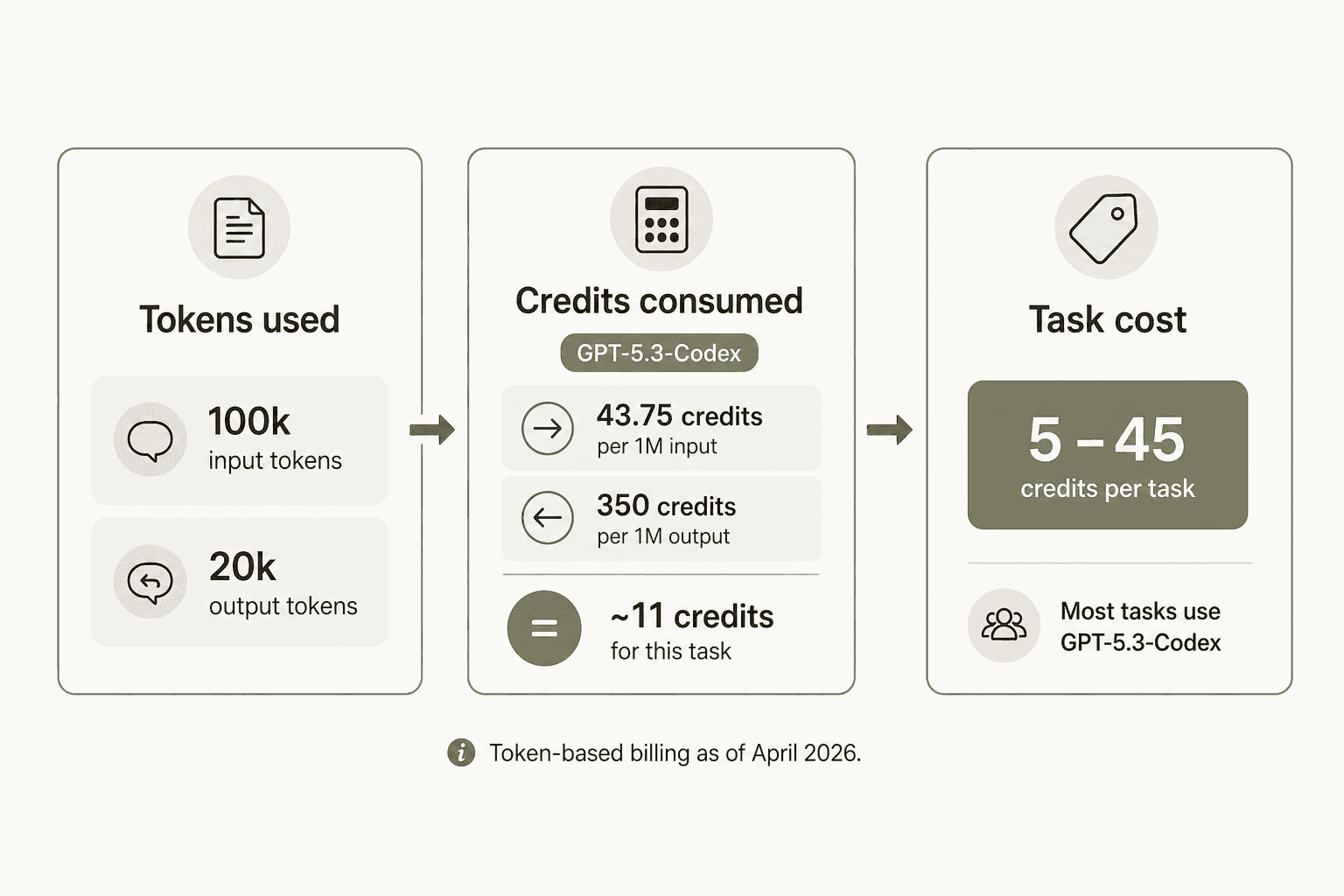
The practical effect: lighter tasks got cheaper, heavier ones cost more, and GPT-5.4-mini stretches local message allowances 2.5–3.3× further than using GPT-5.5 for everything. Plus and Pro users can buy additional credits via the Codex usage panel if they need more headroom in a given window.
Per OpenAI's help documentation, a few things stretch your limits further:
- Route routine local tasks to GPT-5.4-mini instead of primary models
- Keep the AGENTS.md file lean - every token in that file is overhead on every task
- Limit the number of active MCP servers loaded in Codex
- Skip fast mode for tasks that aren't time-sensitive
API developer track pricing
For developers building Codex into products or automations via API key, the original launch pricing for codex-mini-latest was:
- Input: $1.50 per 1M tokens
- Output: $6.00 per 1M tokens
- Prompt caching discount: 75%
For current API pricing on GPT-5.3-Codex and later models, check platform.openai.com/docs/pricing - rates have shifted as the model lineup expanded past the original launch. API access doesn't require a ChatGPT subscription, but it costs you the cloud features: no automatic GitHub code review, no Slack integration, and models like GPT-5.3-Codex land for API users later than for subscribers.
If you want to use Codex in a Jupyter notebook, a custom build pipeline, or a GitHub Actions workflow, the API is the right path. For day-to-day developer use inside the VS Code extension or the macOS app, you want the subscription track with your ChatGPT login.
What a real month actually costs
OpenAI's own rate card publishes a real-world estimate of $100–$200/developer/month for typical active usage. Here's what that looks like across different profiles:
Solo hobbyist / side-project developer On Plus at $20/month. Running 2–5 cloud tasks per session, mostly bug fixes and small features, using GPT-5.4-mini for local messages. Rarely touches the cloud task ceiling. Monthly spend: $20.
Active full-time developer Starts on Plus but hits the 5-hour window limit on heavy coding days. After a few months of pauses, upgrades to Pro 5x at $100/month. 50–300 cloud tasks per window covers parallel work comfortably. Monthly spend: $100.
Heavy power user running parallel agents On Pro 20x at $200/month. Running 10+ parallel cloud tasks, using automatic code review on every PR, running Skills and Automations. Supplements with additional credits during high-volume sprints. Monthly spend: $200–350.
A surprisingly common real-world configuration is running Codex at $20/month alongside a second tool - the pattern shows up often in developer communities:
"I have the $100 CC license and $20 OpenAI plan. When CC can not resolve a difficult problem I give it to Codex and have it take forever but it has fixed numerous issues CC is unable to."
u/SequentialHustle, r/ClaudeAI
This makes sense given how the tools complement each other: Codex tends to produce cleaner PRs and handle difficult back-end tasks better, while tools like Claude Code are often faster at front-end and iterative work.
One LinkedIn practitioner, Matt Koppenheffer, made a sharp point about model access at the Pro tier: Codex Pro gives you GPT-5 at $100/month, while comparable agentic tools at the same price point give you smaller models. For compute-intensive back-end work, that distinction matters.
Gotchas to know before you pay
The rolling window catches people off guard. The 5-hour reset runs from when you first used it, not at midnight. Heavy morning sessions that burn through cloud tasks can leave you waiting mid-afternoon. Usage is trackable at the Codex usage panel, but there's no pre-task estimate of how much a specific job will consume.
Fast mode costs more credits. Fast mode is available for supported models and delivers quicker responses - but at a higher credit rate per task. Easy to forget if you leave it on by default.
Code review is a separate allocation. GitHub code review (triggered automatically when PRs move from draft to ready, or via @codex review) uses GPT-5.3-Codex and draws from your code review bucket, separate from your cloud task count. Heavy PR volume can add up independently.
API key access is not subscription access. The CLI can run on an API key instead of your ChatGPT login, but API key mode strips out cloud features - no GitHub integration, no Slack integration, delayed access to newer models. If those features matter, authenticate with your ChatGPT subscription, not an API key.
Business plan limits start the same as Plus. The upgrade on Business is larger cloud VMs (faster task execution), admin controls, and compliance features - not raw usage headroom. Teams that need more capacity add credit bundles on top.
The old $200/month Pro is now called Pro 20x. If you signed up before April 9, 2026 as a Pro subscriber, you're now on the 20x tier. If your usage doesn't need 20× headroom, you may be able to switch down to the new Pro 5x at $100/month.
Which plan should you choose?
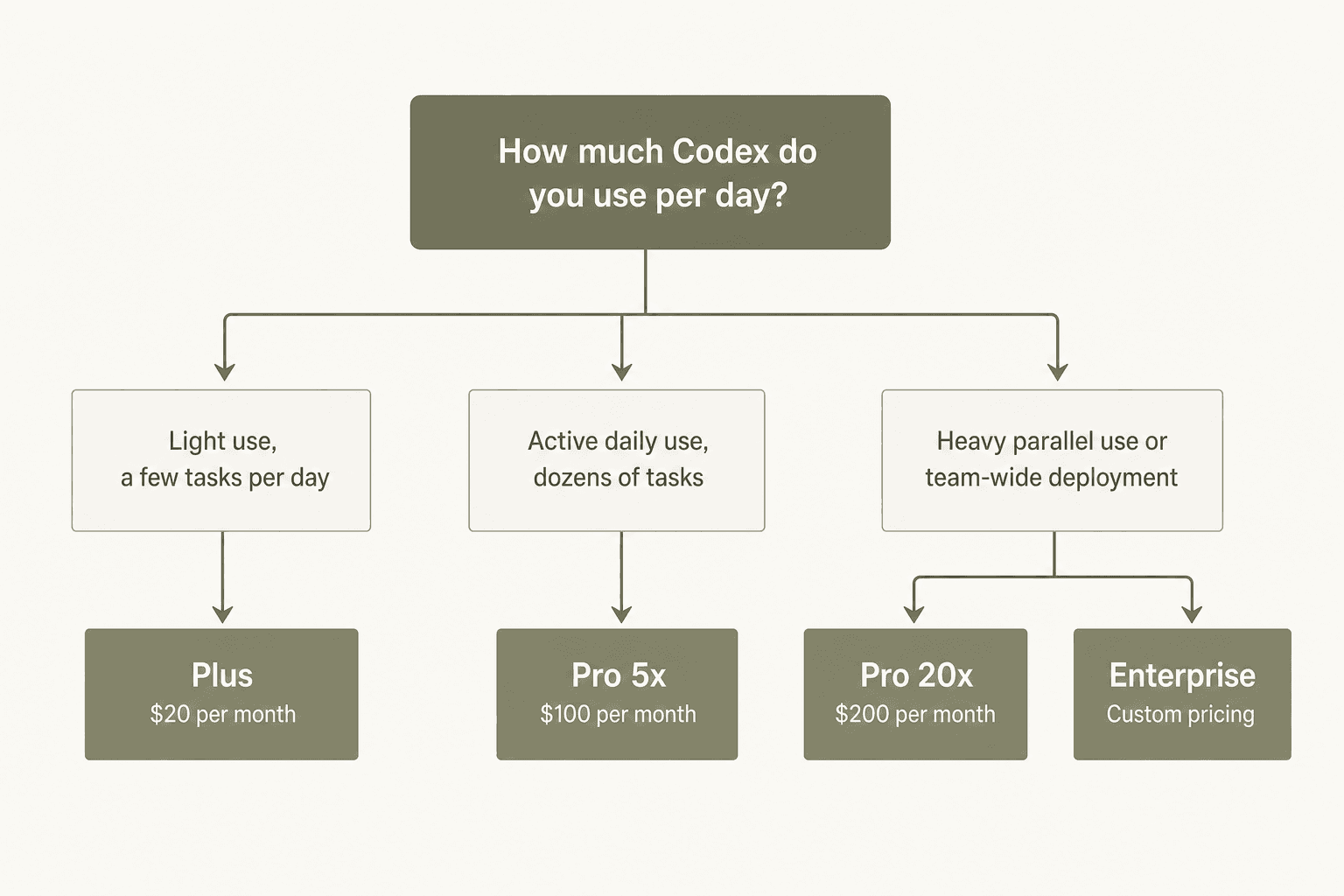
- Free: First-time exploration, simple local tasks, no cloud delegation needed.
- Plus ($20/month): Part-time developers, hobbyists, anyone whose Codex usage fits a few sessions per day. The VS Code extension, CLI, and macOS app all work here. Most hobby developers never outgrow it.
- Pro 5x ($100/month): Active full-time developers who hit Plus limits regularly. Parallel cloud task execution, 5× usage headroom, research preview model access. This is OpenAI's answer to Claude Code at the same price.
- Pro 20x ($200/month): Engineering leads running heavy parallel agent workloads, large-scale code review automation, or long-horizon autonomous tasks. The extreme end of this profile is @KarelDoostrlnck's $10,000 Codex usage at OpenAI for automated research workflows.
- Business (PAYG per seat): Teams needing SAML SSO, MFA, larger VMs, and no-training-on-your-data guarantees.
- Enterprise (contact sales): Organizations needing shared credit pools, no fixed rate limits, SCIM provisioning, audit logs, and data residency controls.
If you're comparing Codex against other options, the OpenAI Codex alternatives guide and our roundup of best AI coding assistant tools cover the full landscape alongside Cursor pricing and GitHub Copilot pricing.
Try eesel
If you're looking at AI tools beyond coding - automating support workflows, handling customer conversations at scale, or deploying AI across your existing helpdesk and messaging tools - eesel is worth a look alongside Codex. eesel is an AI teammate platform that runs autonomous agents directly inside Zendesk, Slack, Freshdesk, email, and 100+ other tools your team already uses. Unlike Codex's code-first focus, eesel handles support tickets, customer interactions, and content workflows at scale - with one fixed monthly price (from $299/month for 500 credits, where 1 credit is one ticket or chat, no seat fees) and a free plan with 100 credits and no card required.