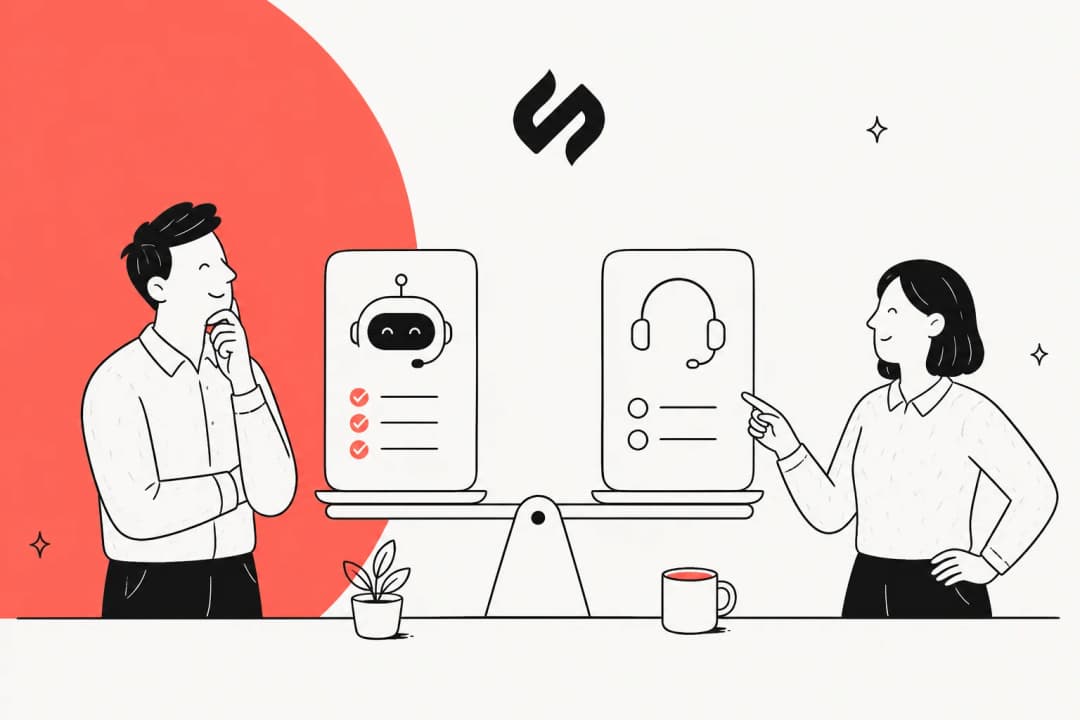

Salesforce Agentforce promises AI-powered customer service, but the reality often falls short for teams not fully committed to the Salesforce ecosystem. With costs reaching approximately $13,600 per user annually and complex implementation requirements, many organizations are exploring more flexible, cost-effective options.
The good news? The AI customer service market has matured rapidly. Whether you're looking to augment your existing help desk or switch to a more modern platform, there are now several viable alternatives that offer comparable (or better) AI capabilities without the Salesforce lock-in.
In this guide, we'll compare 9 of the best Salesforce Agentforce alternatives, examining their pricing models, key features, and ideal use cases to help you make an informed decision.
What is Salesforce Agentforce?
Salesforce Agentforce is the company's AI platform for building autonomous agents across service, sales, and marketing functions. It's designed to work natively within the Salesforce ecosystem, leveraging customer data from CRM records to power intelligent automation.
The platform uses a "Flex Credits" pricing model, where customers purchase credits that can be allocated across different AI capabilities. While this offers flexibility, it also creates unpredictability in budgeting. Enterprise deployments typically require significant professional services investment, with total cost of ownership often exceeding $13,600 per user per year.
Teams explore alternatives for three primary reasons: cost predictability, implementation complexity, and the desire to avoid vendor lock-in. Many organizations already have established help desks (Salesforce Service Cloud included) and want an AI layer that enhances their existing setup rather than requiring a complete platform migration.
How we evaluated these alternatives
We assessed each platform against five key criteria:
- Pricing transparency - Clear, predictable costs without hidden fees
- Ease of setup - Time to value and implementation complexity
- Integration flexibility - Ability to work with existing tools
- AI capabilities - Quality of autonomous resolution and agent assistance
- Target market fit - Alignment with different team sizes and industries
Our focus is on solutions that enhance existing help desks rather than forcing full platform migrations.
Quick comparison table
| Tool | Best For | Pricing | Key Strength |
|---|---|---|---|
| eesel AI | Teams wanting fast AI deployment | From $299/mo (500 credits) | Fastest setup, no per-seat fees |
| Zendesk AI | Enterprises on Zendesk | $1.50-$2.00/resolution | Native ecosystem integration |
| Freshdesk Freddy | Budget-conscious teams | ~$0.49/session | Most affordable option |
| Intercom Fin | SaaS companies | $0.99/resolution | Outcome-based pricing |
| Gorgias | E-commerce brands | $0.90/resolution | Deep Shopify integration |
| Ada | Large enterprises | Custom | Visual builder, multilingual |
| ServiceNow Virtual Agent | ITSM-focused orgs | Custom | Workflow automation |
| Decagon | Enterprises on chat, voice, and email | Custom | Natural-language AOP workflows |
| Forethought | Teams that need triage plus resolution | Custom (platform fee + outcomes) | Ticket triage and routing |
The 9 best Salesforce Agentforce alternatives
1. eesel AI
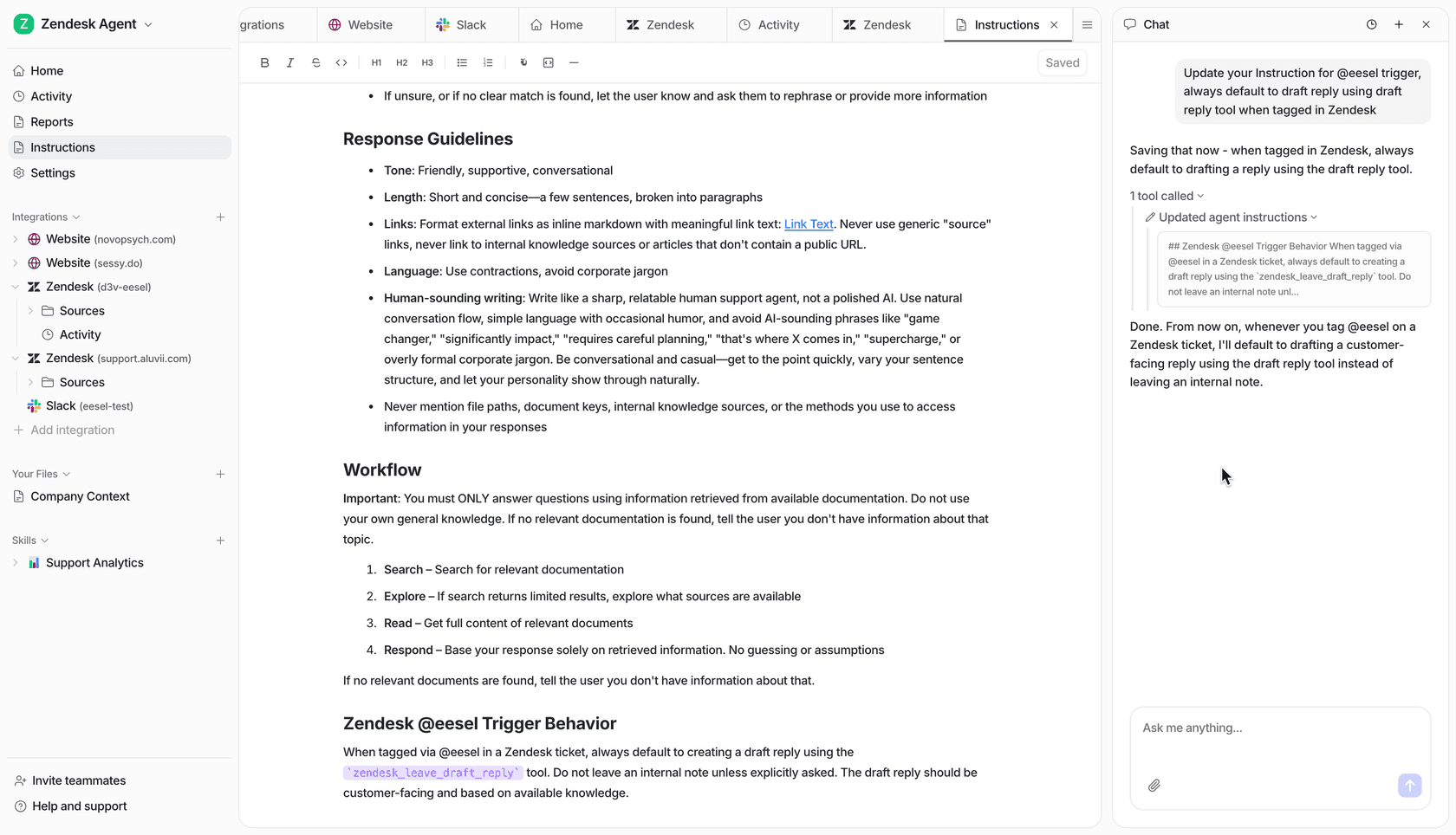
eesel AI approaches customer service automation differently from traditional platforms. Instead of treating AI as a feature layered on top of a help desk, eesel acts as an AI teammate that plugs into your existing tools whether that's Zendesk, Freshdesk, Gorgias, or others.
The platform offers three core products: AI Agent for autonomous ticket resolution, AI Copilot for drafting replies that agents review before sending, and AI Triage for automated tagging, routing, and ticket hygiene. This modular approach lets teams start with assistance and gradually level up to full automation as confidence grows.
Setup takes minutes rather than months. Connect eesel to your help desk, and it immediately learns from your past tickets, macros, help center articles, and connected documentation. There's no manual training or configuration wizards eesel absorbs your business context, tone, and common issues from day one.
A standout feature is the simulation mode. Before going live, you can run eesel against thousands of past tickets to see exactly how it would respond, measure resolution rates, and identify any gaps. This eliminates the "hope for the best" approach that plagues many AI deployments.
Pricing: One fixed monthly price sized to volume, where 1 credit covers one ticket or chat: 500 credits for $299/month, 1,000 for $499, 2,500 for $999, and 5,000 for $1,899. Every integration, channel, and seat is included, and a free plan gives you 100 credits. Above 5,000 credits, talk to them.
Best for: Teams wanting AI capabilities without switching help desks or enduring complex implementations. Particularly well-suited for organizations frustrated with per-seat pricing models.
Pros: Fastest setup in the category, works with existing tools, simulation mode for pre-deployment testing, predictable fixed monthly pricing.
Cons: Not an all-in-one helpdesk requires an existing platform to integrate with.
2. Zendesk AI
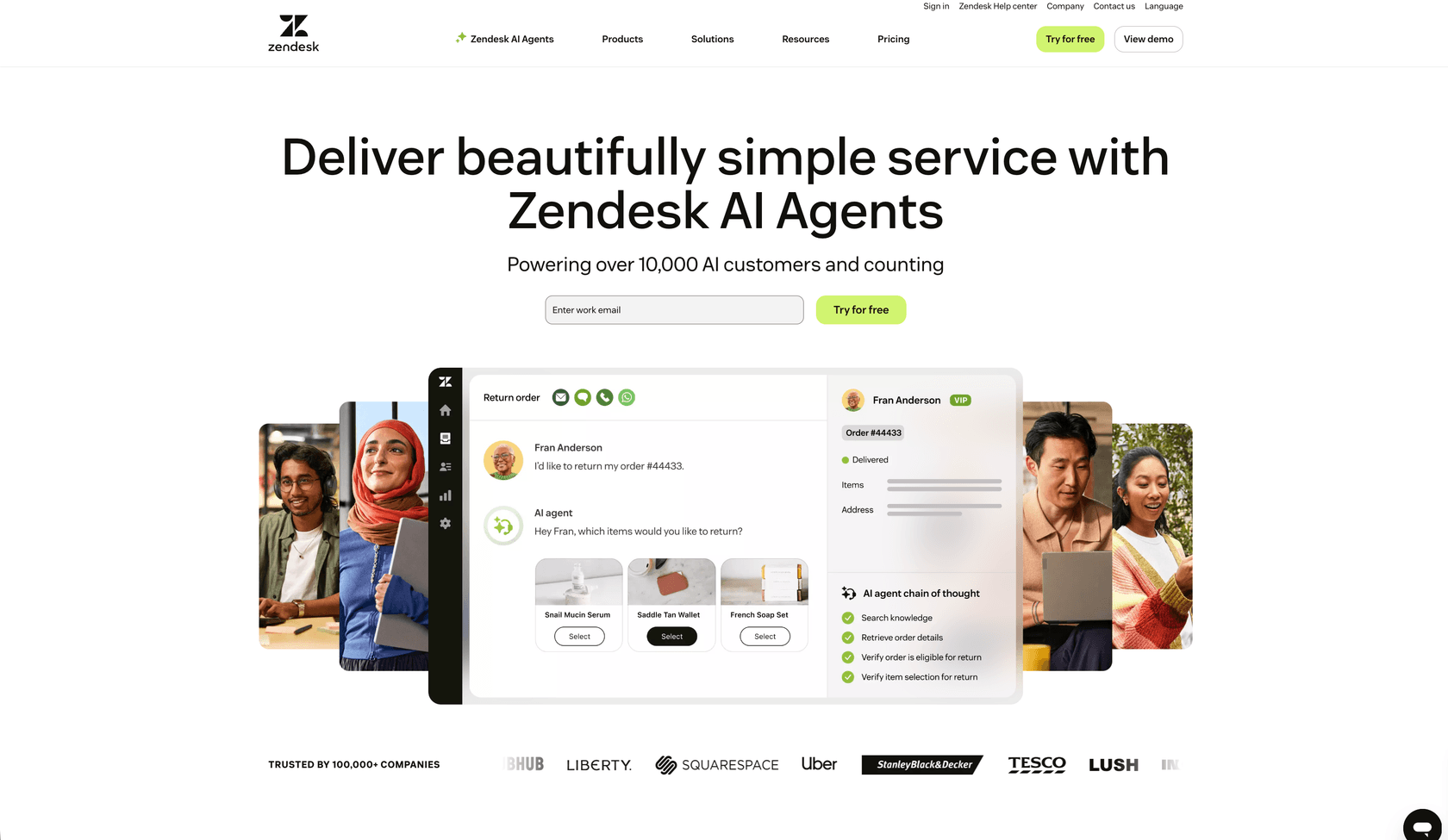
For organizations already invested in the Zendesk ecosystem, Zendesk AI offers native AI capabilities that extend the platform's existing strengths. The company claims to power "the most AI customers in service" with tools designed to resolve 80% or more of interactions autonomously.
The platform centers on two main AI products: AI Agents for customer-facing automation and Copilot for agent assistance. AI Agents handle complex issues across any channel using agentic AI that reasons, adapts, and acts independently. Copilot provides proactive assistance within the agent workspace, offering insights, suggested replies, and the ability to execute agent-approved actions.
Zendesk AI comes pre-trained for major industries including financial services, insurance, IT, HR, travel, hospitality, retail, software, entertainment, and education. Customers can add custom intents to address specific business needs without starting from scratch.
Pricing: Zendesk AI is included in Suite plans starting at $55 per agent per month. Automated resolutions beyond plan limits cost $1.50-$2.00 each. Advanced AI Agents and Copilot are available as add-ons at $50 per agent per month.
Best for: Mid-market to enterprise companies already using Zendesk who want native AI integration without managing separate systems.
Pros: Deep ecosystem integration, pre-trained industry models, omnichannel support, partnership with OpenAI for advanced capabilities.
Cons: Requires Zendesk commitment, per-agent pricing scales quickly, advanced AI features require add-ons.
3. Freshdesk Freddy AI
Freshdesk Freddy AI brings AI capabilities to the Freshdesk platform with a focus on affordability and ease of use. It's a solid choice for teams already in the Freshworks ecosystem or those looking for a budget-friendly entry point into AI-powered support.
Freddy AI includes two main components: an AI Agent for automated email responses and an AI Copilot for agent assistance. The AI Agent handles routine inquiries autonomously, while Copilot helps human agents draft faster, more accurate replies.
The platform includes 500 free AI sessions on Pro and Enterprise plans, making it easy to experiment before committing to additional spend. Freshdesk also offers a free tier for up to 2 agents for 6 months, which is rare among established help desk providers.
Pricing: Platform plans start at $19 per agent per month. Freddy AI Agent sessions cost $49 per 100 sessions after the included 500. Copilot is available as an add-on for any number of agents.
Best for: Budget-conscious mid-market teams, especially those already using Freshworks products or wanting affordable AI experimentation.
Pros: Most affordable entry point, user-friendly interface, free tier available, strong integration with Freshservice for IT teams.
Cons: Session-based pricing means paying regardless of resolution success, AI capabilities less mature than premium competitors, best results require full Freshworks suite adoption.
4. Intercom Fin
Intercom Fin takes an outcome-based approach to AI pricing that's particularly appealing to SaaS companies focused on resolution quality. Instead of charging per conversation or session, Fin only bills when the AI actually solves the customer's problem.
Fin operates at $0.99 per resolution, with resolution defined as either the customer confirming their issue is solved or no follow-up request after Fin's response. This aligns costs with value delivered a customer who asks multiple questions in one conversation only counts as one resolution.
The platform supports 45+ languages and integrates with major help desks including Zendesk, Salesforce, HubSpot, and Freshworks. This flexibility makes Fin attractive for teams who want advanced AI without abandoning their existing infrastructure.
Pricing: $0.99 per resolution, plus platform fees starting at $29 per seat per month for Intercom's full customer service platform. For existing help desks, Fin requires a minimum commitment of 50 outcomes per month.
Best for: SaaS companies and teams prioritizing resolution quality and outcome-based pricing over pure cost minimization.
Pros: Only pay for successful resolutions, strong multilingual support, works with existing help desks, no-code configuration.
Cons: Support-focused rather than sales-oriented, requires Intercom platform for full features, minimum commitments apply for standalone use.
5. Gorgias
For e-commerce brands, Gorgias offers purpose-built AI that understands the unique demands of online retail. The platform combines a unified help desk with an AI Agent specifically trained for e-commerce scenarios like order tracking, returns, and product recommendations.
Gorgias AI Agent handles pre- and post-sales questions, processes returns and refunds, edits orders and subscriptions, generates dynamic discounts, and provides personalized product recommendations. It integrates deeply with Shopify, BigCommerce, Magento, and WooCommerce, pulling real-time order data to inform responses.
The platform's ticket-based pricing (rather than per-agent) can be more economical for growing teams. Unlimited users are included on all plans, with costs scaling based on conversation volume rather than headcount.
Pricing: Helpdesk plans start at $10 per month for 50 tickets. AI Agent resolutions cost $0.90 each on annual plans ($1.00 on monthly). The popular Pro plan includes 2,000 tickets and 600 AI interactions for $300 per month.
Best for: E-commerce brands on Shopify or other major platforms looking for affordable AI support with deep store integration.
Pros: Cheapest per-resolution pricing in the category, purpose-built for online retail, unlimited users, revenue-focused reporting.
Cons: Limited utility outside e-commerce, AI Agent only available on Email and Chat, shorter 7-day trial period.
6. Ada
Ada positions itself as an AI-native platform for enterprise customer service automation. Founded in 2016, the company emphasizes being built entirely around AI models rather than retrofitting automation onto traditional help desk architecture.
The platform's Reasoning Engine powers AI agents across all channels with autonomous decision making, multi-layer safeguards, and adaptive reasoning. Ada's Conversation Hub deploys agents across voice, email, chat, messaging apps, and social channels with dynamic translation.
Ada claims to automate 83% of customer conversations for mature deployments. The platform is particularly strong for global enterprises, with support for 50+ languages and compliance certifications including HIPAA, SOC2, GDPR, and AIUC-1.
Pricing: Custom enterprise pricing based on conversation volume. Ada targets companies with 300,000+ annual customer service conversations. Pricing is not publicly disclosed but industry estimates suggest $1.00-$3.50 per resolution depending on volume.
Best for: Large enterprises with high conversation volumes, strict compliance requirements, and need for multilingual support.
Pros: AI-native architecture, strong no-code tools, enterprise-grade security, high automation rates.
Cons: No transparent pricing, requires minimum conversation volume, setup can be time-consuming, primarily suited for larger organizations.
7. ServiceNow Virtual Agent
ServiceNow Virtual Agent is part of the broader ServiceNow AI Platform, offering conversational AI for IT, HR, and customer service use cases. It's designed for organizations already standardized on ServiceNow for enterprise service management.
The platform provides GenAI-powered chatbot experiences with guided setup using existing knowledge articles and catalog items. Features include agentic AI workflows, issue auto-resolution, conversational analytics, and voice support by phone.
ServiceNow Virtual Agent excels at workflow-driven automation, making it ideal for complex enterprise scenarios involving multiple systems and approval processes. The conversation designer allows non-technical users to build custom flows.
Pricing: Custom enterprise pricing as part of the ServiceNow AI Platform. No public pricing is available contact sales for quotes.
Best for: Large enterprises already using ServiceNow for ITSM and operations who want to extend the platform to customer service.
Pros: Deep workflow integration, enterprise governance, cross-departmental use cases (IT, HR, customer service), voice support.
Cons: Requires ServiceNow commitment, complex implementation, overkill for simple use cases, no self-serve pricing.
8. Decagon
Decagon builds AI agents for chat, voice, and email on one platform, and its customers are mostly large consumer brands. Its customer stories include Chime, and its logo wall includes Deutsche Telekom, American Airlines, and Delta.
Workflows are written as Agent Operating Procedures (AOPs), natural-language instructions that read like a standard operating procedure for a human agent. Engineering teams can version them with Git-based tracking. Decagon also offers simulation testing, live A/B experiments, and an always-on QA layer called Watchtower.
For Salesforce teams, Decagon's integrations page lists Salesforce for syncing support tickets and customer data, and for taking action during live chat escalations to human agents.
Pricing: Decagon doesn't publish pricing. You request a demo through its website to get a quote.
Best for: Large enterprises with high volumes across chat, voice, and email that want natural-language control over complex workflows.
Pros: Chat, voice, and email on one platform, natural-language AOPs, built-in simulation testing and A/B experiments, Salesforce ticket sync and escalations.
Cons: No public pricing, demo-led sales process, customer base weighted toward large enterprises.
9. Forethought
Forethought runs a multi-agent system for customer support. Solve answers customers across chat, email, voice, and more. Triage classifies and routes tickets. Assist gives human agents an AI copilot inside the helpdesk, and Discover finds gaps in your knowledge base. The agents learn from your past tickets and help center content.
Triage is the part Salesforce teams tend to notice. It uses pre-built or custom models to tag tickets, add context, and prioritize cases, so each one lands in the right case queue faster. Salesforce is listed among Forethought's helpdesk integrations, alongside Zendesk, ServiceNow, and Kustomer.
Pricing: Quote-only. Forethought's pricing page lists three plans (Team, Professional, and Enterprise) and describes the model as a platform access fee plus an outcome-based cost. Instead of a free trial, it runs a Proof of Value on your own data.
Best for: Mid-market and enterprise teams that want ticket triage and AI resolution in one platform on top of their existing helpdesk.
Pros: Ticket triage with custom handoff models, AI agents for chat, email, voice, and Slack, knowledge gap detection, works with Salesforce and other helpdesks.
Cons: No public pricing, email, voice, and Slack agents start at the Professional plan, knowledge gap detection is an Enterprise feature or add-on.
Choosing the right Agentforce alternative for your team
Selecting the right platform depends on your current infrastructure, team size, and primary objectives. Here's a decision framework:
Small teams and startups: Consider eesel AI for quick setup without switching platforms, or Freshdesk for a free tier to experiment with AI capabilities.
Mid-market organizations: eesel AI offers the fastest time to value if you have an existing help desk. If you're already on Zendesk or Freshdesk, their native AI options provide good integration at reasonable cost.
Enterprise organizations: Zendesk AI provides mature capabilities for large-scale operations. Ada offers the most sophisticated no-code tools for complex automation. ServiceNow makes sense if you're already invested in that ecosystem.
E-commerce brands: Gorgias is purpose-built for online retail with the best Shopify integration and lowest per-resolution cost.
Key questions to ask:
- What's your primary goal cost reduction or revenue growth?
- What platforms are you already using?
- What's your real budget including total cost of ownership?
- Do you need the AI to handle complex workflows or primarily answer FAQs?
Why eesel AI stands out for most teams

Among the alternatives reviewed, eesel AI offers a unique combination of speed, flexibility, and predictable pricing that addresses the main pain points teams experience with Salesforce Agentforce.
The progressive rollout model lets you start with AI Copilot (drafting replies for review), expand to AI Triage (automating ticket hygiene), and finally deploy AI Agent for full autonomous resolution. This controlled approach eliminates the risk of customer-facing AI mistakes.
Simulation before go-live changes how teams deploy AI. Running eesel against your past tickets shows exactly how it would perform, what it would get right, and where it needs guidance. No other platform offers this level of pre-deployment visibility.
Plain-English control means you define behavior in natural language rather than building rigid decision trees. Instructions like "If the refund request is over 30 days, politely decline and offer store credit" are understood and followed without coding.
Finally, fixed monthly pricing from $299 per month (not per agent) makes costs predictable as you scale. There are no seat fees, and overage is optional with a cap you set.
Start automating your customer service today
Ready to explore AI-powered customer service without the complexity and cost of Salesforce Agentforce? Try eesel AI free and see how it performs on your past tickets before making any commitment.
With setup taking minutes rather than months, you can start seeing value this week not next quarter.