Serval AI alternatives in 2026: 5 platforms worth considering

Amogh Sarda

Katelin Teen
Last edited May 2, 2026

Disclosure: This article is published by eesel AI. eesel is one of the alternatives listed below, and we're recommending it. For each platform we've described, including Serval, we link directly to the company's own materials so you can verify the claims. Go to the original sources if you want a fully independent view.
If you're evaluating Serval, you're probably also looking at what else is out there. Serval is an AI-native ITSM platform with native ticketing, access management, and a workflow builder. That's a specific product shape, and it's not the only shape worth considering.
A note before we start: the AI-ITSM and AI-support space has consolidated rapidly in late 2025 and early 2026. Three of the five alternatives below have been acquired in the last twelve months: Moveworks by ServiceNow, Aisera by Automation Anywhere, and Forethought by Zendesk. For buyers comparing options, who owns each platform increasingly matters as much as the feature set.
This article walks through five alternatives that cover the same problem space (AI-powered IT support, with some also extending to customer support). Each has a different shape, a different commercial model, and now, a different parent company. Every factual claim links back to a primary source.
How we picked these alternatives
We focused on the things buyers usually weigh in this category:
- Setup model. Can you stand it up yourself, or is there a mandatory sales engagement first?
- Integration vs. platform. Does it add AI to your existing help desk, or replace your help desk?
- Knowledge sources. What can it ingest, and how easily?
- Testing. Can you simulate or test before going live?
- Pricing transparency. Is pricing public, or is it sales-gated?
- Ownership status. Independent, or part of a larger platform now?
Quick comparison
A side-by-side. Sources: eesel.ai, moveworks.com, aisera.com, forethought.ai, ada.cx. Where info isn't published, we say so rather than guessing.
| Capability | eesel AI | Moveworks | Aisera | Forethought | Ada |
|---|---|---|---|---|---|
| Best for | AI-native ITSM + CX, integration-first | Enterprise IT, HR, Finance | Multi-domain agentic AI for Global 2000 | Customer support automation | Customer-facing chatbots |
| Ownership | Independent | ServiceNow (Dec 2025) | Automation Anywhere (Nov 2025) | Zendesk (Mar 2026) | Independent |
| Self-serve sign-up | Yes | No | No | No | No |
| Public pricing | Yes | No | No | No | No |
| Trains on past tickets | Yes | Yes | Yes | Yes | No (flow-based) |
| Simulation on past tickets | Yes | Not documented publicly | Not documented publicly | Not documented publicly | Not documented publicly |
The 5 alternatives
1. eesel AI
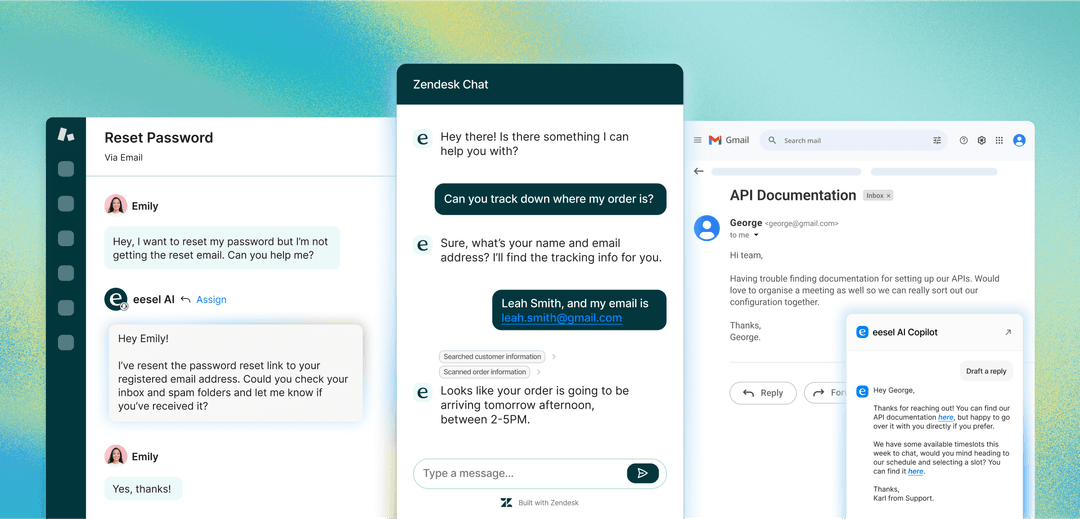
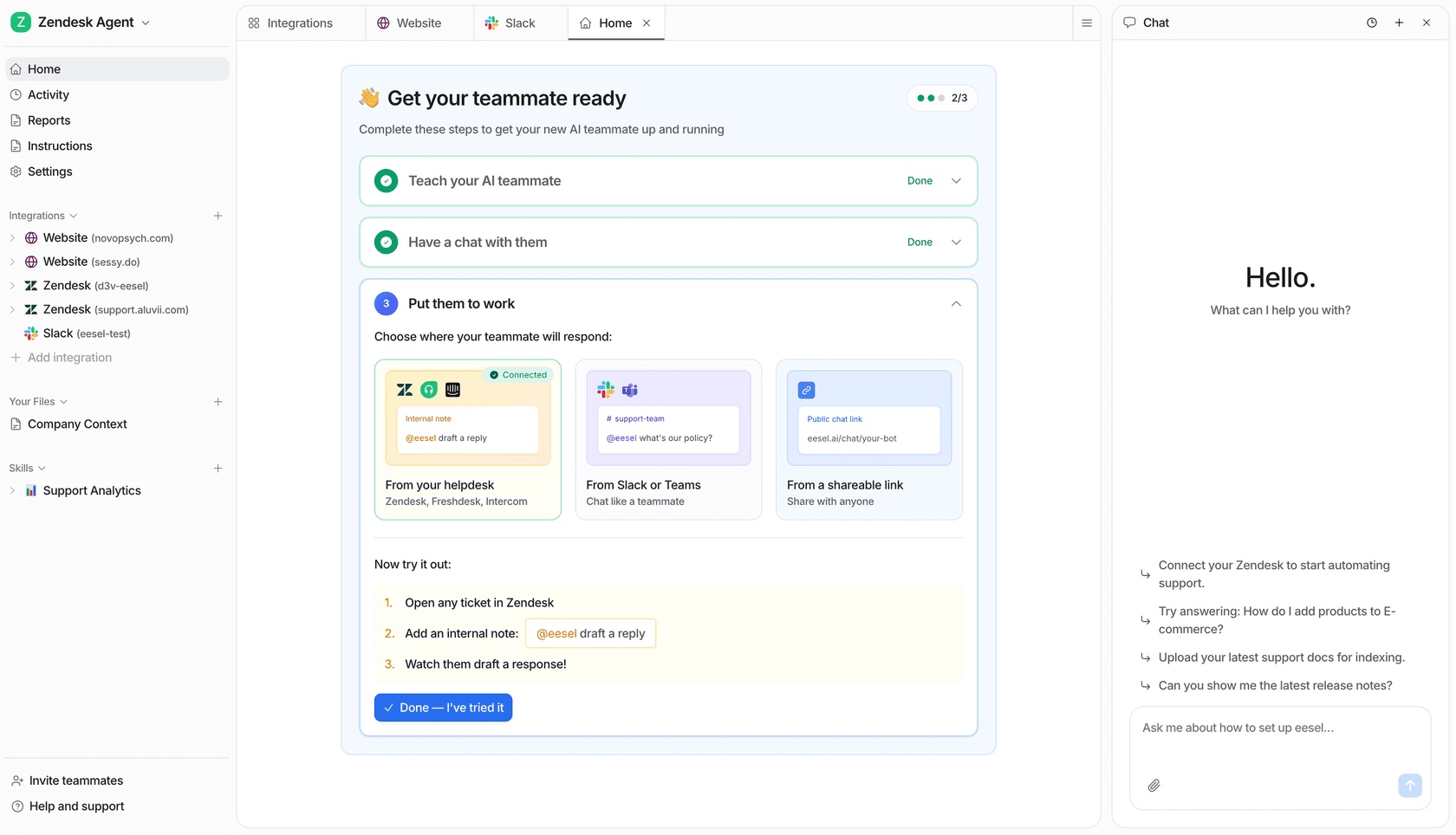
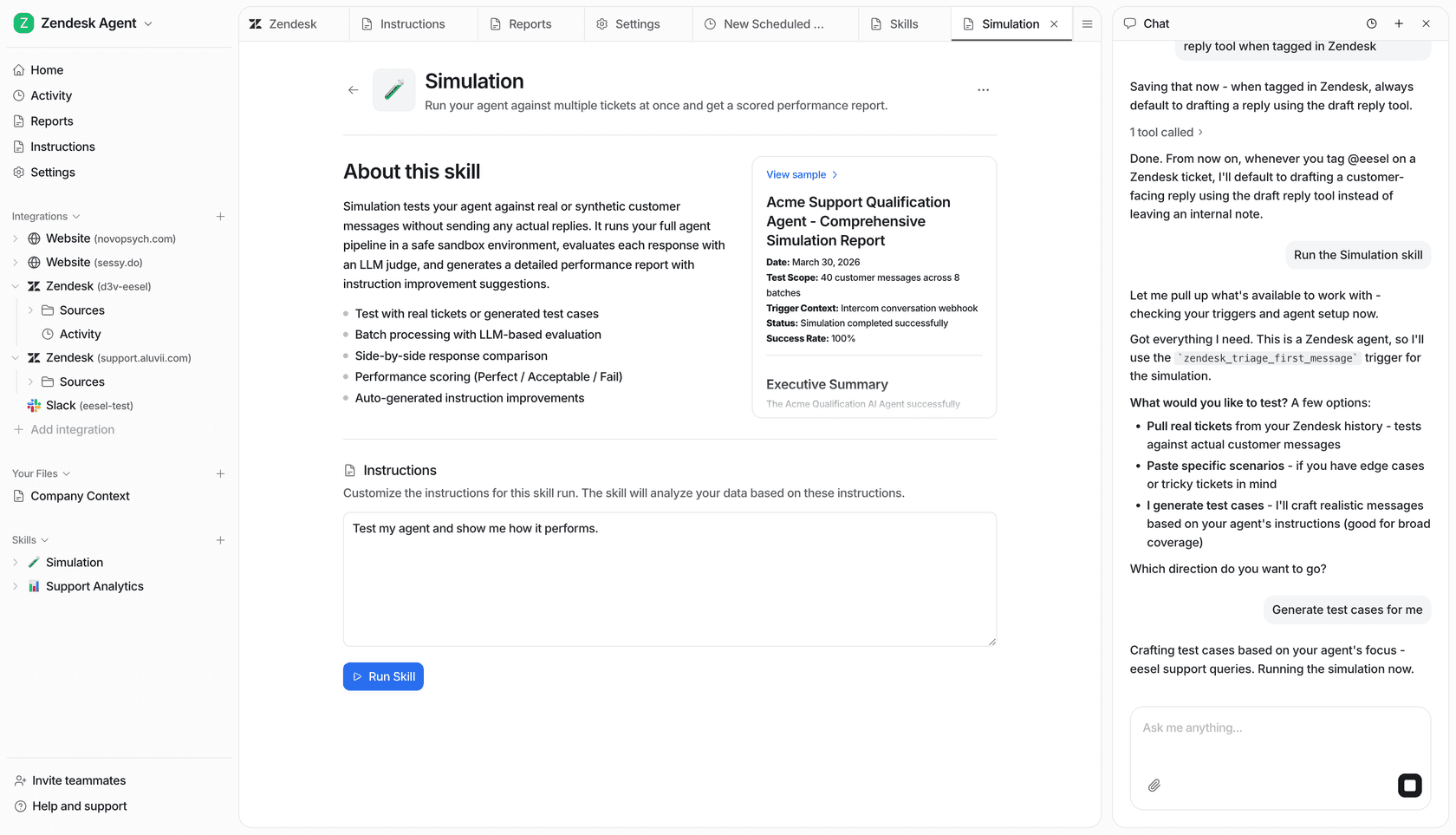
eesel AI is an integration-first AI layer that plugs into your existing help desk and knowledge sources. The shape is different from Serval's: there's no native ticketing in eesel, and the help desk you already use is the help desk that runs. The pitch is that the gap most teams have is AI, not the help desk; eesel slots into the gap without disturbing what works.
Strengths:
- Self-serve. You sign up, connect your help desk, and start without a sales call. One-click integrations with Zendesk, Freshdesk, Slack, and dozens of others. Time-to-first-automation is typically same-day, not multi-week.
- Wide knowledge ingestion. Trains on past tickets, macros, and internal docs in places like Confluence and Google Docs, Notion, SharePoint, Slack threads, and ticket history. Past tickets are particularly important, since they capture the long tail of edge cases that help docs miss.
- Simulation on past tickets. Run the AI against thousands of your historical tickets before going live and see exactly what its resolution rate would have been, where it would have escalated, and what knowledge gaps it surfaced. This turns "we hope this AI works" into "we know the expected outcome before launch."
- Granular control. A prompt editor lets you shape the AI's tone, scope, and what it's allowed to talk about. Selective automation rules let you start with one ticket category (e.g. "password resets only") and expand confidence over time rather than flipping the switch on everything at once.
- Internal IT and external customer support. Same product covers both shapes, useful for teams running both functions.
Considerations:
- It's an AI layer, not a full ITSM platform. If you want native ticketing, native access management, and workflows all in one product, the shape doesn't match what eesel does.
- The integration depth on identity providers is lighter than dedicated ITSM platforms. If granting JIT access through approval chains is the core thing you want to solve, an ITSM-native tool is a better fit.
- Some advanced multi-agent features are on the higher tier.
Pricing: Public, task-based (eesel.ai/pricing). $0.40 per resolved or drafted ticket, free for light tasks (lookups, searches), $4 per heavy task (e.g. a blog post). $50 in free credits to start, no card required. 25% off on annual plans ($300/mo minimum). Enterprise is a $1,000/mo flat fee with SSO, HIPAA option, and a dedicated solutions engineer.
2. Moveworks
Moveworks is an enterprise AI assistant platform built around a Reasoning Engine, Enterprise Search, and Agent Studio, automating tasks end-to-end across IT, HR, Finance, and other departments. Founded in 2016, it raised $315M before being acquired by ServiceNow for $2.85B (announced March 2025, completed December 2025).
Strengths:
- Enterprise scale, proven. Per Moveworks' own homepage, 5M+ employees rely on the platform across 350+ enterprise customers including 10% of the Fortune 500, with named customers including Toyota North America, BambooHR, Instacart, Coca-Cola Consolidated, AkzoNobel, and Procore. Multi-year deployments at this scale mean failure modes are well-understood.
- Deep ServiceNow integration. Now part of ServiceNow's portfolio, with first-class integration to ServiceNow ticketing, Knowledge Base, and the broader Now Platform. For ServiceNow shops, this is the most direct path to AI inside their existing stack.
- Cross-functional scope. Covers IT, HR, Finance, and other departments under one AI, which fits large organisations consolidating internal support across functions. Not designed for customer-facing support.
- Compliance posture. Per the Moveworks platform page: FedRAMP Moderate, SOC 2 Type 2, ISO 27001/27017/27018/27701, GDPR, HIPAA, CCPA. Right shape for regulated industries.
- Reasoning Engine architecture. Modular agentic architecture using multiple LLMs that "autonomously understand, plan, execute, and adapt on the fly." Agent Studio provides a low/pro-code IDE for custom agent development.
Considerations:
- Enterprise sign-up only (the pricing page returns 404; engagement is contact-sales). Multi-month implementations with typical 8-week time to value are standard.
- Probably out of reach for small and mid-market teams from a cost and complexity standpoint.
- Post-acquisition trajectory inside ServiceNow is still being defined. Customers can expect tighter integration over time, and possibly a roadmap shaped more around ServiceNow's strategy than Moveworks' independent direction.
- Not designed for external customer support.
Pricing: Enterprise contracts only, sales-led (the pricing page returns 404).
3. Aisera
Aisera is an enterprise agentic AI platform delivering autonomous execution across IT, HR, Finance, Procurement, Legal, Facilities, and Customer Service. It's a Gartner Magic Quadrant Leader for AI Applications in IT Service Management and was acquired by Automation Anywhere in November 2025, positioning the combined company as one of the larger enterprise agentic-AI players.
Strengths:
- Multi-domain scope. Where Moveworks and Serval focus internal IT, Aisera spans IT, HR, Finance, Procurement, Legal, Facilities, and Sales/CX through Aisera Unify. Right shape for organisations that want one AI layer across many functions.
- Real customer outcomes. Per Aisera's customer page: the City and County of Denver report 81% auto-resolution and 79,000 user hours saved; LifeScan report $2.2M cost savings and 65% automatic resolution; BDO Canada report 72% productivity increase.
- Open-standards orchestration. Aisera Unify uses A2A, MCP, and AGNTCY standards to coordinate native and third-party agents. Teams that don't want to be locked into a single vendor's agent runtime can mix Aisera with other agents.
- No-code, low-code, and pro-code tooling. Agent Composer includes Agent Library, Prompt Studio, Hyperflow Studio, an AI Workflow Builder with 1000+ pre-built actions, and Event Studio. Different team skill levels can build in the right layer.
- Compliance. SOC 2, ISO 27001, GDPR, HIPAA, CCPA, with the TRAPS (Trusted, Responsible, Auditable, Private, Secure) governance framework and 95+ language support.
- Big enterprise customer base. Cisco, Nokia, Workday, Adobe, Gilead Sciences, BNSF, Instacart, SP Global, Unisys, NJ Transit.
Considerations:
- No public pricing (the pricing page returns 404). Enterprise sales-led only.
- Post-acquisition trajectory inside Automation Anywhere is fresh (announced November 2025). Customers can expect tighter integration with Automation Anywhere's RPA platform over time, which is a feature for some buyers and a complication for others.
- Designed for Global 2000 enterprises; smaller teams may find the product surface area larger than they need.
- Multi-product family means evaluation can take longer; figuring out which Aisera product (AI Service Desk vs Aisera Assistant vs AIOps vs Agent Assist) fits your use case is part of the engagement.
Pricing: Enterprise contracts only, sales-led (pricing page returns 404).
4. Forethought
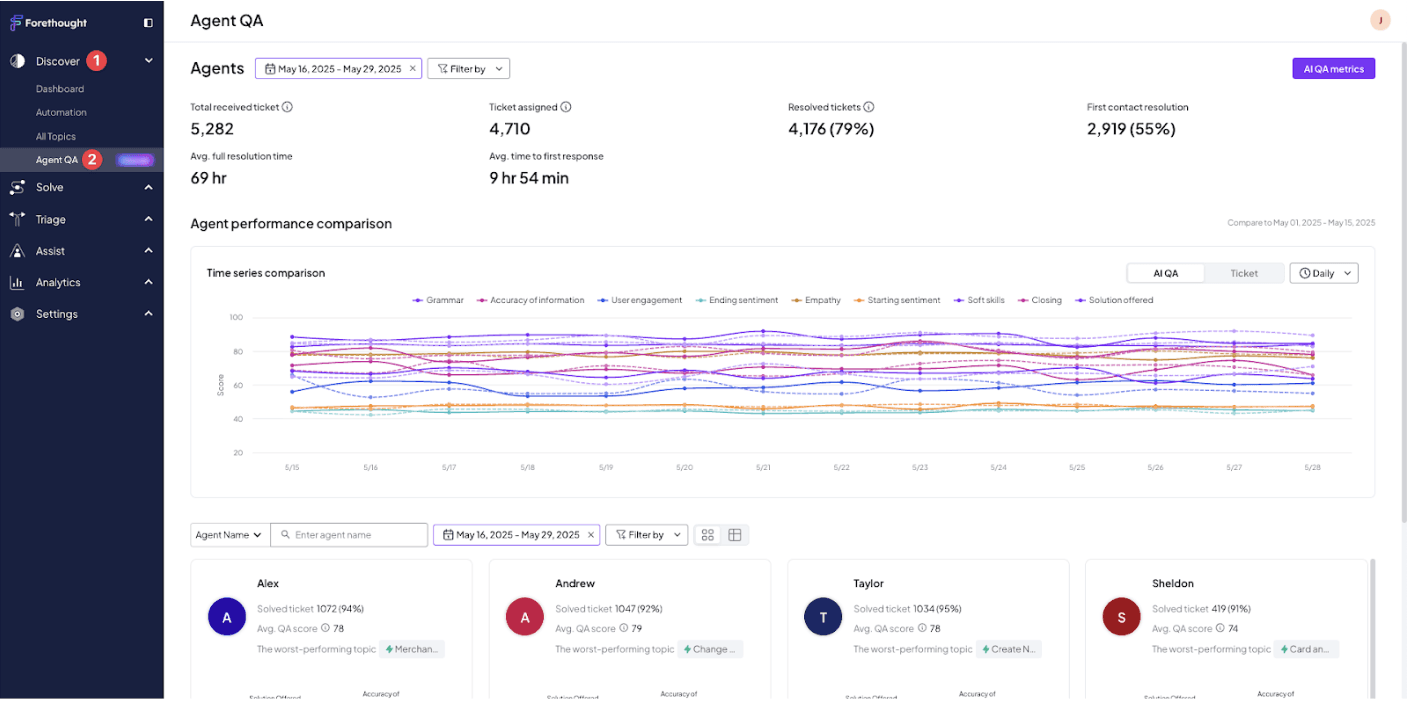
Forethought offers a suite of AI products (Solve, Triage, Assist, Discover) for customer support, with separate modules for resolution, ticket classification, and agent assistance. It was acquired by Zendesk in March 2026 for an undisclosed sum, with the technology being integrated into Zendesk's Resolution Platform.
Strengths:
- Modular product set. Solve handles end-to-end resolution, Triage handles classification and routing, Assist handles agent productivity, Discover surfaces insights and knowledge gaps. Teams can pick the part of the workflow they want to address first rather than committing to the full platform.
- Customer support focus. Unlike Moveworks and Aisera (internal-domain focus), Forethought is built specifically for external customer support, with workflow patterns and metrics aligned to that use case.
- Tight Zendesk integration. Already strong pre-acquisition; the post-acquisition roadmap tightens it further. Natural fit for Zendesk shops.
- Established customer base. Pre-acquisition customers included Upwork, Grammarly, Carta, Brex, Acorns, Datadog, Airtable, UPS, and Lattice. Per TechCrunch, the platform handled over 1 billion monthly customer interactions before the acquisition.
- Recent product additions. Browser Agents (handle automation tasks APIs cannot access), Orchestrator (convert business signals into measurable outcomes), and Test Suite (validate AI behavior before deployment) shipped in April 2026 per Forethought's blog.
Considerations:
- Multi-product setup can be more involved than a single AI layer; you may end up evaluating, configuring, and paying for several products.
- Pricing is sales-gated; the pricing page describes tiers (Basic, Professional, Enterprise) but doesn't publish dollar figures.
- Post-acquisition trajectory inside Zendesk is fresh. Existing customers are maintained, but the long-term product shape inside Zendesk is still forming. Non-Zendesk customers may face roadmap uncertainty.
- Not a fit for internal IT use cases.
Pricing: Sales-gated, tiered. Contact for figures.
5. Ada
Ada is a customer-facing AI agent platform widely used for automated conversations on websites and apps. One of the longer-running independent players in this space.
Strengths:
- Powerful no-code builder. Non-technical users can construct detailed conversation flows without writing code. The builder is widely considered one of the strongest in the category.
- Proactive and journey-driven use cases. Strong fit for sales chat, lead qualification, and structured customer journeys where you want to lead the user down a specific path.
- Conversation analytics. Detailed tracking of how flows perform, where users drop off, what intents trigger which paths.
- Well-established. Long history in the chatbot space means many integrations, mature product, and a large reference customer base.
- Independent. Unlike Moveworks, Aisera, and Forethought, Ada hasn't been acquired. Roadmap stays under its own control.
Considerations:
- Conversation-flow shape rather than ticket-resolution shape. For unstructured support queues where you want the AI to read a question and find an answer in your docs, that's a different primitive. Ada is at its best when the questions and paths are predictable enough to design flows for.
- Doesn't train on past tickets the way Solve, Forethought, or eesel do. Means the AI's coverage is limited to what you've built into flows, not the long tail of edge cases.
- More focused on standalone chat surfaces (your website, your app) than on automating tickets inside an existing help desk.
- Not designed for internal IT use cases.
- Sales-gated pricing.
Pricing: Contact sales.
How to choose
A few questions to ask yourself before deciding.
Do you want a platform or a layer?
A platform (Moveworks-via-ServiceNow, Aisera-via-Automation Anywhere) gives you a coordinated set of capabilities under one roof, often including ticketing or workflow runtime. A layer (eesel) sits on top of what you have. Both are valid; the right one depends on whether you want to commit to a unified system or keep your existing tools and add AI on top.
How do you want to evaluate?
If you want to spin up a trial yourself, run a simulation on past tickets, and see the data before involving sales, an integration-first AI layer with self-serve sign-up will fit better. If you want a guided rollout with an engineer alongside you and an enterprise procurement process, sales-led platforms fit better.
What's your scope?
Moveworks and Aisera are designed for internal employee support across IT, HR, and other functions. Forethought and Ada are built for external customer support. eesel covers both shapes in one product. Match the tool to the work, and to the buyer (an IT team and a CX team buying separately may pick different vendors).
How predictable does pricing need to be?
If your team needs to budget against a public price tier and avoid sales conversations, public task-based pricing (eesel) is the simpler shape. If you can accept a custom contract for a guided rollout, the sales-gated platforms are fine.
How much does ownership matter to you?
Three of the five platforms here have been acquired in the last twelve months. The acquisitions don't make the products bad, but they do change the strategic context. Moveworks now answers to ServiceNow's roadmap, Aisera to Automation Anywhere's, Forethought to Zendesk's. If your buying decision depends on a long-term independent roadmap, the two independent options are eesel and Ada.
A decision framework
If you want a more concrete way to map options to your situation, here's how the five typically sort:
| Your situation | Most likely fit |
|---|---|
| Mid-market team on Zendesk, Freshdesk, or Jira SM that wants AI on internal IT or customer support | eesel. Self-serve, plugs into your existing stack, covers both internal and external use cases. |
| Customer-support team committed to Zendesk | Forethought (now Zendesk-native) or eesel for cross-platform coverage. |
| Large enterprise already on ServiceNow | Moveworks (now ServiceNow). Tightest integration into the platform you've already chosen. |
| Global 2000 with multi-domain AI needs (IT + HR + Finance + Procurement) | Aisera. Multi-domain scope and orchestration across functions. |
| Team running both internal IT and external customer support | eesel. Same product covers both shapes. |
| Website chat for structured customer journeys (sales, lead-qual) | Ada. Conversation-flow shape is right for proactive use cases. |
| Team that wants to evaluate self-serve before any sales call | eesel. Public pricing, simulation on past tickets, no sales process required. |
| Buyer who values a vendor with an independent long-term roadmap | eesel or Ada (the two unacquired options). |
These are heuristics, not rules. A given team's specifics (team size, technical depth, current stack maturity, external vs. internal scope, regulatory requirements) might shift the right answer.
What's likely to change
A note on staleness, since this category is moving fast.
- Acquisitions. Three of the five platforms here have been acquired in the last twelve months. Expect at least one more in the same window. The next round of consolidation will probably target the remaining mid-sized independents.
- Post-acquisition product strategy. Moveworks-inside-ServiceNow, Aisera-inside-Automation Anywhere, and Forethought-inside-Zendesk are all very recent. Customers can expect product roadmaps to shift over the next 12-18 months in ways that aren't fully predictable yet. If you're signing a multi-year deal with an acquired platform, factor that in.
- Pricing. Public-pricing platforms (eesel) update tiers periodically; sales-gated platforms are negotiated per deal anyway. Verify with the vendor before signing.
- Product scope. Every platform here is shipping new agentic capabilities at pace. Forethought added Browser Agents, Orchestrator, and Test Suite in April 2026. Aisera shipped multilingual agents (95+ languages) and HIPAA compliance in 2025-26. Moveworks integrated into ServiceNow's Now Platform. The feature set 12 months from now will look meaningfully different.
If you're making a multi-year commitment, factor in not just where each platform is today but where it's heading.
Try eesel AI
If the integration-first shape fits how you want to work, eesel AI is set up to be evaluated quickly. Connect your help desk, point it at your knowledge sources, and run a simulation against thousands of past tickets to see expected impact before you turn it on.
Start a free trial or book a demo if you'd rather walk through it together.

Frequently asked questions
Common reasons: a preference for self-serve evaluation without a sales call, public pricing, an integration-first shape that adds AI to an existing help desk rather than a unified platform, or a need that includes external customer support rather than just internal IT.
Yes, three of the five. Moveworks was acquired by ServiceNow ($2.85B, completed December 2025), Aisera by Automation Anywhere (November 2025), and Forethought by Zendesk (March 2026). eesel AI and Ada remain independent.
Most teams care about: how the tool deploys, what it integrates with, how it handles knowledge sources, whether you can test before going live, and how pricing works. We use those as the comparison criteria below.
It varies. eesel AI has a simulation mode that runs on your historical tickets before go-live. Most other platforms require a sales engagement first.
No. This guide is published by eesel AI, which is one of the alternatives listed. We've described each platform using its own materials, with sources linked, and we've placed eesel first because we're recommending it. Verify each claim against the linked source if you want.
Share this article

Article by
Amogh Sarda
CEO of eesel AI. Amogh Sarda is obsessed with making the ultimate AI for customer service teams. He lives in Sydney, Australia and has previously worked at Atlassian and Intercom. Outside of work he’s usually surfing or on stage doing improv.