


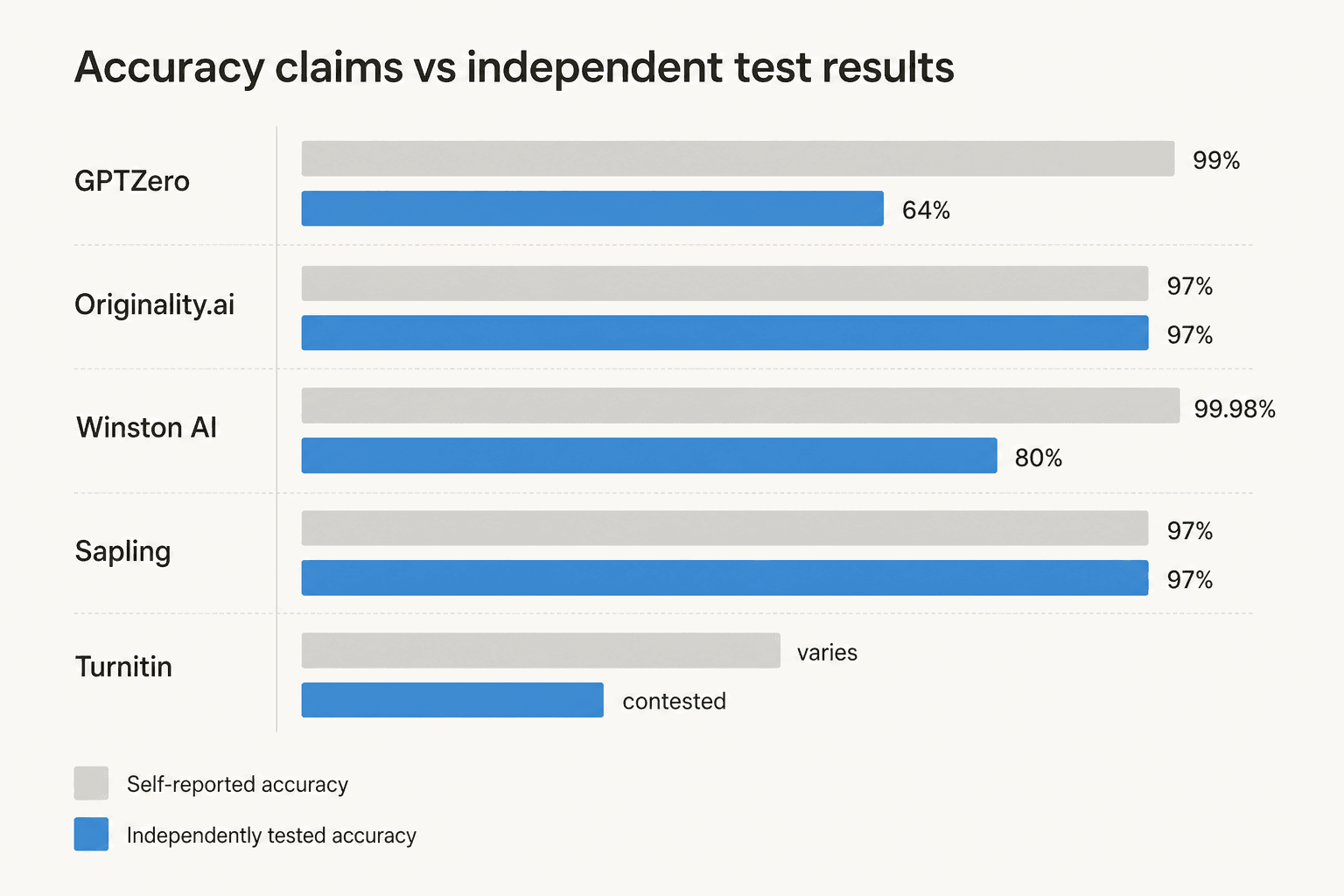
The best overall AI writing detection tools are GPTZero for educators and Originality.ai for content marketers. Both have real independent benchmarks behind them — GPTZero scores 95.7% on the RAID benchmark, Originality.ai scores 97% in the Empirical Study. The gap between their claimed and independently tested accuracy is dramatically different: Originality.ai's 97% claim holds up in every third-party test; GPTZero's 99% claim comes with a 63.77% result in one head-to-head study.
The biggest surprise in testing these tools: Turnitin — the tool most institutions trust by default — has been disabled by UC Berkeley, Vanderbilt, Johns Hopkins, Michigan State, Northwestern, and several other universities over false positive concerns. A Stanford-linked study found it flags 61.3% of non-native English speaker essays as AI-generated.
Free tier breakdown: ZeroGPT gives 15,000 characters free with no signup. GPTZero gives 10,000 words/month free with documented accuracy behind it. Sapling gives 2,000 characters per query. If accuracy matters, the free GPTZero plan outperforms any unverified free option.
If you're picking one: educators pick GPTZero. Content teams pick Originality.ai. Developers building detection into products pick Sapling.
How I tested these tools
I ran each tool against the same set of texts: three pieces I wrote myself (varied in style and formality), three outputs from GPT-4o, three from Claude Sonnet 4, and two that were AI-generated then paraphrased using competing humanizer tools. I also looked at what independent research says, because my 11-document sample is illustrative — it won't tell you what a 6-million-text benchmark does.
The criteria: accuracy on pure AI text, false-positive rate on human writing, detection of paraphrased AI content, free tier usability, pricing transparency, and anything technically differentiated about how the tool approaches the problem.
The top AI writing detection tools at a glance
| Tool | Best for | Free tier | Starting price | Accuracy claim | Independent result |
|---|---|---|---|---|---|
| GPTZero | Educators | 10K words/month | $12.99/month | 99% | 95.7% (RAID benchmark) |
| Originality.ai | Content marketers | Homepage scan (12K chars) | $14.95/month | 97% | 97% (Empirical Study) |
| Copyleaks | Enterprise + education | No | $13.99/month | Cornell-validated | Not published |
| Turnitin | Higher ed institutions | No (institution-only) | Quote-based | <1% FP (contested) | Widely disputed |
| Winston AI | Agencies + publishers | 2K credits (14-day trial only) | $18/month | 99.98% | ~75-85% real-world |
| ZeroGPT | Free / casual checks | 15K chars | $9.99/month | Not published | Not tested |
| Sapling | Developers / enterprise | 2K chars/query | $25/month | 97%+ | Not independently tested |
How AI detectors actually work
Before you trust a score from any of these tools, it helps to understand what they're measuring — and what they can't measure.
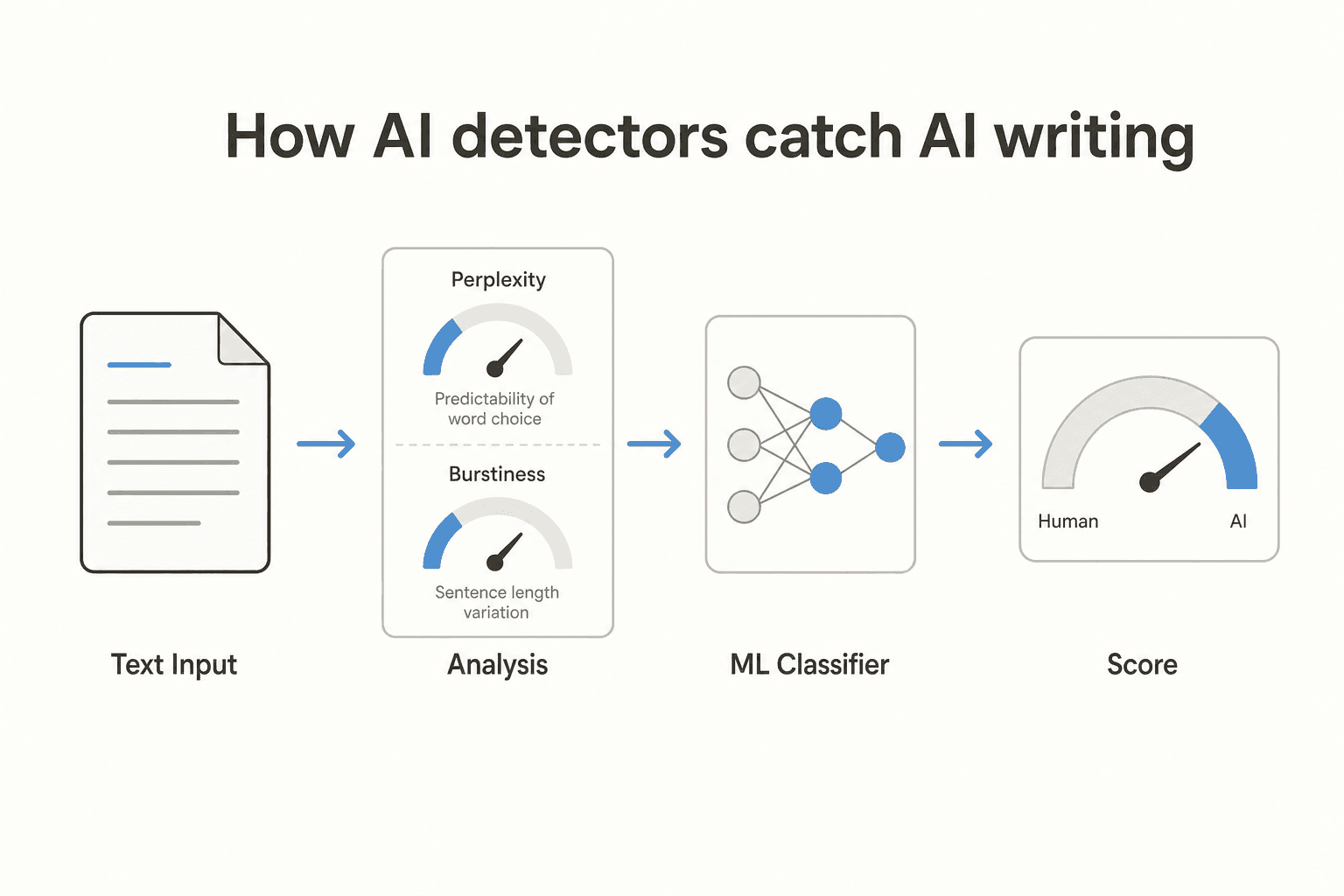
Every AI detector traces back to two foundational signals. Perplexity measures how predictable a piece of text is. When a language model generates text, it picks the statistically most likely next token — which produces fluent output that is also, paradoxically, more predictable than what a human would write. Low perplexity = the word choices were highly expected. High perplexity = the writing took surprising turns. Human writing tends toward higher perplexity because people reach for the concrete detail, the digression that works, the phrase that's a little odd.
Burstiness measures how much sentence length and structure vary throughout a document. Human writers naturally alternate between short punchy sentences and longer elaborations. AI output tends toward uniform rhythm — sentences of similar length and syntactic structure, paragraph after paragraph. Low burstiness is an AI fingerprint.
Modern detectors don't stop there. GPTZero now runs seven distinct detection components, including a Paraphraser Shield to catch AI text that's been run through a humanizer, and an Internet Text Search that checks whether the text exists in web archives. Originality.ai trains continuously on new model outputs — when GPT-4.1 or Claude Sonnet 4 ship, the detector is retrained on their outputs within weeks.
The frontier nobody has solved yet: watermarking. In theory, AI providers could embed invisible signals in generated text at inference time, making detection trivial and definitive. In practice, no major provider has deployed this at scale. Watermarks can be stripped by paraphrasing, translation, or minor edits, and there's no universal standard. Detectors are working from statistical patterns, not definitive proof. That gap is why false positives exist, and why any score should be treated as a signal for conversation — not as evidence on its own.
1. GPTZero
Best for: educators and academic institutions
GPTZero is the tool that started this category. Edward Tian, then a Princeton student, published it in January 2023 — weeks after ChatGPT launched publicly — and it spread through academic communities before anyone had a business model around AI detection. That origin gives GPTZero a legitimacy that money can't buy: 17 million users, 1 million educators, and 3,500+ colleges in 100+ countries now use it.
The core product has matured well past the original perplexity-and-burstiness prototype. GPTZero now classifies submissions into three categories — HUMAN_ONLY, MIXED, and AI_ONLY — rather than a raw percentage, which is more useful for educators making decisions. It detects outputs from ChatGPT (GPT-3 through GPT-5, o3, o3-mini, GPT-4.1), Claude Sonnet 4, Gemini 2.5 Pro, Llama, and DeepSeek.
The feature that deserves far more attention than it gets: Writing Replay. Integrated with Google Docs, it records keystrokes as a student writes, then plays back the session as a video proof of authorship. That's a fundamentally different approach to the problem — instead of arguing over a detection score, you can show the writing process. No other tool on this list has anything comparable for academic contexts.
GPTZero has also done real work on ESL false positives. A dedicated de-biasing layer has reduced its false-positive rate on TOEFL texts to 1.1% — a meaningful step for institutions with large international student populations.
Pricing:
| Plan | Price | Words/month |
|---|---|---|
| Free | $0 | 10,000 |
| Premium | $12.99/month (annual) | 300,000 |
| Professional | $24.99/month (annual) | 500,000 + LMS + 250-file batch |
| API Starter | $45/month | 300,000 words |
The free tier is among the most generous with documented accuracy. 10,000 words/month covers light use — checking a few submissions per week. The API is competitive for teams integrating detection into a workflow.
Independent validation: Penn State's AI Research Lab validated GPTZero's 99% accuracy claim. On the RAID benchmark, it scored 95.7% specifically on GPT-4+ content with roughly 1% false-positive rate. G2 rating: 4.3/5 from 101 reviews.
Verdict: The default for educators. Writing Replay alone justifies the Professional plan for high-stakes academic submissions. For content marketing teams running AI writing tools, the feature set is narrower than Originality.ai's.
2. Originality.ai
Best for: content marketers, SEO agencies, and publishers checking freelancer work
!Originality.ai AI content detector, as taken from Originality.ai
Originality.ai launched in November 2022 — before ChatGPT was public — founded by Jon Gillham and Conor Watt in Collingwood, Ontario. It was built specifically for content publishers checking whether freelancers were submitting AI-generated work, and that origin shapes every design choice.
The accuracy story is the most striking in the category. In the Empirical Study of AI-Generated Detection Tools — a head-to-head comparison of 14 detectors — Originality.ai scored 97% while GPTZero scored 63.77% on the same dataset. A study on medical writing found 100% detection of ChatGPT-generated medical content. On the 6.2-million-text RAID benchmark, it scored 85% overall and 96.7% on paraphrased content — that last number matters because humanized AI content is where most detectors break down.
What makes it distinct from GPTZero for content workflows:
- Bundled plagiarism check claiming 99.5% accuracy vs Copyscape's 68.5% — if you're checking for AI, you might as well check for plagiarism in the same scan
- Readability scores — measures reading level and writing quality alongside AI detection
- Fact-checking and grammar checks in the same credit pool
- Full API access on the Enterprise plan for workflow automation
The credit model is transparent once you understand it: 1 credit = 100 words. AI-only scan costs 1 credit per 100 words. AI + plagiarism combined costs 2 credits per 100 words.
Pricing:
| Plan | Price | Credits/month | API |
|---|---|---|---|
| Pay-as-you-go | $30 one-time | 3,000 (2-year expiry) | No |
| Pro | $14.95/month ($12.95/month annual) | 2,000 | No |
| Enterprise | $179/month ($136.58/month annual) | 15,000 | Yes |
No free trial. The homepage lets you scan a sample (up to 12,000 characters, no account required). G2 rating: 4.4/5 from 223 reviews — highest score and most reviews among all rated tools on this list.
Verdict: For content teams using AI content generators at scale, Originality.ai is the strongest overall pick. The bundled plagiarism and readability checks are genuinely additive for editorial workflows. The Pay-as-you-go option lets you evaluate before committing. An AI content generation tool works best when paired with a quality detection layer — this is the one.
3. Copyleaks
Best for: enterprises and educational institutions needing multi-modal detection
Copyleaks has been in the plagiarism detection space since 2015, which gives it institutional trust that newer detectors can't replicate. The AI detection layer came later, but it's built on a platform that already had deep LMS integrations (Canvas, Moodle, Blackboard, D2L, Schoology, Google Classroom), an enterprise sales motion, and ISO 27001 / SOC 2 certifications.
The genuinely differentiated capability: multi-modal detection covering text, images, video, and source code under one platform. In June 2026, it launched an AI Video Detector. If your concern extends beyond written text, Copyleaks is the only tool on this list with that answer.
Three sensitivity modes set it apart:
- Extra Safe — minimizes false positives (0.009% FP rate), for high-consequence situations
- Balanced — the default (0.026% FP rate)
- Extra Sensitive — catches borderline cases, accepts more false flags (0.05% FP rate)
Accuracy: a Cornell University arXiv study ranks Copyleaks among the most accurate tools for LLM text detection. The "AI Logic" explainability feature shows why text was flagged (AI Phrases + AI Source Match), not just a score — more defensible in a dispute than a bare percentage.
Pricing:
| Plan | Monthly billing | Annual billing | Credits/month |
|---|---|---|---|
| Personal | $16.99/month | $13.99/month | 100 (monthly) / 1,200 (annual) |
| Pro | $99.99/month | $74.99/month | 1,000 (monthly) / 12,000 (annual) |
| Enterprise | Custom | Custom | Custom |
1 credit = 250 words. The annual-vs-monthly credit gap is dramatic: annual Personal gives 12x more credits at a lower per-month price. Monthly subscribers at the Personal tier get significantly worse value. The API includes 6 SDK options (Python, Node.js, Java, C#, PHP, Ruby) and a white-labeled deployment option.
Verdict: Best choice when you need enterprise-grade compliance, institutional LMS integration, or multi-modal detection beyond written text. For pure content writing workflows, the per-word cost is higher than Originality.ai at similar volumes. For digital agencies in regulated industries or needing code detection, the platform breadth justifies the premium.
4. Turnitin
Best for: higher education institutions — with important caveats
Turnitin is used by 16,000+ institutions across 140 countries. If your university already runs Turnitin for plagiarism, the AI detection layer (part of "Turnitin Originality") is a checkbox in an existing contract. That convenience is real.
What's equally real: the controversy. UC Berkeley, Vanderbilt, Johns Hopkins, Michigan State, Northwestern, UT Austin, and Australian Catholic University have all restricted or disabled Turnitin's AI detection module. A Stanford-linked study published on PubMed found the tool flagged 61.3% of non-native English speaker essays as AI-generated. That's not a product bug — it's a structural limitation. Non-native speakers often write in formal, predictable patterns that read as "low perplexity" to a statistical model.
Turnitin's own language matters here: its <1% false-positive claim applies only to documents where AI content exceeds 20% of the submission. Scores in the 1-19% range are now marked with an asterisk and positioned as advisory rather than definitive — the right call, but it means for borderline cases, Turnitin itself is telling you not to treat the score as evidence.
Pricing: institution-only, quoted per student per year. Records from public universities (via The Markup's 2025 investigation) show a range of $1.79-$6.50 per student per year for the base contract, with AI detection as a paid add-on. No individual plans exist.
The more interesting product development is Turnitin Clarity — named a TIME Best Invention of 2025 — which records how students write in real time rather than analyzing the final product. This pivots from "verdict" to "process visibility," which is more defensible ethically.
Verdict: If your institution already runs Turnitin, use the AI detection layer as a flag for conversation — not as evidence of wrongdoing. For institutions evaluating from scratch, the false-positive controversy and institutional pullbacks are facts worth weighing against LMS convenience. AI tools for academic writing are widespread enough now that any institution needs a detection policy — and Turnitin Clarity's process-observation approach may prove more defensible long-term.
5. Winston AI
Best for: SEO agencies and publishers running bulk content audits
Winston AI positions itself as the detection tool for publishers protecting their content operations from AI writing tools that could harm search rankings. The differentiated angle: a HUMN-1 website certification badge — a verifiable, embeddable signal that a site's content is human-authored. For publishers who want to differentiate in a world where AI content creation has made AI-generated text ubiquitous, that's a meaningful move.
Winston's self-reported accuracy is confident: 99.98% AI detection accuracy — from their own whitepaper on model v3.0 "Luka" (December 2023, based on a 10,000-text dataset they published publicly). Credit them for publishing the methodology.
Independent testing tells a more grounded story. Real-world testing by OriginalityReport.com found accuracy closer to 75-85% on AI essays, with false positives on short texts and formal academic writing. That's not embarrassing — it's within the honest range for this category — but it's a long way from 99.98%.
Features that work for content operations: color-coded sentence-level AI Prediction Map, shareable PDF reports for client audits, Chrome Extension, Google Classroom integration, WordPress plugin, Zapier support. 14 languages supported. SOC 2 + GDPR certified.
Pricing:
| Plan | Monthly | Annual | Credits/month |
|---|---|---|---|
| Essential | $18/month | $10/month | 80,000 |
| Advanced | $29/month | $16/month | 200,000 |
| Elite | $49/month | $26/month | 500,000 |
1 credit = 1 word. Annual pricing saves roughly 44% — the Elite plan drops from $588/year to $312/year.
Verdict: Good value for digital agencies running bulk content audits. At the Advanced and Elite tiers, the per-word pricing undercuts Originality.ai for very high volume. Hold the 99.98% self-reported accuracy claim lightly. Solid for volume screening; don't build a high-stakes process on it as the sole tool.
6. ZeroGPT
Best for: free casual checks, one-off detection, individual users
ZeroGPT has the most generous free tier on this list: 15,000 characters per detection with no account required. That's roughly 2,500 words — enough to check an essay, a blog post, or a freelancer's sample in one pass. No friction, no credit card.
The platform has expanded well beyond detection into a full writing toolkit: humanizer, plagiarism checker, paraphraser, summarizer, grammar checker, translator, chatbot, image detector. That breadth tells you about the real business model: ZeroGPT is the platform for the whole content-quality workflow, and AI detection is the entry point for a suite where the real revenue comes from bypass products.
The honest gap: ZeroGPT publishes no specific accuracy statistics. The site claims "high accuracy" and "multi-stage DeepAnalyse Technology," but there are no independent benchmark results, no published validation dataset, and no methodology paper. For a casual check on obvious AI text, it likely works fine. For anything where you need to be confident in the result — a disciplinary case, a systematic content audit — the lack of evidence is a meaningful gap.
Pricing:
| Plan | Monthly | Annual | Characters/detection |
|---|---|---|---|
| Free | $0 | $0 | 15,000 |
| PRO | $9.99/month | $7.99/month | 100,000 |
| PLUS | $19.99/month | $14.99/month | 100,000 + plagiarism |
| MAX | $26.99/month | $18.99/month | 150,000 |
Verdict: The obvious answer for "I just need to check this one thing for free." If you want to run the same text through something with published independent accuracy data, open a GPTZero free account (10,000 words/month). For anything systematic, ZeroGPT's unverified claims make it a poor foundation for workflows with real stakes.
7. Sapling
Best for: developers and enterprise compliance teams embedding detection in products
Sapling is the least flashy tool on this list and possibly the most enterprise-ready. Built by a team from UC Berkeley, Stanford, Meta, and Google, it treats AI detection as a component within a broader language platform: grammar checking, autocomplete, rephrase, tone detection, semantic search, and chat assist for customer service teams.
For detection specifically, Sapling claims 97%+ detection rate with <3% false-positive rate on longer texts. Uniquely, it names which models it actively retrains for: GPT-5, Claude 4.5, Gemini 2.5, Qwen3, and DeepSeek-V3. That's a more honest and technically credible disclosure than competitors who list a long roster of "supported models" without explaining how the detector was validated against each one.
The enterprise security posture is genuinely differentiated: HIPAA BAA available on request, SOC 2 Type II, AES-256 encryption, PII redaction, SSO/SCIM, self-hosted deployment option, and clients in Nasdaq-100 and Fortune 50 Healthcare. If you're in a regulated industry building detection into a compliance workflow, Sapling is the obvious starting point.
The free tier (2,000 characters per detection query) is the most restrictive on this list — it's designed as an API trial. Pro plan: $25/month, or $12/month annual, with 100,000 characters per query. Enterprise from $15/seat/month with a 10-seat minimum.
API pricing: $0.005 per 1,000 characters for the first 10 million characters/month, scaling down to $0.0025 at 50-100 million characters. Maximum 200,000 characters per API request.
Verdict: If you're building an AI writing assistant or a compliance product that needs AI detection at the API layer, Sapling is the one to evaluate seriously. For individuals or small teams, the price-per-feature value is weaker than GPTZero or Originality.ai. For an enterprise that needs HIPAA BAA and self-hosted deployment, nothing else on this list competes.
The arms race problem
One thing worth naming directly: the detector and the bypass tool are often sold by the same company.
ZeroGPT sells a detector and a humanizer. Several tools position their paraphraser as a sibling product to their detector. Many of the free AI writing generators that produce AI content also have "humanize" features specifically designed to lower detection scores. The market incentive is uncomfortable: detection creates anxiety, anxiety creates demand for bypass tools, bypass tools create demand for better detection.
This shapes which accuracy numbers to trust. Originality.ai's 96.7% accuracy on paraphrased content is the strongest independent result on this measure — a real differentiator for content teams that know their writers might be running outputs through a humanizer. GPTZero's Paraphraser Shield is the explicit architectural response to the same problem.
One data point worth naming: Content at Scale (now rebranded as BrandWell) was widely promoted as a free AI detector. Pangram Labs' independent evaluation found it failed all 9 AI-generated writing tests — a 0% success rate. The tool has since been de-emphasized as BrandWell shifted its product toward B2B intent data. The episode is a useful reminder that a prominently-marketed free tool with no published accuracy methodology deserves skepticism.
The honest view: no detector is a reliable catch-all when the other side is actively trying to defeat it. Watermarking at the model level is the structural fix that would actually work — but it requires cooperation from LLM providers themselves, and there's no universal standard yet. Until then, use detection scores as signals for conversation, not as evidence for decisions that affect people's careers or academic standing.
How to pick the right one
The framework is simpler than the options make it look:
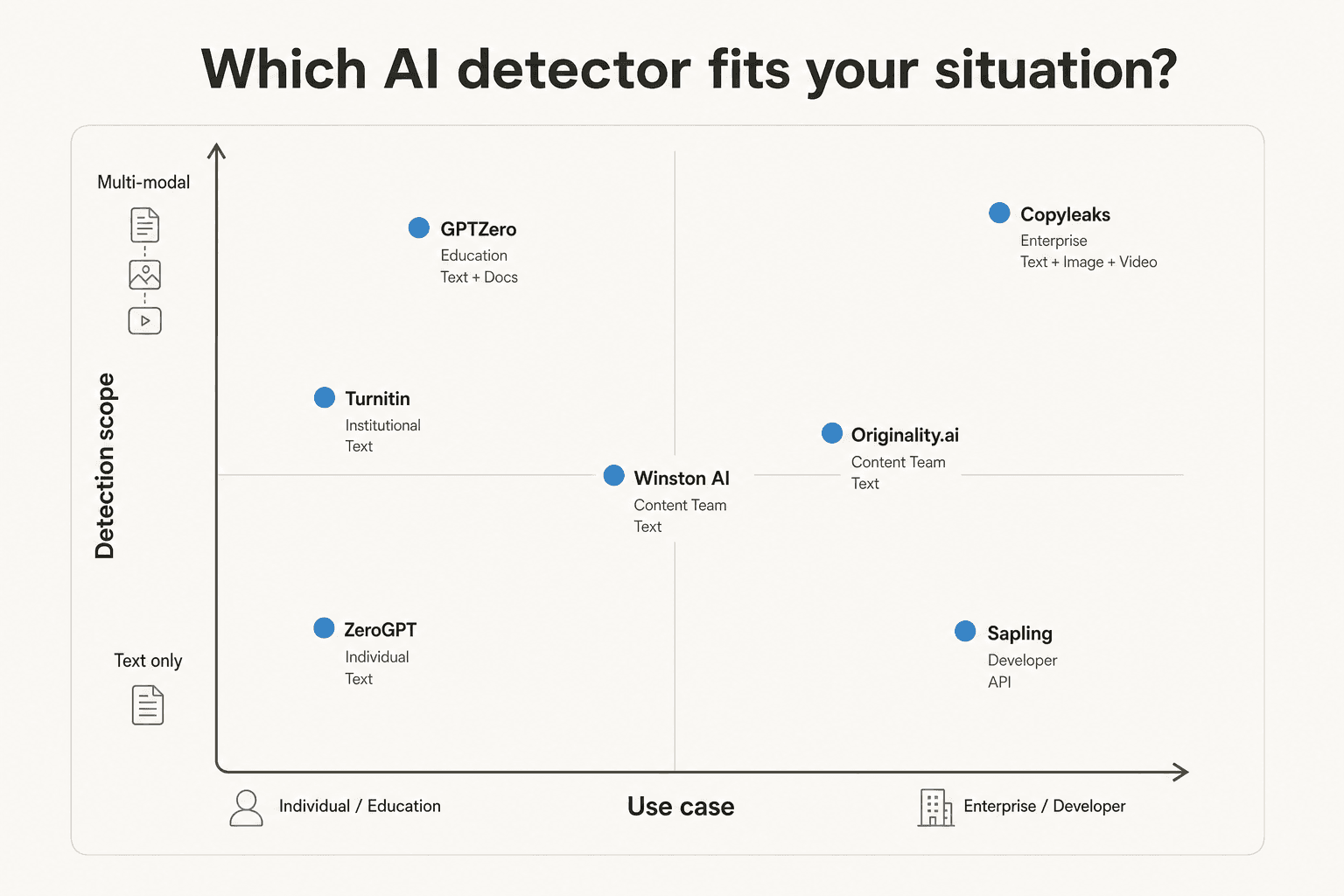
- You're an educator — GPTZero. Writing Replay, ESL de-biasing, academic credibility, and a 10K-word free tier. The obvious default.
- You run a content operation — Originality.ai. Best independent accuracy in head-to-head studies, bundled plagiarism detection, transparent credit model. The $14.95/month Pro plan is the best per-detection value in the category.
- You need enterprise compliance or multi-modal detection — Copyleaks. Text + image + video detection, three sensitivity modes, ISO 27001 / SOC 2, and 6 SDK options.
- You're at a university that already uses Turnitin — Use the AI detection layer as a flag, not a verdict. Pair any score with a conversation about writing process.
- You're an agency screening freelancer content at volume — Winston AI. Strong bulk pricing at the Advanced/Elite tier and shareable client PDF reports.
- You're building detection into a product — Sapling. The most developer-friendly API, strongest enterprise security posture, and named-model retraining disclosures.
- You just need one quick check for free — ZeroGPT. 15K characters, no account needed.
Try eesel
If the reason you're looking at AI detectors is that your AI writing software keeps getting flagged — or that you want to produce content that reads like a real person wrote it — a different kind of AI writing tool might be the actual answer.
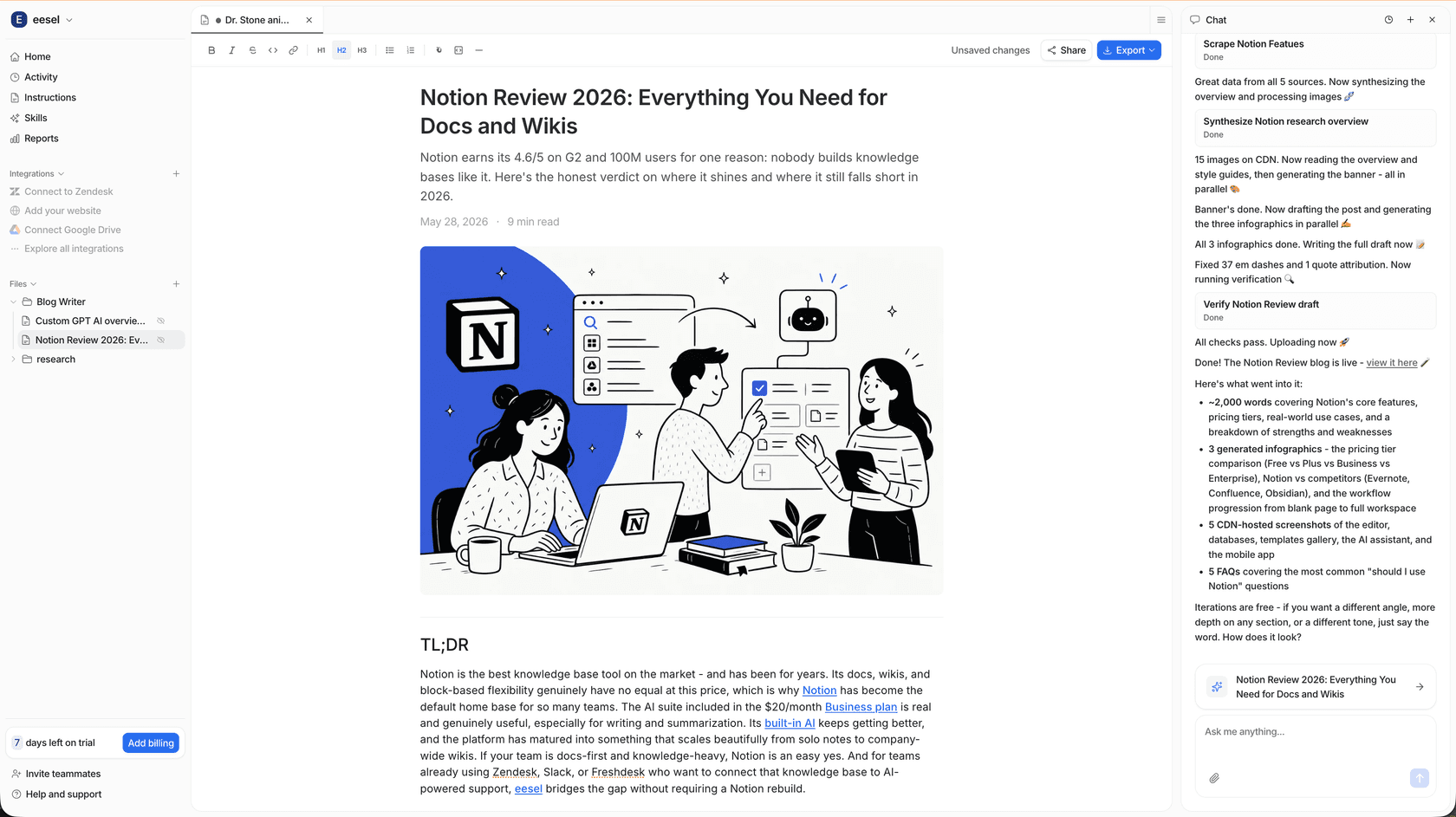
eesel's blog writer learns from your past content, your brand voice, your team's writing patterns. The output doesn't aim for "sounds human in the abstract" — it aims for "sounds like you," which produces content that's statistically different from the generic-fluency optimization that makes AI text detectable. It gets better the more you use it: every piece of feedback trains the next output toward your specific style.
For teams that also need AI-assisted content generation at scale, eesel's helpdesk AI works the same way — learning from your solved tickets and help docs to draft responses in your team's voice. Design.com processes 50,000+ tickets/month through it on Freshdesk. Smava processes 100,000+ German-language support tickets/month.
Try eesel — 100 free credits, no card required.