

Why teams look for ElevenLabs alternatives
The pattern from G2 (4.5/5, 1,140+ reviews) and Trustpilot (3.2/5, 635 reviews) tells a consistent story.
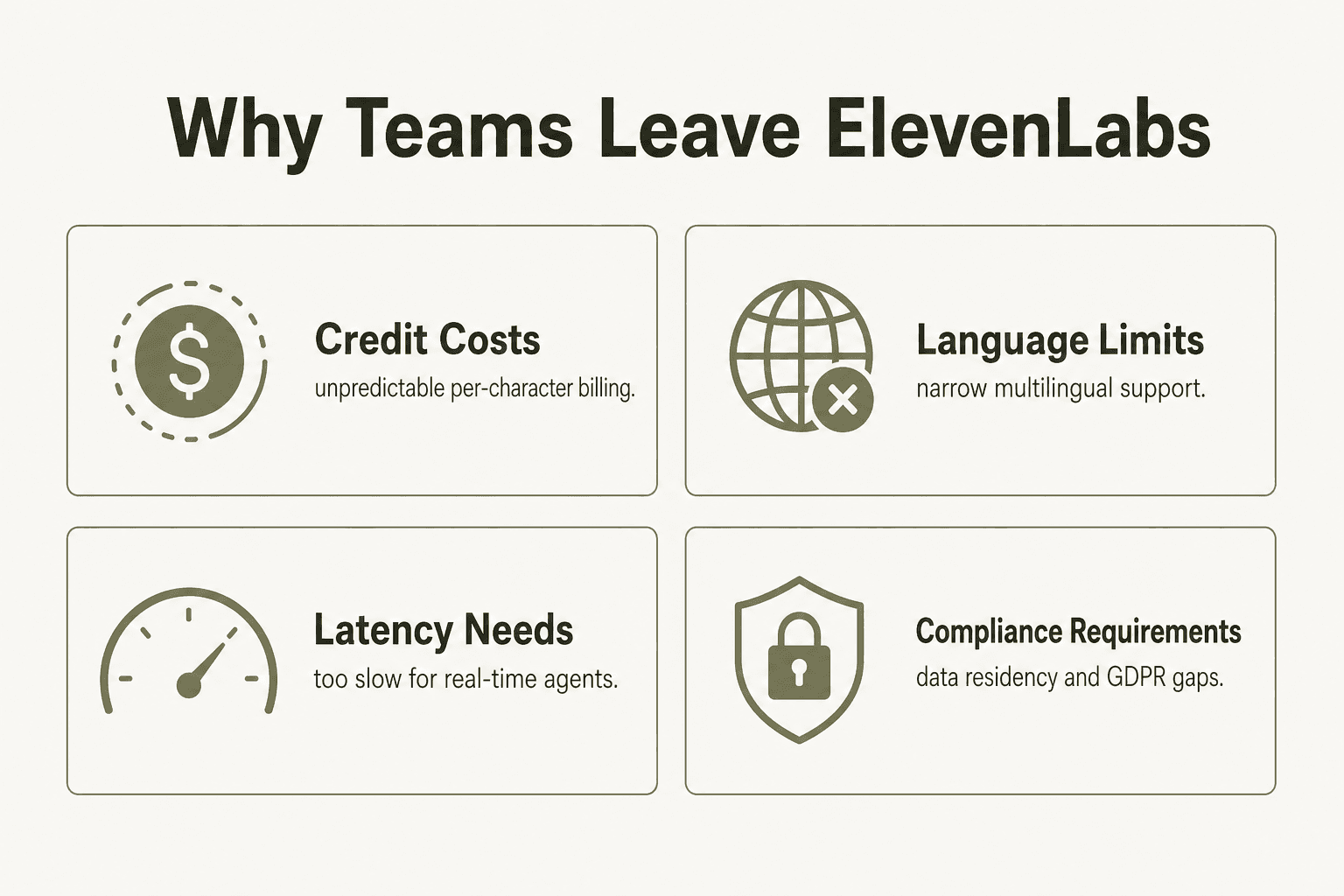
Credits burn faster than expected. ElevenLabs charges per generation attempt - not per successful output. Every regeneration, every failed run, every test consumes credits. Users on Reddit consistently report effective costs running 2.8x the advertised rate. A $22/mo Creator plan with 121,000 characters often feels like 40,000 usable characters in practice when you factor in the inevitable back-and-forth on long-form content.
Real-time use cases need different architecture. ElevenLabs' standard Multilingual v2 model sits at 200–400ms latency. That's acceptable for audiobooks but rough for a phone AI that needs to feel responsive. Flash v2.5 hits 75ms, but at reduced expressiveness compared to v3. Voice agent platforms that need sub-100ms responses at full quality have better options now.
Language support isn't always as deep as advertised. ElevenLabs lists 70+ languages, but community reports flag inconsistent pronunciation and accent drift for many non-English locales - especially on content over 10 minutes. Murf AI's Gen2 model achieves 99.38% pronunciation accuracy across 300,000 multilingual sentences, which tells a different story about what "multilingual support" actually means.
Some teams need a full editor, not an API. ElevenLabs is a voice generation platform. Descript and LOVO AI are production environments where voice is one feature among many. A podcaster fixing a stumble doesn't want to regenerate an entire clip in a separate tab and manually splice it back in.
How we picked these ElevenLabs alternatives
We focused on eight criteria: voice naturalness at comparable quality tiers, pricing transparency (actual cost vs. advertised sticker), latency (documented, not claimed), language coverage, voice cloning quality and accessibility, integration breadth, compliance certifications, and community feedback from G2, Reddit, and X/Twitter.
We excluded Play.ht, which was acquired by Meta in July 2025 and permanently shut down on December 31, 2025. All user data was deleted at year-end. Any resource still listing Play.ht as a live alternative is out of date.
ElevenLabs alternatives at a glance
| Tool | Best for | Free tier | Starting price | Voices | Languages | Voice cloning | API | Latency | Compliance | G2 rating |
|---|---|---|---|---|---|---|---|---|---|---|
| ElevenLabs | General voice AI | 10K chars/mo | $6/mo | 3,000+ | 70+ | IVC + PVC | Yes | 75ms (Flash) | SOC 2, HIPAA | 4.5/5 |
| Murf AI | Enterprise content | 10 min (lifetime) | $19/mo | 200+ | 35+ | Enterprise only | Yes | 130ms (Falcon) | SOC 2, ISO 27001, HIPAA | 4.7/5 |
| Cartesia | Real-time agents | ~27 min/mo | $4/mo | - | 40+ | Yes | Yes | 90ms | SOC 2 | - |
| Deepgram | High-volume API | Pay-as-you-go | $0.030/1K chars | 40+ | 7 | No | Yes | ~90ms | SOC 2, HIPAA | - |
| LOVO AI | Video content | 14-day trial | $24/mo (annual) | 500+ | 100+ | Yes | Yes | - | SOC 2 | 4.5/5 |
| Speechify | Voice productivity | Yes | $11.58/mo (annual) | 1,000+ | 60+ | Yes | Yes | 250ms | SOC 2 | - |
| WellSaid Labs | Enterprise L&D | No | $50/mo | 120+ | English only* | Enterprise only | Enterprise | <600ms | SOC 2, GDPR | 4.7/5 |
| Resemble AI | Voice cloning | Open source (Chatterbox) | $0.0005/sec | Custom | 23 | Yes | Yes | ~75ms | SOC 2, EU AI Act | - |
| Descript | Podcast/video editing | Limited trial | $16/mo (annual) | Your voice only | 20 | Own voice only | No | - | SOC 2 | 4.6/5 |
*WellSaid multilingual requires Enterprise plan.
The 8 best ElevenLabs alternatives in 2026
1. Murf AI - best for enterprise content creation
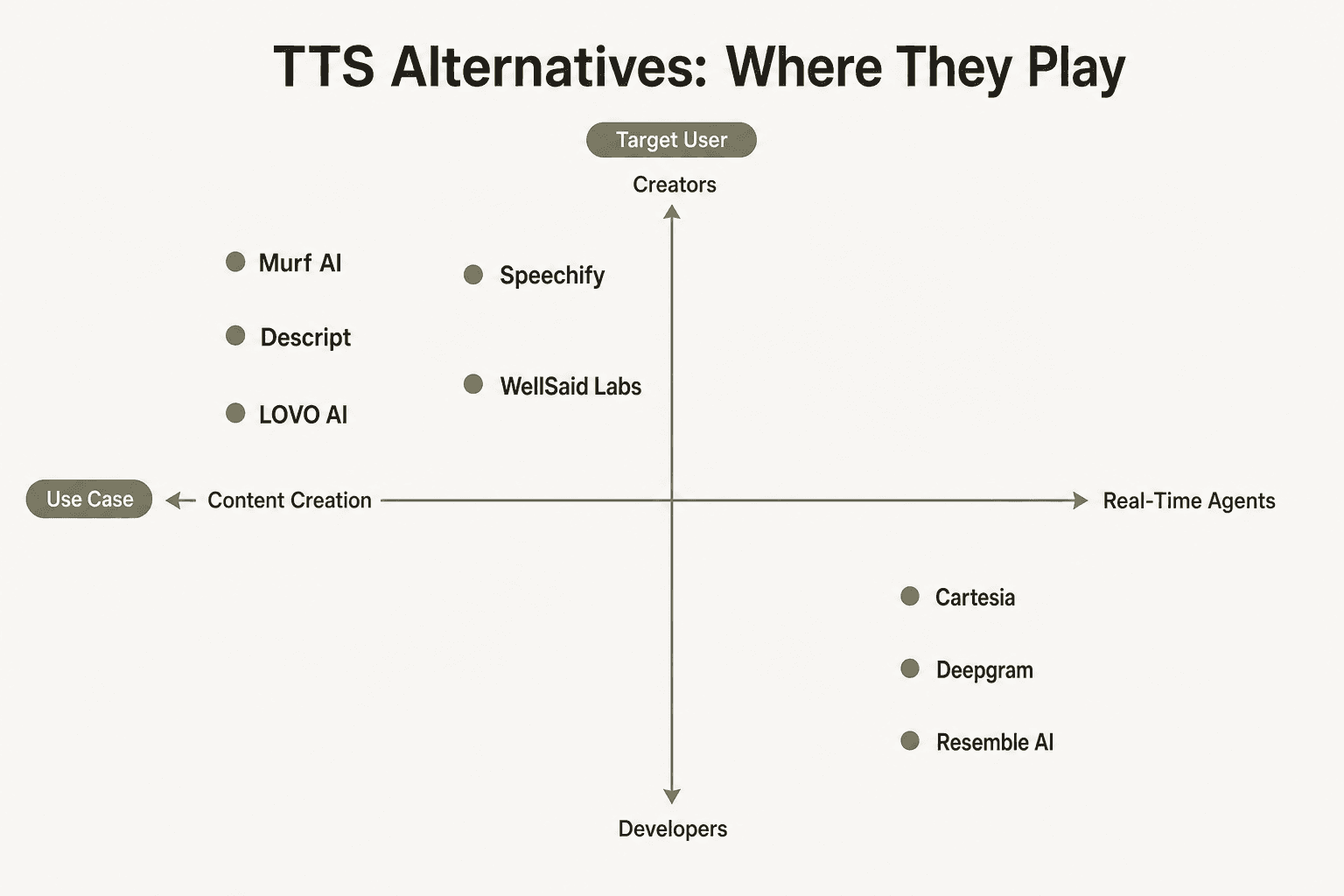
Best for: eLearning teams, corporate L&D, marketing voiceovers, voice agent developers
Murf AI is the ElevenLabs alternative most directly competing for enterprise customers. It runs three products: Murf Studio (browser-based voiceover editor), Murf API (the Falcon real-time TTS API), and Murf Dub (AI video dubbing into 40+ languages). Over 10 million developers and creators use it, including 300+ Forbes 2000 companies - Nestlé, Air France, Vertiv, Honeywell, and Omnicom are publicly listed customers.
The headline number is 130ms time-to-first-audio on Falcon - their real-time API, verified by third-party relay tests across 33 global locations. Murf claims it's the fastest in the category, and benchmarks put it ahead of ElevenLabs, OpenAI, and Cartesia for production-grade latency at $0.01 per minute. ElevenLabs Flash costs roughly $0.30–0.50 per minute equivalent at comparable quality.
The tradeoff is expressiveness. G2 scores put Murf at 6.5/10 for emotion vs ElevenLabs' 7.5/10. For game character dialogue or entertainment content requiring dramatic range, ElevenLabs has an edge. But for eLearning narration, corporate training, IVR systems, and product demo videos - where consistency and naturalness matter more than dramatic range - Murf's 99.38% pronunciation accuracy (tested across 300,000 multilingual sentences) is genuinely excellent.
Enterprise ROI figures from Murf's customer base: Nestlé reported 30% faster voiceover production, Vertiv cut translation time by 95%, and Omnicom achieved 45% faster production across 25 languages.
Pros:
- Fastest real-time API in class at 130ms (Falcon model, third-party verified)
- SOC 2, ISO 27001, HIPAA, GDPR - enterprise procurement-ready on day one
- Native integrations: Canva, PowerPoint, Google Slides, Articulate 360, Adobe, Cisco telephony
- Ethical: voice actors consent and earn royalties on every use
- G2 4.7/5 - higher than ElevenLabs
Cons:
- Studio plans use annual hours, not monthly resets (Creator: 24 hrs/year, Business: 96 hrs/year)
- Emotion score (6.5/10 G2) lags ElevenLabs for character voice and entertainment work
- Voice cloning is Enterprise-only, reportedly $3,000–$8,000/year
- Free tier is lifetime 10 minutes - demo-only, not an ongoing option
Pricing:
| Plan | Monthly price | Voice generation | Notes |
|---|---|---|---|
| Free | $0 | 10 min lifetime | No downloads, demo only |
| Creator | $19/mo | 24 hrs/year | Commercial license, 1 editor seat |
| Business | $66/mo | 96 hrs/year | Transcription, PowerPoint plugin, Business $66/mo |
| Enterprise | Custom | Unlimited | 5+ seats, voice cloning, HIPAA BAA |
| Falcon API | $0.01/min | Pay-as-you-go | 130ms latency, real-time |
| Gen2 API | $0.03/1K chars | Pay-as-you-go | 99.38% accuracy, higher quality |
Verdict: For eLearning teams, corporate L&D departments, or developers building voice agents at scale with compliance requirements on day one, Murf AI is the most complete ElevenLabs alternative. The 130ms API latency and sub-$0.01/min pricing at scale are genuinely better economics. Where it falls short - emotional depth and accessible voice cloning - the next two options on this list have different answers.
2. Cartesia - best for real-time voice agents
Best for: Developers building voice AI, real-time phone agents, IVR, on-prem deployments
Cartesia was built specifically for the latency requirements of real-time voice agents. The Sonic-3.5 model delivers 90ms time-to-first-audio on flagship quality - roughly the same latency as ElevenLabs Flash v2.5, but at substantially higher naturalness. ElevenLabs' better-quality models sit at 200–400ms, making them unsuitable for phone AI that needs to feel conversational. Cartesia's turbo variants hit ~40ms.
The engineering foundation is deliberately different from ElevenLabs: Cartesia uses State Space Models (SSMs) rather than Transformers for streaming inference. SSMs are architecturally more efficient for sequential audio generation, which is how Cartesia can deliver quality-per-latency that Transformer-based systems struggle to match. The team includes Albert Gu and Tri Dao, co-creators of the Mamba and H-Nets architectures - deep technical research turned product.
The economics at scale are striking. At Cartesia's Scale tier ($239/mo), you get approximately 10,667 minutes of TTS. ElevenLabs' $99 Pro tier gives roughly 600 minutes. At comparable quality tiers, Cartesia is roughly 10–15x cheaper per audio minute. The company has raised $91M total ($27M seed from Index Ventures, $64M Series A from Kleiner Perkins in March 2025) - enough runway to treat as a serious long-term vendor. ServiceNow, Quora Poe, and Zomato are among the enterprise customers.
On-prem and on-device deployment is a differentiator that no other mainstream TTS platform offers at this price tier - for regulated industries that can't send audio to third-party cloud APIs, Cartesia is often the only viable option.
Pros:
- 90ms TTFA on flagship quality - best quality-per-latency ratio available
- ~10–15x cheaper per audio minute than ElevenLabs at Scale tier
- On-prem and on-device deployment - unique among mainstream TTS platforms
- No per-request character limit (ElevenLabs Flash caps at 40,000 chars)
- Voice cloning from noisy recordings - doesn't require studio-clean audio
- $91M in funding from Kleiner Perkins - enterprise-grade backing
Cons:
- 40+ languages vs ElevenLabs' 70+ - real gap for multilingual-first products
- Developer-first interface - less polished no-code experience vs Murf or LOVO
- Creative narration quality rated below ElevenLabs v3 in community reviews
- Free plan has no commercial use rights
Pricing:
| Plan | Monthly price (annual) | TTS minutes | Voice agents | Notes |
|---|---|---|---|---|
| Free | $0 | ~27 min | - | No commercial use, instant cloning |
| Pro | $4/mo | ~133 min | - | Commercial use, instant cloning |
| Startup | $39/mo | ~1,667 min | - | Professional voice cloning |
| Scale | $239/mo | ~10,667 min | - | Priority support, high concurrency |
| Enterprise | Custom | Custom | Custom | On-prem, BAA, SSO |
| Voice Agents | $0.06/min | - | All plans | Per call-minute |
Verdict: For developers building real-time voice agents, phone AI, or any latency-sensitive application, Cartesia is the clearest technical upgrade from ElevenLabs. The economics at scale are dramatically better. If you're a content creator rather than a developer, Murf or LOVO will serve you better - Cartesia doesn't try to be a studio tool.
3. Deepgram - best for high-volume TTS API
Best for: Enterprise API teams, healthcare SaaS, regulated industries, high-volume English TTS
Deepgram built the best speech-to-text API in the developer market (Whisper-competitive accuracy, faster inference), then extended into TTS. Their Aura model family - 40+ English voices named after astronomical figures (Asteria, Orion, Luna, Helios) - runs at $0.030 per 1,000 characters for Aura-2, vs. ElevenLabs Flash at $0.050/1K chars. At 10 million characters/month, that's $200/month saved just by switching TTS providers.
Developer benchmarks from Gradium and FutureAGI consistently rate Aura-2 in the top tier for conversational voice quality. Latency sits at ~90ms when optimized with sentence chunking and WebSocket streaming - genuinely competitive with Cartesia for real-time voice agent platforms. Enterprise customers include Twilio, Cloudflare, IBM, and Daily. Vapi and Retell AI (two leading voice agent orchestration frameworks) both default to Deepgram for STT, which means your speech-to-text and TTS pipeline can live in a single vendor relationship.
The hard limitation: Deepgram TTS supports only 7 languages. Not a typo. For any application that needs multilingual voice - even just English and Spanish - Deepgram stops being viable immediately. But for English-first, high-volume, compliance-heavy deployments, the combination of HIPAA certification, on-prem deployment availability, and 40% cheaper-than-ElevenLabs pricing is difficult to match.
Pros:
- 40% cheaper than ElevenLabs Flash on a per-character basis
- HIPAA and SOC 2 Type 2 certified - one of the few TTS platforms with HIPAA
- On-prem deployment available (Enterprise) - air-gapped option for regulated industries
- STT + TTS in one vendor - simpler architecture for voice agent builders
- ~90ms optimized latency - competitive with real-time alternatives
Cons:
- Only 7 languages - the biggest limitation by a wide margin
- No voice cloning - just the Aura model library with preset voices
- Less expressive than ElevenLabs v3 for narration, entertainment, character work
- English-only TTS limits global product roadmaps
Pricing:
| Product | Rate (PAYG) | Rate (Growth tier) | Notes |
|---|---|---|---|
| Aura-2 TTS | $0.030/1K chars | $0.027/1K chars | Flagship quality |
| Aura-1 TTS | $0.015/1K chars | $0.0135/1K chars | Lower cost tier |
| STT (Nova-3) | $0.0043/min | - | Industry-leading accuracy |
| Enterprise | Custom | Custom | HIPAA BAA, on-prem, SLA |
Verdict: The strongest ElevenLabs alternative for English-only, high-volume, enterprise-compliance environments. The 7-language cap is a dealbreaker for global products, but for US/UK-focused regulated industries - healthcare SaaS, fintech, government - Deepgram's HIPAA certification, Aura-2 quality, and 40%-lower-than-ElevenLabs pricing make a compelling combination. Check out our best voice assistant AI comparison if you need a broader roundup of AI voice tools.
4. LOVO AI - best for video content creators
Best for: YouTube creators, marketing video teams, explainer video producers, social media content
LOVO AI (also marketed as Genny) occupies a category ElevenLabs doesn't really compete in: all-in-one AI content production for video creators. Beyond TTS, LOVO bundles a full video editor (Genny) with FHD export, an AI script writer, auto-subtitle generation, an AI art generator, and team collaboration tools. If you're producing YouTube tutorials, explainer videos, or social content, LOVO replaces four separate tools with one subscription.
The voice breadth is impressive: 500+ voices, 100+ languages, and 30+ emotion presets. That's more voices and more languages than ElevenLabs' Creator tier covers - and LOVO's Pro V2 "directable" voices (introduced in 2025–2026) let you specify delivery style before generating, which reduces the regeneration-until-right loop that frustrates ElevenLabs users. Voice cloning from a 1-minute audio sample is available from the Basic plan ($24/mo annual).
There's one notable oddity: per LOVO's own FAQ, the platform licenses some multilingual voices from ElevenLabs for specific language-accent combinations. So for certain multilingual voice selections, you're getting ElevenLabs voice quality through LOVO's wrapper - which complicates any direct quality comparison for those specific combinations.
The community reviews split sharply. G2 and editorial review sites rate LOVO at 4.2–4.5/5. Trustpilot sits at 2.3/5 - a significant cluster of billing complaints, unauthorized renewals, and voices being removed from the library without notice. This pattern appears consistently enough across multiple review platforms to flag as a real operational risk.
Pros:
- Only mainstream TTS platform with a built-in full video editor (Genny, FHD export)
- 500+ voices, 100+ languages - widest language coverage on this list
- 30+ emotion presets + directable Pro V2 voices
- Team collaboration on all paid plans
- Voice cloning from 1-minute sample on the lowest paid tier
Cons:
- Trustpilot 2.3/5 - billing complaints and difficult cancellation documented
- Voices removed from library without notice (disrupts ongoing projects mid-production)
- Support response time: 1–2 weeks reported on Reddit
- Entry price ($24/mo annual) higher than ElevenLabs Starter ($6/mo)
- Some multilingual voices are licensed from ElevenLabs (per LOVO's own FAQ)
Pricing:
| Plan | Annual price | Monthly price | Voice generation |
|---|---|---|---|
| Free Trial | $0 | - | 14 days, 20 min |
| Basic | $24/mo | $29/mo | 2 hrs/mo |
| Pro | $24/mo | $48/mo | 5 hrs/mo |
| Pro+ | $75/mo | $149/mo | 20 hrs/mo |
| Enterprise | Custom | Custom | Unlimited |
Verdict: The right choice for YouTube creators, marketing teams, and video producers who want a single platform for script-to-final-video production. The Genny video editor alone justifies it over standalone TTS tools when you're already editing in-platform. Go in with eyes open about billing practices - use annual billing carefully, keep backups of any voice clones you've created, and verify voices are still available before committing to a large project. Also worth looking at HeyGen alternatives if you need AI avatar video rather than just voiceover.
5. Speechify - best for voice productivity
Best for: Accessibility, research-heavy workflows, content consumption, teams doing heavy reading
Speechify is a category mismatch with ElevenLabs in the best way: ElevenLabs is for producing voice content, and Speechify is primarily for consuming it. Its flagship feature is speed listening at up to 5x reading speed - something ElevenLabs doesn't offer and doesn't try to. If you read Slack threads, research papers, PDFs, and long-form articles by listening to them, Speechify operates in a different product category.
Founded by Cliff Weitzman - who has dyslexia and built the original app as a personal accessibility tool - Speechify has grown to 55 million users. It won the 2025 Apple Design Award and carries a 4.7/5 rating on the iOS App Store with 1M+ reviews. It's the dominant consumer TTS platform by an order of magnitude.
The Speechify Studio product is where it competes more directly with ElevenLabs: 1,000+ voices, 60+ languages, voice cloning from a 20-second browser recording, dubbing, and an API at $10 per 1 million characters. Speechify's own benchmarks claim the Simba TTS model outperforms ElevenLabs, Cartesia, OpenAI, and Gemini on voice cloning similarity metrics. Independent testing puts naturalness at about 12% below ElevenLabs, which is noticeable for professional narration but fine for productivity use.
The billing complaint pattern is real - unauthorized auto-renewals and difficult cancellation appear consistently on Trustpilot and the BBB. The web version is the only place to cancel (mobile subscribers often miss this).
Pros:
- 55M users - most widely adopted consumer TTS platform
- Speed listening at up to 5x - uniquely valuable for research-heavy teams
- 2025 Apple Design Award, 4.7/5 iOS App Store - best mobile TTS experience
- All-in-one voice productivity: reading, dictation, meeting notes, AI podcast creation
- Voice cloning from 20 seconds in the browser - extremely accessible
Cons:
- Billing complaints: unauthorized renewals ($229–$395 charges on BBB) are common
- Free tier is deliberately limited (10 voices, 1.5x speed cap)
- Cancellation only on desktop - mobile subscribers miss this
- Studio quality ~12% below ElevenLabs on naturalness benchmarks
- Android instability compared to iOS
Pricing:
| Product | Plan | Monthly | Annual per month |
|---|---|---|---|
| TTS Reader | Free | $0 | $0 |
| TTS Reader | Premium | $29/mo | ~$11.58/mo |
| Studio | Free | $0 | $0 (600 credits) |
| Studio | Starter | $19/mo | - |
| Studio | Creator | $49/mo | - |
| API | Free | $0 | $0 (10K chars) |
| API | Pay-as-you-go | - | $10/1M chars |
Verdict: For voice productivity and content consumption, Speechify is in a league of its own. For professional voice content production, the Studio product is a valid ElevenLabs alternative at a lower price point, but voice quality trails ElevenLabs v3. We'd reach for Speechify when the use case is processing large volumes of content by ear - not when producing a polished narration for a marketing video or podcast. For AI voice assistant comparisons, see our broader roundup.
6. WellSaid Labs - best for enterprise L&D
Best for: Corporate training, regulated industries, L&D teams, enterprise procurement
WellSaid Labs makes one argument better than anyone else on this list: every voice is modeled on licensed recordings from real, paid voice actors. No synthetic generation from scraped audio, no undisclosed training data, no model sharing with external providers. Your scripts and audio never train external models. In enterprise procurement - healthcare, government, financial services - that argument carries real weight that feature comparisons can't capture.
The platform is deliberately narrow: 120+ voices, English-focused on standard plans, no video editor, no music generation. What it delivers is consistent, professional-quality narration that sounds like a human voice actor did it properly. Microsoft's learning team, APS Energy Services, and Motul are publicly referenced customers.
"It's as simple as copy, paste, download, plug, play. The ease of use is what makes it perfect, and it blows the competitors out of the water."
Joe Hauglie, Senior Instructor, APS Energy Services (via WellSaid Labs)
The AI Director feature lets you specify delivery direction before generating - not just speed and pitch, but instructions like "more confident" or "warmer" - which reduces regeneration loops dramatically for content teams working against a deadline. Native Adobe integration matters for L&D teams working in Creative Suite. G2 rates it 4.7/5 - the highest on this list alongside Murf.
The hard constraints: English-only on standard plans (multilingual requires Enterprise), $50/mo minimum (2.5x ElevenLabs' entry price), and no self-service voice cloning. Billing complaints on Trustpilot appear at a similar frequency to LOVO - a consistent soft spot.
Pros:
- 100% ethically sourced voices - real voice actors licensed and compensated
- Closed model - your scripts never train external systems (critical for regulated industries)
- AI Director for delivery control - reduces regeneration cycles
- Native Adobe integration
- G2: 4.7/5 - highest community satisfaction rating on this list
- SOC 2, GDPR, HIPAA-ready on Enterprise plan
Cons:
- English-only on Creative and Business plans - multilingual is Enterprise-gated
- $50/mo minimum - 2.5x more expensive than ElevenLabs at entry
- No self-service voice cloning (Enterprise-only, custom contracts)
- Billing complaints on Trustpilot (similar pattern to LOVO)
- API access requires Business or Enterprise tier
Pricing:
| Plan | Monthly price | Seats | Key features |
|---|---|---|---|
| Creative | $50/mo | 1 | 120+ voices, unlimited projects, English |
| Business | $160/mo | 1 | Collaboration, API, pronunciation controls |
| Enterprise | Custom | 5+ | Custom voice avatars, multilingual, HIPAA BAA, SSO |
Verdict: The safest enterprise pick for regulated industries and L&D teams that prioritize ethical voice sourcing, compliance, and narration consistency over breadth or price. The English-only limit on standard plans is a genuine constraint - if you're building for multilingual audiences, WellSaid pushes you to Enterprise pricing. For US-focused corporate training, onboarding content, and medical narration, it's the most procurement-safe option here. Also worth checking Synthesia alternatives if you need AI avatar video to go with the narration.
7. Resemble AI - best for voice cloning and security
Best for: Voice cloning specialists, EU compliance, on-prem deployments, security-sensitive applications
Resemble AI tells a story no other TTS platform on this list tells: we generate, verify, and detect synthetic voice. The 2025 expansion into deepfake detection (DETECT-3B Omni, 98.1% accuracy across audio, image, and video) positions it as the only TTS vendor that treats AI voice security as a first-class product concern, not an afterthought.
The most technically notable piece is Chatterbox - their open-source TTS model released under the MIT license. In blind listener evaluations, Chatterbox beat ElevenLabs in 65.3% of tests, with 24,000+ GitHub stars and over 10 million Hugging Face downloads since launch. Chatterbox Turbo hits ~75ms latency and clones a voice from just 5 seconds of audio. Zero-shot multilingual cloning means you train a voice clone once in English and generate in 23 languages without per-language retraining - a capability ElevenLabs' Professional Voice Clone doesn't match.
The PerTh watermarker - built into all Resemble-generated audio - makes provenance verifiable and was designed for EU AI Act Article 50 compliance ahead of the August 2026 mandatory watermarking deadline. If you're publishing AI-generated voice at scale in the EU, Resemble is currently the only mainstream platform designed for this requirement.
In December 2025, Resemble raised a $13M Series B led by Sony Innovation Fund and Okta Ventures - a pairing of an entertainment company and a security firm that says something about where they're positioning in the market.
Pros:
- Chatterbox open-source model beats ElevenLabs in 65.3% of blind listener tests
- Zero-shot multilingual cloning in 23 languages - train once, generate anywhere
- Only TTS platform with bundled deepfake detection (98.1% accuracy)
- EU AI Act Art. 50 compliant via PerTh watermarker - designed for August 2026 deadline
- On-prem and air-gapped deployment available
- MIT-licensed Chatterbox for self-hosted, zero-subscription usage
Cons:
- Per-second Flex pricing ($0.0005/sec) can be harder to budget than flat subscriptions
- Smaller community than ElevenLabs - less public G2/Reddit coverage
- Less polished no-code interface for non-technical users
- Enterprise-skewing pricing model - smaller teams may find it complex to evaluate
Pricing:
| Product | Rate | Notes |
|---|---|---|
| TTS (Flex) | $0.0005/sec | Pay-per-second, no minimum |
| Voice Agents (Flex) | $0.001/sec | Real-time synthesis |
| Audio Detection | $0.04/sec | Deepfake detection |
| Enterprise | Custom | On-prem, BAA, SLA, custom concurrency |
| Chatterbox (open-source) | Free | MIT license, self-hosted |
Verdict: The deepest ElevenLabs alternative for voice cloning specialists and security-sensitive deployments. Chatterbox being MIT-licensed and genuinely beating ElevenLabs in blind tests is a remarkable open-source result. For teams thinking about EU compliance, on-premise deployment requirements, or audio provenance verification, Resemble AI is the only platform designed for those requirements from the ground up.
8. Descript - best for podcast and video editors
Best for: Podcasters, video creators, anyone who records their own audio and needs to fix it
Descript is a different kind of ElevenLabs alternative - an audio and video editor first, where voice AI is one feature of many. The central innovation is transcript-based editing: import audio or video, get an instant transcript, and edit the media by editing the text. Delete a word from the transcript - it's cut from the recording. That's the core, and it changes how editing feels.
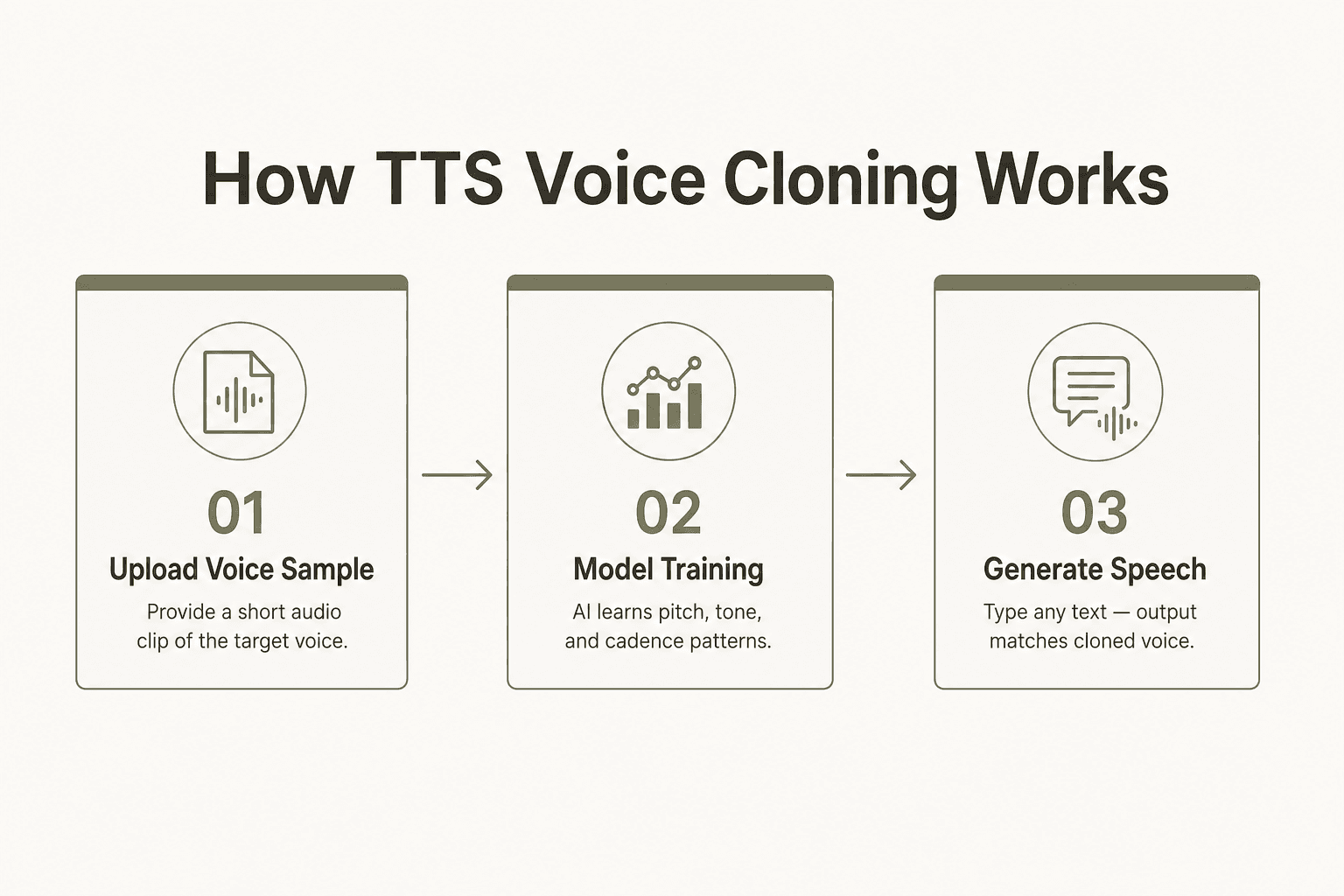
Voice cloning (Overdub) plugs into this workflow at exactly the right moment: you recorded a podcast, you stumble over a phrase, you delete the words from the transcript and type what you meant to say - Descript regenerates just that segment in your cloned voice. Training now takes ~60–90 seconds from your existing recording. The result is context-aware audio correction rather than standalone TTS generation.
The design constraint is deliberate: Overdub only clones your own voice. Descript won't let you clone someone else's. This makes it non-viable as a general-purpose TTS platform, but exactly right for its target: a podcaster or video creator who wants to fix their own recordings without re-recording in a booth.
Notable customers: Amazon, Canva, Salesforce, Figma, Spotify, Reuters, CBS, NYT, GitHub, and Microsoft. G2 gives it 4.6/5 and Best Software 2025 awards in Video Editing, AI Video Generators, and Text to Speech.
Pros:
- Transcript editing - the most natural UX for podcast and video correction workflows
- Voice cloning trains in ~60–90 seconds from your existing recordings
- Regenerate feature patches audio quality around cuts (removes background noise in targeted spots)
- No separate TTS subscription needed for self-voice corrections
- G2: 4.6/5 - Best Software 2025 across three categories
- Used by Amazon, Canva, Salesforce, Spotify
Cons:
- Only clones your own voice - not a general TTS replacement
- No API - can't use in apps, pipelines, or automations
- Voice naturalness trails ElevenLabs on longer generated passages
- Much smaller stock voice library vs ElevenLabs (a few named voices vs 3,000+)
- 20 languages vs ElevenLabs' 32+ - limited multilingual coverage
Pricing:
| Plan | Annual price | Monthly price | Voice cloning |
|---|---|---|---|
| Free | $0 | $0 | Limited AI speech trial |
| Hobbyist | $16/mo | $24/mo | Overdub + Regenerate |
| Creator | $24/mo | $35/mo | Full AI speech + video generation |
| Business/Enterprise | Custom | Custom | Full suite |
Verdict: We'd reach for Descript in exactly one scenario: you record your own audio or video and need to fix it after the fact without a re-recording session. The transcript editor makes corrections feel like editing a Google Doc rather than using a DAW. For everything else - stock voices, third-party character voices, bulk TTS generation, API access - Descript isn't the tool, and one of the earlier options will serve you better.
What about ElevenLabs itself?
We'd do you a disservice if we glossed over this: ElevenLabs is still the quality benchmark for creative voice AI in 2026. Eleven v3 is the most emotionally expressive TTS model available - the kind of delivery that sounds like a trained actor. The 10,000+ voice library, 70+ language support, and Professional Voice Clone tier (from $22/mo) are genuine advantages over most alternatives.
The G2 score of 4.5/5 from 1,140+ reviews reflects real quality. The Trustpilot score of 3.2/5 reflects real frustration - mostly around the credit model and billing, not the voice output itself.
If your use case is audiobooks, game character voices, entertainment dubbing, or any creative context where emotional range matters more than budget, ElevenLabs remains the first choice. The alternatives on this list win on specific dimensions - price, latency, compliance, workflow - not on raw voice quality at the top tier. Our full ElevenLabs review breaks down where it earns its price and where it doesn't.
Try eesel.ai
If you're building AI-powered automation for your support or knowledge workflows, eesel.ai deploys AI teammates directly inside the tools you already use - Zendesk, Slack, Freshdesk, email, Shopify, and 100+ more. Unlike point solutions, eesel agents read tickets, draft replies, take actions, and handle entire workflows autonomously, with no new interface to adopt. Teams handling 100,000+ tickets/month use it to resolve the majority without a human touching them.
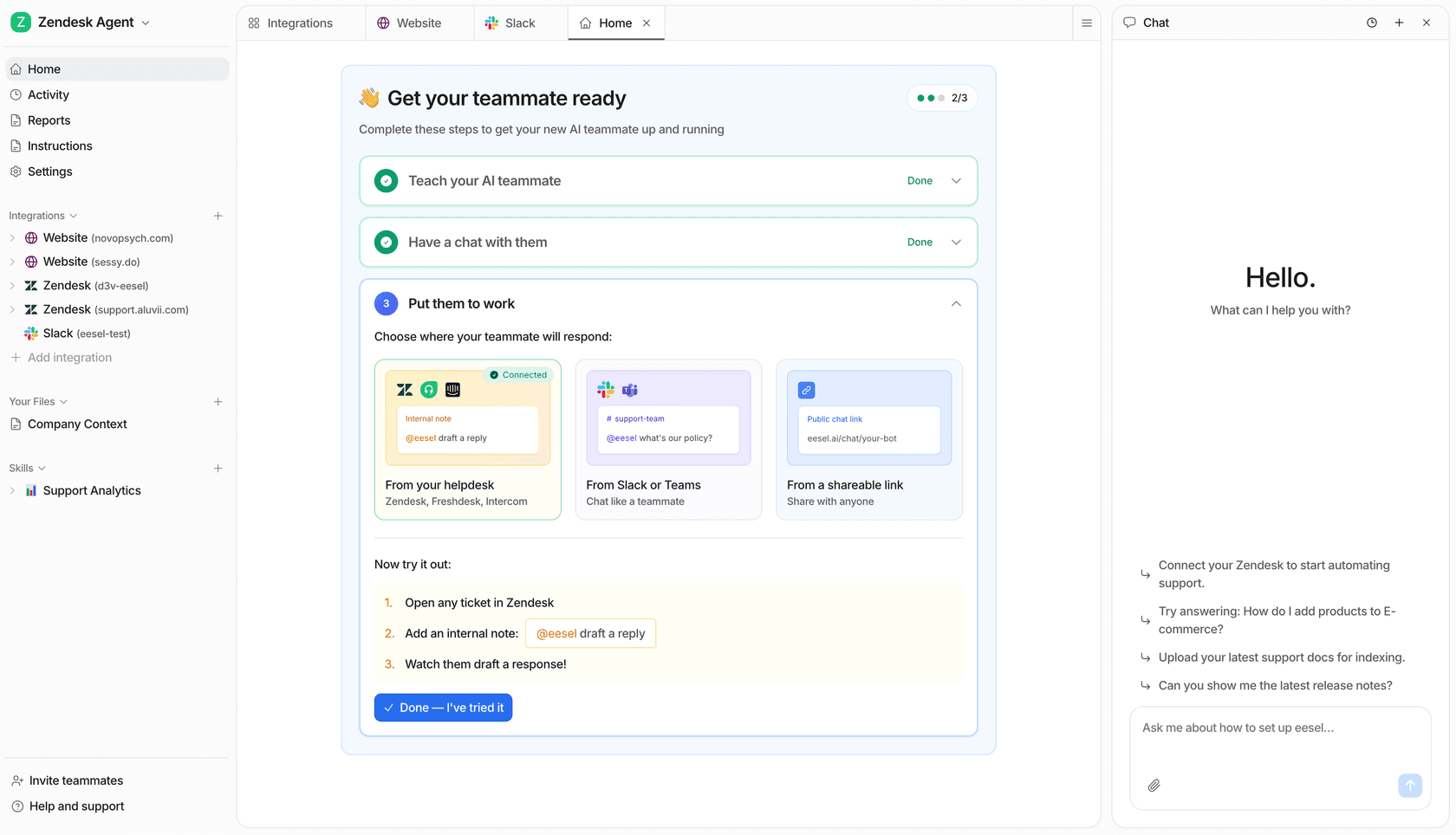
Start free - 100 free credits, no card required, onboards in minutes from your existing knowledge history.
Frequently Asked Questions
What is the best free ElevenLabs alternative?
Cartesia offers ~27 free minutes per month with instant voice cloning included on the free tier. For zero-cost self-hosting, Resemble AI's open-source Chatterbox model clones voices from a 5-second clip under the MIT license with no subscription. Murf AI's free tier gives 10 lifetime minutes - enough to demo but not to use in production. For a broader comparison, see our free vs paid AI tools guide.
Which ElevenLabs alternative has the best voice cloning?
Resemble AI's Chatterbox model beat ElevenLabs in 65.3% of blind listener tests and clones a voice from just 5 seconds of audio in 23 languages simultaneously. For no-code voice cloning, Speechify Studio clones from a 20-second browser recording, while LOVO AI clones from a 1-minute sample. For your own recorded content, Descript's Overdub clones your voice in ~60–90 seconds and applies it inline during transcript editing.
Is Murf AI better than ElevenLabs?
It depends on the use case. Murf AI wins on enterprise compliance (SOC 2, ISO 27001, HIPAA), API latency (130ms Falcon vs ElevenLabs' 200–400ms on standard models), and pricing transparency. ElevenLabs wins on emotional range (7.5/10 vs Murf's 6.5/10 on G2), voice library size (3,000+ vs 200+), and entry-level pricing ($6/mo vs $19/mo). See our full ElevenLabs review for a detailed breakdown.
What ElevenLabs alternative is best for real-time voice agents?
Cartesia's Sonic-3.5 hits 90ms time-to-first-audio on flagship quality, and turbo variants reach ~40ms - both beating ElevenLabs' standard models (200–400ms). For call center and IVR use cases, Deepgram competes with ~90ms optimized latency, HIPAA certification, and on-prem deployment. Both are designed for the latency requirements of real-time voice agent platforms that ElevenLabs standard tiers can't meet.
Why is ElevenLabs so expensive compared to alternatives at scale?
ElevenLabs charges per generation attempt - including failed runs and regenerations - so the effective cost often runs 2–3x the advertised rate. At volume, Cartesia is roughly 10–15x cheaper per audio minute at comparable quality tiers ($239/mo for ~10,667 min vs ElevenLabs Pro's $99/mo for ~600 min). Deepgram's Aura-2 at $0.030/1K chars also undercuts ElevenLabs Flash ($0.050/1K chars) by 40%. If budget is the concern, our cheap AI tools guide has more options worth considering.