

Disclosure: This article is published by eesel AI, a competitor of Atlassian. We encourage you to read Atlassian's own materials for their perspective.
If you’re trying to get your head around Atlassian’s AI tools, you’re definitely not the only one. With all the recent updates, a common question is popping up: "Is Atlassian Intelligence the same as Rovo?" The short answer is no, but it’s not quite that simple.
Think of it this way: Atlassian Intelligence is the powerful engine, and Rovo is the shiny new car it runs. This guide will break down what each one does, how they’re different, and the ways they rely on each other. We’ll also look at a simpler, more flexible way to get AI working for your team without getting locked into one company's world.
What is Atlassian Intelligence?
Atlassian Intelligence isn't a separate product you can just go out and buy. It’s actually AI features woven directly into the Atlassian Cloud products you might already be using, like Jira and Confluence. It’s the behind-the-scenes brainpower making those tools a bit smarter.
Its whole purpose is to help you get more done within the Atlassian ecosystem. Some of the things it can do include:
-
Generative AI in the editor: You can ask it to summarize a lengthy Confluence page, rewrite a paragraph with a different tone, or help you brainstorm ideas without leaving your editor.
-
Smart search: It allows you to use plain English to do a Jira search. For example, you could type "show me all high-priority bugs assigned to Dave this month," and it will handle the tricky Jira Query Language (JQL) for you.
-
Task automation: You can set up new automation rules just by describing what you want to happen, which saves you from digging through complicated menus.
-
AI Work Breakdown: It can look at a big task or user story and suggest a list of smaller sub-tasks to help you get the ball rolling.
Basically, Atlassian Intelligence makes your existing Atlassian tools work a little harder for you.
What is Atlassian Rovo?
Atlassian Rovo, on the other hand, is a brand-new, standalone AI product. It's designed to be an AI teammate for your whole company, capable of working across all your tools, not just the ones from Atlassian. Its main job is to stop information from getting trapped in different apps.
Rovo is built on a few main parts:
-
Rovo Search: This is a universal search bar that can find information not only in Jira and Confluence but also in other apps like Google Drive, Slack, and Microsoft Teams. The goal is to give you one spot to find anything.
-
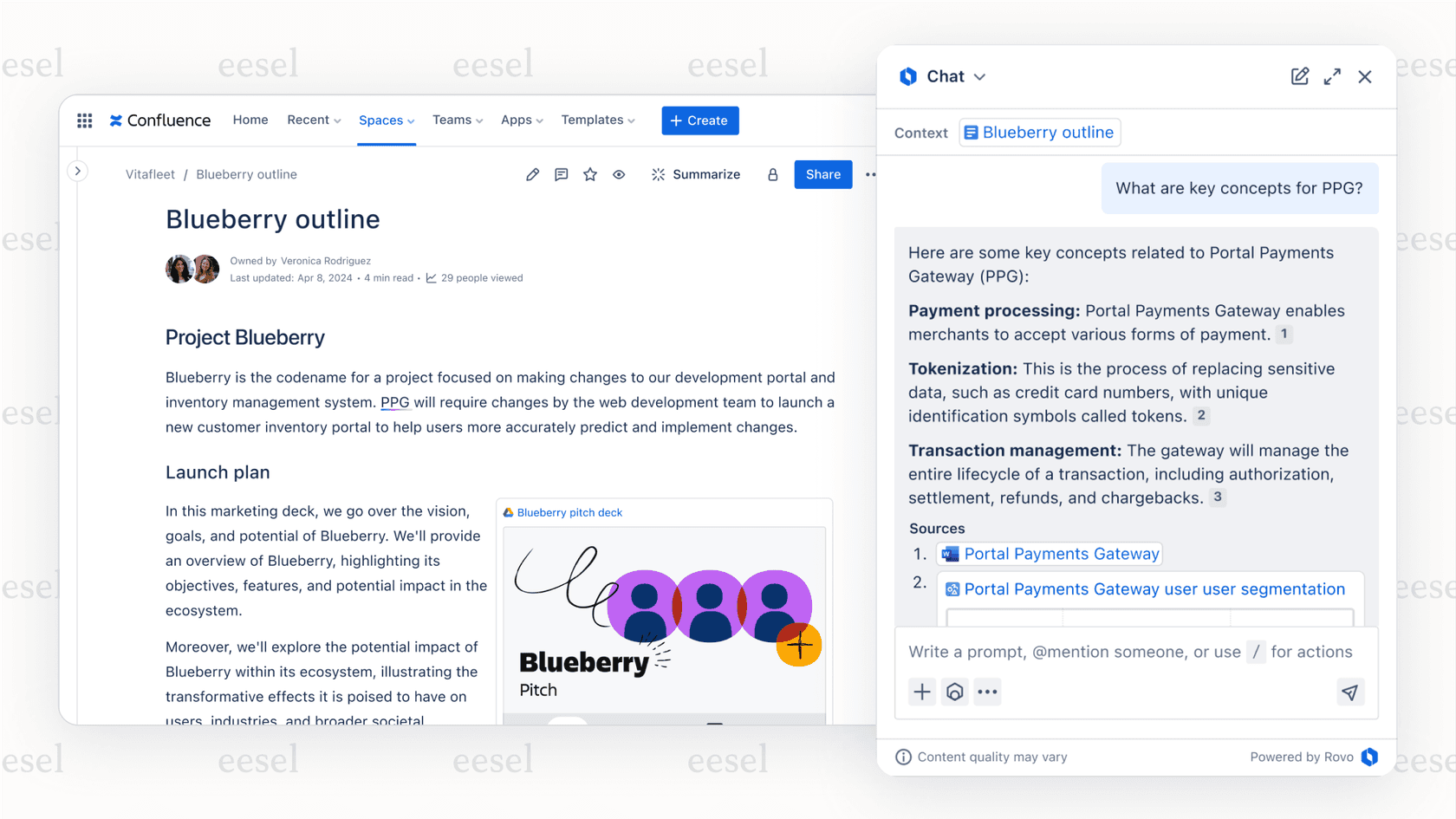
Rovo Chat: This is an interactive chatbot that can answer questions by pulling knowledge from all your connected company sources. You can ask it about project updates, company policies, or who the go-to person is for a specific topic.
-
Rovo Agents: These are AI assistants you can put in charge of specific, repetitive tasks. For instance, an agent could draft your weekly release notes, help organize your project backlog, or even translate documents.
-
Rovo Studio: This is where you can build your own custom Rovo Agents to fit your team's specific ways of working, often without having to write any code.
Rovo is Atlassian’s big play for company-wide AI, moving beyond just tweaking its own products to creating a central hub for all your team's knowledge.
Key differences in features and scope
So, to stick with our analogy: Atlassian Intelligence is the engine, and Rovo is the car. Atlassian Intelligence provides the core AI power, while Rovo is the product that packages that power into a tool meant for collaboration across different teams and apps.
One is a built-in feature, and the other is a product you use on its own. Here’s a quick table to make the differences totally clear:
| Feature | Atlassian Intelligence | Atlassian Rovo |
|---|---|---|
| Primary Goal | Improve how you work within individual Atlassian products. | Unify knowledge and automate work across all company tools. |
| Scope | Limited to the Atlassian ecosystem (Jira, Confluence, etc.). | Atlassian products plus third-party apps (Slack, Google Drive, Figma). |
| How You Get It | Automatically activated on Standard, Premium & Enterprise Cloud plans. | Automatically activated on the same plans, with a monthly Rovo credit allowance per user. |
| Key Features | In-editor summaries, plain-language JQL search, AI-assisted automation. | Company-wide search, cross-tool chat, customizable AI agents. |
| User Interaction | A feature you use while you're already in Jira or Confluence. | A destination (Chat, Search) and a virtual teammate (Agents). |
While Rovo's vision of connecting all your apps is pretty cool, let's be real: managing connectors can turn into a huge administrative burden. It feels a bit heavy-handed.
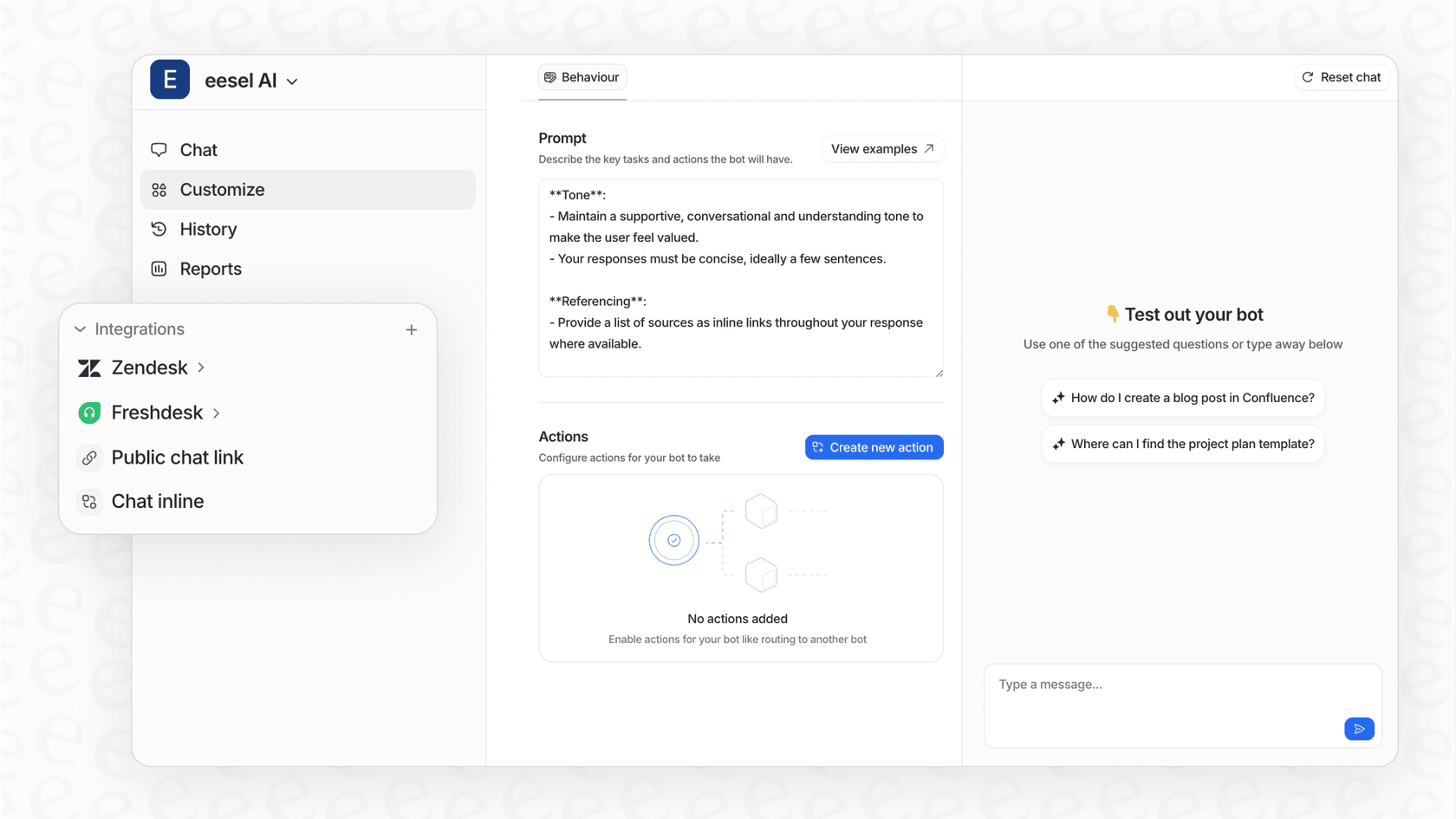
For teams that just want to get started with AI without a massive project, this can be a real hurdle. A more direct approach, like the one from eesel AI, focuses on a simple, do-it-yourself setup. You can connect your helpdesk, Confluence, and Google Docs in minutes, and start getting value right away without having to go all-in with a single company's products.
How they work together (and their limitations)
Here’s where it gets a little tricky. Rovo's AI-powered search and chat depend on Atlassian Intelligence being turned on. If Atlassian Intelligence is the engine, Rovo is a car whose smarter features go quiet without it.
This dependency matters. In practice, it means the AI is tied to a paid Cloud plan, and heavy use is metered through Rovo credits. That keeps you inside Atlassian's world, and the cost depends on how much your team actually uses the AI.
-
On a Standard Plan: Rovo is activated automatically, including Search, Chat, Studio, and agents. The catch is the allowance: Jira and Confluence Standard include 25 Rovo credits per user per month, so heavy chat and agent use runs through it quickly.
-
On a Premium or Enterprise Plan: The same features come with a bigger allowance, 70 credits per user per month on Premium and 150 on Enterprise. Premium also adds advanced agents with model selection and deeper-thinking chat.
This is where a tool that works with anything offers a better alternative. eesel AI plugs right into the tools you already use, whether that's Zendesk, Intercom, or Slack, without forcing you into a costly, platform-wide upgrade. It gives you capable AI agents and agent-assist features that play nicely with your current software, offering a more direct and affordable way to automate support.
Atlassian Intelligence and Rovo pricing explained
Atlassian’s pricing can feel like a maze, so let’s break it down.
Atlassian Intelligence isn't sold on its own. It comes with your Atlassian Cloud subscription and is automatically activated on Standard, Premium, and Enterprise plans, so you don't buy it separately. Admins can switch it off if the team isn't ready.
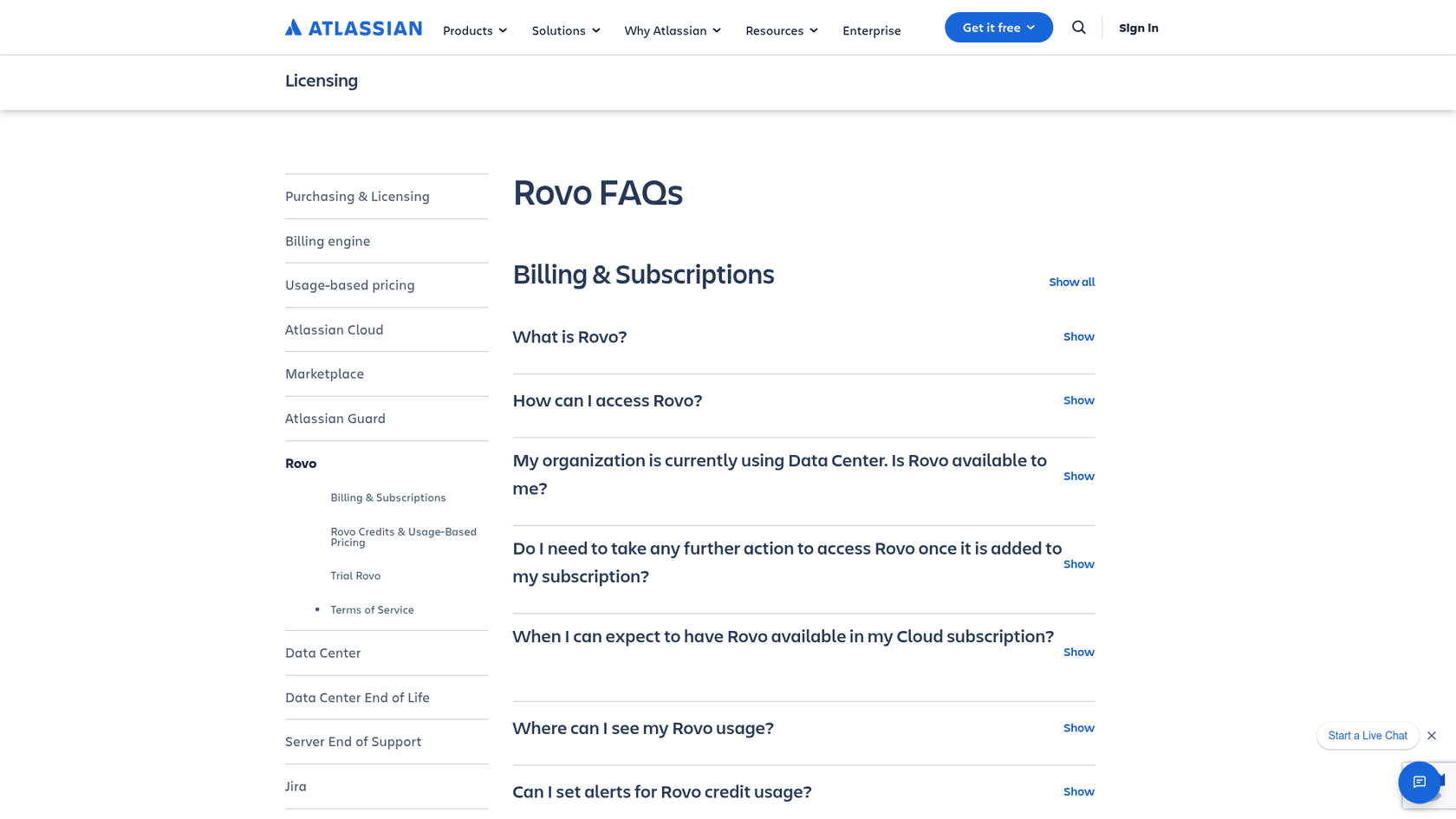
Atlassian Rovo is on all paid Cloud plans (Standard, Premium, and Enterprise), and since it is activated automatically, the real cost question is credits. Per user per month, Jira and Confluence include 25 Rovo credits on Standard, 70 on Premium, and 150 on Enterprise, while Service and Teamwork Collections include 250, 700, and 1,500. A basic AI interaction costs 10 credits, and admins get alerts at 80% and 100% of the allowance, so the allowance, not a plan gate, decides how far the AI goes.
This model is a world away from the straightforward and predictable pricing of a solution like eesel AI. With eesel AI:
-
What you see is what you pay. There are no hidden requirements. You don't need to upgrade your helpdesk or any other tool just to make the AI work.
-
No surprise fees. Pricing is one fixed monthly price sized to your volume (from $299/month for 500 credits, with 1 credit per ticket or chat), so costs are predictable even during a busy week. This is a common catch with AI tools that charge per resolution or bolt on usage fees.
-
Real flexibility. eesel AI offers month-to-month plans you can cancel anytime. This gives you the freedom to try it out and make sure it’s the right fit, which is pretty rare in an industry that often pushes for long-term contracts.
A simpler path to AI-powered support
So, to sum it up: Atlassian Intelligence is the technology, and Rovo is the product that uses that technology. They aren't the same thing, but they are very closely connected. While Atlassian's AI tools are powerful for teams who are already deep in its ecosystem, they ask for a complex, all-in commitment that can be expensive and restrictive.
For teams looking for powerful and easy-to-use AI without being tied to one platform, a more focused solution is often the better move. eesel AI is built for teams that want results now, not after a six-month implementation project.
Here’s what makes it different:
-
Go live in minutes, not months. eesel AI is a truly self-serve platform. You can sign up, connect your helpdesk, and link your knowledge sources with just a few clicks. No mandatory sales calls or long onboarding sessions required.
-
Test with confidence. Before you let an AI talk to your customers, you need to know it will do a good job. eesel AI has a powerful simulation mode that lets you test its performance on thousands of your past tickets. You get a clear forecast of your automation rate and return on investment before you ever go live.
-
Unify all your knowledge. Don't just connect to other apps, train your AI on the conversational history from your past support tickets. This gives it a deep understanding of your brand's voice and common customer problems, leading to incredibly relevant answers from day one.
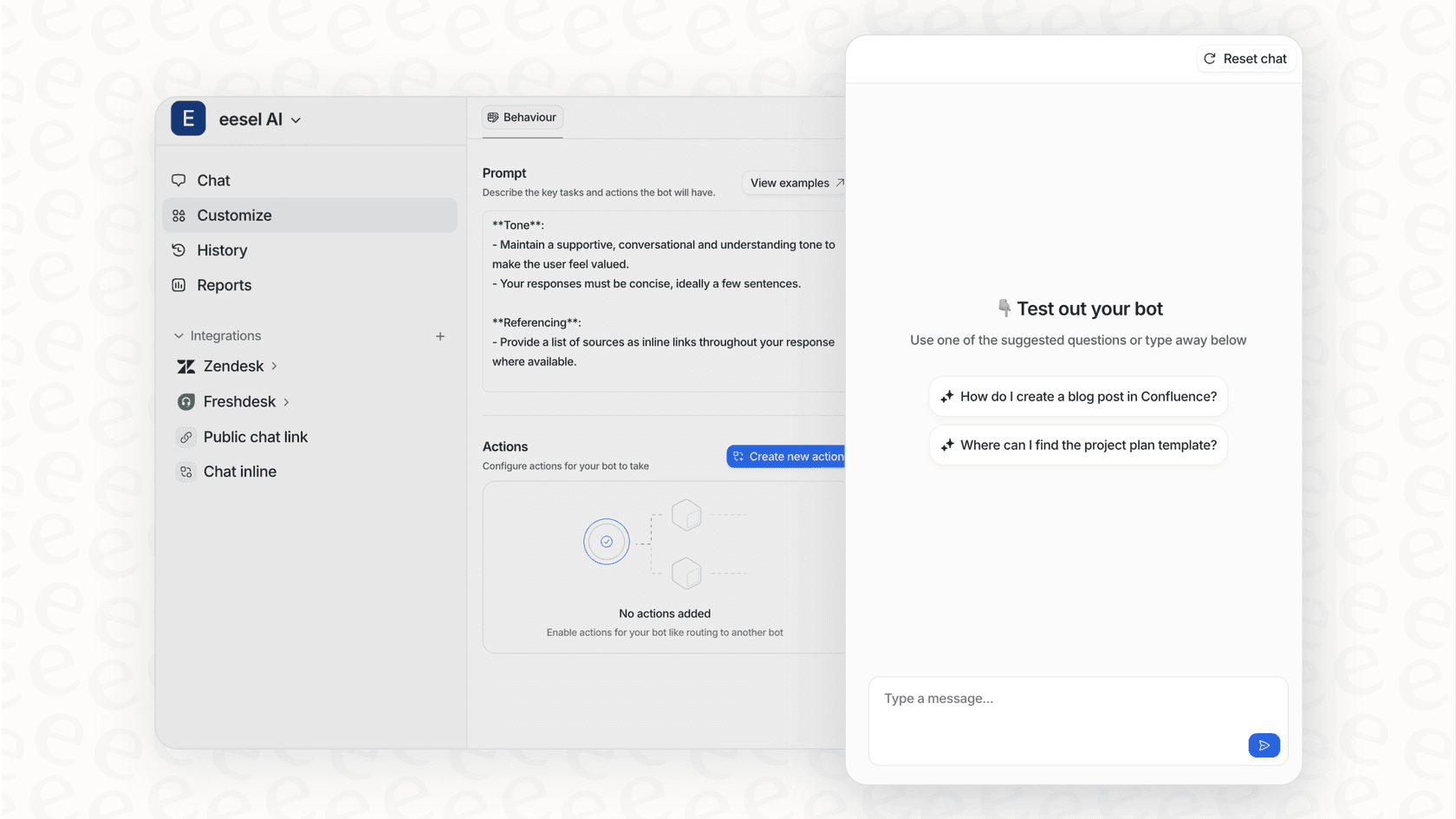
Ready for an AI solution that works with your tools, not against them? Try eesel AI for free and see how quickly you can automate your support.
Frequently asked questions
To clarify, is Atlassian Intelligence the same as Rovo, or are they distinctly different offerings?
They are distinctly different. Atlassian Intelligence is the underlying AI capability integrated within Atlassian Cloud products, whereas Rovo is a new product built on top of Atlassian Intelligence, designed for knowledge unification across your company.
How does the dependency of Rovo on Atlassian Intelligence impact the functionality I can expect; specifically, is Atlassian Intelligence the same as Rovo in terms of feature availability?
Rovo's AI-powered search and chat rely on Atlassian Intelligence being activated. Atlassian says it is on by default for Standard, Premium, and Enterprise, and if an admin deactivates it, Rovo's core apps such as search and Studio keep working while AI-powered search and chat become unavailable.
Considering the different pricing structures, is Atlassian Intelligence the same as Rovo when it comes to how I access their full capabilities?
No, their access models differ significantly. Atlassian says its AI is automatically activated on Standard, Premium, and Enterprise Cloud plans, and Rovo is included on those same plans with a monthly Rovo credit allowance per user.
What are the key differences in their scope of operation; for instance, is Atlassian Intelligence the same as Rovo regarding the types of applications they integrate with?
Atlassian Intelligence improves specific functions within Atlassian products like Jira and Confluence. Rovo, however, extends its reach to third-party applications like Slack and Google Drive, aiming for company-wide knowledge unification.
When should my team consider Atlassian Intelligence versus Rovo, or is Atlassian Intelligence the same as Rovo in terms of the primary problems they solve?
Atlassian Intelligence is best for enhancing productivity within your existing Atlassian workflows (e.g., summarizing Confluence pages). Rovo is designed for broader knowledge discovery and automation across all your company's tools, serving as a virtual AI teammate.