


What Lovable actually is (and why the pricing is confusing)
Lovable is an AI-powered web app builder that went from zero to $300M ARR in under 12 months - one of the fastest ramps in SaaS history. You describe what you want to build in plain language, and Lovable generates a working React app with a Supabase backend, authentication, database schema, and deployment in minutes. As of mid-2026, it has 8M+ registered users, a $6.6B valuation, and was named one of TIME's most influential companies of 2026.
The pricing looks simple. It's not. Here's why: Lovable doesn't charge per seat or per hour. It charges by credits - a variable-cost consumption unit where every message you send to build or edit your app burns a different number of credits depending on how complex your request is. That variability is the source of most billing surprises.
We tested Lovable extensively and dug into the community's real cost experiences so you don't have to guess. Here's the full breakdown.
The four Lovable plans
| Plan | Price (monthly billing) | Price (annual billing) | Base credits/month | Daily bonus credits | Users |
|---|---|---|---|---|---|
| Free | $0 | $0 | 30 (5/day max) | 5 | Unlimited |
| Pro | From $25/mo | From $21/mo ($250/yr) | 100–10,000 | 5 | Unlimited |
| Business | From $50/mo | From $42/mo ($500/yr) | 100–10,000 | 5 | Unlimited |
| Enterprise | Custom | Custom | Volume-based | Custom | All employees |
A few things stand out right away. First, Lovable doesn't charge per seat - all plans let you invite unlimited collaborators, which is genuinely useful for small teams. Second, the credit allocations shown above are the entry-level tiers; you can buy more credits within each plan at a higher per-credit cost (see the full tiers below). Third, the gap between Pro and Business isn't credits - it's features: SSO, data training opt-out, team workspaces, and reusable design templates.
How credits actually work
This is the section most pricing pages gloss over, and it's where most billing surprises come from.
Every message you send to Lovable's editor consumes credits. The cost is not flat - it scales with the complexity of what you're asking the AI to do. Since July 2025, Lovable moved from a flat one-credit-per-message model to complexity-weighted pricing.
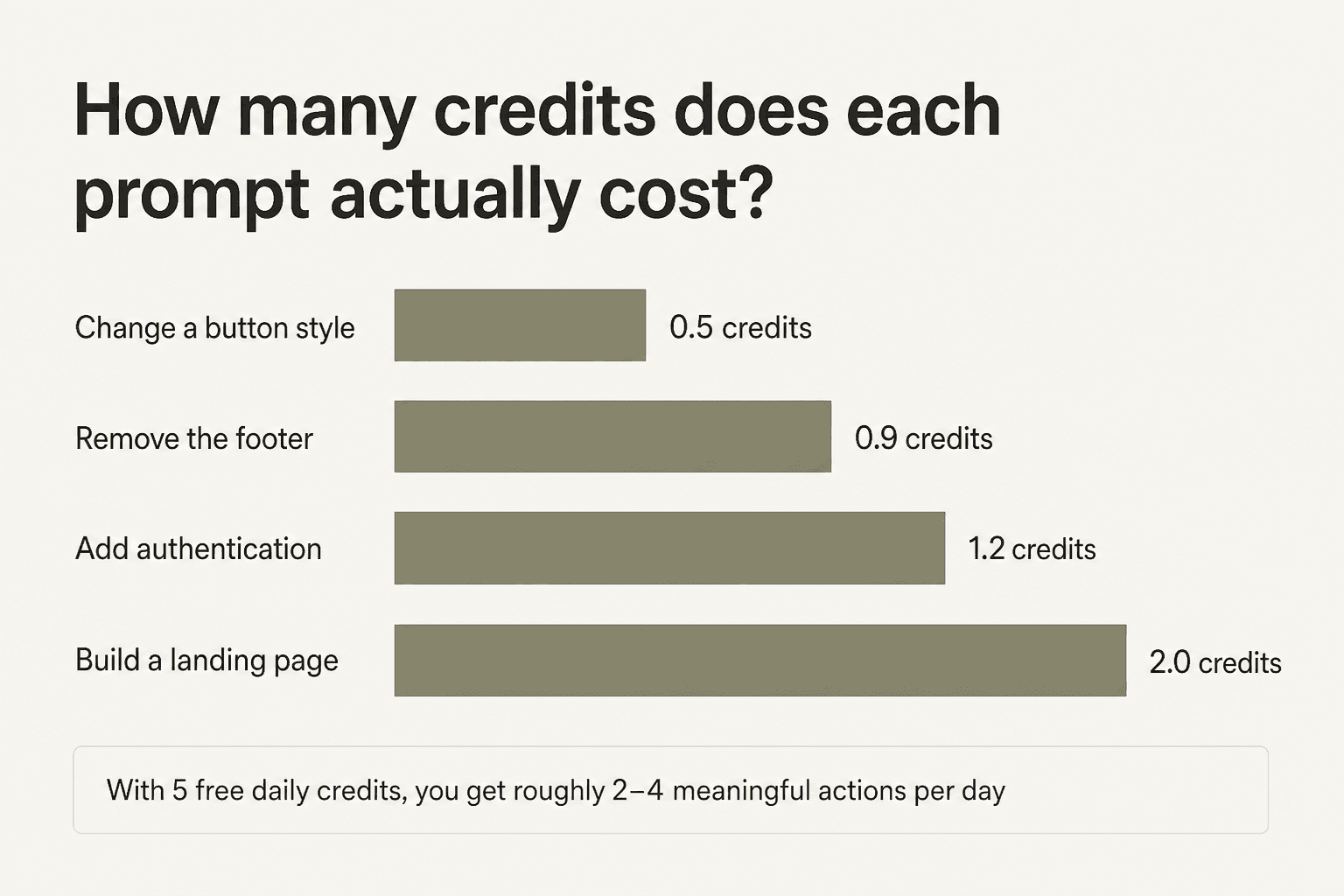
The official docs give concrete examples:
| Prompt | What it does | Credits used |
|---|---|---|
| Make the button gray | Changes one CSS property | 0.50 |
| Remove the footer | Removes a component | 0.90 |
| Add authentication | Adds login + auth logic | 1.20 |
| Build a landing page with images | Full page generation | 2.00 |
One nuance: you can click the three dots under any chat message after sending it to see exactly how many credits it consumed. That retroactive transparency is useful - but it doesn't help you before you send.
The dual credit pool: daily + monthly
Every plan has two separate credit pools, and they behave differently.
Daily credits (5 per day, all plans): These reset at midnight UTC and do not roll over. Unused daily credits are gone at the end of each day. On the free plan, these are your only credits - capped at 30 per month.
Monthly credits (paid plans only): These are your main allocation. Unused monthly credits roll over into the next billing cycle (or for the rest of your annual term if you're on annual billing). They expire if you cancel.
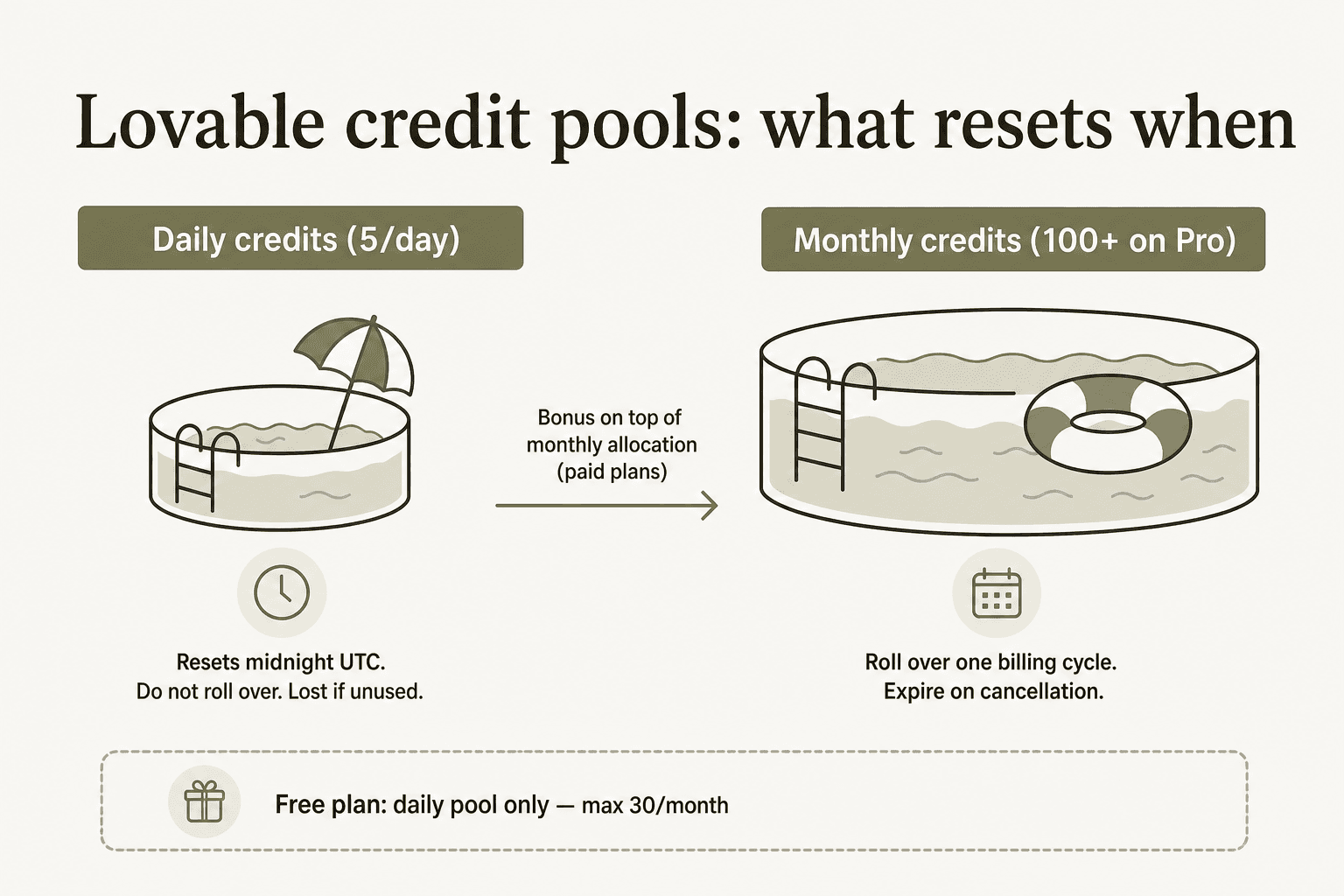
On the Free plan, your 5 daily credits disappear in roughly 2–4 meaningful interactions. That's confirmed in community feedback: one developer described it as "burning through 5 credits in a couple of hours" of heavy use.
The full pricing tables
Here's what the Pro and Business tiers actually cost at each credit volume - this is the table the pricing page doesn't show you upfront.
Pro plan - full credit tiers
| Monthly credits | Monthly billing | Annual billing |
|---|---|---|
| 100 | $25/mo | $250/yr (~$21/mo) |
| 200 | $50/mo | $500/yr (~$42/mo) |
| 400 | $100/mo | $1,000/yr (~$84/mo) |
| 800 | $200/mo | $2,000/yr (~$167/mo) |
| 1,200 | $294/mo | $2,940/yr (~$245/mo) |
| 2,000 | $480/mo | $4,800/yr (~$400/mo) |
| 3,000 | $705/mo | $7,050/yr (~$588/mo) |
| 5,000 | $1,125/mo | $11,250/yr (~$938/mo) |
| 10,000 | $2,250/mo | $22,500/yr (~$1,875/mo) |
Business plan - full credit tiers
| Monthly credits | Monthly billing | Annual billing |
|---|---|---|
| 100 | $50/mo | $500/yr (~$42/mo) |
| 200 | $100/mo | $1,000/yr (~$84/mo) |
| 400 | $200/mo | $2,000/yr (~$167/mo) |
| 800 | $400/mo | $4,000/yr (~$334/mo) |
| 1,200 | $588/mo | $5,880/yr (~$490/mo) |
| 2,000 | $960/mo | $9,600/yr (~$800/mo) |
| 5,000 | $2,250/mo | $22,500/yr (~$1,875/mo) |
| 10,000 | $4,300/mo | $43,000/yr (~$3,584/mo) |
Source: Lovable docs - credits and plan pricing
The progression is roughly linear within each plan, with a slight per-credit discount at higher volumes. Business is consistently ~2x the Pro price for the same credit count - the premium goes entirely toward the enterprise features (SSO, data training opt-out, per-user credit limits, restricted projects).
What each plan actually costs: worked examples
The tables above tell you what Lovable charges. These examples tell you what it tends to cost in practice for different use cases.
Solo founder building an MVP
A non-technical founder validating an idea typically runs 3–5 prompt sessions to build a prototype - homepage, auth, a core workflow, and some styling passes. That's roughly 15–25 credits for a basic MVP.
- Free plan: Enough for a simple prototype across 4–5 days of daily credits. You'll hit the 5/day cap on active build days.
- Pro 100: Covers this comfortably with room to spare. At $25/month, this is strong value.
Verdict: Free plan for initial validation. Pro 100 ($25/mo) once you're actively building.
Small team iterating on a product
A 2–3 person team actively iterating - new features weekly, regular design tweaks, debugging - typically burns 50–100 credits per active developer per month. Shared workspace helps: one Pro subscription covers the whole team.
But here's the thing community members flag consistently: bug loops eat a disproportionate share of credits. When the AI introduces an error while fixing something else, you spend credits on fix attempts that may not work. One DesignRevision survey of 200+ developers found 65–75% of developers hit this pattern on complex features, and a single authentication bug could burn "15 credits that a manual code change would have resolved in minutes."
- Pro 200 ($50/mo): Reasonable for a small team with moderate complexity.
- Real spend: Often $60–80/month once you factor in a top-up pack ($15/50 credits) after one debugging session.
Developer building a complex SaaS
At this complexity level, the credit model starts working against you. Multiple API integrations, custom business logic, background jobs, Stripe webhooks - these are exactly the scenarios where the AI gets stuck in loops.
"One developer described spending an entire month's Pro credits in a single afternoon debugging a Stripe integration."
At this usage level, you're looking at the Pro 400–800 tiers ($100–200/month), and you'll likely supplement with Cursor or Windsurf for the parts Lovable struggles with. Tools like Replit and StackBlitz are also worth comparing at this stage.
The hidden costs
1. Cloud credits - the second billing layer
On paid plans, Lovable runs your app on Lovable Cloud - Supabase-backed hosting. This isn't covered by your plan subscription: it's a usage-based layer billed separately.
For most small apps, this is negligible. But as traffic and data grow, it activates:
| App type | Estimated monthly cloud cost |
|---|---|
| Personal blog (~500 visits/mo) | ~$1 |
| Small business site (~5,000 visits/mo) | ~$5 |
| Team project manager (20 active users) | ~$15 |
| E-commerce store (~10,000 visitors, ~500 purchases/mo) | ~$65 |
Source: Lovable hidden costs analysis - dev.to
This dual billing is the most common source of "I expected $25, I got $60" complaints - especially for founders who get past the prototype stage and suddenly have real traffic.
2. The top-up mechanic (not quite what it sounds like)
When you run out of credits mid-project, you can buy top-ups on Pro or Business:
- Pro top-ups: $15 per 50 credits (min 50, max 1,000 per purchase)
- Business top-ups: $30 per 50 credits
One important gotcha flagged across multiple community sources: when you upgrade your plan tier mid-cycle (say, from the 100-credit tier to the 200-credit tier), Lovable gives you the additional credits to reach the new ceiling - not a fresh allocation. Moving from Pro 100 to Pro 200 partway through the month gives you 100 more credits, not 200 fresh ones.
As one community analysis put it: "Buying extra credits only adjusts your monthly limit cap rather than adding a fresh pool on top." That's a meaningful distinction when you're mid-build and running low.
3. Credit opacity - the slot machine problem
Perhaps the most-cited frustration in Lovable reviews: you can't see how many credits a prompt will cost before you send it. You only see the deduction after.
"I love Lovable and have been using it for the past months. But especially regarding credit usage, I am blind. Whenever I perform an operation, I don't know how many credits will be used for it. Result? My credits die faster than I expect. And I am not alone."
This opacity is the structural reason users describe credits feeling like a "slot machine." G2 reviews flag it in 60% of negative feedback. The official response from Lovable's credit tips thread - batch your changes, use Chat mode, group features - is good advice, but it doesn't solve the underlying uncertainty.
What the data says: where Lovable actually delivers
To be fair to Lovable, it genuinely is exceptional at what it's designed for. The DesignRevision developer survey found satisfaction varies sharply by project type:

That pattern should calibrate your expectations more than any pricing table. If you're building landing pages, investor demos, or simple internal tools, Lovable is excellent and the credit burn will likely feel proportionate to the output. If you're building complex SaaS - multi-user platforms, sophisticated payment flows, production-grade security - the credit model will fight you.
The community consensus in 2026, expressed across Reddit, G2, and practitioner blogs, lands somewhere like this:
"Lovable gets you at most 70% of the way there, but you'll spend a lot of time wrestling with that last 30% to make it usable for real customers."
And the "speed" praise is genuinely earned:
"Did 6 months of work in 2 days in Lovable."

Both things are true simultaneously. That's the honest picture.
Plan-by-plan verdict
Free - best for: trying it once
Five daily credits is enough to build something in a weekend sprint. You'll hit the cap on any serious build day. No custom domains, no Code Mode, no top-ups. This plan is for validation, not production.
Our take: Use it to see if Lovable's style fits your project. Graduate to Pro the moment you're building something real.
Pro ($25–$480/month) - best for: solo founders and small teams
The entry-level Pro tier ($25/month) is genuinely good value for non-technical founders who need to get from idea to live URL fast. The credit rollover is a meaningful quality-of-life feature - unused credits don't evaporate at month-end. At higher credit volumes, Pro starts to look expensive relative to flat-rate tools, so compare Lovable alternatives before committing to the Pro 400+ tier.
Our take: Pro 100 ($25/mo) for the first 1–2 months. Evaluate your actual credit burn before upgrading tiers.
Business ($50–$4,300/month) - best for: teams with compliance needs
Business doubles the Pro price while adding SSO, data training opt-out, team workspaces, and per-user credit limits. If your org requires SSO or has data sensitivity concerns, Business is the tier to be on. If you don't need those features, there's no credit reason to pay the premium - the credit allocation is identical to Pro at the same tier.
Our take: Only worth it over Pro if SSO or data opt-out is a hard requirement.
Enterprise - best for: large org rollouts
Custom platform fee covers all employees with volume credit pricing, SCIM provisioning, audit logs, dedicated support, and custom connectors. The right choice when legal, IT security, or compliance teams need to sign off.
How to stretch your credits further
These tips circulate consistently in the Lovable community and are worth knowing before you burn through your first month:
-
Batch your changes. Instead of one prompt per small edit, group 3–5 changes into a single message. The multi-edit prompt often costs the same as or slightly more than one single-edit prompt, but you accomplish far more per credit.
-
Use Chat mode for non-coding questions. Chat mode costs a flat 1 credit for questions that don't generate code. Ask questions, think out loud, plan the architecture - then fire the build prompt.
-
Start new sessions per feature. Long chat threads accumulate context that can drift and cause the AI to reintroduce earlier bugs. Fresh sessions per feature reduce debugging loops.
-
Sync to GitHub early. GitHub sync is available on all plans. If you're comfortable in a code editor, edit locally and push back rather than prompting Lovable for every small change - that's free. Code Mode (which lets you edit directly inside Lovable) requires Pro+.
-
Set credit alerts. Business and Enterprise admins can set per-user monthly credit limits. Even on Pro, monitor your credit bar actively - the low-credits alert appears in the chat, and at that point it's already late.
Lovable vs competitors on price
How does Lovable's pricing compare to the tools developers actually reach for as alternatives?
| Tool | Starting price | Pricing model | Best for |
|---|---|---|---|
| Lovable Pro | $25/mo | Credit-based (variable) | Full-stack app generation, MVPs |
| Cursor Pro | $20/mo | Flat unlimited | Sustained coding, any language |
| Replit Core | $25/mo | Flat + usage | Python/multi-language apps |
| Windsurf Pro | $15/mo | Flat | IDE-style AI coding |
| v0 by Vercel | $20/mo | Flat + generous free | UI components, Next.js apps |
The key difference: Cursor, Windsurf, and v0 charge a flat monthly fee with no per-prompt metering. Lovable's variable credit model is more generous for simple work, more expensive for complex debugging, and fundamentally less predictable.
The community pattern that's emerged by 2026: use Lovable for the first 70–80% of a project (prototyping is fast and cheap), export to GitHub, and finish in Cursor. It's not a failure mode - it's a workflow.
Try eesel.ai
If Lovable's pricing is on your radar, you're probably building or evaluating AI-powered tools for your team. Once your app is live, the next question is usually: how do you handle the support load without scaling a human team proportionally?
That's what eesel.ai does. eesel deploys autonomous AI agents inside your existing tools - Zendesk, Slack, Freshdesk, email - and handles tickets, answers questions, and escalates edge cases without you having to build a new interface. Teams using eesel typically handle 100,000+ tickets per month with meaningful deflection rates, so your engineering time stays on the product rather than the queue.
Unlike Lovable's credit model, eesel's pricing is one fixed monthly price sized to your ticket volume, from $299/month for 500 credits (1 credit per ticket or chat), with a free plan of 100 credits.
Frequently Asked Questions
How much does Lovable cost per month?
What is a Lovable credit and how many do I get?
Does Lovable offer a free plan?
How does Lovable pricing compare to Cursor?
Is Lovable Pro worth $25 a month?


Article by
Rama Adi
Rama is a software engineer at eesel AI with two years of experience writing about B2B SaaS, AI tools, and customer support technology. Based in Bali, Indonesia, he brings a developer's perspective to product comparisons — cutting through marketing copy to what the integrations and APIs actually do.