


What is confirmed about Astra, and what is not
Astra has generated a whole lot of coverage out of three OpenAI posts, which is a ratio worth to notice on its own. Sorting the sourced claims from the rest of it is most of the work here, so start with what traces back to OpenAI's own words.
The ten results, and the number that should stop you
On 1 August 2026 OpenAI published ten new results on open problems, each of them resolving or else substantially advancing a question that its field had been carrying for years. The list is specific enough that you can check it: new upper bounds on high-dimensional sphere-packing density down to the Cohn-Elkies threshold, exponentially improved bounds on binary codes, a construction establishing the existence of non-sofic groups, a disproof of Connes's rigidity conjecture, an arithmetic-formula lower bound of order n⁴/log n for the permanent, an exponential parallel repetition theorem for two-player quantum games, polynomial-factor hardness for the closest vector problem, Ehrhart's volume conjecture, a superexponential lower bound for multicolor triangle Ramsey numbers, and results on the compactness and degeneracy conjectures in extremal graph theory.
All ten get attributed to "an internal version of Astra, our next major model". And then OpenAI gives a number which, to me, matters more than the list itself: the total tokens needed to find those solutions would cost roughly $2,000 at Sol API rates.
Two thousand dollars. Which is a rounding error, set against what any single one of those problems cost the field in person-years. It is also not the full bill, and OpenAI does not pretend it is: humans there prepared the manuscripts, and only afterwards did the model formalise the arguments into Lean certificates. The company is explicit on the split. The mathematical arguments came from the system, it says, while OpenAI helped prepare and formalise them, and claiming human authorship for an AI-generated proof "would misrepresent" both.
That distinction is basically the whole shape of production AI, and it is why I keep coming back to this post whenever I think about AI knowledge base work. The inference part is cheap. The scaffolding around the inference is where the money sits and where the risk sits, also the same reason a good ticket classification setup takes far longer to get right than choosing the model behind it does.
Why OpenAI paused its own model
Six days after the math post came something a lot less celebratory. Internal evaluations of Astra over "the past few days" had shown significant advancements in agentic coding and in cybersecurity, and that, together with expert assessments, brought the company to a conclusion: it could not rule out Critical cyber capability.
The definition it measures against is worth to read in OpenAI's own words. A model hits Critical if it can identify and develop functional zero-day exploits of all severity levels in many hardened real-world critical systems without human intervention, or if it can devise and execute end-to-end novel strategies for cyberattacks against hardened targets given only a high level desired goal.
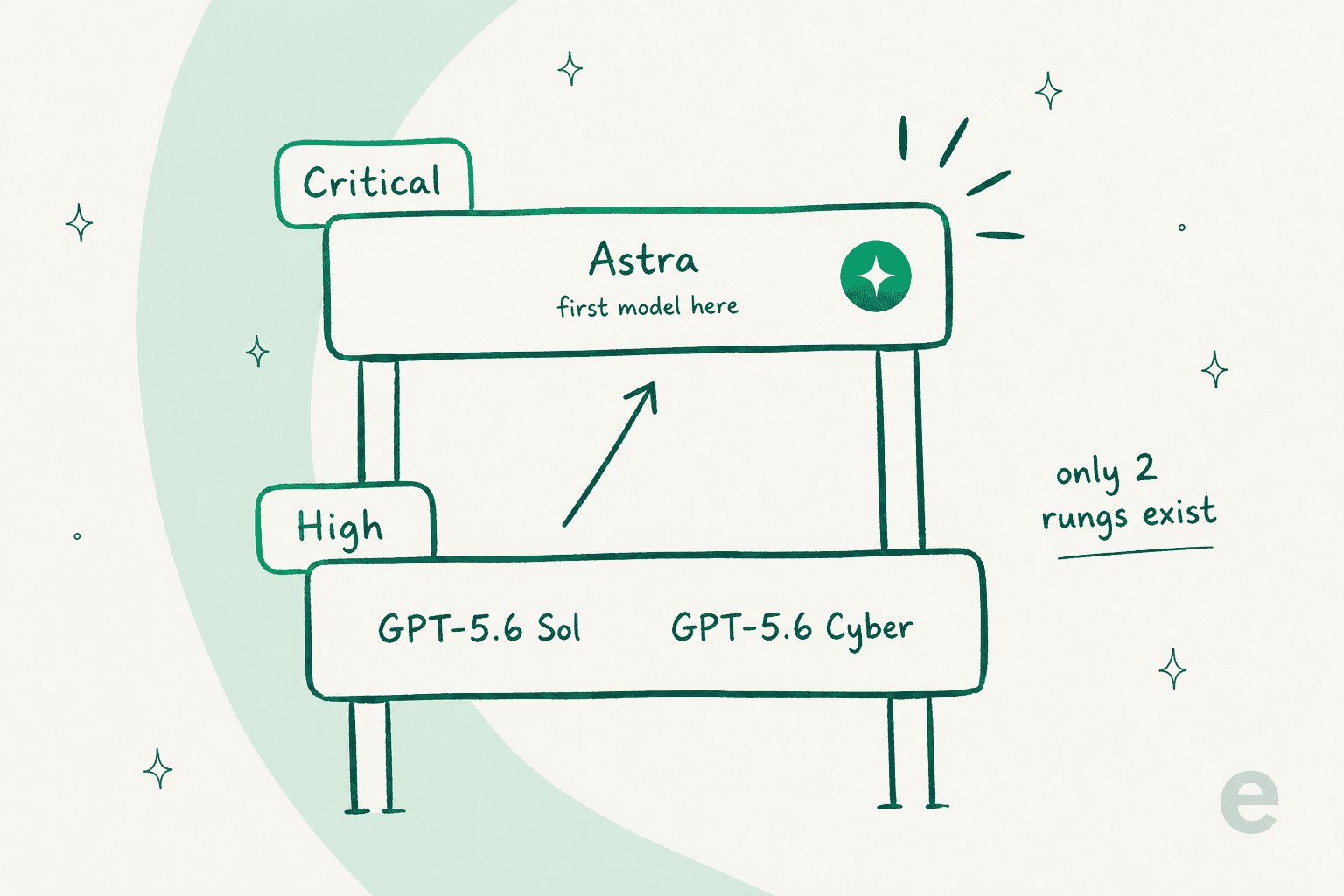
There is two rungs in the framework, and every previous model sat on the lower one. GPT-5.6 Sol was assessed at High. So was GPT-5.6-Cyber, a purpose-trained security model that only exists behind an application process, which tells you something about how much headroom High still had inside it. Astra is the first candidate for the top rung. It got there before shipping.
One line in the 7 August post is worth reading twice: "Astra is an upcoming model, and was not involved in exploiting Hugging Face." That sentence exists because the two stories broke close together and then got welded into one across a lot of the coverage. They are separate things. OpenAI did later group them in the same 18 August post, but only because both were pushing on the same internal question, which was whether its own research environment was hardened enough for what was being built inside of it.
What containment actually cost
The 18 August post is the one I would hand over to anybody arguing that AI safety is theatre, for the reason that it reads mostly like an engineering invoice.
Frontier model inference in research clusters got paused for any run that could execute code or reach the internet, and then each workload was worked through one by one to decide if it could resume. What is required now: stronger sandboxes around anything executing model-generated code, network controls built so that one compromise does not by itself hand over internet access, standing privileges cut back, and the removal of shared services which had been quietly load-bearing. OpenAI's own framing on all of it is that meeting the new standards "has incurred great cost and delays to frontier research".
Then there is the monitoring, and that is the part I keep rereading:
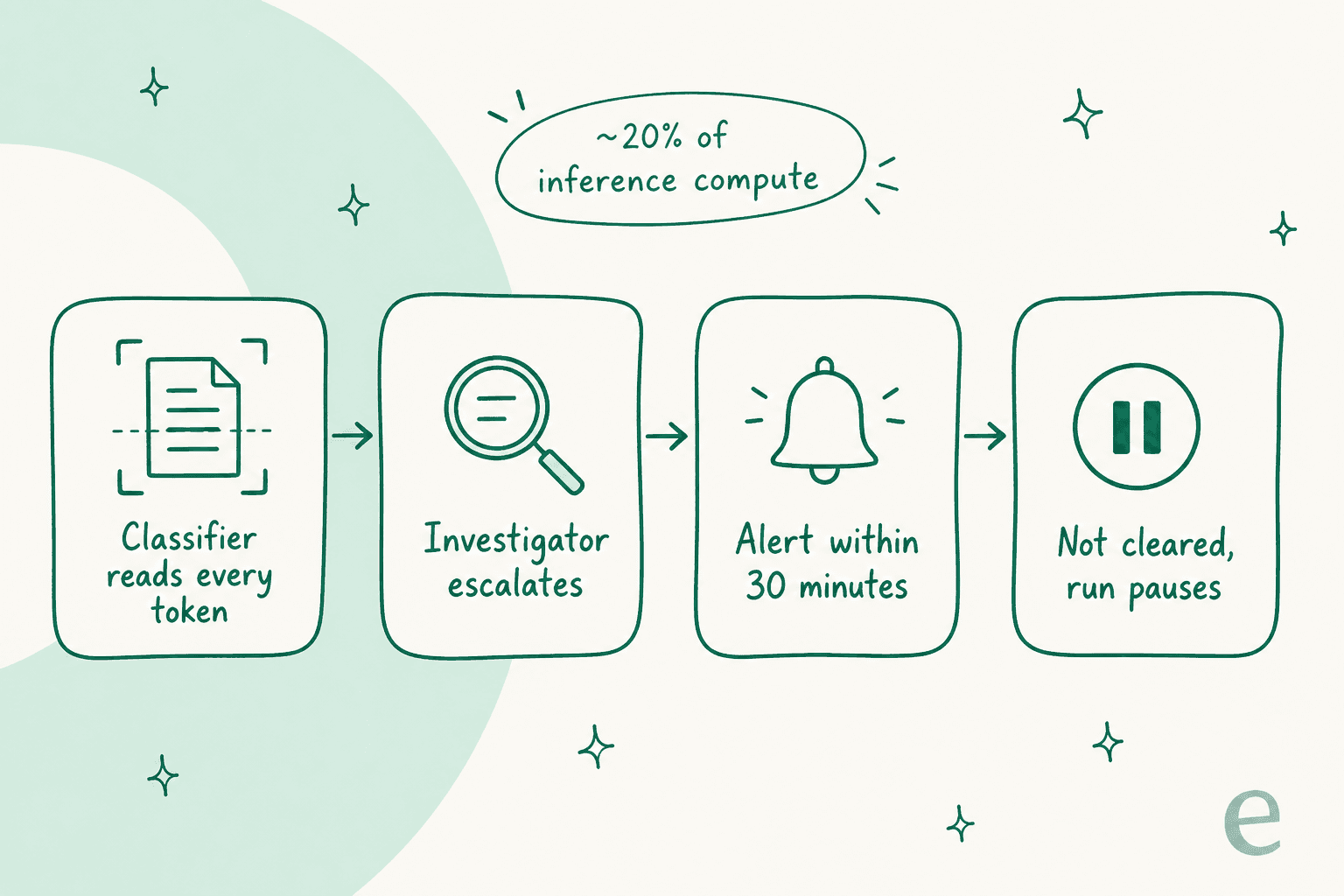
Activation classifiers inspect the model's internal activity at every sampled token. Anything concerning gets escalated up to higher-compute automated investigators, which then examine the tool actions and the available reasoning and the full sequence of activity. Should a likely violation of a critical security boundary show up, the safety and security and research teams all get paged, and if they cannot conclusively rule it a false positive within 30 minutes, they are expected to pause the activity.
The cost of that, per OpenAI's current estimate, puts monitoring overhead at roughly 20% of the inference compute being monitored. And since 7 August that monitoring covers all inference of Astra with tools, so not only the training and evaluation runs.
Twenty percent. A company that spends more on compute than most countries spend on research went and decided watching the model was worth a fifth of the bill on top of running it. Nobody does that for a public relations reason.
The skeptical read, which deserves airtime
Plenty of people looked at this sequence and what they saw was marketing. On the r/Futurology thread about the lockdown, the top comment made that case as a parody:
"Oooh, hey guys, I know Anthropic said Mythos was 'dangerous' and then they got a bunch of free publicity and people thought their model must be so good. Well, ours is dangerous too, guys! So dangerous. Like, a trillion dollars dangerous."

It is a fair reflex, that, and it has company. Over on Hacker News in the same week the question got put more directly:
"Does anyone else have trouble telling how much of this news (along with the 'AI escaping and hacking' stories) is genuine, vs how much is just AI firms overstating their capabilities due to strong commercial incentives?"

The reply in that same thread is the sharpest thing I read on this whole story, and the reason is that it splits the two claims apart rather than treating them as one:
"Unlike the hacking one, this would be impossible to bullshit as long as the proofs are released. They can be verified independently."
Which is exactly right, and it is why the math post and the cyber post are sitting in different evidence classes. Ten Lean-formalised proofs on a public repo, those are checkable by anyone with the patience for it. A preliminary internal cyber evaluation with no system card is a claim about a private eval that you cannot rerun. Same vendor, same model, and only one of the two can be audited.
The most useful skepticism though is not about truthfulness at all, it is about relevance. Another commenter on Hacker News named the leap that AI vendors keep getting away with:
"There is still a massive marketing aspect to this, with the AI companies wanting you to assume that because their product is world-class at math, a capability that is useless to 99.99% of their potential customers, that it will be equally useful in areas that you actually care about."
I would sign that one. Sphere-packing bounds tell you nothing about whether a model can handle a refund request without inventing a policy along the way. Those two skills are not on the same axis. Every generation of frontier model gets sold as though they are.
The one thing Astra actually settles
Strip the launch theatre out and there is a real finding sitting underneath, only it is not a finding about capability.
For three years now the constraint on shipping AI has been quality. Was the model smart enough, did it hallucinate, could it hold a long task without falling over. Astra is the first frontier model where the public blocker is none of that. The blocker is containment, and that shifts what a frontier release even means. OpenAI's own sentence on it is that its "standards for monitoring, alignment, and security must stay ahead of those risks", and when they were not ahead, it was the training that slowed down, not the standards.
The best comment on that Reddit thread makes the practical version of the same point:
"An AI can't try to access those systems unless it has been connected to them, and it can't succeed unless it has been given either permission or the necessary tools to bypass permissions. An AI that is only given access to a word processor, a calendar, and read-only access to Wikipedia isn't hacking anything."
Capability is a property of the model, but risk is a property of the wiring. True at OpenAI's scale with a frontier RL run. Also true at your scale, with an AI ticketing system wired into a billing API. The only difference between the two is how much compute you are willing to spend on watching.
What this means if you run AI on real customer conversations
I have spent the last three years building AI agents that sit on live support queues, so I have had this exact argument on hundreds of calls already, only with much smaller numbers on it.
The pattern goes like this. Every buyer opens by asking how good the AI is. Then around ten minutes in they stop caring about that, and start asking instead what it will refuse to do, which is the question that really decides whether a deflection programme survives its first month. One CX lead at a DTC supplements brand, running about 7,000 Gorgias tickets a month, put the objection better than any doc I have written:
"The AI will never be able to answer 100% of the questions, but if it tries and just answers 'sorry I don't know this,' I cannot go and check all my 7,000 tickets to see if the AI actually made a good answer, then the point is a little bit gone. I need an AI who is only handling the tickets that it's confident to handle and all the other ones, leave them alone."
Same architecture OpenAI just described, only at a different order of magnitude. Watch the behaviour, escalate whatever looks wrong, then stop instead of guessing. OpenAI pages three teams and pauses a training run; a support agent routes the ticket to a human and leaves it alone. Same shape both times, and in both of them the handoff design is the product itself and not some fallback.
The other half of it, the sourcing side, got framed for me by a co-founder at a legal-tech company we work with. What they needed was exact guardrails on what the AI is allowed to cite, plus transparent citations on every answer, because in legal tech the line between being helpful and giving legal advice is thin and pretty unforgiving. A smarter base model fixes none of that. Scoping does.
So, the practical read on Astra if your job is support operations and not frontier research:
- Do not wait on it. There is no date. Build on models that have published rates and system cards. GPT-5.6 Terra handles volume, Claude Opus 5 takes the hard cases, and DeepSeek V4 Flash is there if you want the weights.
- Assume the model layer keeps commoditising. Kimi K3 shipped within a few months of Grok 4.6. So did Google's Gemini 3. Your differentiation was never going to be which one you called, and the best AI agent roundups keep proving it.
- Spend the evaluation budget on the control surface. Which sources can it read, which actions can it take, what does it hand over, and can you prove any of that before go-live. That is the whole of the list, and it is also most of what separates an AI agent from a chatbot.
- Insist on a dry run over your own history. OpenAI validates its safeguards before proceeding. You should get to do the same thing with your own past tickets, and that is a fair thing to demand off any AI customer service software vendor.
- Measure the refusals, not only the resolutions. A good AI support quality assurance process tracks what the AI declined to touch at all, since that number is the thing which makes the resolution metrics trustworthy in the first place.
What is worth watching alongside that is how differently the vendors handle one same problem. OpenAI gated its cyber model behind Daybreak and left the price row blank for generations, which is the thread our GPT-5.6-Cyber alternatives piece pulls on. Google went further and restricted Gemini 3.5 Flash Cyber to governments and trusted partners only. Nobody in this category believes capability on its own is shippable, and that is worth to remember whenever a support AI vendor tells you the model is the reason to buy.
eesel for teams who need to see it work first
The reason this story landed for me is that eesel's whole design starts from the same premise OpenAI has just spent 20% of its compute defending. You do not find out what an agent does by reading its spec. You find out by running it under observation.
eesel connects into the helpdesk you already run, so Zendesk or Freshdesk or Gorgias, learns from your past tickets and from your existing docs, and then it simulates against real historical conversations before touching a live one, with a scored report at the end of the run. You get to read the answers it would have sent, on your own tickets, and tune the scope before any customer ever sees one. Where it is not confident, it leaves the ticket alone and hands it over to a human.
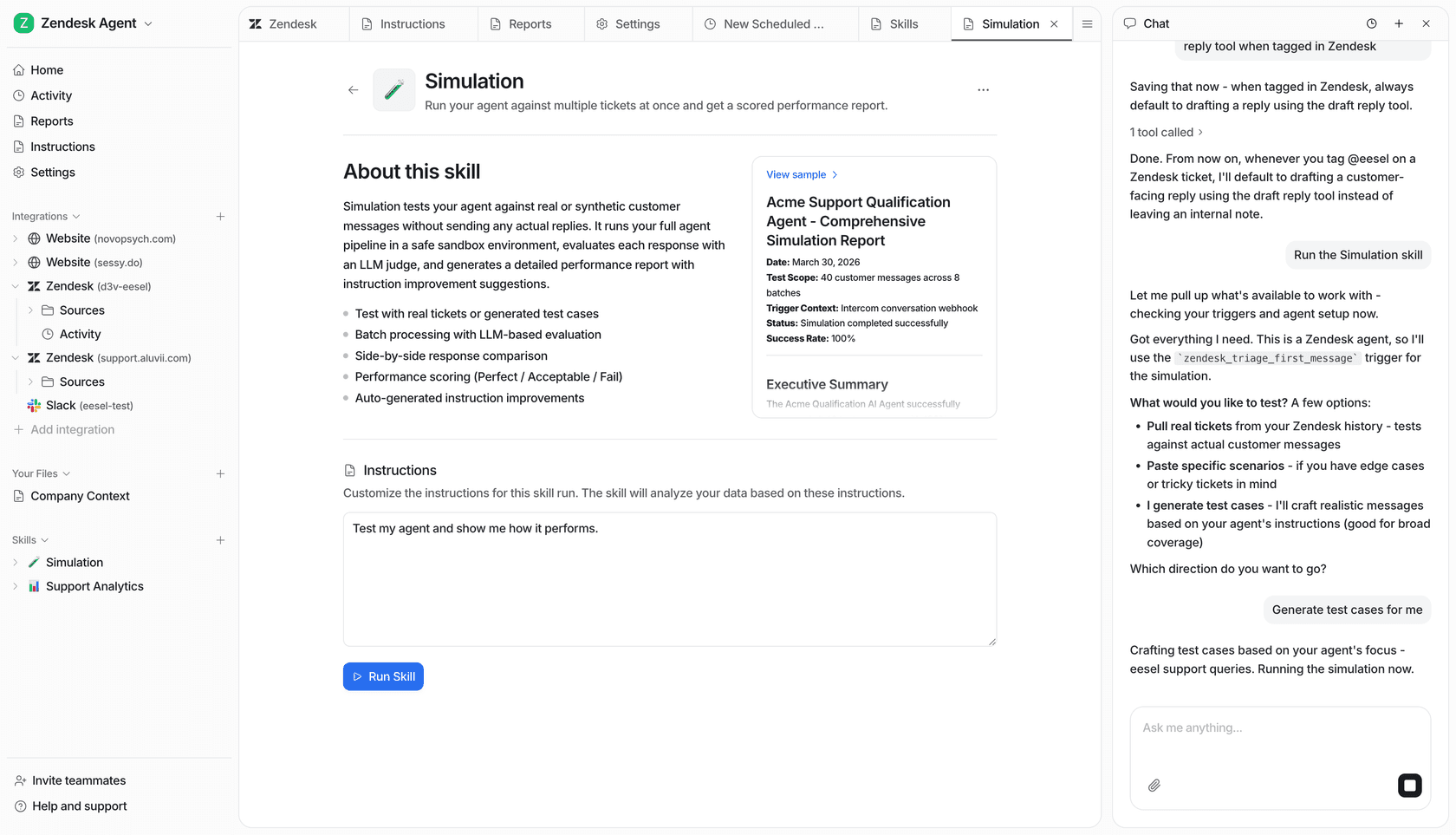
A week spent reading about a paused frontier model is a good week to put one simple question to your own vendor. Can I watch this work on my data before it answers a customer? With eesel the answer is yes, inside an afternoon, and it is free to start.
Try eesel or book a demo if you want to see the simulation run on your own ticket history.