


What is an AI support agent?
An AI support agent is software that can understand a customer request, find the relevant company knowledge, and complete or route the next step. Unlike a basic scripted chatbot, it can work across a conversation, call connected systems within limits you set (bounded autonomy), and hand the case to a human when confidence is low.
You will also see this category described as an AI agent for customer service or a customer service AI agent. Those phrases describe the same core job: resolving routine support work while keeping a human in control of exceptions.
What we looked at, and what we ignored
Eleven tools made the list. The original eight focus on helpdesk automation and broader customer-service operations. FwdSlash and HelpShelf add options for creators and small SaaS businesses that need answers and human handoff on their own websites.
For the broader support platforms, we evaluated four areas:
- Actually agentic, not just retrieval-augmented chat. The product has to take action - look up orders, process refunds, tag and route tickets, update accounts - not just answer questions from a help center.
- Real production deployments, named. Logos with case studies and numbers we can verify, not anonymous "Fortune 500 customer" claims.
- Multi-channel. Email, chat, voice or messaging - the agent has to follow the customer across at least two channels with the same context.
- A pricing story that survives scrutiny. Either public and predictable, or sales-led but with a known shape (per-resolution, outcomes-based, volume-tier).
We left out products when we could not verify enough current pricing, implementation, and customer evidence to compare them fairly at this depth.
FwdSlash and HelpShelf are included for website support and human handoff. Their entries distinguish that use case from the enterprise workflow automation above. Customer deployments and G2 scores for these two additions have not been independently verified.
The 11 best AI support agents for customer service in 2026
| # | Tool | Best for | Pricing model | Public pricing? | Starting price | G2 score | Notable customers |
|---|---|---|---|---|---|---|---|
| 1 | eesel | Mid-market support teams keeping their stack | Monthly credits (1 per ticket / chat) | Yes | From $299/mo (500 credits), 100 free credits | 4.8 (Zendesk app store) | Smava, Ecosa, Yellowdig, Gridwise, InDebted |
| 2 | FwdSlash | No-code AI agent for website customer support | Flat monthly + message allowance | Yes | Free; paid from $20/mo | Not independently verified | Vendor-listed: Looppanel, BharatBenz, Huddex, Machete, FormX |
| 3 | Fini | Regulated, high-volume B2C support | Per resolution (escalations free) | Yes | From $0.49/resolution (Enterprise) | 4.9 (G2, vendor-reported) | PostFinance, Bitdefender, Wefunder, Unit, Atlas |
| 4 | HelpShelf | Creators and small SaaS with their own website | Monthly plans with search and chat allowances | Yes | Free; Pro $49/mo; Scale $149/mo | Not independently verified | Not independently verified |
| 5 | Decagon | Enterprise CX replacing brittle flow bots | Sales-led, volume-tiered | No | Sales-led (10K+ tickets/mo) | 4.8 | Chime, Duolingo, Hertz, Rippling, ClassPass |
| 6 | Sierra | Large consumer brands, outcomes-priced | Outcomes-based (per resolved outcome) | No | Sales-led, multi-week deploy | 4.5 | Rocket Mortgage, SoFi, ADT, Sonos, Sweetgreen |
| 7 | Ada | 300K+ conversations/year enterprise | Sales-led, per-conversation | No | ~$30K–$300K+ ACV reported | 4.7 | Monday.com, IPSY, Pinterest, Cebu Pacific |
| 8 | Forethought | Enterprise on Salesforce or legacy Zendesk | Platform fee + outcome-based | No | Quote only, POV instead of trial | 4.6 | Upwork, Carta, Grammarly, UPS, Cohere |
| 9 | Tidio Lyro | SMB Shopify and SaaS stores | Per seat + per-conversation | Yes | $24.17/mo or $0.50/Lyro convo | 4.7 | Under Armour, The Body Shop, Stanley, ADT |
| 10 | Zendesk AI Agents | Teams already deep in Zendesk Suite | Per agent + per resolution | Partial | $19+/agent + AR overage | 4.3 | Vimeo, Best Egg, BritBox, Babbel |
| 11 | Gorgias AI Agent | Shopify ecommerce brands | Per ticket + per resolved AI conversation | Yes | $10/mo + $0.85-$1.00/interaction | 4.6 | Steve Madden, Decathlon, On, Olipop |
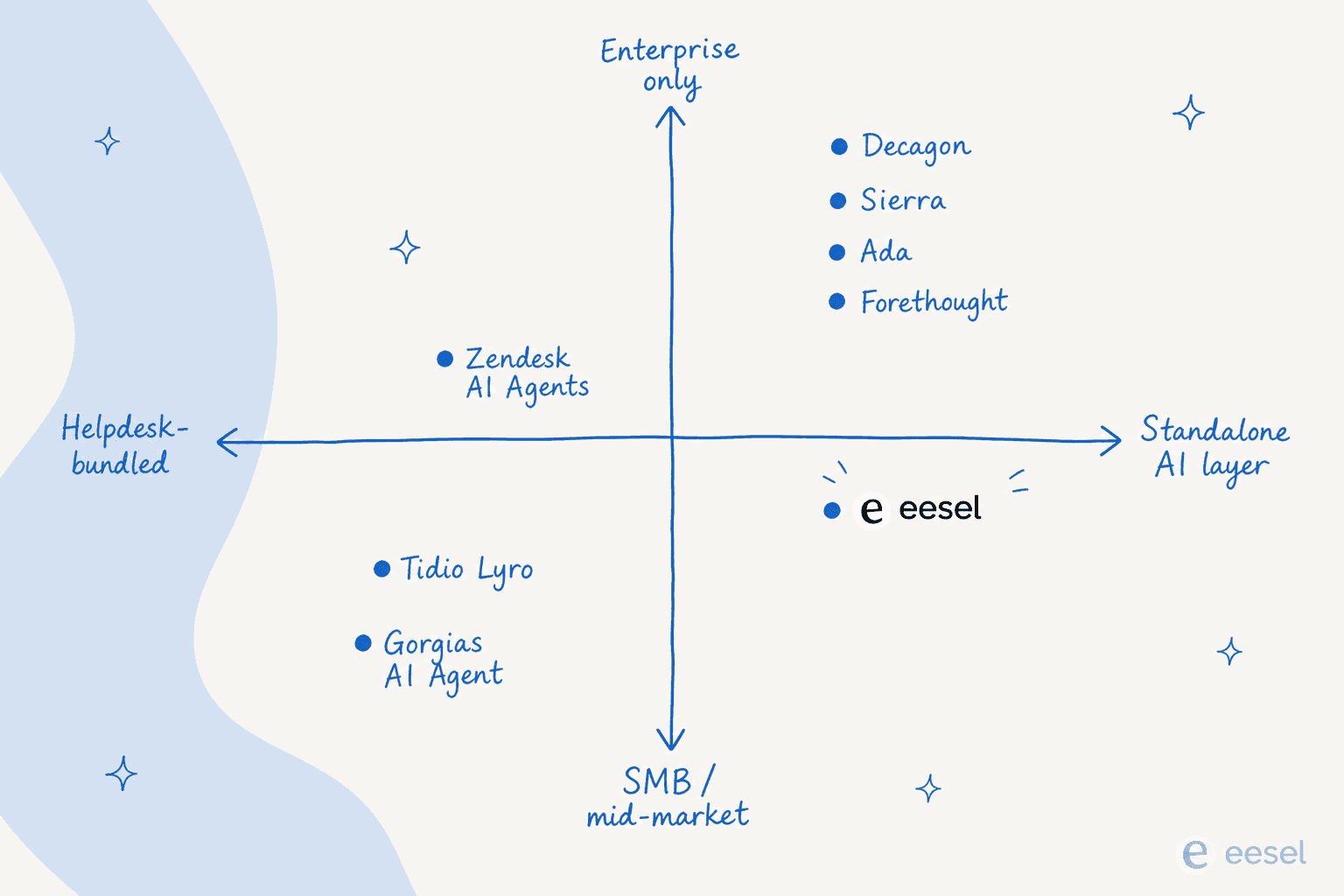
A quick read of the quadrant above: the AI-native heavyweights cluster in the top-right (standalone, enterprise-only). The helpdesk incumbents sit on the left (bundled). The mid-market sweet spot - standalone but accessible to teams under 300K conversations a year - is where we'd say eesel currently sits alone.
1. eesel - best for keeping your existing helpdesk and paying a fixed monthly price
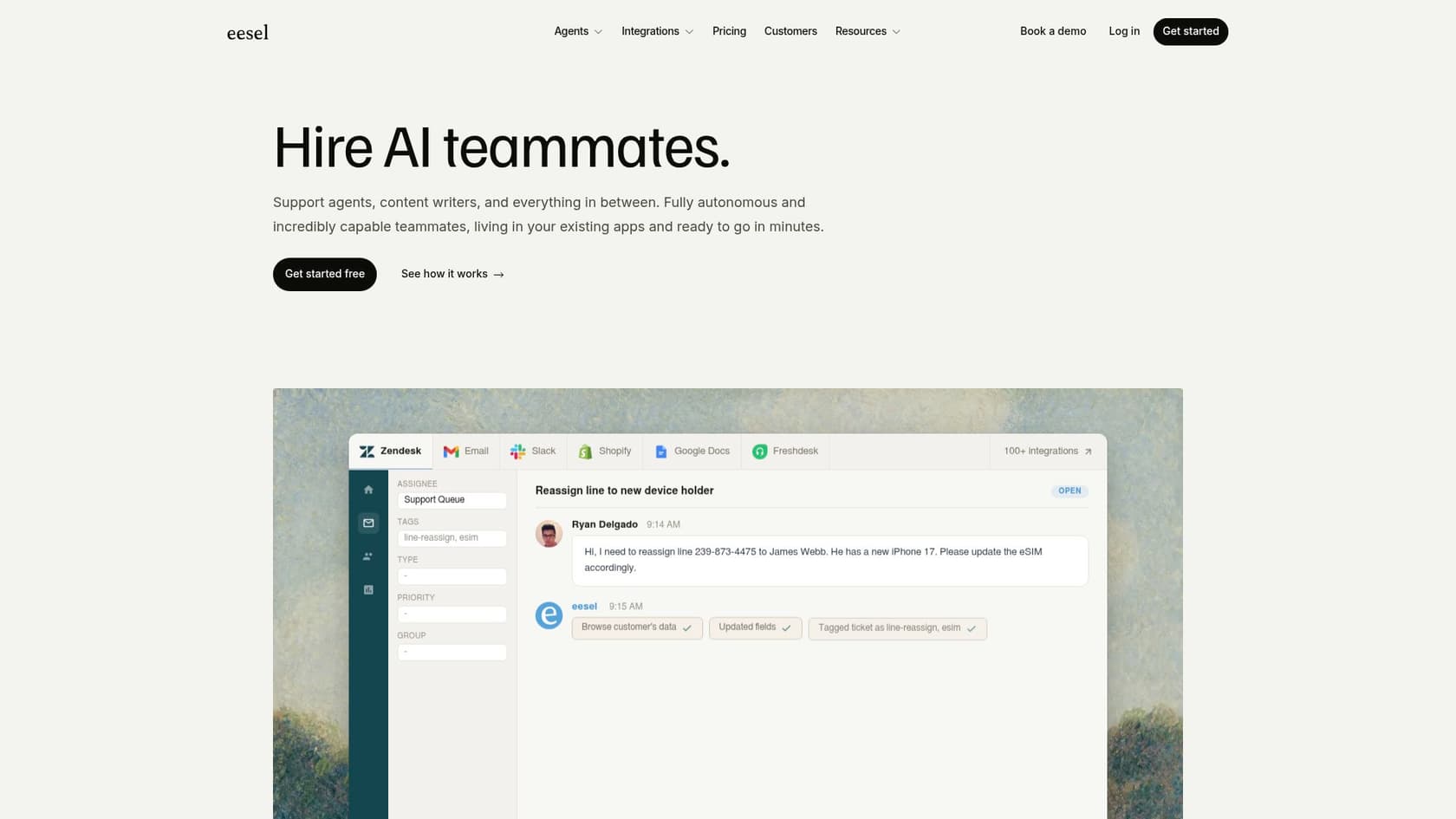
We'll start with the one we built - eesel - and we'll be honest about where it fits. eesel positions itself as "AI teammates" rather than chatbots or copilots: an autonomous worker that lives inside the helpdesk you already pay for (Zendesk, Freshdesk, Gorgias, Intercom, Slack, email), reads tickets, drafts replies, takes actions, and escalates the edge cases.
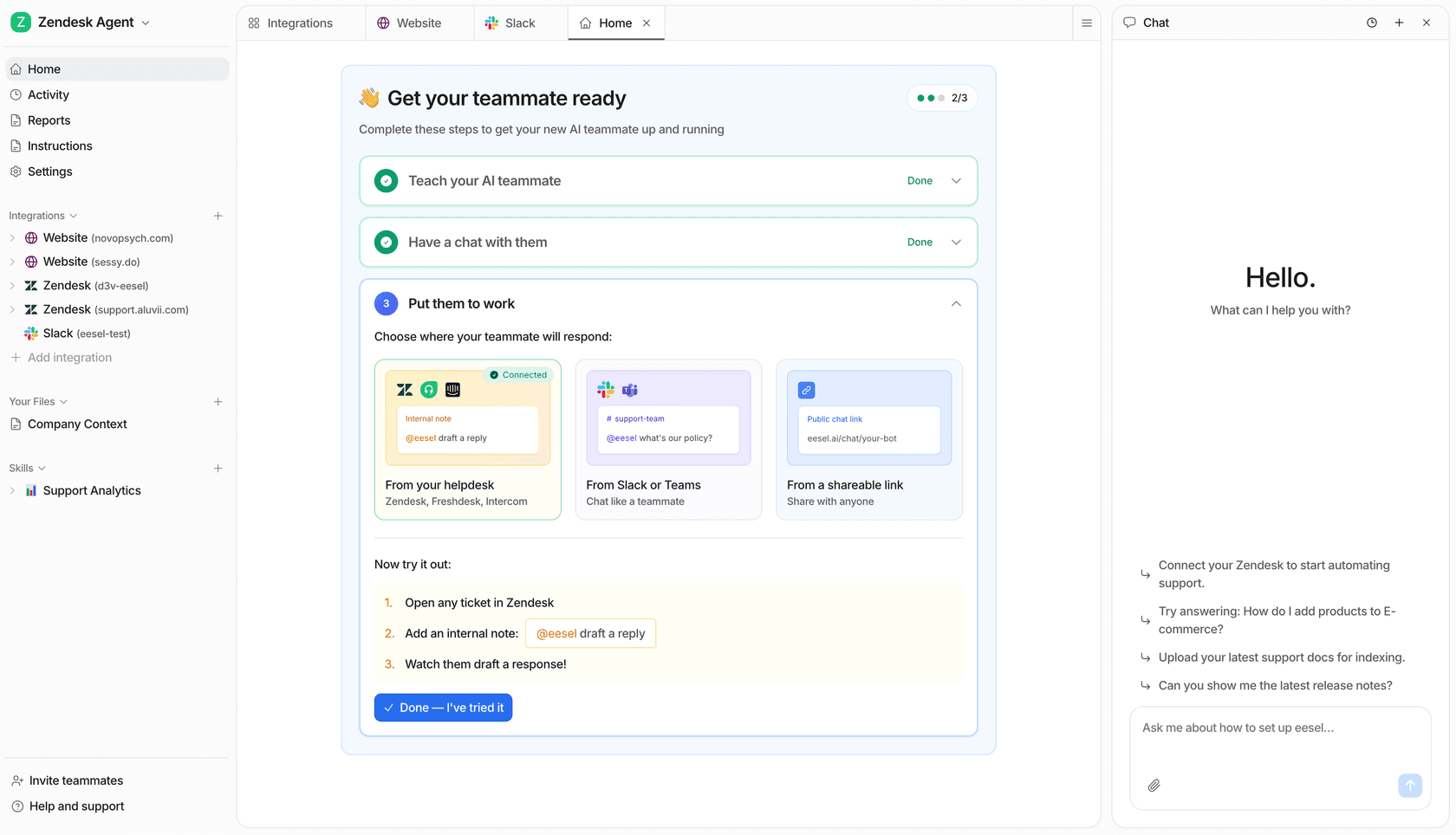
The thing that makes it different from most of the rest of this list is the pricing model and the on-ramp. There's no sales call to start, no 300K-conversations-a-year floor, and no per-resolution billing surprise. One ticket is one credit, however long it runs - chat sessions are the same, and questions asked in the dashboard are mostly free. Smava runs 100,000+ tickets/month in German on Zendesk through eesel; Design.com handles 50,000+/month in Freshdesk with multiple agents and 1,000+ help articles. Same model whether you're processing 200 tickets or 200,000.
Where eesel fits best:
- You're already on Zendesk, Freshdesk, Gorgias, Intercom or email and don't want to migrate
- You want to start in a copilot pattern (drafts replies as internal notes, you approve), then graduate to autonomous handling as confidence grows
- You want predictable, line-item-on-the-invoice pricing - not "we'll true up against your AR allowance"
- You want to use the same agent platform for helpdesk and internal Q&A
Pros:
- Public, predictable monthly plans from $299/month for 500 credits (1 credit per ticket or chat) - and our team will walk through cost modelling with you before you commit
- No seat fees, no platform fee, every integration included (optional add-ons for SSO, data residency and priority support)
- Live across 100+ tools - Slack, Confluence, Google Docs, Notion, HubSpot, Salesforce, Shopify on top of the helpdesks
- Confidence-based routing and ticket-type exclusion as first-class controls - for the buyers (and there are many) who said "I need an AI who is only handling the tickets that it's confident to handle"
- 100 free credits to try without a card
Cons:
- Not yet a fit for the genuinely "enterprise-only" buyer who wants a service-led ACX-style deployment with dedicated practitioners - Sierra, Ada and Decagon outrun us on white-glove deployment muscle
- Voice is on the roadmap, not GA in the way it is at Decagon or Sierra
- Newer brand than Zendesk or Ada - if your procurement team requires Gartner-Magic-Quadrant-leader status, that's not us (yet)
Pricing: One fixed monthly price on the Teammate plan, sized to volume. 1 credit covers one ticket or chat, however long. Blog post drafts are $4 each. Pay a year upfront and get two months free. Add-ons (SSO and MFA, data residency, priority support) are priced separately. The full table lives on the pricing page.
| Monthly credits | Price |
|---|---|
| 100 (free plan, no card) | $0 |
| 500 | $299/mo |
| 1,000 | $499/mo |
| 2,500 | $999/mo |
| 5,000 | $1,899/mo |
Our take: If you're already on a major helpdesk and you want to put an agent on top of it without changing anything else, eesel is the lowest-friction path on this list. The pitch we hear most often from customers in the dossier is "finally, AI software that suits our needs" - Mateusz Golda, a director at a multi-brand gardening e-commerce on Shopify + Zendesk, put it that way in a G2 review. If you're an enterprise CX leader at a Fortune 500 with a multi-year incumbent contract and a service-led RFP, look at Sierra or Ada first.
2. FwdSlash - best for resolving questions on your website before they become tickets
FwdSlash is a no-code AI agent for teams whose support starts on their website. It answers visitors using site content, product documentation, and support material, helping handle questions before they become helpdesk tickets.
Teams can configure the agent around existing content and deploy it on their site without building their own chatbot. FwdSlash also offers human handoff. According to the team's supplied product description, Slack handoffs include the full conversation so the person taking over has context.
Best for: Teams that want to handle pre-sale and self-service website questions before they reach an email or helpdesk queue.
Pros:
- No-code setup using existing website content, files, and FAQs.
- Non-technical teams can revise prompts, knowledge, and escalation rules.
- Can complement a helpdesk agent by handling website questions earlier in the support journey.
- The team describes Slack handoff with conversation context.
Cons:
- The website-support use case does not replace an agent working an existing helpdesk queue.
- Thin or outdated source material limits answer quality.
- Human escalations still require staffing and an out-of-hours process.
Pricing: Public monthly plans use message allowances rather than per-resolution billing. Basic is free with one agent and 200 messages. Intermediate costs $20/month for one agent, 2,000 messages, and three team members. Pro costs $100/month for three agents, 20,000 messages, and five team members. Enterprise pricing is custom. Confirm annual discounts and add-on charges against the selected plan before subscribing.
Verdict: FwdSlash is worth evaluating when website questions create much of your support workload. Measure whether it reduces incoming tickets and how often visitors still need a person. If your main bottleneck is an existing email queue, prioritize helpdesk automation first.
3. Fini - best for regulated, high-volume teams that want to pay per resolution
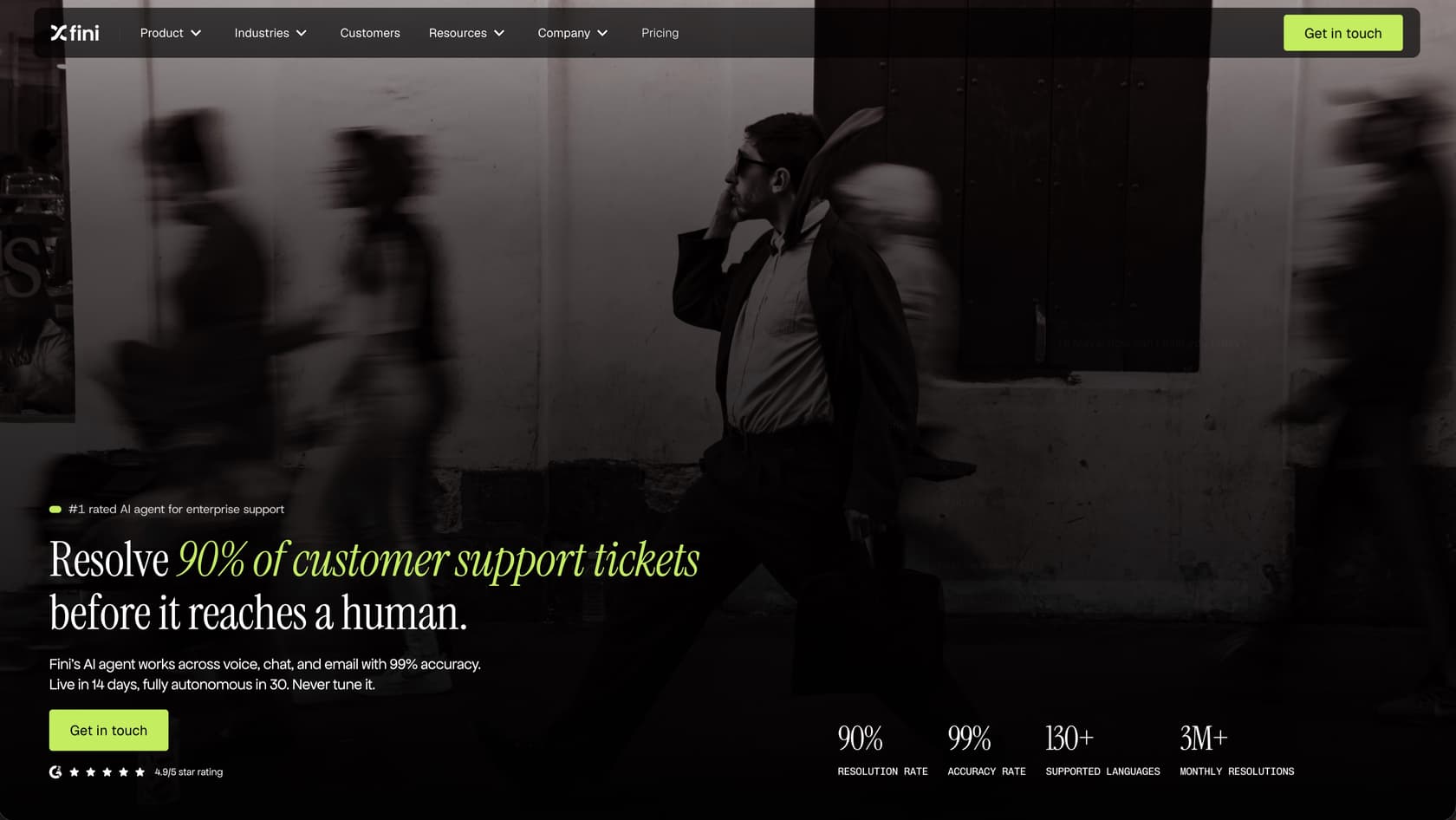
Fini is a Y Combinator and Matrix Partners-backed AI support agent built for regulated, high-volume B2C support: fintech, banking, insurance and healthcare, plus e-commerce and gaming brands with similar ticket loads. It resolves tickets end to end across voice, chat and email from one agent, on top of the helpdesk you already use. There are marketplace-verified apps for Zendesk, Intercom, HubSpot, Front and Gorgias, plus Salesforce, Freshdesk and LiveChat.
The technical wedge is Knowledge Atlas, a self-maintaining knowledge layer. It scans resolved tickets, spots what your docs don't cover, and publishes the missing article, so the agent keeps improving without someone re-tuning it every week. Every answer is confidence-scored and policy-checked, and anything below threshold is handed to a human with full context attached. Fini reports 90% resolution at 99% accuracy across 3M+ resolutions a month (vendor-reported).
"We went from 15% to 70% automation on key journeys."
Crystal Stephens, Head of Operations, Atlas (Fini case study)
Best for: high-volume B2C teams in regulated industries that want an autonomous agent on their existing helpdesk and a bill based on resolved tickets.
Pros:
- Per-resolution billing: escalations are free, reopens within 72 hours aren't billed twice, and greetings, spam and abandoned sessions never count
- Voice, chat and email on one agent, with support for 130+ languages
- Fini lists SOC 2 Type II, ISO 27001, PCI DSS Level 1, HIPAA, GDPR and CCPA compliance; confirm BAA and data-residency requirements for your plan
- Customers include PostFinance, la Mobilière, Bitdefender, Wefunder, Unit and Atlas
- Fini’s supplied offer includes a 90-day money-back guarantee, with resolution, CSAT and accuracy targets agreed in writing; confirm the applicable terms with Fini
Cons:
- Aimed at volume; a B2B SaaS desk doing a few hundred tickets isn't its primary audience
- Guided 14 to 30 day rollout with Fini's engineers, not same-day self-serve
- Fini reports a G2 rating of 4.9/5, but from a small number of reviews
Pricing: Published pricing starts at $0.49 per resolution on Enterprise, with no per-seat fees and implementation included. Growth is $0.89 and Scale is $0.69 per resolved ticket; voice has a separate rate card. Details on Fini's pricing page.
Verdict: If you're a regulated or high-volume B2C team and the security review is the hardest part of buying, Fini is one of the most complete answers here, and its per-resolution meter with free escalations is one of the cleaner pricing models on this list. If you need a free self-serve trial this week, look elsewhere.
4. HelpShelf - best for creators and small SaaS who want cited answers on their own site
HelpShelf is an AI agent installed with a script tag on pages you control, including marketing sites, sales pages, and help centers. It answers from your own content, including scanned website pages, help articles, and editor content, and cites sources on confident answers. It can capture leads after visitors submit their email and offer a visitor-confirmed human handoff when a tested channel is reachable.
Creators use it for pre-sale FAQs and support questions on the pages that lead to checkout. It is a website support layer, not a helpdesk add-on or a Whop, Kajabi, or Skool marketplace app.
Best for: Course creators, coaches, and small self-serve SaaS businesses that want cited answers, clear monthly usage, and an agent on their own domain.
Pros:
- Answers grounded in your content, with source citations
- Script-tag installation on pages where you can add code
- Lead capture and visitor-confirmed human handoff
- A free plan and separate monthly allowances for AI searches and chats
Cons:
- No full enterprise ticketing suite, SLAs, phone support channel, or workforce management
- Requires a page that permits script embedding to run the widget
- Human handoff depends on a tested, reachable channel
Pricing: Free includes 500 AI searches and 100 AI chats per month. Pro is $49/month for 10,000 searches and 2,000 chats. Scale is $149/month for 100,000 searches and 20,000 chats.
Verdict: A focused option for answering questions on a creator's or small SaaS business's own site. Teams that need a deep helpdesk should keep Zendesk, Intercom, or Gorgias and use HelpShelf alongside it.
5. Decagon - best for enterprise CX teams replacing a brittle flow bot
Decagon is the one most likely to come up if your CX leadership is reading TechCrunch. Founded in 2023 by Jesse Zhang and Ashwin Sreenivas, it's raised through a Series C of ~$131M led by Andreessen Horowitz and Accel at a reported ~$1.5B valuation - putting it in the CX-AI unicorn bracket alongside Sierra and Cresta.
The technical wedge is Agent Operating Procedures (AOPs): natural-language instructions that compile into executable code. The pitch - and you can hear it most clearly in the Duolingo case study - is that AOPs let non-technical CX operators author and iterate agent logic, while engineers keep control over guardrails, integrations and versioning. It's a deliberate shot at the "developer SDK and decision-tree" model used by most competitors. The Duolingo testimonial puts the point on it:
"With the previous vendor, at least half my week was dedicated to maintaining their system. With Decagon, it's been a night-and-day difference."
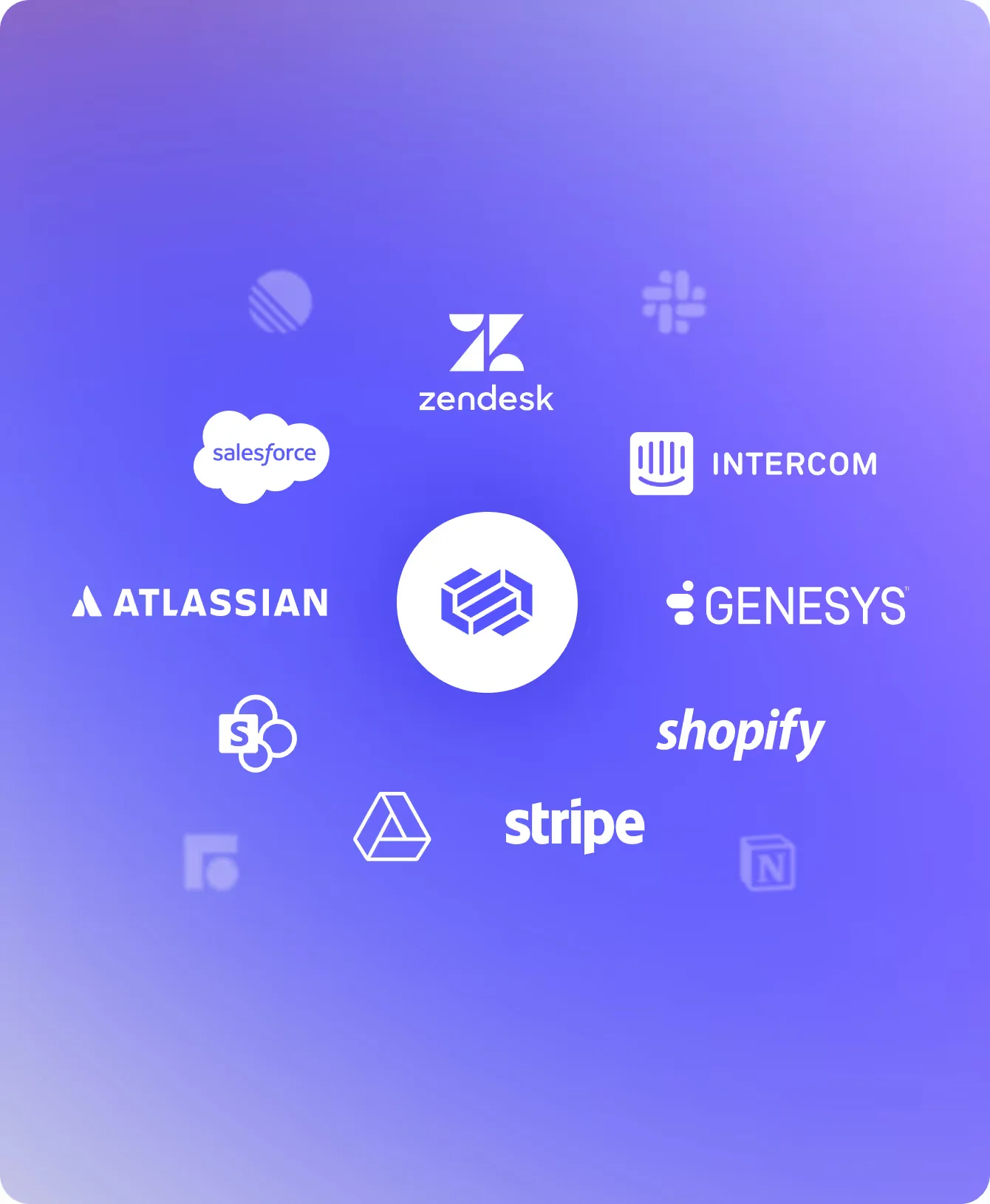
Best for: mid-market and large enterprise CX teams (10,000+ monthly tickets) who already tried a chatbot or flow-builder vendor and got burned by maintenance burden.
Pros:
- The customer roster is genuinely heavyweight - Chime (70% chat + voice resolution), Duolingo (80% deflection), Hertz, Rippling, ClassPass, Oura, Notion, Figma
- Omnichannel parity (chat, voice, email, SMS, custom API) from one runtime
- Decagon Voice is GA, not vaporware - see the voice product page
- Built-in transparent observability - every model call and KB lookup is traceable
- Proactive Agents for outbound use cases recently launched
Cons:
- Sales-led only - the
/pricingURL is a 404. Every CTA routes to a demo form gated by a "Monthly Support Tickets" dropdown whose smallest bracket is "<9,999" - Multi-week implementation, not a same-day install
- The ICP gate excludes most SMB and lower-mid-market teams by design
- No public pricing means budget-conscious buyers can't compare on cost without going through the qualification call
Pricing: No public pricing. The demo form's volume brackets (<9,999 / 10,000–49,999 / 50,000–249,999 / 250,000+) are the clearest signal: this is sold as an annual enterprise contract bracketed by ticket volume, not seats.
Verdict: If you're an enterprise CX leader who's spent the last two years maintaining a Genesys Dialog Engineer or a Salesforce Einstein flow and you're done with that, Decagon is the strongest one-to-one swap. If you need a quote in 24 hours or you want to self-serve a trial, look elsewhere.
6. Sierra - best for large brands willing to pay per outcome
Sierra is the one your CEO has heard of, because Bret Taylor (ex-Salesforce co-CEO, ex-Facebook CTO, current OpenAI board chair) is the co-founder, alongside Clay Bavor (18 years at Google, ran Google Labs). The 2025 Series D was reportedly $350M at a ~$10B valuation, making it the most aggressively-funded private AI company in this list.
The product is built around three ideas that the rest of the list mostly doesn't have:
- Outcomes-based pricing. You pay only when the agent resolves the contracted outcome (a resolved ticket, a completed subscription change, a retention save). Sierra's homepage frames it as "Pay for a job well done - Ensure you only pay for the value Sierra delivers with outcome-based pricing."
- Ghostwriter - the agent that builds agents. You feed it SOPs, transcripts or audio, and it builds the first draft of your agent. The implementation cycle that competitors quote in weeks shrinks dramatically.
- Agents through ChatGPT. Sierra agents can be deployed in ChatGPT itself, which no one else in this list can claim. Bret Taylor's OpenAI board seat is the relationship layer behind that.
Best for: large consumer brands and regulated enterprises (Fortune 500-ish) where the AI's bill can be tied to a clear KPI - completed transactions, resolved tickets, retention saves.
Pros:
- The regulated-industry customer roster is unmatched - Rocket Mortgage, SoFi, Vanguard, FINRA, Paychex, Sutter Health, Sonos, Sweetgreen, ADT, Discord
- ISO 42001 (the AI-specific management system standard) is on the homepage - most competitors don't have it yet
- The Agent SDK is genuinely code-first for engineering teams (Ramp wrote their customer journeys as code) while Agent Studio is no-code for ops teams
- Outcomes pricing shifts implementation risk onto Sierra rather than the customer
- One agent across chat, voice, SMS, WhatsApp, email and ChatGPT - same context everywhere
Cons:
- No public pricing of any shape - no per-outcome rate, no minimums, no published averages
- Outcomes pricing means a fundamentally variable bill - finance teams who want predictability hate it
- Implementation is multi-week even with Ghostwriter; no self-serve trial
- Worst fit for SMB and mid-market by Sierra's own admission
"Bret Taylor's Salesforce / Facebook / Google Maps track record plus Clay Bavor's 18-year Google product run gives Sierra unusual enterprise-buyer pull - and explains the regulated-industry logos that most AI-native vendors can't land."
from our internal research synthesis on Sierra, pulled from their About page
Pricing: No public price list. Outcomes-based - you negotiate the unit and the rate per use case via sierra.ai/learn-more.
Verdict: If your CFO will sign an outcomes-based contract and your CX team has a multi-week implementation runway, Sierra is the closest thing to white-glove agent deployment money currently buys. If you want to know what you'll pay this quarter, this is not the one.
7. Ada - best for the 300K-conversations-a-year enterprise
Ada is the Toronto-headquartered standalone AI customer service platform that's been at it longer than most - Series C of $130M led by Spark Capital at a $1.2B valuation in 2021, total ~$190M+ raised. In 2026 they've rebranded the product as the ACX Platform ("Agentic Customer Experience") with four pillars: the Reasoning Engine (multi-LLM orchestration), Conversation Hub (omnichannel), Performance Center (Playbooks + Coaching), and Developer Toolkit (APIs, MCP, SDKs).
What makes Ada distinct is the ICP gate. Their pricing page is the only one on this list that explicitly says "we're not for you" if you're under a threshold:
"We are a great fit for companies with at least 300,000 annual customer service conversations."
The qualification form's volume picker runs all the way up to "More than 100 million." This is a deliberately enterprise-only product. Customer logos confirm: Monday.com (42% reduction in average agent handle time), IPSY ($2.7M estimated annual savings, 943% ROI in four months), Pinterest, Grab, Sky, Barnes & Noble, Cebu Pacific, Malaysia Airlines.
Best for: enterprise CX teams above 300K annual conversations who want a standalone AI layer sitting on top of (not replacing) their helpdesk.
Pros:
- Genuinely helpdesk-agnostic - integrates with Zendesk, Salesforce Service Cloud, Freshworks, ServiceNow, Genesys
- Multi-LLM orchestration via the Reasoning Engine is a real technical wedge (most competitors lean on a single proprietary stack)
- One of the few CX vendors leading with AIUC-1 (AI-specific compliance certification) and zero data retention with LLM providers
- MCP-native developer toolkit - they're positioning for the agentic / Model Context Protocol ecosystem
- ACX Practice + ACX Experts service wraps mean you get a methodology and humans, not just software
- 4.7 G2 score with substantive review volume
Cons:
- 300K conversations/year floor is enforced on the pricing page itself - SMB and most mid-market are explicitly out
- No public pricing; expect $30K–$300K+ ACV based on Vendr / G2 / Reddit operator triangulation
- "Sold as a platform, not a feature" means a service-led enterprise deployment, not a self-install
- Voice is being shipped through 2026 but is younger than Decagon's or Sierra's voice product
Pricing: No published list. Vendr and Salesforce AppExchange listings consistently triangulate $30,000/year floor → $300,000+/year ceiling based on conversation volume. The 2021 Series C and the conversation-floor positioning are the strongest indicators that this is an annual enterprise contract.
Verdict: If you do 300K+ conversations a year and you want to keep your existing helpdesk (Zendesk, Salesforce, ServiceNow) without bolting on its native AI, Ada is the strongest standalone option. The ACX Practice + Experts wrap is also genuinely useful when you have nobody in-house who knows how to run an AI agent program.
8. Forethought - best for enterprise on legacy Zendesk or Salesforce
Forethought is the elder statesman of AI-native CX. Founded in 2017 by Deon Nicholas, winner of TechCrunch Disrupt SF Startup Battlefield 2018, they've raised ~$92M total including a $65M Series C in 2021 led by STEADFAST Capital Ventures. The product is now structured as a multi-agent system:
| Product | What it does |
|---|---|
| Discover | Insights agent - finds knowledge gaps from historical tickets, auto-generates Autoflows and KB articles |
| Solve | The flagship customer-facing agent - chat, email, voice, SMS, Slack, mobile, API - with Autoflows, Custom Actions, and a Browser Agent |
| Triage | Tagging and routing agent (Forethought's earliest standalone product) |
| Assist | The agentic copilot for human agents |
| Agent QA | Automated QA scoring across 100% of interactions vs. the typical <5% manual sample |
The strongest pitch for Forethought is the Browser Agent - for legacy systems without proper APIs, the agent can operate the GUI directly. That's a wedge most newer vendors don't have, and it matters in regulated industries with 20-year-old internal tools.
Best for: mid-market and enterprise teams with mature support orgs who want agentic AI but are locked into their current helpdesk - especially Salesforce Service Cloud, Intercom, or legacy Zendesk Support deployments.
Pros:
- Helpdesk-agnostic - sits on top of Zendesk, Salesforce, Freshworks, Intercom and others via integration
- The Browser Agent solves a real problem (acting on systems that lack proper APIs)
- Customer roster includes Upwork (50% reduction in time to resolution, 65% self-serve rate), Cotopaxi (168% ROI in 6 months), Carta, Grammarly, UPS, Cohere, Scale AI, Redis
- Discover closing the loop on KB gaps is a genuinely useful feature - most competitors leave that work to the customer
- The 2025 AI in CX Benchmark Report is a real piece of primary research
Cons:
- No published pricing of any shape - "Get a Quote" is the only CTA, and the FAQ admits "additional usage charges may apply"
- No free trial, only a Proof of Value (POV) engagement run on your own data
- Older brand than Decagon and Sierra - the AI-native peer group's funding pace has left them behind
- Some 2024 reviews on G2 flag onboarding burden
Pricing: Quote-only. The pricing page lists three tiers (Team, Professional, Enterprise) plus three add-ons (Multibrand, Analytics API, Discover) - every CTA is "Get a Quote." Industry secondary sources (Vendr, G2, SaaSworthy) quote Forethought as mid-five-figure to low-six-figure ACV.
Verdict: If you're on Salesforce Service Cloud and don't want to migrate, or you've got 20-year-old internal tools without APIs, Forethought is the most credible AI-native vendor that won't force a helpdesk swap. Their multi-agent framing (Discover / Solve / Triage / Assist / Agent QA) is also one of the clearest articulations of how the agent surface area decomposes.
9. Tidio Lyro - best for SMB Shopify and SaaS stores
Tidio is the SMB-first pick on this list. The platform bundles a live chat, helpdesk, automation flows, and an AI agent called Lyro - powered by Anthropic's Claude rather than OpenAI, which Tidio uses as a differentiator in their feature copy. They claim a 67% average resolution rate (presented as market-highest, though resolution rate isn't standardized, so vendor figures don't compare directly) and a money-back guarantee if you don't hit 50% resolution, which is the closest thing on this list to outcomes-based pricing without actually being outcomes-based.
300,000+ businesses use the platform - Under Armour, The Body Shop, Dermalogica, Stanley, ADT. G2 review pages were inaccessible during our research but the Shopify App Store sits at 4.8/5 with 1,300+ reviews and Capterra is 4.8/5 across 200+ reviews.
Best for: SMB e-commerce and SaaS teams (under 2,000 billable conversations/month) who want one tool for live chat + AI agent + helpdesk and don't want sales calls.
Pros:
- Public, predictable pricing - Free up to 50 Lyro conversations lifetime, paid from $24.17/mo, Lyro standalone from $32.50/mo with new conversations at $0.50 each
- The 50% resolution money-back guarantee is unusually friendly
- 7-day free trial on all paid plans, no card required
- Strongest Shopify integration in the SMB tier - native Shopify Actions on Growth+ (order tracking, cart recovery)
- 120+ integrations including Zendesk, HubSpot, Mailchimp, WordPress, MCP support on Plus/Premium
- Lyro Connect lets you layer Lyro on top of an existing Zendesk or Salesforce as the AI layer (Plus/Premium only)
Cons:
- Multi-axis usage pricing - paying per billable conversation and per Lyro conversation and per Flows visitor - gets harder to predict at scale
- The $749/mo jump from Growth to Plus is a step change, not a smooth ramp
- Live chat support only on Plus and Premium tiers; lower plans are email-only
- Built more around live chat + automation flows than around fully autonomous resolution - best as a copilot/hybrid, not as a pure agent
- Lyro Smart Actions are newer than the equivalents at Decagon and Sierra
Pricing:
| Plan | Price (annual) | Billable conversations | Key unlock |
|---|---|---|---|
| Free | $0/mo | 50 (+ 50 Lyro lifetime) | 100 Flows visitors |
| Starter | $24.17/mo | 100 | Live visitors list, operating hours |
| Growth | from $49.17/mo | 250–2,000 | Advanced analytics, Shopify actions, macros |
| Plus | from $749/mo | Custom | Departments, Lyro Connect, OpenAPI, CSM |
| Premium | ~$2,999/mo | Custom | 50% resolution guarantee, managed AI, SSO |
| Lyro AI only | from $32.50/mo | per-conversation | AI layer for existing helpdesks |
Verdict: If you're a Shopify store doing 100–2,000 tickets a month, want one tool for everything support-related, and don't want to talk to sales - Tidio Lyro is the path of least resistance. Above that volume the per-conversation math starts to hurt and you'll want eesel's fixed monthly credit plans or Gorgias's deeper Shopify hooks.
10. Zendesk AI Agents - best for teams already deep in Zendesk Suite

Zendesk's AI Agents is the incumbent's play. Post the January 2024 Ultimate.ai acquisition, the autonomous resolution layer that used to be sold as Ultimate is now embedded as AI Agents - Advanced inside Zendesk. There are two tiers - Essential (bundled with every Suite/Support plan) and Advanced (Ultimate.ai-derived, ~$50/agent/month historically, now rolling into every Suite/Support plan as of May 11 – June 12, 2026). On top of that sits Copilot (the agent-side AI: Auto Assist, Intelligent Triage, Admin Copilot), bundled at Enterprise or $50/agent/month as an add-on.
| Tier | Price | Capabilities |
|---|---|---|
| AI Agents - Essential | Bundled with Suite/Support; metered via AR | KB Q&A via generative replies; no scripted dialogues, no authorized actions, no external API calls |
| AI Agents - Advanced | Was ~$50/agent/month; rolling into Suite May–June 2026 | Generative procedures, scripted dialogues, authorized actions, API integrations, entity capture, multi-LLM |
Verified customer claims include Vimeo (30–40% automation), Best Egg (80% messaging automation, $500K+ saved), BritBox, NOBULL, Hello Sugar, TeamSystem, Babbel, Fortnum & Mason, Action Property Management. Zendesk was named a 2025 Gartner Magic Quadrant Leader for CRM Customer Engagement Center.
The Reddit community is harder on Zendesk than the case studies suggest. The dominant 2026 complaint is the per-resolution billing structure:
"No, it's just terrible and a rip off. You can't even export the data on like what people ask the bot so you can sort it or manipulate it how you want. We stopped using it because ARs are a rip off, and it's a rushed product to get into the AI hype."
u/OGShakey, r/Zendesk thread on Zendesk AI Agents

And the Essentials tier is widely described as insufficient on its own:
"doesn't feel like AI at all"
A more concerning data point: at the 2025 ProductLab Conference, only ~10% of AI agents built in the prior six months were still in use - Zendesk's own poll surfacing an abandonment signal.
Best for: teams already on Zendesk Suite Professional or higher who want to stay in one suite and have the KB hygiene to make Essentials work.
Pros:
- Zero integration work - the AI is one toggle away from your existing Zendesk tenant
- Includes everything an AI agent needs (KB, ticketing, omnichannel, workforce engagement) under one contract
- Marketplace of 1,800+ apps including eesel, Ada, Forethought (now Zendesk-owned), DigitalGenius, Aisera - you can layer alternative AI on top if Zendesk's own isn't enough
- Three-tier resolution model (since May 18, 2026): only Verified Resolutions draw from your allowance; Assisted Escalation and Contained Resolution are free
- A real Suite of capabilities for the "consolidate vendors" buyer
Cons:
- Per-resolution billing has no graceful cap - the only overage control is "pause AI entirely." Zendesk's pricing page puts AR overage at $1.50 per resolution committed or $2.00 pay-as-you-go
- AI cost can easily 2–3x the base subscription once Copilot + AR overage stack
- KB hygiene is the real ceiling - multiple reviewers cite ~20% automation in month one until KB cleanup catches up
- Onboarding the AI layer (Copilot + AI Agents + Intelligent Triage) is repeatedly described as "burdensome"
- The Essentials tier "doesn't feel like AI" according to multiple Reddit operators
- The ProductLab abandonment poll is a real warning sign
Pricing:
| Plan | Price (per agent / month, annual) | What you get |
|---|---|---|
| Support Team | $19 | Ticketing only; no AI |
| Suite Team | $55 | First tier with AI Agents (Essential) + Knowledge Base |
| Suite Professional | $115 | Advanced AI, basic Admin Copilot |
| Suite Enterprise + Copilot | Contact Sales | Full Copilot, Intelligent Triage, Generative Voice, sandbox |
AI Agents Advanced was historically a $50/agent add-on; AR overage is unmetered and quote-only.
Verdict: If you're already on Suite Professional and your KB is clean, the bundled AI is the lowest-friction option. If you're shopping AI agents and not yet on Zendesk, going Zendesk-first because of the AI is the wrong order - the AR pricing tail will hurt as you scale. Plenty of buyers we've talked to ended up running eesel inside Zendesk specifically to dodge the AR meter.
11. Gorgias AI Agent - best for Shopify ecommerce brands
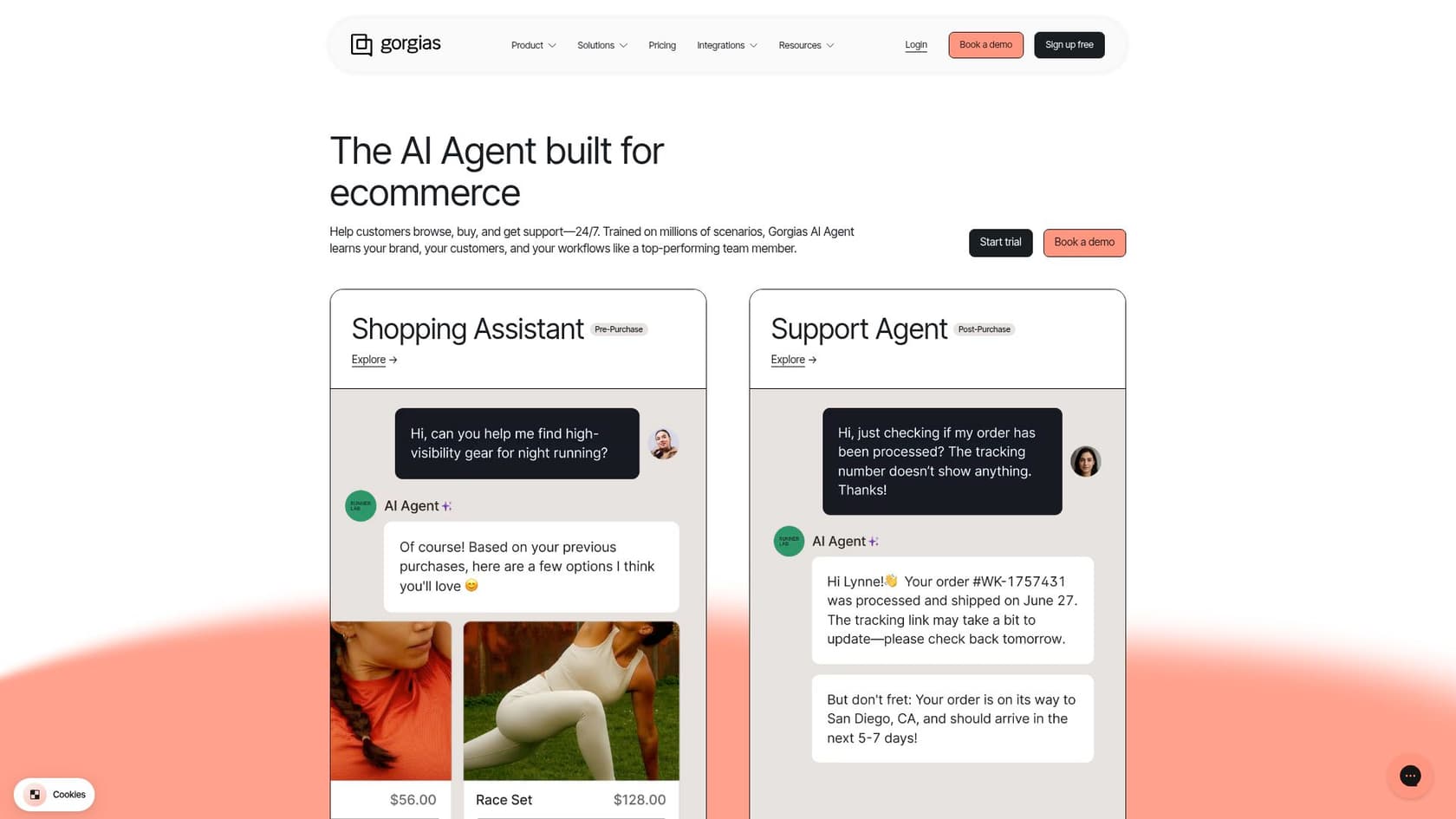
Gorgias is the Shopify-first helpdesk that's been pivoting hard into AI since 2024. It powers 40% of the top 1,500 Shopify brands - that's the moat - and the AI Agent ships with the deepest native Shopify data integration of any tool on this list. Order history, product catalog, customer context - all surface in every ticket without tab-switching.
Headline numbers from Gorgias's own customer stories: Orthofeet hit 56% automation in under 2 months, Pepper saw 19.2x ROI on AI-driven sales, bareMinerals at 8.83x. The platform-level claim is 60% of support automated for AI-active customers.
Best for: Shopify ecommerce brands of any size - Gorgias is built specifically for this stack and competing tools (Zendesk, Freshdesk, even eesel) need extra integration work to match the depth.
Pros:
- Native Shopify integration is genuinely best-in-class - no integration work, no API mapping
- Public, ticket-volume pricing - Starter from $10/mo, AI Agent included on every plan at $0.85–$1.00 per automated interaction
- 3 seats on Starter and 500 on every other plan (priced by ticket volume, not seats)
- 4.6/5 on G2 across 560+ reviews
- AI Agent works on Email and Chat channels, available on all plans
- Strong proactive sales automation (cart abandonment, product recommendations) alongside the support agent
Cons:
- Heavily Shopify-centric - for B2B SaaS or non-ecommerce, Gorgias is the wrong shape
- Per-ticket pricing on the helpdesk plus per-resolved on the AI Agent means a two-axis bill
- The AI Agent is newer than the helpdesk; some 2024 reviews flag it as still maturing
- Less omnichannel breadth than Decagon or Sierra (no voice agent yet)
- Reliance on the Shopify integration is a strength and a lock-in
Pricing:
| Plan | Monthly price | Tickets / month |
|---|---|---|
| Starter | $10 | 50 |
| Basic | $60 | 300 |
| Pro | $360 | 2,000 |
| Advanced | $900 | 5,000 |
| Enterprise | Custom | Custom |
AI Agent (included on every plan): $0.85–$1.00 per automated interaction. Annual billing saves up to 16%.
Verdict: If you're on Shopify and your support volume is concentrated around order, fulfillment and product questions, Gorgias is the most natural fit on this list. If your store is also running a knowledge base and want the same agent to handle internal Q&A or other helpdesks, eesel running alongside Gorgias is the pattern we see most often.
How to actually pick
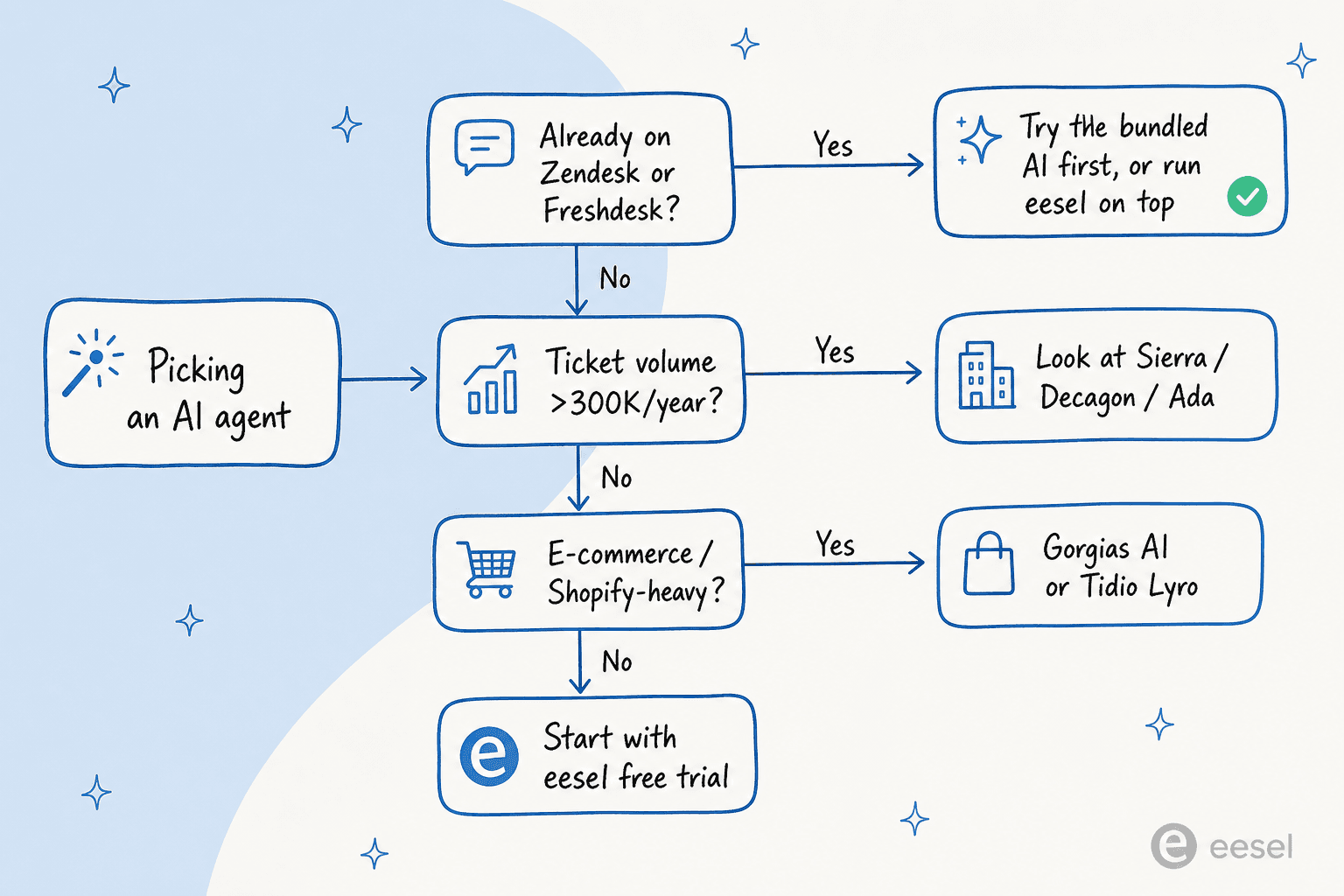
The shortcuts most buyers reach for don't survive scrutiny. Gartner Magic Quadrant alone won't tell you whether the agent will work on top of your specific helpdesk. G2 score alone won't tell you whether the pricing structure will survive your volume growth. Customer logos alone won't tell you whether the implementation runway works for your timeline.
The four questions that actually matter, in order:
- What helpdesk are you on, and are you moving? If you're staying on Zendesk, Freshdesk, Gorgias or Intercom, you have two paths: use the bundled AI (Zendesk AI Agents, Freddy, Gorgias AI Agent) or layer a standalone agent on top (eesel, Ada, Forethought). The bundled AI is cheaper to start but the AR/per-resolution math gets worse at scale. The standalone agents cost more upfront but the pricing is more predictable.
- What's your annual conversation volume? Under 250K conversations a year, eesel or Tidio Lyro are the practical picks - Sierra, Decagon and Ada are explicitly out of band at that volume. Above 300K, the AI-native enterprise platforms become viable, but eesel still works at that scale (Smava runs 100K+/month on Zendesk through eesel; Ecosa 10K+/month).
- Can your CFO sign an outcomes-based contract? If yes, Sierra is the strongest commercial fit because the implementation risk transfers. If no - and most companies are no - predictable fixed or per-ticket pricing (eesel, Tidio, Gorgias) is where the budget conversation gets easier.
- Does the buyer want self-serve or a service-led deployment? Decagon, Sierra, Ada and Forethought are all sales-led with multi-week deployments - that's by design. eesel, Tidio and Gorgias's AI Agent are self-serve, same-day starts. Zendesk's AI is self-serve in toggle but service-led in tuning.
The pattern we see most often in customer calls: buyers initially shortlist Decagon, Sierra and Ada based on TechCrunch coverage, then realize the 6–12 week implementation and the lack of public pricing won't survive their timeline. They end up running eesel inside their existing Zendesk or Freshdesk because it is a fixed monthly price, they can try it without a sales call, and they keep their stack. That's not us being smug - that's the conversational pattern, and it tells you where the genuine gap in the market is.
A note on per-resolution billing
This deserves its own callout because it's where the most buyers get burned.
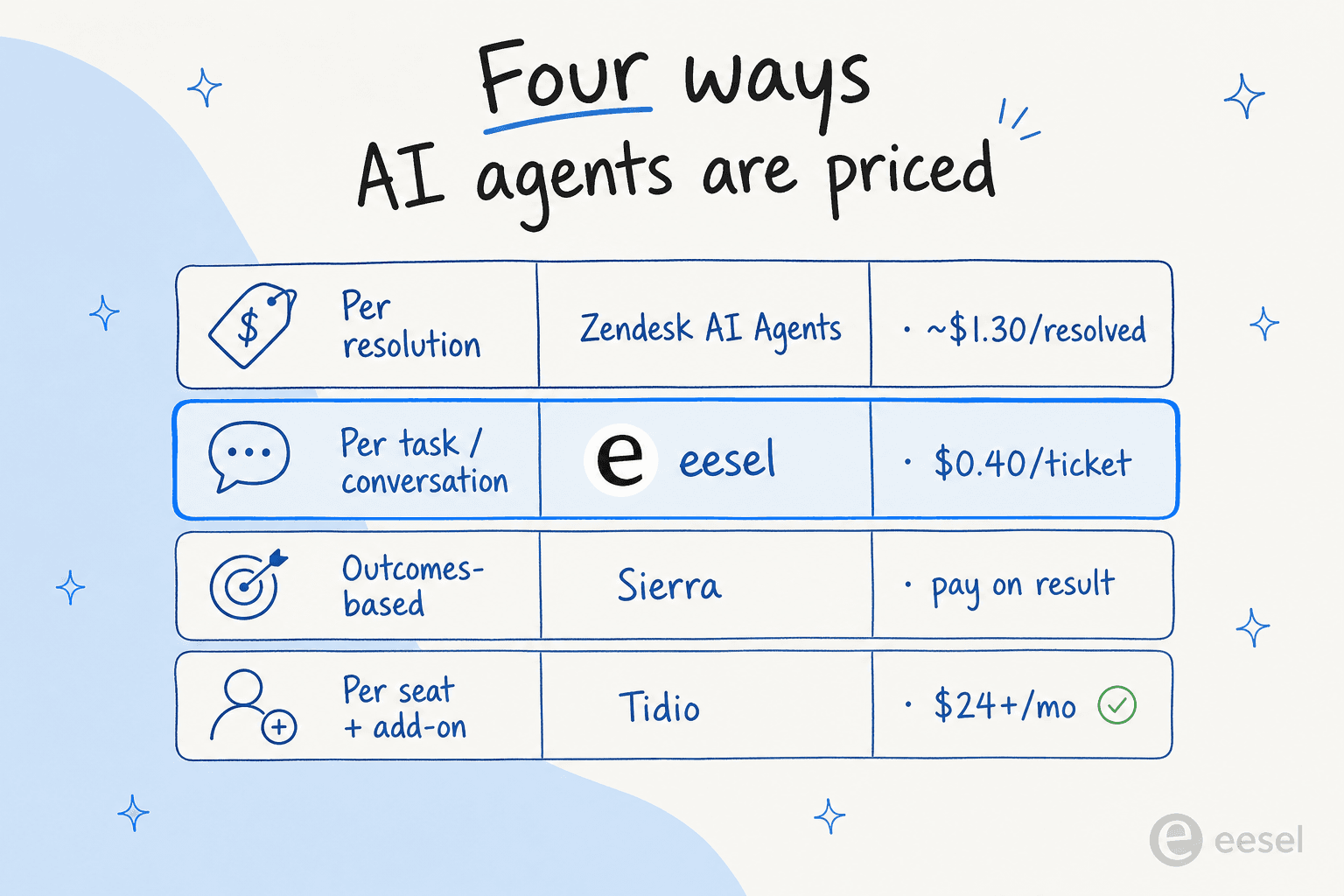
There are four pricing shapes in the market, and they bite differently:
- Per resolution (Zendesk AI Agents Advanced, Gorgias AI Agent). The model charges per AI-resolved conversation. The bill is volatile and ramps fast - Zendesk's third-tier resolution model (May 2026) only charges for Verified Resolutions, but extra resolutions still cost $1.50 each committed or $2.00 pay-as-you-go. The gotcha: there's no graceful cap. The only overage control is "pause AI entirely."
- Monthly credits (eesel from $299/month for 500 credits). Flat, predictable, no surprise. One ticket equals one credit regardless of how many replies the agent sends, and blog drafts are $4 each. You pick the plan that fits your ticket volume, and optional overage has a cap you set.
- Outcomes-based (Sierra). You only pay when the agent resolves the contracted outcome. The risk transfers to Sierra, but the bill is fundamentally variable, and disputed-outcome handling isn't publicly disclosed.
- Per seat + AI add-on (Tidio, Freshdesk Freddy, Zendesk Suite + Copilot). The traditional SaaS shape - seat price covers the helpdesk, the AI is a per-agent add-on or a per-resolution overlay. The cleanest budgeting model when you're small, the trap when you're at scale.
The buyer mistake most often is treating the per-resolution number as the headline price. It isn't. The headline price is per-resolution × your monthly resolution count - and that second number is the one nobody can forecast accurately until they've been live for six months. If you can't predict your monthly resolution count, prefer a fixed-credit plan (eesel) or set a hard monthly cap before signing.
What our customers actually told us
Beyond the public reviews and product pages, we went into our internal customer dossier - sales calls, churn deep-dives, support chats - to pull the lines that buyers actually say when they're evaluating AI agents. A few worth surfacing here:
"I've tested many AI agent solutions, but so far Eesel is one of the best. It has many features we need, such as broad sources availability, variety of options, integrations, and so on. Highly recommended." -- Mikita Tsybulka, Gcore (cloud / edge infrastructure) on the Zendesk Marketplace
"It feels like a partnership, rather than a vendor relationship. eesel AI was flexible enough for us to get started quickly and iterate, with great support from the eesel team. eesel has quickly become an integral part of our workflows."
"In the first month, eesel is resolving 73% of our tier 1 requests. eesel offers easy Zendesk implementation and setup. Our team implemented and achieved results quickly during our 7-day trial."

And one line from a recent sales call captures the trust-and-control objection cleanly. A CX lead at a DTC supplements brand on Gorgias + Shopify (~7K tickets/month, ~30K orders/month) put it this way: "The AI will never be able to answer 100% of the questions, but if it tries and just answers 'sorry I don't know this,' I cannot go and check all my 7,000 tickets to see if the AI actually made a good answer. I need an AI who is only handling the tickets that it's confident to handle and all the other ones, leave them alone."
That last one is the single most important sentence in the buying process, and most of the vendors on this list either don't have confidence-based routing or treat it as a footnote. The ones that lead with it (eesel, Sierra) tend to win the deal when the buyer asks the question.
Try eesel
If you've read this far and the pattern you keep recognising is "we're already on a helpdesk and we want to bolt an AI agent on without changing anything else" - that's exactly what eesel is built for. It runs inside Zendesk, Freshdesk, Gorgias, Intercom, Slack, email and 100+ other tools, starts at $299/month for 500 credits, and you can start with 100 free credits without a card or a sales call.
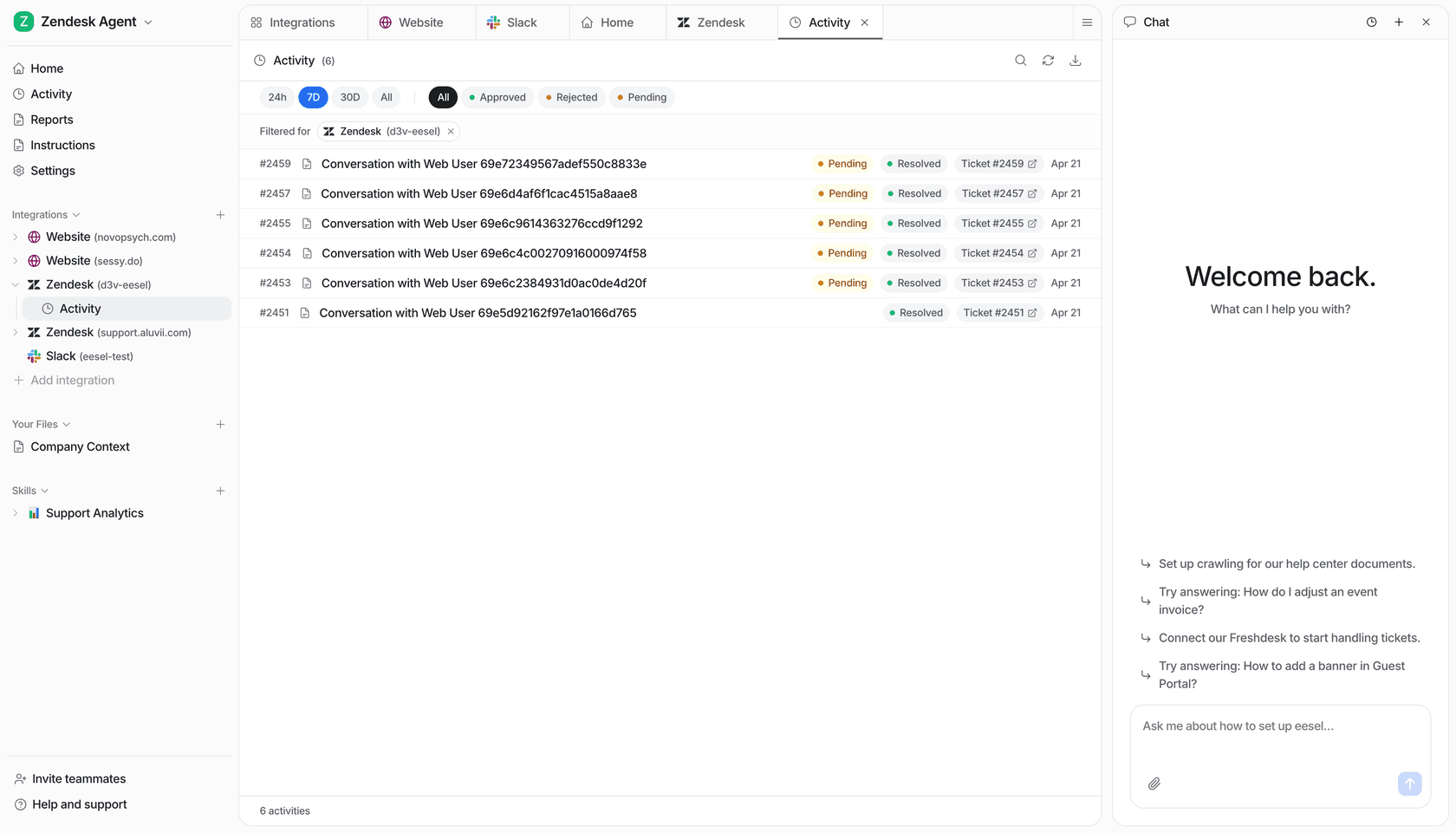
The same platform supports a helpdesk agent, a blog writer, and an e-commerce agent - same account, same task-based pricing. Try eesel or book a 30-minute walkthrough if you'd rather have one of us show you the shape.