

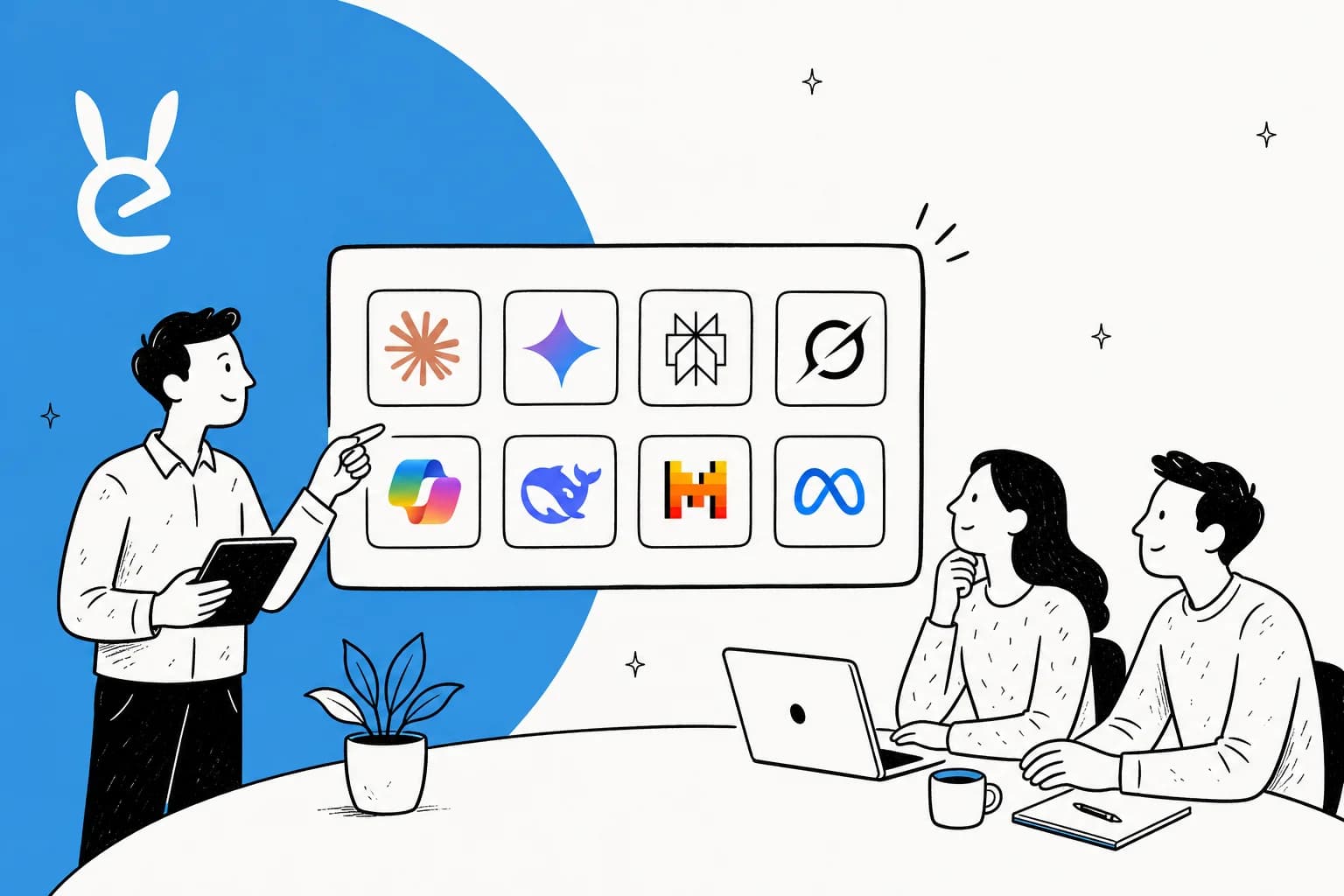
Why people leave ChatGPT
ChatGPT pricing is the first friction point. The four-tier structure - Free ($0), Go ($8), Plus ($20), Pro ($100+) - sounds reasonable until you realize that the free tier has a 27K context window and rate limits that kick in quickly, Plus caps at 54K context, and the full 128K-400K window only unlocks at Pro. Pay $20 a month and you still can't analyze a long document without hitting a wall.
Then there's the content policy, which has tightened noticeably. Users writing fiction, running red-team experiments, or building tools in adjacent-to-sensitive domains increasingly run into refusals that didn't exist two years ago. Privacy is another driver - ChatGPT chats can train OpenAI's models by default (you can opt out, but most users don't know to). And for EU organizations, there's still meaningful uncertainty around data residency.
None of this means ChatGPT is bad. With 200 million weekly users, it's the dominant AI chatbot for a reason. But "the most popular" and "the right choice for you" are different questions.
How we evaluated these tools
We looked at eight alternatives. For each one, we dug into the official pricing pages, scraped documentation and feature pages, read community sentiment across Reddit, G2, and X, and where possible tested the product directly. The criteria: model quality, pricing transparency, privacy posture, real-world use cases, and what the community actually says after the honeymoon period.
Here's the full comparison before we go deep on each tool.
At a glance: all 8 ChatGPT alternatives compared
| Tool | Free tier | Paid starts at | Best for | Standout feature |
|---|---|---|---|---|
| Claude | Yes | $17/mo | Writing, coding, long docs | 200K context, instruction-following |
| Gemini | Yes | $7.99/mo | Google ecosystem, multimodal | 1M context, Search integration |
| Perplexity | Yes (limited) | $17/mo | Research, fact-checking | Real-time citations, multi-model |
| Copilot | Yes | $8.25/mo (M365 Personal annual) | Microsoft 365 users | Embedded in Word, Teams, Outlook |
| Grok | Yes (limited) | ~$30/mo | X/Twitter users, real-time data | X Search API access |
| DeepSeek | Yes (unlimited) | Free (API paid) | Budget users | 200x cheaper than GPT-4 Turbo |
| Mistral | Yes (limited) | $14.99/mo | EU/privacy-conscious users | EU-hosted, GDPR-compliant |
| Meta AI | Yes (unlimited) | Free only | Casual / social media users | Built into Facebook, WhatsApp |

1. Claude - best for writing and long-context coding
Claude is Anthropic's AI assistant, and in 2026 it's probably the single strongest writing and coding tool available. The positioning is "your thinking partner" - and it earns that framing in a way ChatGPT mostly doesn't.
What makes Claude stand out is its instruction-following. When you give it a specific constraint - write in this voice, keep to this length, use this format - it holds the constraint through the entire response. ChatGPT has a tendency to drift: the style requirement you set in sentence one gets "forgotten" by paragraph four. Claude doesn't. Reddit users consistently describe the output as "less AI-smelly" and more natural - a low bar to clear, perhaps, but meaningful when you're editing at scale.
For coding, the numbers are striking: 78% of developers prefer Claude for code tasks over ChatGPT, and the advantage shows in multi-file refactoring work, where Claude's 200K context window lets it hold an entire codebase in memory.
Pricing (full breakdown):
| Plan | Price | What you get |
|---|---|---|
| Free | $0 | Chat, code gen, web search, extended thinking, file creation |
| Pro | $17/mo annual or $20/mo monthly | Claude Code, Cowork, unlimited projects, Research, higher usage |
| Max | From $100/mo | 5x-20x more usage, priority access, early features |
| Team Standard | $20/seat/mo annual | Central billing, SSO, admin controls |
| Enterprise | Custom | HIPAA-ready, audit logs, SCIM, IP allowlisting |
API pricing via Anthropic: Opus 4.8 at $5/MTok input, Sonnet 4.6 at $3/MTok, Haiku 4.5 at $1/MTok.
The honest caveat here - and it's a significant one - is usage limits. In June 2026, Claude's usage caps are the top complaint across every developer forum we read:
"One complex prompt to Claude and by the end you've burned 50-70% of your 5-hour limit."
Reddit developer, 388 upvotes
There's also been documented infrastructure instability since March 2026, with 8 incidents in just the first 2.5 days of June alone. Anthropic's response to user reports has been slow. We're being honest about this because it matters: if you're building a production workflow on Claude, you need a fallback.
That said, for writing, editing, and code work where you're not hammering it 8 hours a day, Claude is still the best-in-class option.
Verdict: The top pick for writing quality and coding. Book the Pro plan at $17/month if you're a regular user - just know the usage limits bite hard if you're a heavy user, and keep an eye on reliability. Read the ChatGPT vs Claude comparison if you're deciding between the two.
2. Google Gemini - best for Google ecosystem users
Google Gemini has made the sharpest improvement of any major AI assistant over the past 12 months. The community narrative through early 2025 was "Gemini is behind" - by mid-2026, the Gemini vs ChatGPT question is genuinely competitive. One Reddit user put it bluntly: "I genuinely cannot believe I wasted so much time and money on ChatGPT when Gemini is so much better."
The current model lineup - Gemini 3.5 Flash (fastest, best for agents), 3.1 Pro (reasoning), and 3.1 Deep Think (extended reasoning for science) - is genuinely impressive. The headline specs: 1M token context window on flagship models (vs ChatGPT Plus's 54K), responses roughly 2x faster than Claude, and strong benchmark performance on multimodal reasoning (84.2% on CharXiv).
Where Gemini genuinely wins is Google ecosystem integration. If you use Gmail, Docs, Sheets, or YouTube, the paid tiers unlock AI that has context across your actual work - not just the conversation window. For an applied math student, the precision advantage is real too: "Gemini is way better with math expressions. GPT makes dumb mistakes with operators and coefficients all the time."
Pricing (full breakdown):
| Plan | Price | Gemini access | Storage |
|---|---|---|---|
| Free | $0 | 3.5 Flash, limited 3.1 Pro | 15 GB |
| AI Plus | $7.99/mo | 3.1 Pro + Omni Flash | 200 GB |
| AI Pro | $19.99/mo | 3.1 Pro + Deep Search, Jules coding agent | 5 TB |
| AI Ultra | $99.99-199.99/mo | 3.1 Pro + Deep Think, 20x limits | 20-30 TB |
The main community complaint: Gemini Advanced has billing bugs where paying subscribers get fewer features than free users. One subscriber reported: "The 'Pro' mode has completely disappeared from my account... my friends who have free accounts still have the Pro toggle." Google has been slow to resolve this. The API is solid; the consumer subscription tier feels less polished.
Verdict: The best value ChatGPT alternative for Google users, especially at $7.99/month for AI Plus. If you're already paying for Google One, it's almost a no-brainer. Check the Gemini pricing guide or the Gemini alternatives overview for more.
3. Perplexity AI - best for research with real-time citations
Perplexity AI occupies a different category from the other tools on this list: it's an AI answer engine, not just a chatbot. Every answer searches the live web and returns citations you can click. There's no knowledge cutoff problem, no confident hallucination about outdated facts - just a cited answer you can trace back to a source.
The mechanism: Perplexity routes your query across multiple models - GPT-5.4, Gemini 3.1 Pro, Claude Sonnet 4.6, and its own Sonar model - and selects the best response. On Pro, you also get Perplexity Computer, an agentic layer that can execute multi-step research workflows, scrape data, and integrate with Slack, Notion, and 100+ other tools.
The community take is consistent: researchers, journalists, and analysts who switched from ChatGPT describe Perplexity as a different kind of tool. "I switched to Perplexity for all my research because I need to know the sources." For anything where you'd otherwise verify facts after the AI gives you an answer, Perplexity gives you those facts pre-attached.
G2 rates Perplexity Pro at 4.5/5 stars overall, with "best deal for researchers" as a recurring theme - partly because the $20/month Pro tier bundles access to GPT-5.4, Claude Sonnet 4.6, and Gemini 3.1 Pro in a single interface. Buying those services natively runs $60/month.
Pricing (full breakdown):
| Plan | Price | Daily searches | Notable |
|---|---|---|---|
| Free | $0 | ~5 Pro searches/day | Basic access |
| Pro | $20/mo ($17 annual) | 300+/day | Multi-model, Computer, premium data (PitchBook, Statista) |
| Max | $200/mo ($167 annual) | Unlimited deep research | 10K Computer credits, Model Council |
| Enterprise Pro | $40/seat/mo | Team limits | SOC 2, SAML, SCIM |
One honest caveat: a vocal subset of Pro users report throttling of deep research (10/week vs. advertised unlimited). Image generation is weak. And the mobile app lags the web version. But for research-heavy work? It's the right tool.
Verdict: Our recommendation for anyone who regularly needs cited, current information - researchers, journalists, analysts, or anyone who spends time fact-checking AI outputs. At $17/month annual, it's one of the better value propositions on this list. See the full Perplexity vs ChatGPT Atlas comparison or the Perplexity alternatives list for context.
4. Microsoft Copilot - best if you live in Microsoft 365
Microsoft Copilot is the most ecosystem-dependent tool on this list. Outside of Microsoft's suite, it competes poorly with ChatGPT Plus at the same price point. Inside it, the value proposition clicks. A product manager who tested both put it well: "I use ChatGPT for creative or research-heavy tasks because it just thinks better, but prefer Copilot for drafting presentations or summarizing Teams calls because it already has the context."
The embedded context is the thing. Copilot can reach into your actual emails, documents, meeting transcripts, and spreadsheets and use them in its answers. No chatbot can replicate that without the deep M365 integration - not even Claude, with its 200K context window.
Pricing (full breakdown):
| Plan | Price | Key features |
|---|---|---|
| Free (consumer) | $0 | Web chat, image generation, no app integrations |
| Microsoft 365 Personal | $99.99/year | Copilot in Word, Excel, Outlook, 1 TB storage |
| Microsoft 365 Copilot Business | $18-21/user/mo | Teams, Outlook, Office integrations, custom agents |
| Microsoft 365 Copilot Enterprise | $30/user/mo | Everything + OneNote, voice, pre-built agents |
The adoption data should give enterprise buyers pause: only 35.8% of eligible users actually use Copilot despite deployment. Procurement and change management are the real barriers, not the technology. There are also known limitations: Copilot can't process images or convert them to text, and struggles with datasets over 150 rows. Session quality degrades after 20-30 exchanges.
GitHub Copilot (Microsoft's coding assistant) has also seen sentiment drop to 60% positive from 70%+ in 2023-24. Developer trust took a hit after Copilot injected promotional tips into 1.5M pull requests in March 2026. Read the Microsoft Copilot blog for more context.
Verdict: If your team lives in Microsoft 365, Copilot is worth the add-on. If you're not a heavy M365 shop, spend that $30/month elsewhere - Claude Team, Gemini AI Pro, or Perplexity Pro will get you further.
5. Grok - best for real-time X/Twitter data
Grok is xAI's AI assistant, and its clearest differentiator is the X/Twitter data pipe. Where other tools can search the web, Grok has server-side access to live X posts, profiles, and threads via its x_search tool - useful for brand monitoring, trend analysis, and anything that needs real-time social signal. One developer captured it: "Grok is magnitudes cheaper and bypasses X API data pulling limits. If you're building anything on X, start pricing through Grok API instead."
The current flagship, grok-4.3, has a 1M token context window and a median API latency under 200ms. The Grok Voice API is a real differentiator too - Artificial Analysis named it the top speech reasoning model in February 2026, and it became the default voice for Vapi in June 2026.
Pricing (grok.com):
| Plan | Price | Access |
|---|---|---|
| Free | $0 | Grok chat, limited daily usage, all modalities |
| SuperGrok | ~$30/mo | Higher limits, priority access, multi-agent mode, Grok Build |
| API (grok-4.3) | $1.25/M input, $2.50/M output | Developer API |
The community frustration with Grok is real: when grok-4-1-fast-reasoning ($0.20/M input) was retired and grok-4.3 ($1.25/M) replaced it, developers described it as a ~6x price jump. Production reliability is also inconsistent despite strong benchmarks - "the goods are really good. The bads are REALLY bad." Check the Grok Beta review for the full picture.
Verdict: The right tool if you're building on X or need real-time social data. For general use at $30/month for SuperGrok, Claude Pro at $17 is a better deal unless you have a specific X-data use case.
6. DeepSeek - technically brilliant, politically complicated
DeepSeek deserves a longer discussion than most "ChatGPT alternatives" listicles give it, because it's genuinely two different things depending on how you use it.
On raw capability, DeepSeek R1 is legitimately impressive. The reasoning model scores "neck-and-neck with OpenAI's O3" on LiveCodeBench for math and coding, and users describe the chain-of-thought as "like having 10 GPTs working together" - the model visibly shows its reasoning steps rather than hiding them. On cost, it's not even close: the API runs ~200x cheaper than GPT-4 Turbo, and the free chat interface at chat.deepseek.com gives you unlimited access to flagship models at no cost.
The Reddit thread titled "ChatGPT Plus is dead" got 4,000 upvotes in a single day. The sentiment among developers who switched: 80-90% API cost reductions.
Pricing:
| Access | Cost |
|---|---|
| chat.deepseek.com | Free, unlimited |
| API - V4-Flash | ¥0.02/M cached, ¥1/M uncached input, ¥2/M output |
| API - V4-Pro | ¥0.025/M cached, ¥3/M uncached input, ¥6/M output |
Now, the part most listicles soft-pedal: DeepSeek is a Chinese company. All user data is stored on servers in the People's Republic of China. Researchers have found hidden code capable of transmitting user data to CMPassport.com, a state-controlled telecom registry owned by China Mobile, collecting chat history, device info, keystroke patterns, and IP addresses. Italy's data protection authority banned it within 72 hours of this becoming public; 13 EU jurisdictions launched probes; the U.S. Navy, NASA, and multiple government agencies blocked access.
There's also documented censorship on geopolitically sensitive topics - China's government, Taiwan, Tiananmen Square - embedded into both training and response layers.
If you're a developer doing personal projects and you understand these trade-offs, DeepSeek is extraordinary value. If you're handling customer data, corporate IP, or anything regulated - stay away.
Verdict: Technically the most impressive free AI tool available, full stop. But the privacy and censorship issues are real and documented, not theoretical concerns. Use it for personal work with clean data; don't use it for anything confidential or regulated.
7. Mistral AI - the European privacy-first option
Mistral AI is a French AI company that has built an unusual positioning in the market: explicitly European, explicitly privacy-first, and explicitly anti-lock-in. Le Chat, their consumer chatbot, competes with Claude and ChatGPT on a smaller budget. Their enterprise offering - with EU-hosted deployments, GDPR compliance, and self-hosting options - serves a real need that US-based labs can't easily meet.
The customer roster (HSBC, ASML, CMA CGM, Stellantis) tells you who buys this positioning: European enterprises with data sovereignty requirements that make US AI providers genuinely complicated.
Pricing (full breakdown):
| Plan | Price | Key inclusions |
|---|---|---|
| Free | $0 | Limited messages, web search, image gen, 5 tasks |
| Pro | $14.99/mo | 6x messages, unlimited coding sessions, 40x image gen |
| Team | $24.99/user/mo (min $50/mo) | All Pro + data export, 30 GB/user |
| Education | $5.99/mo | Pro-level with .edu email |
| Enterprise | Contact sales | Custom models, private deployments, SAML SSO |
API: Mistral Large 3 at $0.50/M input, $1.50/M output - significantly cheaper than Claude Sonnet or GPT-5.
The honest community assessment: Mistral is faster than Claude but less accurate on first pass. One user who tested Le Chat for retrospective tooling put it directly: "The Mistral models, including the largest, are among the worst performers I have tried so far." Another, more charitably: "Currently it's just cheap." But EU users who are willing to accept a performance trade-off for data sovereignty are clear-eyed about the choice: "I'm keeping the money in Europe, at the sacrifice of a bit of performance."
The open-source angle is worth noting separately: Mistral's Apache 2.0 licensed models (Mistral 7B, Mixtral 8x7B, Mistral Large 3) can be self-hosted and fine-tuned. Developers running them locally via Ollama rate them significantly higher than the Le Chat cloud product - the models themselves are competitive; the hosted interface has room to improve. Read the ChatGPT vs Mistral comparison or Gemini vs Mistral breakdown for more depth.
Verdict: The right pick if you need EU data residency or want open-source models you can self-host. Accept the quality trade-off with clear eyes - it's real, especially for complex reasoning tasks. At $14.99/month Pro, it's the cheapest paid alternative on this list.
8. Meta AI - free and everywhere, not particularly great
Meta AI is the free AI assistant embedded in Facebook, Instagram, WhatsApp, Threads, and Meta's Ray-Ban glasses. It's powered by Llama 4 and requires no signup if you already have a Meta account.
The strongest argument for Meta AI is access: with billions of monthly active users across Meta's platforms, it's the most widely available AI assistant on earth. For a quick question in WhatsApp, or a search in Instagram, it's genuinely frictionless.
The weakest argument: the model quality. Community consensus in 2026 is that Llama-4 lags meaningfully behind ChatGPT, Claude, and Gemini for most tasks. "Their last model was updated in April, and it's an absolute joke. It's worse in every aspect when compared to ChatGPT, Gemini, and even Grok." Forced integration into platform search has also generated significant user frustration - "Not everything needs to be AI, just give me my search bar back."
There's also a documented privacy concern: Meta AI's system prompt was exposed, revealing it's instructed to "never share that a user's information is being accessed" and to "subtly incorporate user information into the responses without explanation." The assistant accesses saved facts, interests, location, and conversation history. Whether that's a dealbreaker depends on your comfort level with Meta's data practices more broadly.
Pricing: Free. No paid tier available.
Verdict: Use it for casual questions in apps you're already in - it's convenient and free. Don't rely on it for work, research, or anything requiring consistent quality. Not a recommendation over any of the tools above; a mention because it exists and is genuinely ubiquitous.
Match the tool to the job
Here's a quick map of which tool wins by use case - the research, community data, and our own testing all pointed the same direction.

- Writing and editing: Claude, then Gemini 3.1 Pro
- Coding and dev work: Claude, then Gemini 3.5 Flash (agentic coding), then DeepSeek R1 (if privacy isn't a constraint)
- Research with cited sources: Perplexity - nothing else is close
- Microsoft 365 workflows: Copilot, and only Copilot
- Real-time social and X/Twitter data: Grok
- EU data sovereignty: Mistral
- Budget constraint, personal use: DeepSeek (free), Gemini (free), Meta AI (free)
- Long document analysis: Claude (200K context), Gemini (1M context)
The pattern that emerges: most people landing here will be best served by Claude, Gemini, or Perplexity. Copilot, Grok, and Mistral serve narrow but real niches. DeepSeek and Meta AI are for specific trade-offs.
A quick word on data privacy before you choose
One thing the typical "best alternatives" list skips over: where your data actually goes matters, especially if you're using these tools for work.

The quick version:
- Mistral - EU-hosted, GDPR-compliant, self-hosting available. Best for EU regulatory requirements.
- Claude - HIPAA-ready at enterprise tier, US-based, SOC 2. Good for healthcare and regulated industries.
- Perplexity - SOC 2 Type II on enterprise tiers; Pro queries not used to train third-party models.
- Gemini - Google's data practices apply; Enterprise tier available with additional controls.
- ChatGPT - Chats used for training by default (opt-out available); no SOC 2/HIPAA on individual plans.
- Grok - xAI's data policy applies; US-based.
- DeepSeek - Data stored in China, subject to Chinese national security laws. Multiple government agencies have blocked access. Documented hidden data transmission.
This isn't to say you can't use tools in the middle of the spectrum - most personal and creative use is fine. But if you're using AI for customer data, internal company information, or anything regulated, the left side of that spectrum is where you want to be.
Try eesel
Every tool on this list is a chat interface - you type, it responds. eesel works differently: it's an autonomous AI agent that deploys directly inside the tools your team already uses, including Zendesk, Slack, Freshdesk, email, and 100+ others. Instead of switching to a new chat window, the AI reads tickets, composes replies, handles entire workflows, and escalates edge cases - all without anyone having to open a separate tab.
If your team is fielding support tickets at scale - or simply wants AI that works inside your existing stack without a new interface to adopt - eesel's usage-based pricing at $0.40/task (with no seat fees) is worth a serious look.
Frequently Asked Questions
What is the best free ChatGPT alternative in 2026?
Is Claude better than ChatGPT?
Which ChatGPT alternative is best for privacy?
What's the cheapest paid ChatGPT alternative?
Can I use a ChatGPT alternative for my whole team?

Article by
Rama Adi Nugraha
Rama is a software engineer at eesel AI with two years of experience writing about B2B SaaS, AI tools, and customer support technology. Based in Bali, Indonesia, he brings a developer's perspective to product comparisons — cutting through marketing copy to what the integrations and APIs actually do.


